NVIDIA earnings release + Anthropic IPO: Is the AI supply chain facing a major shift?

NVIDIA enters the post-Jensen Huang era: What warnings lie hidden in Apple's history?
Forty-one years ago, Steve Jobs was forced to leave Apple, the company he founded. Forty-one years later, another legendary tech founder is facing a major turning point in his career.
On November 12 local time, $NVIDIA (NVDA.US)$ it was officially announced that Jensen Huang has resigned from his positions as President, CEO, and Director, effective immediately. CFO Colette Kress has taken over as interim CEO, while the Board of Directors has initiated the process to select a permanent successor.This marks the formal exit of Jensen Huang, who led NVIDIA for 33 years, from the core of the company's operations and board decision-making.
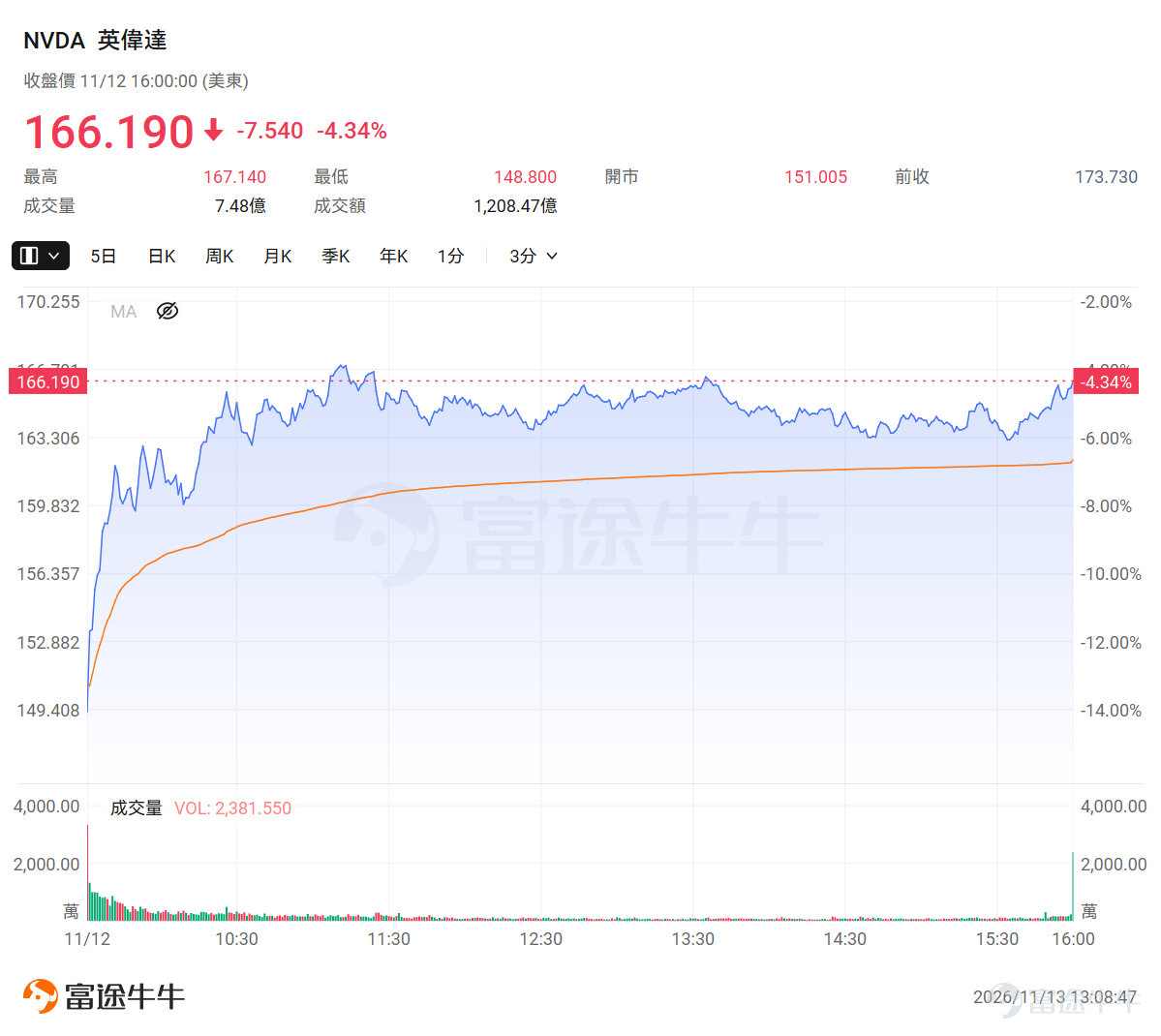
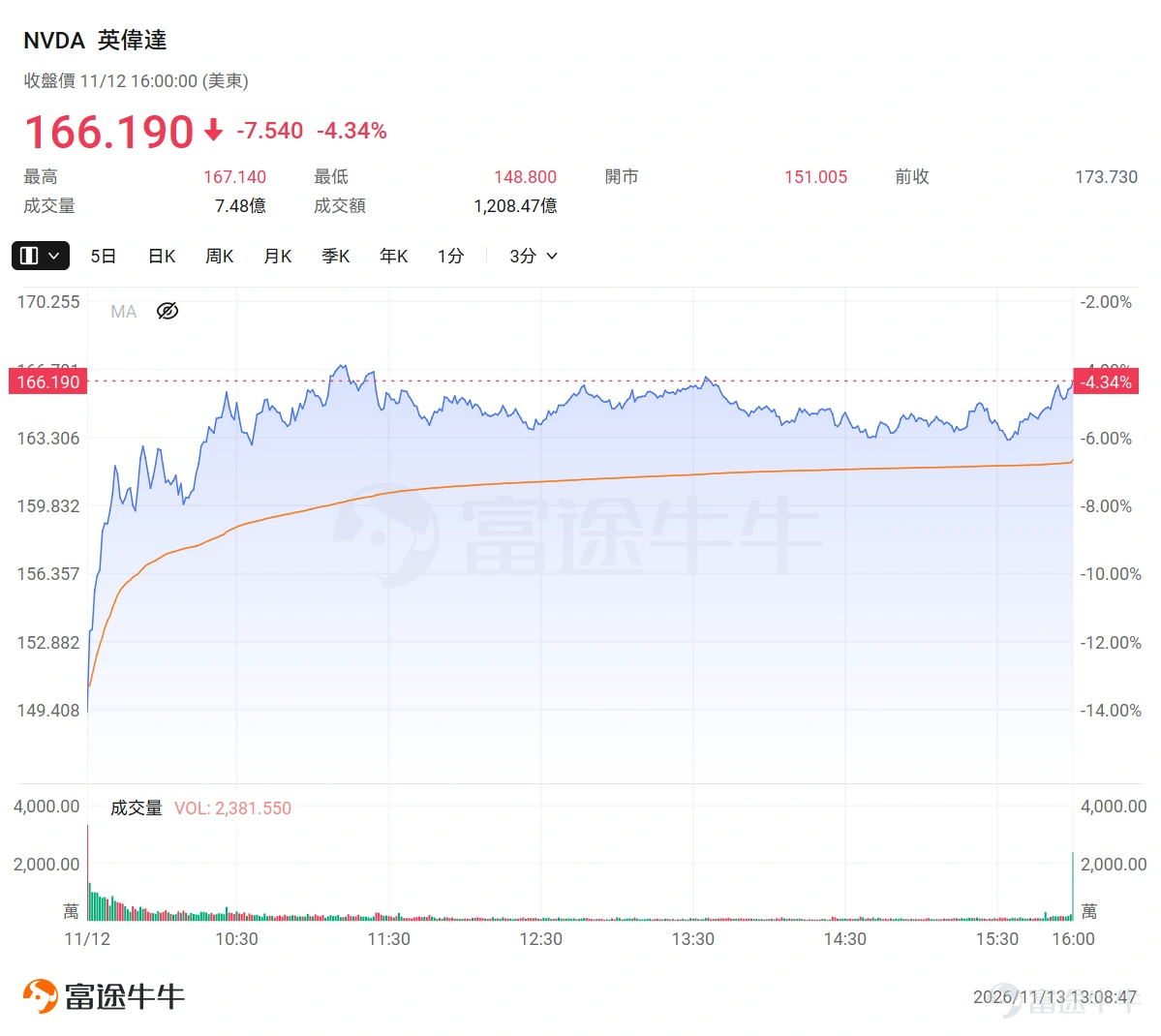
Following the announcement, NVIDIA's stock price plummeted by approximately 14% during intraday trading before narrowing its losses to close down 4.3%. Meanwhile, competitors' $Advanced Micro Devices (AMD.US)$ 、 $Broadcom (AVGO.US)$ stock prices rose against the trend, prompting the market to reassess the competitive landscape of the AI computing power industry.
--
--
--
A question subsequently arises:Will NVIDIA, without Jensen Huang, repeat the fate that befell Apple after it lost Steve Jobs?
Looking back at history, the answer may be more complex than imagined. After Steve Jobs left, Apple did not immediately collapse; instead, it continued to grow for several years. The real crisis only fully erupted when a new round of technological competition emerged and the advantages of existing products gradually weakened.
For NVIDIA today, this history may offer a more cautionary lesson:Losing a founder does not necessarily mean the end of short-term growth, but the impact of lacking a key strategic leader may only truly become apparent when the next wave of technological paradigm shifts arrives.
1. From Jobs to Huang: What happens when tech giants lose their iconic leaders?
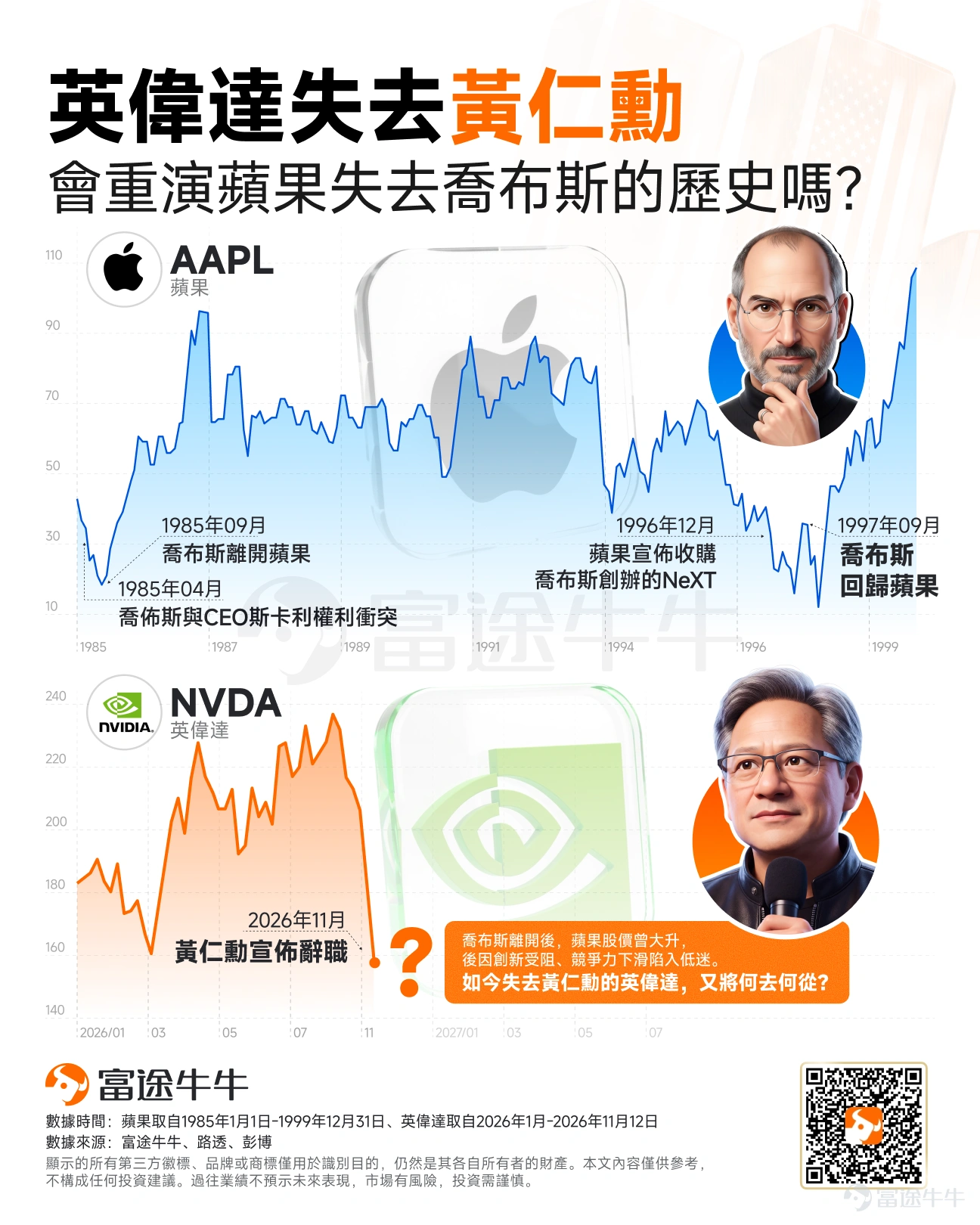
In 1985, $Apple (AAPL.US)$ co-founder Steve Jobs clashed with then-CEO John Sculley over management control, was ultimately stripped of actual power by the board of directors, and left the company in September of that year.
However,Jobs' departure did not immediately plunge Apple into crisis; instead, the company entered a period of strong performance in the following years. Driven by the Macintosh computer, LaserWriter printer, and PageMaker software, which fueled the desktop publishing market, Apple's annual revenue grew from approximately $1.9 billion in 1986 to about $5.6 billion in 1990.
The true turning point came in the 1990s. With the successive launches of Windows 3.0 and Windows 95, Microsoft gradually eroded Apple's competitive moat through its vast PC ecosystem and pricing advantages. Compounded by product strategy missteps and management turmoil, Apple recorded a loss of approximately $816 million in fiscal year 1996, a predicament that was only gradually reversed after Jobs' return.
In other words, Apple's real crisis did not occur when Steve Jobs left, but rather years later, when its existing technological advantages were eroded and a new competitive paradigm emerged.
Today, NVIDIA may be facing a similar test.
Just as Apple relied on the Macintosh ecosystem to sustain growth back then, NVIDIA currently benefits from its CUDA software ecosystem, a vast AI customer base, and a product roadmap featuring Blackwell and Rubin. These advantages will not disappear immediately upon Jensen Huang's departure, and short-term performance may continue to ride the momentum of growth.
However, if ASICs and tech giants' in-house chips accelerate their market penetration, or if the AI capital expenditure cycle peaks, NVIDIA's competitive edge could come under challenge. At that point, the risks associated with Jensen Huang's absence—such as those related to technical strategy, talent retention, and ecosystem cohesion—may become further amplified.
--
--
--
Of course, the industrial environments of the two companies are not identical, and history may not repeat itself. Nevertheless, Apple's experience offers an important insight:
The loss of a founder does not necessarily mean the end of short-term growth; what truly determines the long-term fate of tech giants is often whether they can maintain their lead during the next technological paradigm shift.
II. Entering the 'Post-Jensen Huang Era': Can the New CEO Continue NVIDIA's Legend?
Following Jensen Huang's departure, CFO Colette Kress has assumed the role of interim CEO at NVIDIA. Kress joined NVIDIA in 2013, having previously held positions at Microsoft, Cisco, and Texas Instruments, where she witnessed and participated in the company's transformation from a gaming GPU giant to a leader in AI computing power.
However,In contrast to Jensen Huang's management style, which aggressively bet on new technologies and the AI ecosystem,Kress is likely to place greater emphasis on financial discipline and capital allocation efficiency.
According to a Reuters report on November 12, Kress had previously objected to some of the large-scale AI investment and financing initiatives championed by Jensen Huang. If the new management tightens funding support for AI startups and data center projects, it may help reduce financial risks but could also dampen some customers' demand for computing power purchases.
However, more important than capital allocation is whether NVIDIA can sustain its historical technology strategy.From CUDA to accelerated computing, and then to the full suite of AI infrastructure, Jensen Huang has repeatedly made early bets on the direction of industry development. While Kress excels in financial management, it remains to be seen whether he can uphold this long-term technological vision.
Currently, Kress serves only as interim CEO, while the board continues its search for a permanent successor. The market has discussed potential candidates such as NVIDIA executive Ian Buck, Arm CEO Rene Haas, and AMD CEO Lisa Su, but none have been officially confirmed.
For NVIDIA, the real challenge is not finding a manager capable of maintaining current operations, but rather identifying a leader with the technical foresight to guide the company through the next wave of AI computing transformation.
3. How does Wall Street view it? Earnings may remain unchanged, but valuation is repriced first.
Following Jensen Huang's departure, Wall Street quickly reassessed NVIDIA's investment value. Several institutions have consecutively downgraded their ratings and target prices, yet opinions remain divided on the company's short-term fundamentals.
Specifically,Goldman Sachs characterized Jensen Huang's departure as a 'negative event with material impact, but relatively controllable.' Analyst James Schneider maintained his 'Buy' rating but lowered the target price from $300 to $220.
Notably, Goldman Sachs did not adjust its $10 earnings per share (EPS) forecast used for target price calculation; instead, it compressed the valuation multiple from 30x to 22x. This adjustment reflects strategic uncertainty and execution risks associated with the management transition.
In other words, even if earnings expectations remain unchanged, the market may reduce the valuation premium it is willing to pay due to the loss of Jensen Huang.
Interestingly, Goldman Sachs also cited the historical case of Apple losing Steve Jobs, but focused on his medical leave and passing in 2011, rather than his forced departure in 1985.
Within about 18 months starting in 2011, Apple's forward P/E ratio dropped from approximately 17x to 12x, and even fell below 9x at one point in 2013. It was not until the market gradually confirmed that Apple under Tim Cook could maintain product competitiveness and earnings growth that the valuation slowly recovered to around 15x.
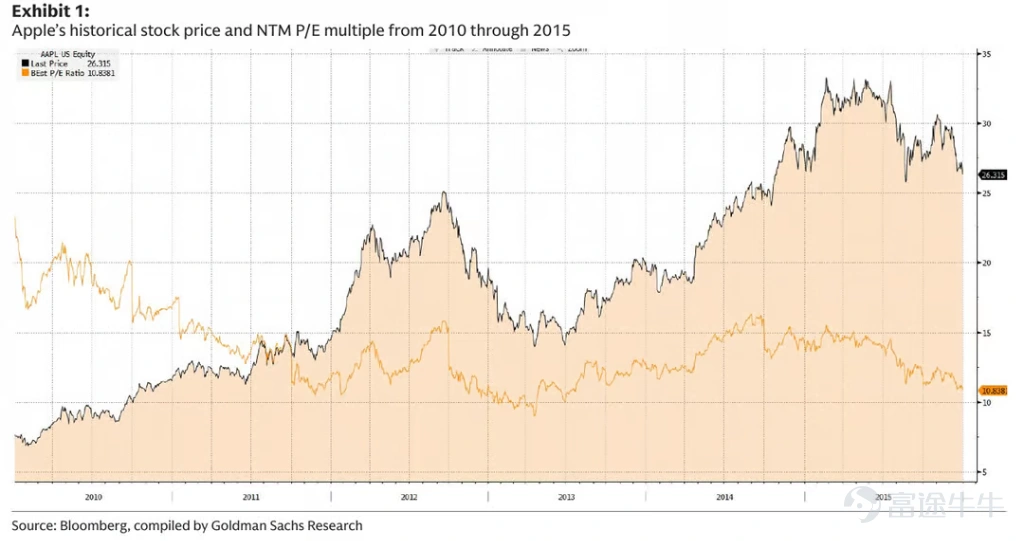
Goldman Sachs believes that NVIDIA may undergo a similar valuation repricing process until the new management team and business growth prospects become clear again.However, there are significant differences between the two: Apple had a clear successor at the time, whereas NVIDIA has not yet determined a permanent CEO and faces additional uncertainties related to regulation and investigations.
Other institutions are more cautious. Bernstein downgraded NVIDIA from 'Outperform' to 'Market Perform,' slashing its target price significantly from $400 to $200; Evercore ISI lowered its target price from $465 to $186 and downgraded its rating to 'In Line.'
Nevertheless, Wall Street is not uniformly bearish. Both Wedbush and BNP Paribas have set target prices at $345. Most firms still maintain 'Buy' ratings. The only 'Sell' rating comes from Jay Goldberg at Seaport, with a target price of $180—ironically, this price is still higher than the current market price.
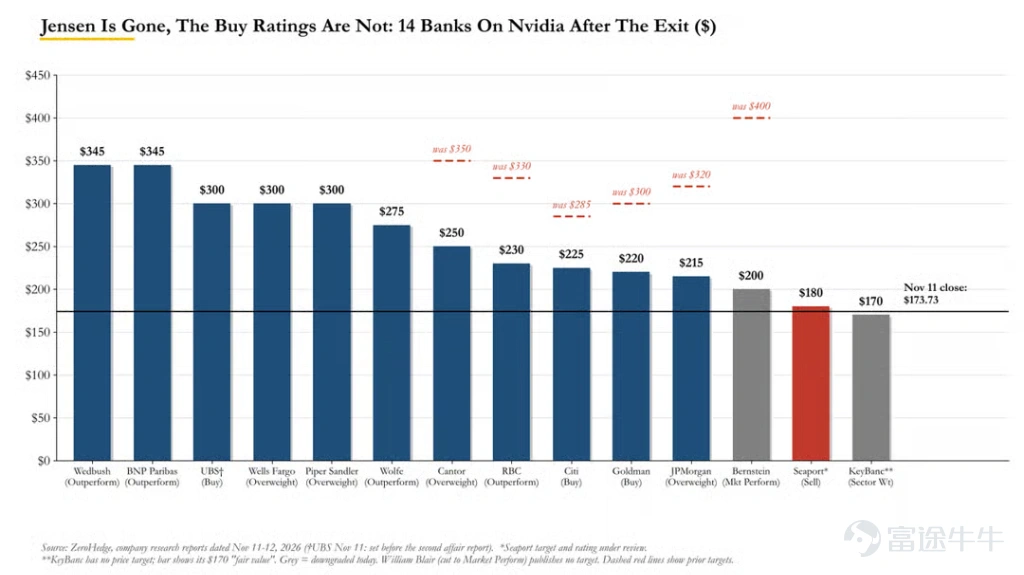
This also implies that NVIDIA may face two tests ahead: in the short term, how the market re-evaluates the 'founder premium,' and in the long term, whether the company can maintain its growth advantage in the next round of AI computing competition.
4. What lies ahead for NVIDIA? Earnings reports and Congressional investigations become key tests.
For investors, Jensen Huang's departure is now a fait accompli. The most important task ahead is to determine whether this management crisis will further evolve into a fundamental and regulatory crisis.
In the short term, the quarterly earnings released after hours on November 17 and the upcoming congressional investigation will serve as two key observation windows.
On November 17, NVIDIA will release its first quarterly financial report since Jensen Huang's departure. Beyond revenue, gross margin, and guidance, the market will closely monitor the new management's latest comments on AI customer financing, Vera Rubin product deliveries, and capital expenditure by major cloud service providers to assess whether the company's growth has been impacted.
On the other hand,Jensen Huang continues to face a U.S. Congressional investigation.Jensen Huang is scheduled to attend a joint closed-door hearing (closed briefing) held by the U.S. Congress on November 18, 2026. Additionally, three House committees have requested his closed-door questioning on December 1, while the Senate Banking Committee has requested his appearance at a hearing on December 3. U.S. Secretary of Commerce Lutnick has also been requested to testify on December 10.
The investigation focuses on NVIDIA's national security safeguards and the risk of leakage of sensitive technologies. While these allegations remain unconfirmed, if the incident prompts the U.S. to tighten chip export restrictions, the risk could escalate from an individual matter to impact NVIDIA's actual business operations.
Over the medium to long term, the key issue remains whether NVIDIA can maintain its competitive advantage in the computing power ecosystem.
On one hand, we need to observe whether self-developed chips like Google's TPU and Amazon's Trainium can accelerate the replacement of GPUs. On the other hand, attention must be paid to whether the new management can sustain the CUDA ecosystem's advantages and maintain technological leadership in the next generation of AI computing platforms.
Looking back at Apple's history, Steve Jobs' departure did not immediately halt the company's growth. The real crisis emerged years later when a new round of technological competition arose, and Apple failed to respond in time.
The same applies to NVIDIA today.Jensen Huang's departure is not necessarily the end of NVIDIA's growth. However, the ability to mitigate regulatory risks, sustain existing performance, and maintain leadership in the next technological paradigm shift will collectively determine the future of this AI giant.
5. Conclusion
The market will eventually rediscover NVIDIA's valuation, and the AI revolution will not halt due to one person's departure. However, some things may never be replicated.
From founding NVIDIA in 1993 to personally driving the GPU, CUDA, and AI computing power revolution, Jensen Huang spent 33 years transforming a once-obscure chip company into a central player on the global technology stage.
He showed the world how far one person's dedication to technology can go, and convinced countless people that the once-unattainable future would eventually become reality.
No one knows where NVIDIA will head in the next decade without Jensen Huang. But regardless of the outcome, his contributions to the modern computing industry have already been etched into the history of technological development.
Yet, no one expected this 33-year legend to come to an end in such a manner.
We are fortunate to have witnessed an era pioneered by him.
It is also regrettable that this era has drawn its curtain in such a way.
Thank you, Jensen Huang.
Risk Disclaimer: The above content only represents the author's view. It does not represent any position or investment advice of Futu. Futu makes no representation or warranty.Read more


Comments (46)
to post a comment
123
134