
BAT's new flagship returns to the top tier, shifting the pressure onto ByteDance.
On November 11, Baidu’s ERNIE, after a long period of silence, suddenly unveiled its performance results.
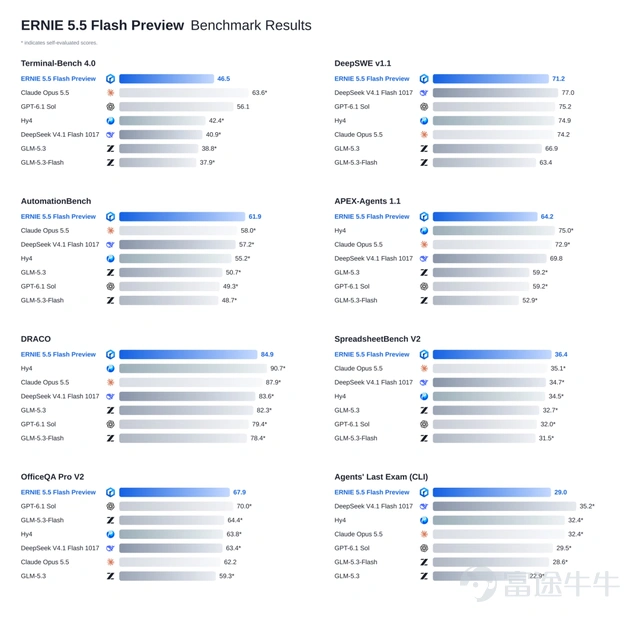
The model is ERNIE 5.5 Flash Preview. It was tested across eight benchmarks, with control groups including Claude Opus 5.5, GPT-6.1 Sol, Tencent’s Hy4, DeepSeek V4.1 Flash, and Zhipu AI’s GLM-5.3 series. It secured first place in two of the eight categories.
This marks ERNIE’s third move within a week.
On November 5, it open-sourced the base model ERNIE 5.5 Flash Base; on November 9, it disclosed the automated research system ERNIE Evolve; and on November 11, it released the Preview version.
Furthermore, Baidu ERNIE’s official WeChat account, which had not been updated for nearly a year, resumed posting during this period.
During the same period, Alibaba also released the preview version of Qwen4-Max.
A week earlier, on November 4, Tencent launched the official version of Hy4, scoring 35 points on Artificial Analysis’s Intelligence Index V5 leaderboard, ranking second among Chinese models.
The original big three of the internet era—BAT—are back at the table.
As large language models gradually integrate into daily life, DeepSeek, Moonshot AI, and Zhipu AI have increasingly seized the narrative. The 'B' in BAT has been replaced by ByteDance.
Speaking of ByteDance, the latest generation of its Seed series remains Seed 2.1, released on June 23.
In August, foreign media reported that the Seed team was pre-training a model with up to 10 trillion parameters. Three months later, this model still has no name, no release date, and no performance benchmarks.
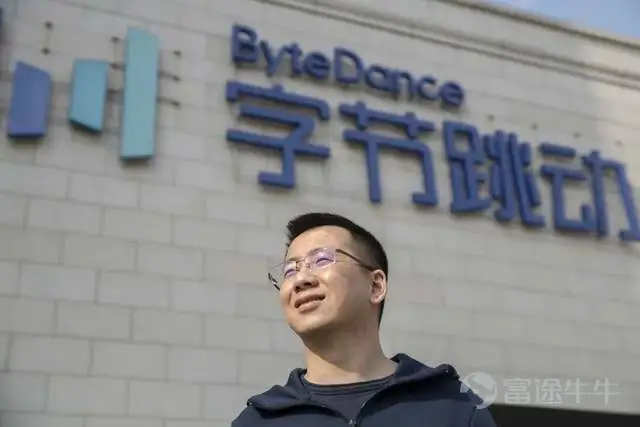
On November 12, The Paper learned from multiple informed sources that Zhang Yiming stated at a recent all-hands meeting for the AI team that ByteDance has the capability to compete with OpenAI and Anthropic, but catching up to the technological frontier will take until at least 2029 or 2030.
Has BAT truly made a comeback? And where is Zhang Yiming's 10-trillion-parameter model?
01
How did BAT make its comeback?
In February's LMArena comprehensive rankings, Ernie Bot 5.0 ranked 17th, trailing behind ByteDance's Seed 2.0, Zhipu AI's GLM-5, and Qwen 3.5.
During that period, Baidu's foundation model team devoted significant resources to creative writing, internally championing the goal of creating the 'strongest liberal arts student,' while competitors focused intensely on coding, long-context handling, and AI agents.
On August 18, Baidu released its Q2 financial report, showing a net profit attributable to Baidu of RMB 2.319 billion, a 68% year-on-year decline. Its US-listed shares fell 12.73% that night. During the earnings call, Robin Li stated, 'Throughout our journey, there have been both attempts and missteps, but our determination to make Ernie Bot competitive has never wavered.' He also expressed confidence in bringing Ernie Bot 'back to the first tier of foundational large models.'
The phrase 'back to' essentially acknowledges that it is no longer there.
The turning point occurred on July 1.
Sun Tianxiang, a Fudan University PhD born in 1997, joined Baidu as the head of the Basic Model R&D Department. He was the lead developer of MOSS, the first generation of open-source large language models in China comparable to ChatGPT. According to Deep Web, this marks the third major restructuring of Baidu's model division in nearly ten months.
Four months later, Wenxin began rolling out consecutive moves.
First came Wenxin 5.5 Flash Base, with 280 billion total parameters and 14 billion activated per token, pre-trained from scratch on 33.5 trillion tokens. Baidu benchmarked it alongside DeepSeek-V4-Flash-Base, Tencent's Hy3-preview-Base, and Xiaomi's MiMo-V2.5-Base within the same framework, securing first place in 24 out of 30 benchmarks. This also marks Baidu's first open-sourcing of a model with hundreds of billions of parameters in approximately 16 months.
Preview is its first post-training version.
It scored 61.9 on AutomationBench and 36.4 on SpreadsheetBench V2, ranking first in both categories and ahead of Claude Opus 5.5. On OfficeQA Pro V2, it scored 67.9, second only to GPT-6.1 Sol. On Terminal-Bench 4.0, it scored 46.5, higher than Hy4's 42.4 but still trailing significantly behind Claude Opus 5.5's 63.6.
In DeepSWE and Agents’ Last Exam, it ranked fifth among seven models.
A footnote in the chart notes that scores marked with an asterisk are from Baidu's internal testing. Most of the competitors' scores also carry asterisks.
Baidu described the results as 'achieving competitive scores' and cautioned that this is an intermediate version in the post-training process, noting that 'capability gaps due to insufficient training may still exist.'
However, two facts are concrete. First, it is fast and cost-effective: on Qianfan, single-user inference speed exceeds 200 tokens per second, with pricing at 2 yuan per million input tokens and 8 yuan per million output tokens during peak hours, currently offered at a 50% discount. Second, it is open-source: weights will be released under the Apache 2.0 license by November 25. In 2024, Robin Li stated that open-source models would increasingly fall behind.
Let's turn our attention back to Alibaba.
At 10:00 AM on November 11, Alibaba released the preview version of Qwen4-Max, disclosing neither pricing, parameter counts, nor benchmark scores.
The same documentation page also stated that the model would be retired after 24:00 on November 25, with no changes made in the interim. It is obvious that Alibaba is signaling the official release of Qwen4-Max for November 26.
The teaser campaign referenced "Free and Easy Wandering": "In the Northern Darkness there is a fish, whose name is __." The original text continues, "The Kun is so vast that its size is unknown, spanning thousands of li."
Only a few specifications have been confirmed, all emphasizing scale. The maximum output is 393,216 tokens, shared between reasoning and answers, which is exactly three times that of the previous generation, Qwen3.8-Max. Reasoning intensity comes in three tiers, with 'xhigh' as the default, meaning it engages in the longest possible reasoning process out of the box.
Furthermore, Qwen4-Max is available exclusively via Token Plan subscriptions and does not support pay-as-you-go pricing.
Qwen4-Max gives the impression of "overwhelming power overcoming all complexities."This is the logic behind its preview version: as long as the model's parameter count and intelligence level are sufficiently high, the model will inevitably perform well.
However, Qwen's strength is not derived from brute force accumulation, but from efficiency savings.
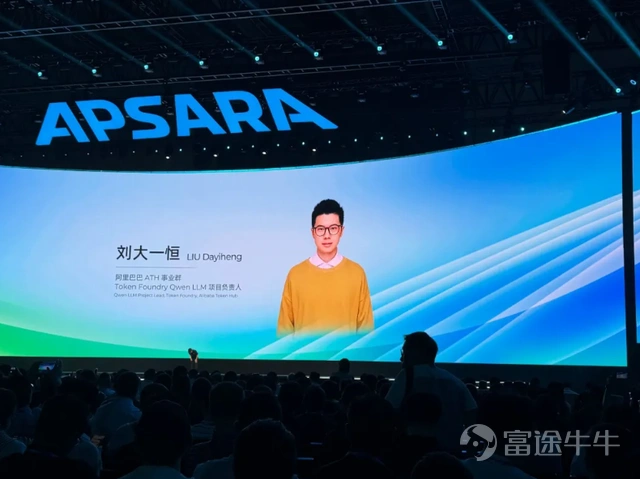
On September 22, at the Yunqi Conference, Liu Dayiheng made his first public appearance as the head of Qwen. Letterbang summarized his speech in one sentence: How much intelligence is gained per unit of computing power? He cited figures showing that, compared to Qwen3.7-Plus, Qwen3.8-Flash reduced activated parameters to one-third and training costs to one-ninth.
The cost-saving measures are detailed in the model card for Qwen3.8-Flash-Next, open-sourced on August 26. Alibaba describes it as a "pilot preview of the model architecture used in Qwen4." Three out of every four attention layers have been replaced with Gated DeltaNet, the residual stream has been expanded from one to four pathways, a separate 51-billion-parameter embedding lookup table is attached alongside the main model, and the optimizer has been switched to Muon. These four modifications all focus on reducing computational costs.
Where did the saved computing power go?
The total parameter count of the current flagship, Qwen3.8-Max, has already reached 2.4 trillion, with plans to expand Qwen4.5 and Qwen5 to between 5 and 10 trillion parameters. The model card also states: "Fixing the number of activated experts while continuously increasing the total number of expert parameters can steadily reduce training loss."
Liu Dayiheng has driven down the cost per unit of intelligence, reinvesting all the savings into scaling up.
In his own words, the Max series aims to push the ceiling of intelligence, while lowering the barrier to entry is the role of the Flash and Plus series. Scaling up parameter size remains one of the core paths toward Artificial Superintelligence (ASI).
Hy4's performance speaks for itself, and Yao Shunyu's stature in the model development community needs no further elaboration.
Hy4 has a total of 770 billion parameters, less than one-third of Qwen3.8-Max. Although Hy4 scores only one point higher than Qwen3.8-Max on the Artificial Analysis leaderboard, its cost per task is approximately $0.78, just one-thirteenth that of the latter.
Tencent released four models this year: Hy3 Preview in April, Hy3 in July, Hy4 Preview in August, and Hy4 in November.
In May, Ma Huateng described the company's situation as follows: "A year ago, we thought we had boarded the ship, only to discover later that it was leaking. Now, we feel like we've managed to get on board, but we still can't sit down comfortably."
BAT is back.
02
Where is Zhang Yiming's 10-trillion-parameter model?
As mentioned earlier, Seed 2.1 was released on June 23. By November 12, 142 days had passed.
During these 142 days, Tencent, Alibaba, and Baidu have all made significant moves, which clearly puts considerable pressure on Zhang Yiming.
In fact, the situation was different at the beginning of the year.
On the LMArena leaderboard in February, Seed 2.0 still ranked ahead of Wenxin 5.0. By August, third-party rankings showed Seed 2.1 Pro placing 21st among global large language models. ByteDance CEO Liang Rubo acknowledged at the mid-year all-hands meeting on August 6 that the gap between their large language models and leading overseas models had widened.
It was also in early August that news of the 10-trillion-parameter model emerged.
Foreign media reported that ByteDance is pre-training a model with a parameter scale potentially reaching 10 trillion, though it remains in the early stages, with the final scale to be determined in subsequent training phases.
At that time, the largest publicly disclosed domestic model, Kimi K3, had 2.8 trillion parameters, while industry estimates placed Anthropic's Mythos 5 at just 8 trillion.
Reports suggest the project's full training cycle is estimated at 3 to 6 months, with no certainty yet on whether it will be released externally. Counting from early August, 3 months brings us to the present, and 6 months points to next February.
In other words, its absence so far does not yet constitute a delay.
Zhang Yiming also stated at an all-hands meeting that the pre-training dataset used for the Seed large language model was several orders of magnitude smaller than that of its top competitors.
In its 2022 Chinchilla paper, DeepMind offered an empirical rule: when parameters double, training data must increase proportionally. While parameters can be scaled up and GPUs purchased—ByteDance discussed raising its annual capital expenditure to a maximum of $70 billion this past May—data is a different story.
Data, however, cannot be simply bought or scaled in the same way.
Foreign media previously reported that Zhang Yiming explicitly opposed relying on distilling external models to catch up during a Seed all-hands meeting, arguing that ByteDance should be willing to 'sacrifice some short-term interests for long-term goals.' Internally, Seed also restricts third-party model outputs from entering its training set through API detection and training data filtering.
If you don't copy others' homework, you have to put in the extra effort to catch up yourself.
This year, ByteDance consolidated data teams scattered across various business lines into a new first-tier department called 'AI Data and Security,' which operates on par with Seed, Flow, and Douyin.
In October, Tim from Media Storm (Yingshi Jufeng) demonstrated ByteDance's yet-to-be-officially-announced world model during an internal exchange.
Built on ByteDance's Seedance video generation framework, this model supports features such as free-camera movement for old films, real-time interaction in virtual scenes, and VR occupational simulations, focusing on cloud-rendered immersive spatial experiences.
In fact, foreign media disclosed in September that Zhang Yiming, who had already stepped down from ByteDance's daily operations, was personally coordinating R&D, computing power, and hardware teams across departments to oversee the training progress of this real-time world model.
The reports stated that this project was listed as one of ByteDance's top annual priorities, aiming to achieve interactive performance with 50-millisecond latency and 20 frames per second, with future adaptation planned for the Pico VR ecosystem and Douyin's content platform.
ByteDance's data budget for areas such as world models and coding has already reached the tens of millions of dollars this year, with room for further increases.
Nevertheless, ByteDance's advantage remains unshakable. Doubao continues to be the AI chat application with the largest user base in China, boasting approximately 324 million monthly active users.
Zhang Yiming previously stated in an internal meeting that model development requires a long-term orientation and delayed gratification, rather than leveraging others' outputs merely to achieve temporary rankings on leaderboards.
Then let's just wait patiently! $ByteDance (FT0001)$$ByteDance Ecosystem (LIST1266.HK)$$AI (LIST0535.SH)$$Artificial Intelligence (LIST23586.HK)$$Artificial Intelligence (LIST2136.US)$$TENCENT (00700.HK)$$Tencent (TCEHY.US)$$Baidu (BIDU.US)$$BIDU-W (09888.HK)$$BIDU-SWR (89888.HK)$$Alibaba (BABA.US)$$BABA-W (09988.HK)$$BABA-WR (89988.HK)$
Risk Disclaimer: The above content only represents the author's view. It does not represent any position or investment advice of Futu. Futu makes no representation or warranty.Read more

Comments
to post a comment
3
1