
Franchisees suffer millions in losses as Fresh Snack begins debt repayment for expansion
Source | Tech Planet
Text | Lin Jing
Changsha's new consumer brands are making a comeback. The previous wave produced chain brands with tens of thousands of stores, such as 'Snack Busy,' while this round is dominated by fresh snacks.
Expansion has already begun moving northward. On the B1 level of Hopson One in Beijing, four different types of fresh snack stores are engaged in fierce competition within a radius of less than 50 meters. Mimicking Sam's Club-style shelf displays, offering short shelf lives of 3 to 7 days, combining baked goods and braised items with freshly made beverages, and supplementing these with snacks of varying medium-to-long shelf lives have become the standard configuration for these new stores.
This has even prompted Xueji Roasted Nuts, located on the same floor, to upgrade its stores by adding similar baked goods and freshly squeezed juices.
Online supermarkets are also accelerating their entry into the market. Not only has DingDong announced its entry into the fresh snack sector, but former discount snack store chains and Walmart have also launched new store formats focusing on short-shelf-life snacks.
However, the other side of the coin is that while short shelf lives imply lower inventory spoilage, they entail higher supply chain and operational costs. The reality of 'many openings accompanied by many closures' over the past year has already sounded an alarm for this business model.
DingDong Enters the Fray: Intensifying Competition in Fresh Snacks
DingDong's announcement of its entry into the fresh snack sector adds another variable to a market that is already fiercely competitive and saturated.
In the past, the boundaries of the fresh snack sector have remained blurred. The bakery and beverage sections in many stores are essentially collections of products similar to those found at Sam's Club and Hema. Guosheng Securities pointed out in a research report that Jinlimen takes large, proven SKU hits from Sam's Club, Hema, and Pang Dong Lai, repackages them into smaller portions priced between RMB 8 and 20, and places them within easy reach of consumers, positioning itself as an accessible 'mini Sam's Club' for the mass market.
Led by brands such as Jinli Men, a wave of new fresh snack startups has emerged. By leveraging deep collaborations with major commercial complexes like those in the MixC ecosystem, these brands have rapidly secured limited high-traffic retail locations.
Tech Planet observed that these new fresh snack offline stores operate on a collection store model. On one hand, they aggregate hit products from fresh food e-commerce platforms; on the other, they compete for market share in the new-style tea beverage sector. In-store, juices and milk teas with a one-day shelf life are the best-sellers.
A store manager of a fresh snack brand told Tech Planet that a key characteristic of this round of collection stores is "low prices and large volumes." Most single items from brands like Jinli Men and Jiduo Quan are priced between 10 and 25 yuan, with many popular items even under 10 yuan, such as freshly made drinks for 6.5 yuan. The average transaction value per customer can reach around 50 yuan.
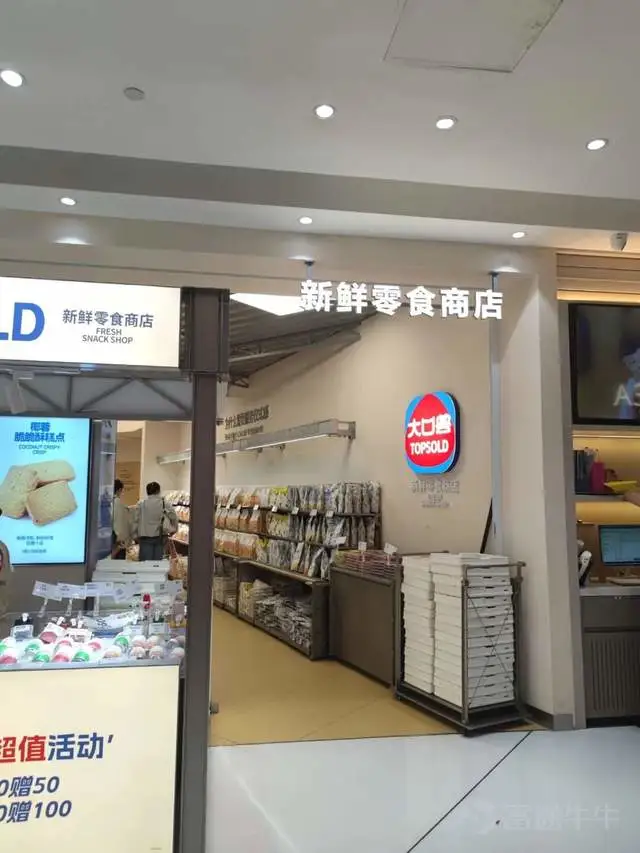
Caption: A fresh snack store at Hopson One in Beijing, photographed by Tech Planet.
According to the aforementioned store manager, amid rapid expansion, brands have begun imitating each other, resulting in largely similar product assortments. Short-shelf-life products are delivered daily from nearby warehouses, while juices are kept frozen. On one hand, the supply chain radius prevents these brands from expanding quickly nationwide, confining them to cities with warehousing and distribution capabilities such as Changsha, Guangzhou, and Wuhan. On the other hand, snack consumption density in northern markets is lower than in the south, leading brands to be more cautious about expanding northward.
Li Ming noted that, taking a store in Changsha as an example, sales between 10 PM and midnight account for a significant portion of daily revenue. Since short-shelf-life products have low gross margins, the business model only works if high foot traffic dilutes the costs.
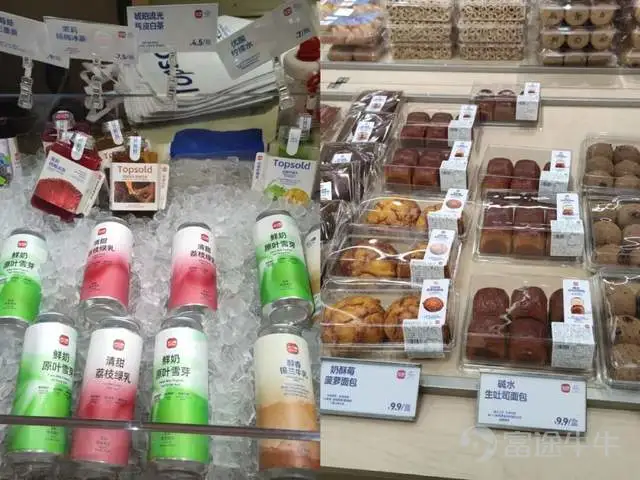
Caption: Short-shelf-life products inside a fresh snack store, photographed by Tech Planet.
Changsha is the absolute hub for the spicy braised cooked food supply chain, and most of these fresh snack brands originated there. However, the strongholds for bakery and short-shelf-life fresh food supply chains are in the Yangtze River Delta. To address this weakness, Jinli Men has built its own factories in Changzhou and Nanjing over the past two years.
As startups accelerate their expansion, DingDong has also entered the fray. However, its strategy is not to open stores to secure locations, but to directly apply its fresh food turnover and cold chain capabilities to the snack category. The initial launch included over 100 SKUs, covering dried fruits, baked goods, fresh braised foods, puffed snacks, sweet soups, and alcoholic beverages. Within DingDong's overall portfolio of thousands of SKUs, this segment currently accounts for one-tenth.
For the industry, comprehensive retail channels like Hema and Sam's Club already possess mature short-shelf-life supply chains, vast member feedback data, instant retail fulfillment capabilities, and private label development systems. These channels have long been offering freshly baked goods, short-shelf-life fresh foods, and nuts and seeds; they simply have not marketed them separately under the "fresh snacks" label.
As more players enter the fray, the dimensions of competition will be rewritten. The industry is shifting from a phase focused on the speed of copying products and securing prime retail locations to one centered on inventory turnover rates and loss prevention.
Franchising suspended: While store openings are numerous, closures are equally high.
The other side of the coin is that controversies surrounding fresh snacks have never ceased, with the most frequently cited issue being that the "fresh" label itself lacks substance.
Currently, many brands in the industry have less than 50% of their portfolio comprised of short-shelf-life products. The majority remain snacks with shelf lives of 60 to 180 days, used to support gross margins. Furthermore, there is no unified industry standard for what constitutes "fresh snacks."
Cai Jingzhong, founder of Wujie Innovation Capital, revealed to Tech Planet that fresh snacks should meet three criteria: freshness, freshly made, and clean labels (i.e., minimal additives). In his view, a more accurate term for fresh snacks would be "clean-label snacks."
DingDong's market entry strategy involves redefining industry standards. In October 2026, DingDong launched a dedicated section for fresh snacks, featuring over 100 initial SKUs, alongside an A-F six-tier "Freshness Grading" system. Only grades A, B, and C are classified as "fresh snacks," while grade D and below are excluded. The hard thresholds for this classification are clear: a shelf life of no more than 60 days, no preservatives, and minimal seasoning and processing.
However, it remains questionable whether consumers will accept the definition of "snacks with a shelf life of under 60 days" as fresh snacks, raising concerns that the concept may be more hype than substance.
From a store model perspective, mass-market snack retailers have already produced brands with tens of thousands of stores, such as Haoxianglai and Mingming Henmang. In contrast, even the best single-store performance data in the fresh snack sector cannot currently support a narrative of scaling to ten thousand stores—Jinlimen operates 50 direct-owned stores, Yili Nutco has nearly 100, and Jiduoquan has over 200.
In July this year, Jiduoquan, backed by Changsha-based food enterprise Wuai Food Group, announced a suspension of franchising, sounding an alarm for the industry. This brand, which previously leveraged its supply chain advantages to expand rapidly, has now hit the brakes.
An employee of Jiduoquan revealed to Tech Planet that, on one hand, the queue of prospective franchisees was once extremely hot, with many franchisees from Snack Henmang applying and over a thousand interested applicants. Many Jiduoquan store managers also wished to become franchisees themselves but were barred due to a capital verification threshold of RMB 3 million.
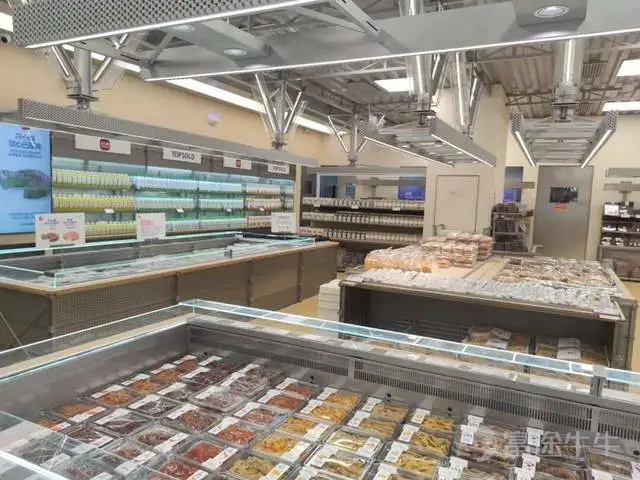
Caption: Shelf display at a Fresh Snack store in Beijing Hopson One, photographed by Tech Planet.
On the other hand, the fresh snack business is operationally intensive. The quality of product selection directly determines whether a store manager can keep the shrinkage rate below 0.3%. Furthermore, hit products vary by city and cannot be simply replicated. For instance, stores in Changsha see strong sales of short-shelf-life braised snacks, whereas in Wuhan, where local brands like Zhou Hei Ya already dominate, the best-seller is actually short-shelf-life stinky tofu. Therefore, each store must tailor its product assortment and operations to local consumer habits.
A franchisee revealed to Tech Planet that rent and labor costs impose significant pressure. Monthly rent alone can reach hundreds of thousands of yuan, causing many new franchisees to face losses amounting to millions in rent shortly after joining. Taking a 200-square-meter store as an example, daily revenue must reach 150,000 yuan to break even. Over the past year, while many stores opened, many also closed; it is common to see losses of millions within a short period, with large quantities of short-shelf-life products turning into continuous inventory backlog.
According to the aforementioned franchisee, many fresh snack brands from Changsha are now exercising caution when expanding into northern cities, shifting their strategy to focus on direct-operated stores in provincial capitals and franchise expansion in lower-tier markets.
Jiduoquan’s suspension of franchising is essentially a microcosm of supply chains failing to keep pace with scale expansion.
Hyper-competition has turned the market into a bloodbath, with 'only one or two brands likely to survive out of hundreds.'
The surge in popularity of fresh snacks essentially fills a gap between the 'low price' model of traditional bulk snack retailers and the 'quality' focus of premium supermarkets: it satisfies young consumers' desire for 'visible freshness' and 'instant gratification' through freshly made perceptions, short shelf lives, and clean ingredient lists.
However, despite the hype, this sector has not yet produced any chain with tens of thousands of stores, yet it has already become hyper-competitive, resembling a bloodbath.
A closer look at snack stores reveals that while business models vary, they are essentially collection stores offering everything from baked goods and braised items to beverages. Products are highly homogeneous, with similar offerings and even logo styles across competitors. Meanwhile, high shrinkage due to short shelf lives and food safety control challenges remain looming threats. How long the 'freshness' narrative can last ultimately depends on who can solidify their supply chain and quality control.
With underlying concerns unresolved, market participants and capital investors are already unable to hold back.
With Jinlimen temporarily unable to expand into southern cities, many emerging fresh snack brands from the north have accelerated their land-grab strategies. Players from various cross-industry sectors are flooding in: not only are new brands like Jiduoquan and Yili aggressively expanding their store networks, but giants such as Juewei and Cha Yan Yue Se are also entering the fray. Capital has moved quickly on the news, with valuations for top-tier brands briefly reaching RMB 2 billion to RMB 3 billion.
However, the capital frenzy needs to be analyzed with a cool head.
Cai Jingzhong, founder of Wujie Innovation Capital, told Tech Planet that capital is currently unable to invest in Jinlimen because many fresh snack brands maintain relatively robust cash flows. In his view, the industry has not yet entered a consolidation phase. Currently, the strategy for various brands is to continuously stock their fresh snack collection stores with regional hit products—such as Changsha-style braised foods and konjac snacks—which are mature, single items with market education already completed and sales volumes reaching billions of yuan.
Cai Jingzhong stated that clean labeling will definitely be the direction for all supermarket reforms in the future. With the large-scale expansion of fresh snacks, out of the hundreds of brands, ultimately only one or two may survive.
Currently, Jinlimen remains the leading brand in the industry. From September to October this year, Jinlimen's operating entity completed two rounds of equity financing in succession: Wu Yuening, founder of KK Group, along with the operating entity, acquired a combined 10% stake, while an affiliate of Bu'er Capital acquired 3.5%.
However, it should be noted that there is a founder-level connection between Bu'er Capital and KK Group. Wu Yuening is not only the founder of KK Group but also an investor who participated in founding Bu'er Capital. Therefore, although these two financings involved different entities, they are better understood as continuous increased investment from the same industrial capital system, which is insufficient to prove that a broad investment consensus has formed in the fresh snack sector.
Looking back at this surge, it was precisely this profit effect that drove a massive influx of players in the short term.
According to data from Guohai Securities, Jinlimen, the leading brand, achieves a monthly GMV of approximately RMB 3 million to RMB 4 million per store, with a gross margin still exceeding 30% after accounting for shrinkage, and a payback period of just a few months. Due to the limited number of directly operated stores, calls for proxy purchasing of Jinlimen products have surged across major platforms, with its popularity rivaling that of Sam's Club and Pang Dong Lai.
However, judging by its development trajectory, fresh snacks have not escaped the law governing consumer enterprises: after a business model becomes popular, players with supply chain and fresh food experience quickly flood in and replicate it rapidly. As the supply chain matures, it also means that no one can establish an absolute barrier in terms of new product launches.
The fierce competition continues. This round of expansion will be even more brutal than the wave of discount snack stores.
Risk Disclaimer: The above content only represents the author's view. It does not represent any position or investment advice of Futu. Futu makes no representation or warranty.Read more
Comments
to post a comment