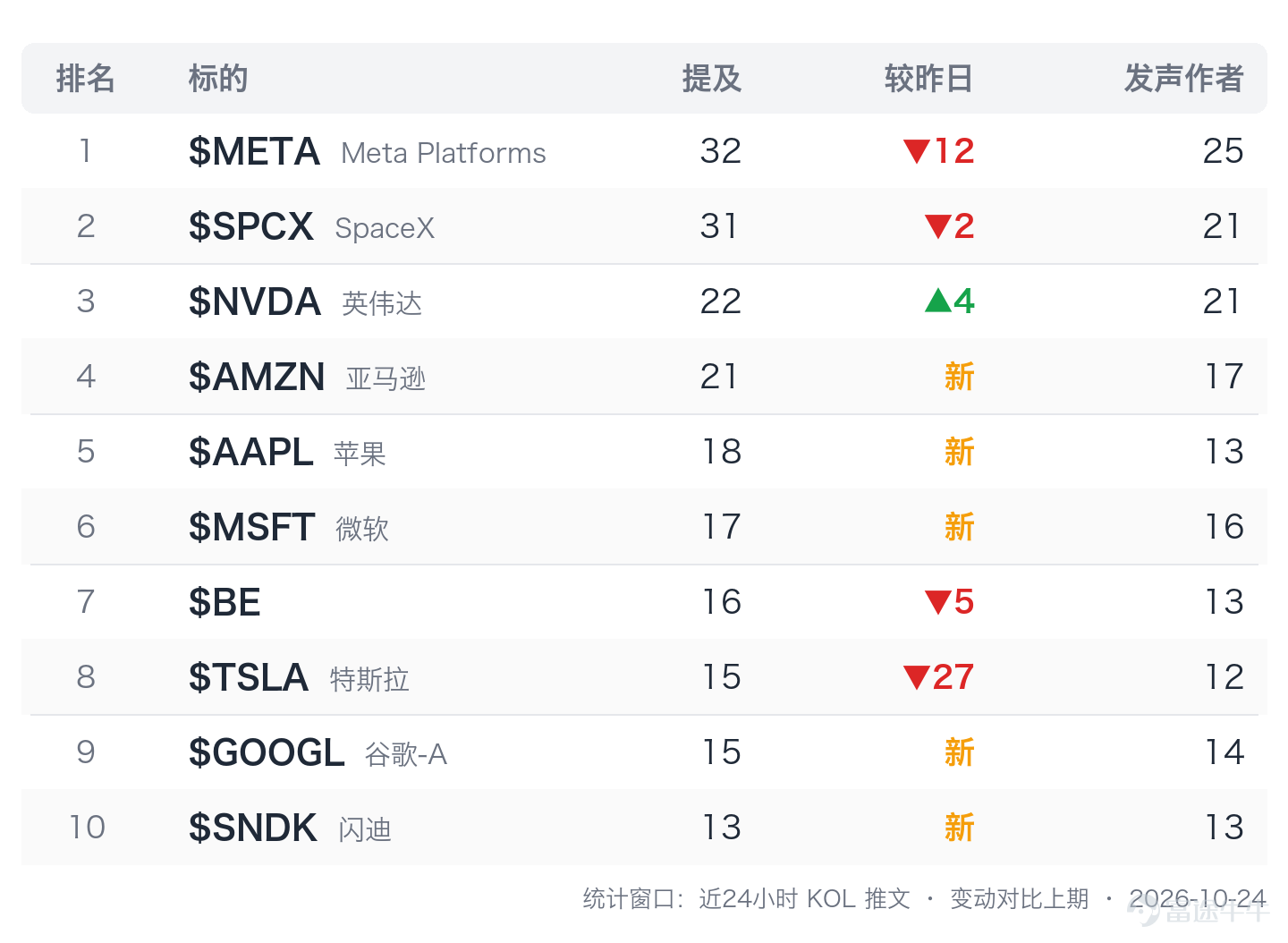

Tuitui X Daily: Oil prices have taken full control of the market, and the Dow Jones couldn't hold up; hedge fund selling is approaching late-March levels, while institutions are hesitant to buy the dip; META/SPCX/NVDA/AMZN/AAPL/MSFT/BE/TSLA/GOOGL/SNDK
October 24, 2026 · Covering 377 KOLs and 2,016 tweets
Oil prices took charge of the market on Friday, with Brent crude hitting a two-year high. Energy became the only safe haven, while ordinary stocks that had held up the day before were sold off as well. Pressure on AI stocks has shifted from fundamentals to liquidity; hedge funds are deleveraging, and institutions are waiting for others to make the first move. Next week, the Fed's interest rate decision coincides with earnings releases from the three major cloud providers, putting both inflation and AI investment returns to the test.
I. Trending Stocks on X

2. Trading Themes | Soaring oil prices weigh on risk assets; even the Dow Jones couldn't hold up. Hedge funds are selling off, while institutions remain hesitant to bottom-fish AI stocks. Gold falls below $4,000, as safe-haven capital flows exclusively into the US dollar and US Treasuries.
1. Brent crude closed up 3.1% at $116.72, making energy the only rising sector.:According to@HedgeyeBrent crude surged past $118 intraday, reaching its highest level since 2022.@TheFlowHorseThe S&P 500 fell 0.5%, the Nasdaq-100 was flat, and the Dow Jones dropped 1.2%, while the energy sector rose 2.7%. $SLB Ltd (SLB.US)$ Rose 7% after earnings; the equal-weighted S&P$Invesco Exchange Traded Fd Tr S&P 500 Equal Weight Etf (RSP.US)$ fell 0.8%. Ordinary stocks held up yesterday but were sold off today. I believe this directly clashes with the inflation concerns surrounding Wednesday's FOMC meeting. With crude oil above $100, it will be difficult for the Federal Reserve to maintain a dovish stance.@robin_j_brooksCrude oil imports by major Asian economies have returned to pre-war levels, consistent with the recovery in Gulf supplies. This spike in Brent prices represents a risk premium detached from fundamentals.
2. Hedge fund selling approaches late-March levels, while institutions remain reluctant to bottom-fish AI stocks.:According to@ConnorJBates_, Goldman Sachs' long-short portfolio, used to track hedge fund stress, fell about 4.2% on October 22, marking its worst performance since 2011, with a monthly decline of 10.4%. According to @RyanDetrick, Goldman Sachs Prime Brokerage data shows that net selling of global equities has approached levels seen in late March.@ParadisLabs: Institutional confidence was completely shattered this week. Today, there was virtually no bullish demand for hyperscale cloud providers, new cloud infrastructure, and optical communications, despite $SpaceX (SPCX.US)$ 、 $Meta Platforms (META.US)$ 、 $Bloom Energy (BE.US)$ and $Western Digital (WDC.US)$ earnings releases signaling positive demand-side trends, no one wants to be the first to pull the trigger; cost of capital and financing concerns appear to be the biggest bottleneck for the entire AI trade.
3. The probability of the FOMC holding rates steady next week has risen to 90%, while consumer confidence has fallen to its second-lowest level in history.:According to@StockSavvyShay, the market's pricing probability for the Federal Reserve to maintain interest rates unchanged next week has risen to 90%, hitting a record high. According to @bespokeinvest, the market's pricing probability of no further rate hikes this year has risen to 26%, up from just 6% a month ago.@elerianm: The University of Michigan's Current Conditions Index fell to its second-lowest level on record, though expectations improved slightly. One-year inflation expectations edged up to 4.7%, which is unlikely to prompt the Fed to raise rates next week but reinforces the probability of a hike in December. According to @Mr_Derivatives statistics, the S&P 500 closed lower on all six FOMC decision days so far this year.
4. Moody's kept France's rating unchanged, gold fell below $4,000, and safe-haven flows are flocking only to the US dollar and US Treasuries.:According to@GlobalMktObservThe spread between French and German 10-year government bonds widened to 178 basis points, the widest since late 2011. The yield on France's 10-year bonds briefly rose 13 basis points to 5.14%, the highest level since 2002. According to@zerohedgeMoody's completed its review of France's credit rating after hours and took no action.@RonStoeferle: Gold is under pressure, with silver and mining stocks underperforming and showing no signs of strength. I expect a capitulation low in the coming days. With the US dollar remaining strong and US Treasury yields falling while French yields rise, the preferred safe-haven assets for now remain the US dollar and US Treasuries.
3. Individual Stock Forum
1. $Meta Platforms (META.US)$| The stock price is testing the 200-day moving average. Bulls calculate that next year's capital expenditure can be sustained without external financing.
Bull-bear divergence: A bullish researcher calculated that Meta could support $220 billion in capital expenditure next year using only its own cash, while cautioning against diluting shareholders at current valuations. A trader initiated a long position based on a calculated stop-loss. On the bearish side, a macro trader stated bluntly that no one would lend Meta that much money, while a technical analyst described any potential rebound near the 200-day moving average as a counter-trend 'dead cat bounce.' Neutral factors include the CFO's comments on the ROI cycle for AI investments, the acquisition of Sundial, and ARK's buying during the decline.
***Bullish
• @RihardJarc: Meta could support $220 billion in capital expenditure by 2027 without external financing, which is 50% more than this year. Operating cash flow over the past 12 months was $133 billion, with another $80 billion in cash on the balance sheet. Even so, the computing power acquired would exceed that of any frontier lab in 2027. However, under current market conditions, if Meta truly believes it must accelerate spending so aggressively, it should first cut costs—especially in Reality Labs—and consider other options before diluting shareholders at this valuation level.
• @RedDogT3: $639 is the turning point, and the low of $633 is the stop-loss level. I am risking $6, but it has only risen $5 so far.
***Bearish
• @DarioCpx: Meta will never be able to spend this amount because no one is willing to provide the funding, and its internally generated cash is insufficient to cover it. Other hyperscale cloud providers with absurdly large capital expenditure plans face the same situation.
• @DKellerCMT: Meta is testing its 200-day moving average. It is not surprising to see at least one counter-trend rebound, commonly known as a 'dead cat bounce,' at this level.
***Neutral
• @TheTranscript_Meta's CFO stated that AI investments have already generated significant incremental advertising revenue through enhanced user engagement, improved recommendations, and more efficient monetization. While the return on investment for MSL (Meta Smart Glasses/Llama-related initiatives) may take longer than core business segments, the breadth of monetization opportunities and internal efficiencies give the company confidence in its long-term potential.
• @StockSavvyShayMeta has acquired Sundial, an AI analytics startup founded by former Meta executives.
• @WealthCode99978According to market reports on October 23, ARK Invest purchased approximately 38,110 shares of Meta during the post-earnings decline, with an estimated transaction value of around $24.7 million; institutional buying does not necessarily indicate that the stock price has bottomed out.
2. $SpaceX (SPCX.US)$| The three major telecom carriers jointly lobbied the Federal Communications Commission (FCC); the 10-Q filing disclosed that Anthropic contributed over 30% of revenue.
Bullish but thin: On the bullish side, one author is optimistic about the explosion of the AI business, while another believes that traditional carriers' lobbying indicates they misjudged Starlink Mobile. On the bearish side, only one trader argued that capital was exiting by leveraging the strong post-earnings reaction. Neutral information includes the specific demands of the carriers' lobbying, customer concentration disclosures in the 10-Q, and a two-tier rating upgrade by a brokerage firm.
***Bullish
• @WiseInvest513The most noteworthy aspect of SpaceX this time is its AI business. Revenue from the SI division increased from approximately $813 million in the same period last year to $7.56 billion, a growth of about 830%, with quarterly operating profit reaching $431 million, compared to a loss of $1.722 billion in the same period last year. I have always believed that the market's understanding of SpaceX was stuck on rocket launches and Starlink, but the company's business model has now changed.
• @SawyerMerrittA few months ago, traditional telecom carriers claimed that Starlink Mobile would not be a competitor, arguing that its signal could not even penetrate walls. Now they realize they were wrong and are urgently lobbying to prevent it from competing. SpaceX plans to launch the next generation of Starlink Mobile services, offering 5G-level speeds, in early 2028.
***Bearish
• @801010athleteThis is how they handled the initial strong reaction post-earnings: using liquidity to exit positions. Before the start of earnings season, I mentioned that perhaps this period could bring a qualitative shift, but that did not happen.
***Neutral
• @SpaceInvestor_D: $AT&T (T.US)$ 、 $Verizon (VZ.US)$ and $T-Mobile US (TMUS.US)$ On October 20, they visited the offices of three FCC commissioners through the industry association CTIA to oppose the draft rules that would open up more carrier spectrum for direct-to-device satellite services.
• @Money_or_Life_XSpaceX's 10-Q filing shows that Anthropic contributed $5 billion in revenue in a single quarter, accounting for 34.5% of total company revenue. This exceeds the previously announced contract value of $1.25 billion per month ($3.75 billion per quarter), indicating that Anthropic purchased more computing power than contracted. Revenue from the U.S. government increased from $1.4 billion in Q2 to $2.4 billion. Combined, Anthropic, the U.S. government, and Cursor contributed nearly 60% of total revenue.
• @SchwabNetwork: Phillip Securities upgraded SpaceX from Sell to Buy, a two-notch upgrade, and raised the target price from $75 to $250.
3. $NVIDIA (NVDA.US)$| Bulls see the price reaching $250–$265 by year-end; Jensen Huang states that AI chips are the lowest-risk assets.
Bull-bear divergence: A bullish trader believes the pullback is forming higher lows, while an author argues that retail investors can only access "pick-and-shovel" companies with immediate quarterly revenue recognition. On the bearish side, a technical analyst describes this as a failed breakout unseen in a long time, and other data shows NVIDIA's credit default swap (CDS) spreads rising to record highs. Neutral information includes Jensen Huang's comments on chip residual value and shipments.
***Bullish
• @Banana3Stocks: NVIDIA is forming higher lows; this pullback increases my confidence that it will reach $250–$265 by year-end. To create higher highs, one must first establish higher lows.
• @Balder13946731: The window to board the AI trend closed long ago. OpenAI's primary market valuation has already exceeded $500 billion, and the earlier thousand-fold gains were fully captured by crossover funds and sovereign wealth funds. Retail investors missed the bubble entirely; what remains in their hands are just a few "pick-and-shovel" plays like NVIDIA and memory stocks, where revenue is recognized within the quarter.
***Bearish
• @RedDogT3: NVIDIA has executed one of the worst failed breakouts I have seen in a long time. After losing the $234–$236 zone, it appeared to stabilize briefly before plunging sharply, erasing gains from several previous trading sessions.
• @Hedgeye: Since July, trading volume in AI-related credit default swaps has quadrupled, with spreads for both Meta and NVIDIA rising to record highs.
***Neutral
• @PhotonCap: Jensen Huang stated that NVIDIA's AI chips have high residual value and are versatile across workloads, making them the lowest-risk assets. He suggested AI accelerators could serve as loan collateral. The H100 and B200 models retain or even appreciate in value; reportedly, the B200 trades at 158% of its original purchase price in the secondary market.
• @wallstengine: At the GTC event in Berlin, Jensen Huang explained why power constraints at certain data centers would not necessarily delay NVIDIA's GPU shipments: "We sell computers to those who can utilize them," and "We are the only computing platform universal to every AI model."
4. $Amazon (AMZN.US)$| Jassy stated that AWS computing capacity is essentially sold out through 2027, and plans for Virginia data centers have been withdrawn.
Bullish bias ahead of earnings: A bull-side analyst, after listening to Jassy's interview, believes next year's capex guidance will be at least $330 billion. A bear-side author points out that capex has exceeded operating cash flow, resulting in negative free cash flow. Neutral information includes Jassy's comments on sold-out compute capacity and inference costs, as well as the withdrawal of data center plans in Loudoun County.
***Bullish
• @TJ_ResearchAmazon's CEO stated that despite $220 billion in capex this year, significant demand remains unmet. Capacity for 2026 is fully booked, 2027 is nearly sold out, and a substantial portion of 2028 is also committed. The market expects Amazon's 2027 capex to reach $285 billion, a 29% year-over-year increase. I believe the guidance will be at least $330 billion, representing a 50% increase, and could ultimately settle even higher.
***Bearish
• @SergeyCYWAmazon has a $496 billion AWS backlog, but its $173 billion in capital expenditures exceeds operating cash flow, leading to negative free cash flow of approximately $12 billion. The planned $220 billion expenditure may further widen this gap.
***Neutral
• @TheTranscript_Amazon CEO Andy Jassy stated that AWS compute capacity is essentially sold out through 2027, with a significant portion of 2028 already locked in. He noted, "There is only so much data center space, power, and memory available. I do not believe the shortage will end in 2027."
• @StockSavvyShayAmazon's CEO remarked that AI inference remains "an order of magnitude more expensive," hindering large-scale adoption. He believes Amazon's Trainium chips will help reduce costs.
• @zerohedgeAmazon has abandoned its data center plans in Loudoun County, Virginia.
5. $Apple (AAPL.US)$| iPhone Duo sells out immediately upon launch; bulls and bears diverge on foldable screen experience
Divergence between bulls and bears: A bull-side research firm views this as the dawn of Apple's hardware innovation era, with one author citing strong pricing power evidenced by rapid sell-outs despite price hikes. A bear-side author asserts the foldable iPhone will be a major failure, while a trader warns of the risks of chasing gap-up rallies. Neutral information includes scalpers marking up prices on launch day.
***Bullish
• @DivesTechThe Duo went on sale today, marking a significant day for Apple. Crowds were excited and lines were long at the Fifth Avenue flagship store in New York this morning. We still believe this marks the beginning of Apple's hardware innovation era under Ternus's leadership.
• @StockSavvyShayApple has launched its most expensive iPhone ever, with the iPhone Duo priced at $1,999. Reports indicate it sold out by 5:20 AM. Such rapid sales despite a 54% increase in the top-tier price demonstrate strong pricing power.
***Bearish
• @Micro2Macr0Foldable iPhones will be a massive failure; the landscape browsing experience is terrible. Samsung has already solved this issue with the Fold 8 Ultra.
• @PatrickWalker56I have consistently warned about the risks of chasing rallies and gap-ups. This is precisely why we did not buy Apple.
***Neutral
• @StockMKTNewzAccording to CNBC, on launch day outside the Apple Store in Sanlitun, Beijing, scalpers were offering an additional premium of $448 to acquire the new foldable iPhone Duo on the spot.
6. $Microsoft (MSFT.US)$Earnings report scheduled for next Wednesday; credit default swap spreads rise to record highs.
Pre-earnings thin commentary: On the bullish side, only one macro trader refuted the bearish narrative on Microsoft and Amazon based on credit default swaps. On the bearish side, one author cited data showing spreads hitting new highs. Neutral input came from an author assessing the weighting of earnings reports for three cloud providers next week.
***Bullish
• @AndreasStenoSeeing someone chart credit default swaps for Microsoft and $Amazon (AMZN.US)$ , I immediately unfollowed. Do you really believe they will drive themselves into bankruptcy because of AI?
***Bearish
• @GlobalMktObservThe AI spending frenzy has pushed the credit risk of US tech companies to record highs, $Oracle (ORCL.US)$ , Microsoft, and $Broadcom (AVGO.US)$ have all seen their credit default swap spreads widen to record highs.
***Neutral
• @qinbafrank: While SpaceX and Meta’s earnings reports are key this week, the core focus shifts next week to Microsoft, Google, and Amazon. These three companies not only sell computing power for cutting-edge large language models but also provide cloud computing and cost-effective tokens to hundreds of enterprises. Their performance serves as the most critical benchmark for AI commercialization, carrying greater market impact weight than SpaceX and Meta.
Overwhelmingly bullish: Three bulls viewed the post-earnings decline as an opportunity. Two have already bought or added to their positions, citing surging customer prepayments and projected earnings growth in 2027. The third cited the rebound following last quarter’s similar mispricing as a precedent. Bears offered only a single caution regarding weak technicals. Neutral information focused on the Q3 revenue structure.
***Bullish
• @michaelsikand: Bloom fell below $200? I just bought at $190, representing 16% of my highly concentrated portfolio. What concerns me most is that customer prepayments increased from approximately $145 million at the start of the year to around $750 million, indicating customers are prepaying to lock in capacity before it is built. I believe energy has more structural potential than storage; Bloom is a stock I can hold for 10 years.
• @JonahLupton: Bloom rebounded perfectly off the trend line dating back to July 2025. I believe its 2027 EPS can exceed $7, implying a forward P/E of less than 27x based on today’s lows. We reduced our position by 10% before earnings and added back when it dropped 6% to 7% post-earnings. This morning, we added another 15% as it rebounded off the trend line.
• @Kaizen_Investor: Bloom dropped 12% after earnings. I bought when it was suppressed after last quarter’s earnings report, and it has since risen 20%. I believe the market has given us another opportunity.
***Bearish
• @InvestmentGuru_: Bloom’s fundamentals are strong, but its technicals are currently weak.
***Neutral
• @InvestingVisual: In Q3, Bloom’s product revenue was $1.07 billion, up 179% year-over-year; installation revenue was $85 million, up 29%; service revenue was $68 million, up 15%; and net profit was $250 million.
8. $Tesla (TSLA.US)$| NHTSA proposes relaxing regulations for steering-wheel-less vehicles; bears remain focused on valuation and the break below the 200-day moving average
Bearish bias: One fund manager among the bears remains cautious due to valuation concerns and the commercialization of autonomous driving. A technical analyst pointed out that the stock is trading below its 200-day moving average. An author highlighted that Cybertruck sales are far below targets. On the bullish side, only one trader acknowledged its resilient performance this week. Neutral information includes the NHTSA’s new regulatory proposal and shareholder initiatives pushing for accelerated mergers.
***Bullish
• @The_RockTradingAdmittedly, while market indices performed poorly this week, Tesla held up well. I'll keep a close watch on it next week.
***Bearish
• @garyblack00I remain cautious on Tesla. With a 2026 P/E ratio of 220x and a PEG ratio of 5x, earnings expectations are being revised downward. As autonomous driving continues to commercialize, the valuation appears excessive.
• @DKellerCMT"Nothing good happens when prices fall below the 200-day moving average"—this applies to you, Tesla.
• @JasonZXTesla notified Australian Cybertruck reservation holders via email to cancel their orders. It is not just that Australian demand cannot support the development of right-hand-drive models; the key issue is that North American sales are far below expectations. Sales in the first three quarters of 2026 totaled 13,700 units, a 21% year-over-year decline, missing the annual target of 250,000 units by a wide margin. To boost volume, price cuts, improved range, and higher yields for 4680 batteries are needed. I believe Tesla will eventually resolve these issues.
***Neutral
• @SawyerMerrittThe NHTSA announced proposed new regulations to remove federal regulatory barriers for autonomous vehicles like the Cybercab that lack steering wheels and pedals. This includes allowing autonomous systems to control turn signals, hazard lights, and high/low beams, as well as permitting the use of cyan exterior lights to indicate the vehicle is in autonomous mode.
• @WangNextDoor2Shareholders have launched an initiative collecting signatures to urge Tesla's Board of Directors and special committee to accelerate the merger between the two companies. They request that negotiations on the share exchange ratio take into account the stock's historical highs, internal revenue forecasts, and the scaling prospects of Cybercab and Optimus.
9. $Alphabet-A (GOOGL.US)$External TPU sales are seen as a new growth driver; technical traders are waiting for a rebound from oversold conditions.
Slightly bullish but with thin margins: One researcher on the buy side argues that Google's greatest advantage is its lower-cost AI infrastructure, while a trader believes a rebound is imminent. There were no clear bearish voices during the session. The neutral factor is the prior quarter's base effect.
***Bullish
• @Beth_KindigGoogle's biggest competitive advantage may not be producing chips faster than NVIDIA, but building AI infrastructure at a lower cost. External TPU sales open up significant new revenue opportunities, with analysts predicting revenues between $100 billion and $250 billion by 2028. The challenge lies in HBM shortages and customer financing constraints, which may limit the speed at which this potential converts into cash flow.
• @Mr_DerivativesA rebound for Alphabet is imminent; I am simply waiting for it. The candlestick chart is well below the lower Bollinger Band, so it has been added to next week's watchlist.
***Bearish
No clear bearish sentiment at present.
***Neutral
• @truflationAlphabet is scheduled to release its Q3 earnings on October 28. The base from Q2 was strong, with revenue rising 24% year-over-year to $119.8 billion, while Google Cloud revenue surged 82% to $24.8 billion.
10. $SanDisk (SNDK.US)$The price has fallen below the 200-day moving average. Bulls argue this is an unjustified sell-off caused by hedge fund deleveraging.
Bearish view: Two bearish traders cite a technical breakdown, with one warning that prices could fall back below the April lows of $800. Bullish view: One author attributes the drop to irrational selling driven by hedge fund deleveraging.
***Bullish
• @aleabitoredditIn separate interviews, Citadel and JPMorgan stated that retail investors are buying the dip in semiconductor, new cloud, and storage stocks, with Nebius, SanDisk, and Taiwan Semiconductor seeing the most retail buying. According to Reuters, this round of declines has triggered deleveraging among hedge funds. I believe there is significant irrational selling right now, with hedge fund deleveraging appearing to be the main driver.
***Bearish
• @NickSchmidtAfter a stock breaks below its 30-week moving average, you want to see it recover quickly, as SanDisk did in July. Last week marked the first time it closed below the 30-week line, but buyers did not step in to pick up cheap shares, and it hit new lows this week. Anything can happen, but I wouldn't be surprised if it quickly falls back below the April low of $800.
• @The_RockTradingSanDisk has filled the gap and has now fallen back below its 200-day moving average. The alarm bells should be ringing.
***Neutral
No clear neutral information available.
IV. Event Calendar
1. Announced
• October 23: The preliminary S&P Global Composite PMI for the US in October came in at 56, versus an expectation of 55.5 and a previous value of 55.9 ·@LizAnnSonders。
• October 23: Germany's strategic petroleum reserve agency, EBV, issued a tender to release reserves of diesel, heating oil, and crude oil ·@MacroEdgeRes。
• October 23: A tanker carrying 40,000 tons of Russian diesel set sail for New York after Putin and Trump reached an agreement ·@chigrl。
• October 23: NASA announces the Artemis III mission plan, targeting summer 2027; Blue Origin's lander will launch first, followed by Starship lifting off from Florida. @SpaceInvestor_D。
2. Further Ahead
• October 28 (Wednesday): FOMC interest rate decision and Waller press conference; $Microsoft (MSFT.US)$ 、 $Alphabet-C (GOOG.US)$ Earnings reports released in the same week $Amazon (AMZN.US)$ 、 $SanDisk (SNDK.US)$ will also release earnings reports. @JesseCohenInv。
• October 29 (Thursday): Release of US PCE and GDP data, $Amazon (AMZN.US)$ 、 $Intel (INTC.US)$releases earnings ·@The_RockTrading。
• October 28 (Wednesday): FOMC interest rate decision and Waller press conference; $Microsoft (MSFT.US)$ 、 $Alphabet-C (GOOG.US)$ Earnings reports released in the same week $Amazon (AMZN.US)$ 、 $SanDisk (SNDK.US)$ will also release earnings reports. @JesseCohenInv。
• October 29 (Thursday): Release of US PCE and GDP data, $Amazon (AMZN.US)$ 、 $Intel (INTC.US)$releases earnings ·@The_RockTrading。
• October 29–30: Bank of Japan monetary policy meeting; expected to keep the policy rate unchanged at 1.25%. @GlobalMktObserv。
• November 2: $Apple (AAPL.US)$releases earnings ·@cfromhertz。$S&P 500 Index (.SPX.US)$$SPDR S&P 500 ETF (SPY.US)$$Invesco Exchange Traded Fd Tr S&P 500 Equal Weight Etf (RSP.US)$$NASDAQ 100 Index (.NDX.US)$$Invesco QQQ Trust (QQQ.US)$$Dow Jones Industrial Average (.DJI.US)$$State Street® SPDR® Dow Jones Industrial Average® ETF Trust (DIA.US)$$Russell 2000 Index (.RUT.US)$$iShares Russell 2000 ETF (IWM.US)$$Roundhill Magnificent Seven ETF (MAGS.US)$$USD (USDindex.FX)$$U.S. 10-Year Treasury Notes Yield (US10Y.BD)$$iShares 20+ Year Treasury Bond ETF (TLT.US)$$XAU/USD (XAUUSD.CFD)$$SPDR Gold ETF (GLD.US)$$CBOE Volatility S&P 500 Index (.VIX.US)$$CME-Bitcoin RR Futures (NOV6) (BTCmain.US)$$iShares Ethereum Trust ETF (ETHA.US)$$NVIDIA (NVDA.US)$$Tesla (TSLA.US)$$Meta Platforms (META.US)$$Amazon (AMZN.US)$$Alphabet-C (GOOG.US)$$Microsoft (MSFT.US)$$Apple (AAPL.US)$$Spdr Series Trust Spdr Portfolio S&P 500 Growth Etf (SPYG.US)$$Spdr Series Trust Spdr Portfolio S&P 500 Value Etf (SPYV.US)$
This report summarizes public statements from top KOLs on the X platform regarding US stocks, representing curated professional and leading viewpoints, which should not be equated with general retail investor sentiment. All arguments are attributed to their respective authors. Content is for reference only and does not constitute any investment advice.
Risk Disclaimer: The above content only represents the author's view. It does not represent any position or investment advice of Futu. Futu makes no representation or warranty.Read more


Comments
to post a comment
12
1