
Is the next big trend in AI drug discovery here? Viral research firm Citrini reveals five key beneficiary sectors—who stands to gain the most?
Citrini Research, the Wall Street "influencer" research firm that has frequently made headlines during this AI wave, has recently come up with a "new stunt":A group of securities analysts personally stepped in, using Claude to attempt "developing new drugs," thereby seeking investment opportunities across the AI drug discovery supply chain.
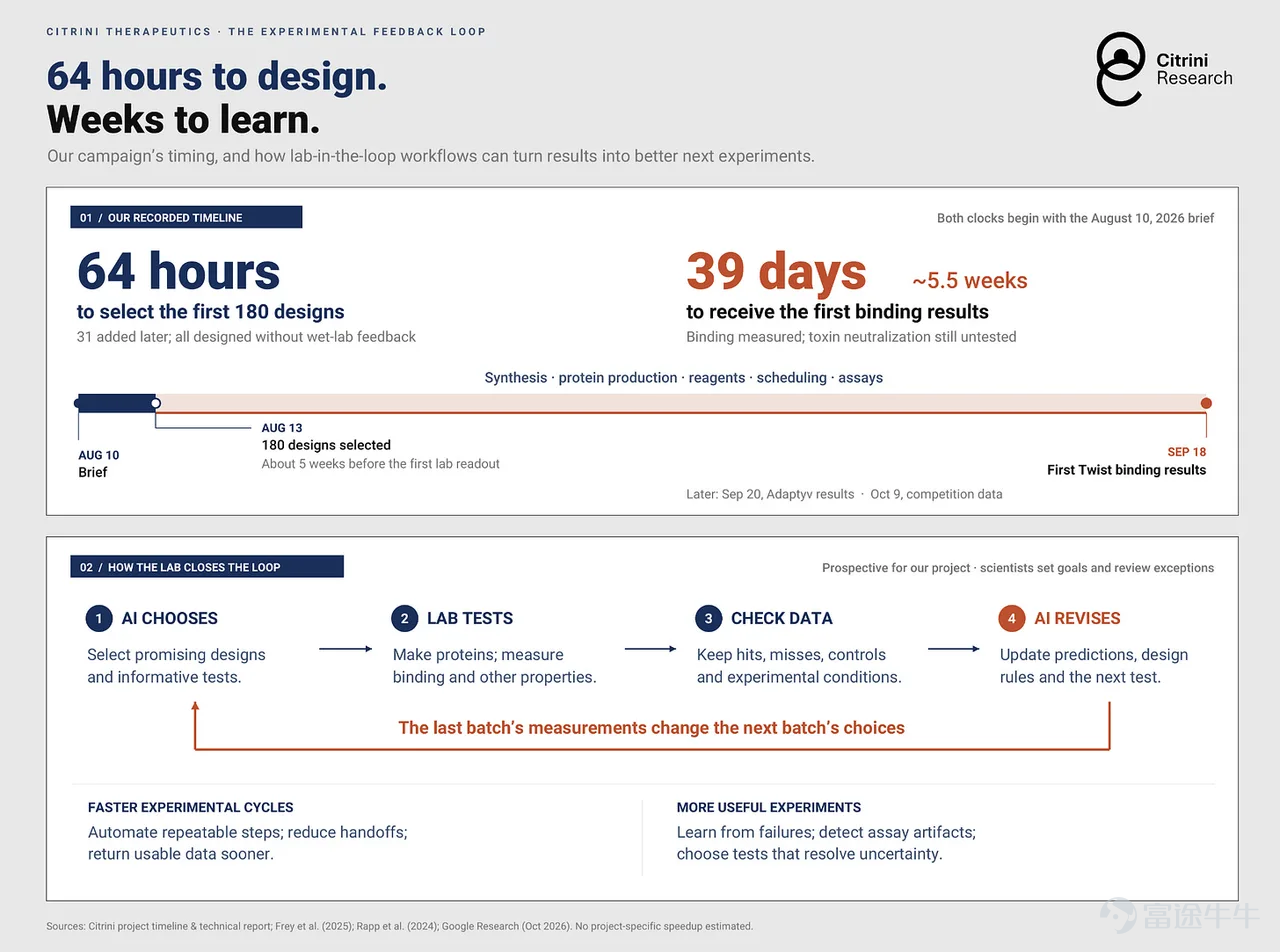
The results were quite surprising: Claude completed the initial design of 180 proteins in just about 64 hours. After subsequent iterations, 17 designs ultimately passed the laboratory binding tests.
Although there is still a long way to go before truly developing new drugs, this experiment led Citrini to identify an even more compelling investment thesis:As AI significantly accelerates drug design speed, the true industry bottleneck may shift from "molecular design" to "experimental validation." Compared to betting on which AI biotech firm will develop a new drug first, the "shovel sellers" providing lab equipment, automation systems, and R&D outsourcing services may be the ones to profit first.
Based on this judgment, Citrini, in collaboration with Hudson Labs, identified a list coveringfive major segments of the industryThe AI biopharma investment landscape, with a particular bullish outlook on $Charles River (CRL.US)$ 、 $Revvity (RVTY.US)$ and Tecan.
While the market is still chasing AI computing power, will life sciences become the next investment hotspot? Which of these companies is best positioned to benefit first?
1. The investment logic for AI drug discovery has shifted: from "designing molecules" to "validating molecules"
The most significant finding from Citrini's experiment was not that AI already possesses the capability to independently develop new drugs, but rather thatAI is significantly compressing the time required for early-stage drug design, yet the speed of validation in real-world laboratories remains difficult to synchronize.
With support from Anthropic, Claude deployed over 300 sub-agents, leveraging specialized molecular design tools and more than 10,000 H100 GPU hours to complete the design of numerous candidate proteins. Ultimately, 211 candidate designs entered laboratory testing, with 17 meeting the binding criteria set by the research team, covering 4 out of 5 target toxins.
However,There remains a significant efficiency gap between AI-driven molecular design and real-world experimental validation. Claude completed the initial design of 180 proteins in just about 64 hours, but subsequent steps—including DNA synthesis, protein production, purification, and assay—took approximately 39 days.

This disparity precisely reveals the next industrial bottleneck in AI drug discovery: as AI rapidly generates vast numbers of candidate molecules, laboratory validation capacity may instead become the key constraint on R&D efficiency.
Citrini summarizes this investment theme as:"Long Experiments" — bullish on the demand for experimental services.The research report suggests that the advantage of such companies lies in their ability to generate revenue from the increase in R&D activities, without having to wait for a specific AI-designed drug to successfully pass clinical trials and reach the market.
This implies that AI-driven drug discovery not only has the potential to boost experimental demand for existing pharmaceutical companies but also creates new sources of demand for the life sciences industry.
II. The AI Biopharma Investment Landscape Revealed! Which Segments Will Profit First?
To identify potential beneficiaries within the AI drug discovery supply chain, Citrini, in collaboration with Hudson Labs, screened over 100 listed companies covering five major industry segments and 14 sub-sectors. These five segments are: Measurement Biology, Molecular Design, Experiment Execution, Testing & Validation, and Drug Manufacturing.

--
--
--
From an investment perspective, although all five segments stand to benefit from AI,the timeline for realizing financial performance varies.
Among them, AI drug design platforms benefit directly from technological advancements, but their commercial value remains highly dependent on the subsequent development outcomes of candidate drugs. Clinical trials and drug manufacturing are located at the downstream end of the supply chain, requiring time for more AI-designed candidate drugs to advance to the corresponding stages.
In contrast, laboratory equipment, testing tools, and early-stage R&D outsourcing services are more closely aligned with the current trend of AI enhancing molecular design efficiency.
Citrini believes that investors should prioritize companies capable of converting new R&D activities driven by AI into revenue in the coming years, rather than relying solely on distant expectations of new drug successes to support their valuations.
However, whether relevant companies can actually benefit depends on the number of effective candidate molecules generated by AI, experimental expenditures, and each company's business exposure.
3. Citrini names three potential winners! Who is worth watching most?
Under the aforementioned investment framework, Citrini highlights three companies:$Charles River (CRL.US)$ 、 $Revvity (RVTY.US)$ and Tecan, corresponding to preclinical validation, life sciences testing, and laboratory automation, respectively.
1. Charles River Laboratories: The highest-conviction pick
Citrini lists $Charles River (CRL.US)$ as the most high-conviction investment target. The company is a globally renowned provider of outsourced drug R&D services, mainly offering drug discovery, preclinical research, safety assessment, and other services. Its stock has risen more than 58% year-to-date.

--
--
--
The core logic of the research report is:AI can rapidly generate candidate molecules, but it cannot directly prove their safety and efficacy in real biological systems.
As more candidate drugs enter the validation phase, demand for preclinical studies and safety assessments is expected to rise, particularly given supply constraints on certain animal testing. The research report notes that the breeding cycle for laboratory monkeys is approximately three to four years, making it difficult to rapidly expand related experimental resources.
Furthermore, Charles River's existing business is showing signs of recovery. Data for the second quarter cited in the report shows that revenue from its Discovery and Safety Assessment segment was approximately $607 million, accounting for about 60% of total revenue. Although organic growth in this segment was only around 0.2%, management stated that its net bookings-to-billings ratio reached a relatively strong level not seen in nearly four years.
Therefore, Citrini is bullish on the company benefiting simultaneously fromthe recovery of traditional pharmaceutical R&D cycles, as well as new experimental demand potentially driven by AI.However, it is important to note that not all candidate drugs require primate testing, and this business segment also faces risks related to regulatory changes and fluctuations in R&D budgets.
2. Revvity: A Potential Winner from Rising Demand for Laboratory Testing
$Revvity (RVTY.US)$ The company primarily provides life science research instruments, cell analysis technologies, reagents, and scientific research software. As AI enables the generation of large volumes of candidate molecules, the next step is to identify truly promising designs through experimentation. This will increase demand for high-throughput screening, cellular imaging, functional assays, and experimental data analysis.
Citrini is particularly optimistic about Revvity's business in high-content cell analysis. The research report points out that some customers have begun purchasing multiple high-content screening systems for individual laboratories, reflecting positive changes in related testing demand.
Additionally, its Signals scientific research software platform helps researchers manage, analyze, and integrate experimental data.
Citrini believes that Revvity is poised to benefit simultaneously from increased demand for laboratory equipment, rising complexity in testing, and the long-term trend toward digitization of scientific research data.Key indicators to watch going forward include instrument orders, equipment utilization rates, and the continued growth of revenue from配套 reagents, consumables, and software. Notably, the company's stock has risen more than 60% year-to-date.

--
--
--
3. Tecan: A Beneficiary of Laboratory Automation
Swiss company Tecan primarily provides laboratory automation, liquid handling, and related scientific research equipment. Citrini believes that as AI rapidly enhances its ability to generate candidate molecules, laboratories cannot rely solely on hiring more researchers to meet the increased demand.
Therefore, automation will become a crucial means of boosting laboratory throughput. For instance, platforms like Tecan's Fluent can assist laboratories with liquid handling, sample management, and repetitive experimental operations.
The research report points out that Anthropic has included Tecan's Fluent in its relevant integration platforms for AI-controlled laboratory equipment.If AI can not only design experiments but also directly coordinate automated equipment to execute them and collect data in the future, Tecan is poised to be a significant beneficiary of this trend.
Compared to larger life sciences equipment companies with more diversified businesses, Citrini believes Tecan has a relatively concentrated exposure to laboratory automation. However, the commercialization of AI-controlled laboratories is still in its early stages, and the incremental revenue potential remains to be seen.
4. What other opportunities exist among AI drug-discovery concept stocks?
In addition to the top three picks, Citrini is also keeping an eye on$Twist Bioscience (TWST.US)$ 、 $Thermo Fisher Scientific (TMO.US)$ 、 $Danaher (DHR.US)$ , as well as potential beneficiaries such as China's CXO industry chain.
Specifically, $Twist Bioscience (TWST.US)$It is one of the most direct beneficiaries of the demand for AI-driven drug discovery. Citrini’s recent experiment utilized DNA synthesis, protein expression and purification, and assay services provided by Twist, demonstrating how AI-based molecular design translates into actual laboratory expenditures. However, the research report notes that Twist’s stock price and valuation have risen significantly in 2026 (up nearly 350% year-to-date), suggesting the market may have already priced in some of the growth expectations for AI-driven drug discovery; therefore, it was not included among the top three picks.

--
--
--
$Thermo Fisher Scientific (TMO.US)$ and $Danaher (DHR.US)$stands to benefit from the growth in laboratory capital expenditures. As AI pushes more candidate molecules into the experimental stage, demand for life science instruments, research reagents, consumables, and automation equipment is expected to increase. However, given the diversified nature of both companies’ businesses, the actual contribution of AI-driven drug discovery to their overall revenue remains to be seen.
China’s CXO industry chain also warrants attention, including $WUXI APPTEC (02359.HK)$、 $WUXI BIO (02269.HK)$and other companies. Citrini believes that Chinese drug R&D service providers possess cost and supply chain advantages and have already benefited from the recovery in outsourced R&D demand. However, as the stock prices of these companies have already rebounded significantly, coupled with geopolitical risks, their investment appeal still needs to be assessed in conjunction with their valuations.
Citrini emphasizes thatbeing bullish on the industry prospects of AI-driven drug discovery does not mean that all related stocks are worth buying. Rather than simply chasing AI concepts, investors should focus on which companies can convert new experimental demand into actual orders and profits, and whether these growth expectations have already been fully reflected in stock prices.
5. Can AI-driven drug discovery become the next major investment theme? Three key signals to watch
From AI chips and computing infrastructure to software applications, the market has been searching for the next growth vector driven by advancements in AI technology.
Citrini believes that life sciences are at a noteworthy stage: on one hand, after years of financing and valuation pressure, there are signs of cyclical improvement in industry fundamentals; on the other hand, advances in AI technology could further enhance R&D efficiency.
However, significant uncertainty remains regarding the commercialization of AI-driven drug discovery.The previous wave of AI-assisted drug discovery has not yet fully demonstrated its ability to significantly improve clinical trial success rates. Even if next-generation AI models achieve breakthroughs in molecular design, more clinical data validation is still needed.
Therefore, rather than simply chasing the AI drug discovery concept, investors should focus on three key signals:
Experimental Demand: Is AI driving more candidate molecules into the lab, thereby boosting orders for CROs and testing services?
Equipment Demand: Are orders and utilization rates for laboratory automation, high-throughput screening, and research consumables showing sustained improvement?
Performance Realization: Can relevant companies convert increased demand into revenue, profits, and cash flow, rather than just inflating valuations?
From this perspective, the most important investment takeaway from Citrini's experiment may not be that AI is about to replace traditional pharmaceutical companies, but ratherAI is reshaping value distribution across the biopharmaceutical industry chain.
As the cost of molecular design gradually declines, companies equipped with experimental capabilities, specialized infrastructure, and high-quality data may become increasingly critical in the next phase.
The initial winners in AI-driven drug discovery may not necessarily be the companies that successfully launch new drugs, but rather the "shovel sellers" providing experimental and validation capabilities to the entire industry.
This is precisely why Citrini ultimately focused its attention onCharles River Laboratories, Revvity, and Tecanwas able to maintain such performance.
 Celebrating Futu's 14th Anniversary! Thank you to our fellow investors for your continued support! From October 12 to November 21, Futu's 3rd Global Paper Trading Competition brings together contestants from 8 major regions!
Join the paper trading competition and prediction games now for a chance to shareUp to $200,000 in cash rewards!
The top 3 global finalists will even have the chance to go international and appear on the Nasdaq billboard in Times Square, New York! Earn competition points and win rich rewards—sign up now!
📢Event Period: October 12, 2026, 10:00 – November 21, 2026, 09:00
Register Now:https://start.futunn.com/05bhHn
*This event is open only to Futu Hong Kong users and existing investors.
Risk Disclaimer: The above content only represents the author's view. It does not represent any position or investment advice of Futu. Futu makes no representation or warranty.Read more


Comments (5)
to post a comment
42
148