Jensen Huang steps down! Has the investment thesis for NVIDIA changed?

Market Watch This Week | AI Bubble Fears Resurface! Do Tech Stock Dips Present Opportunities, or Are Risks Still Unfolding?
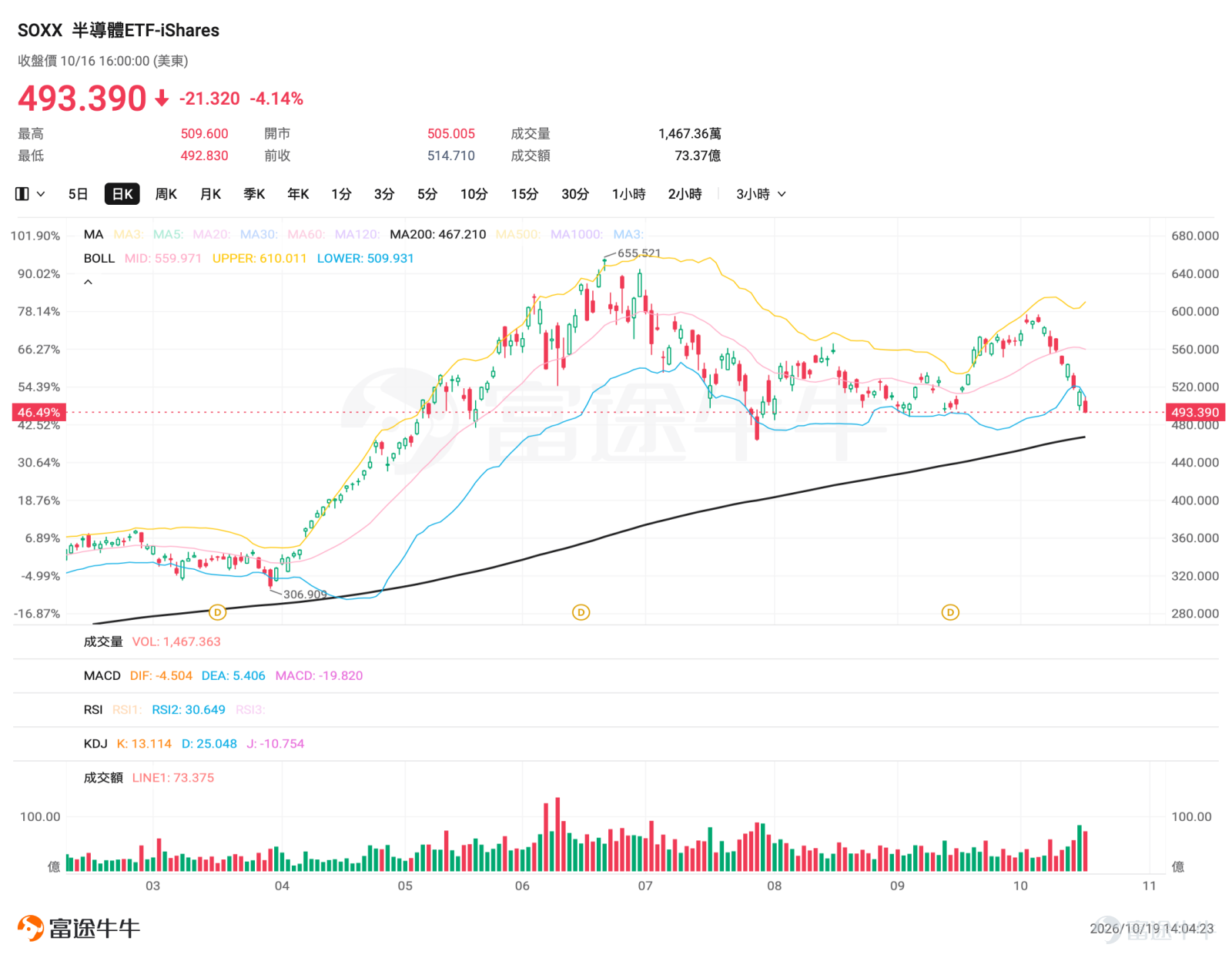
US tech stocks faced intense selling pressure last week!$iShares Semiconductor ETF (SOXX.US)$ Down 11.8% for the week,$Invesco QQQ Trust (QQQ.US)$ dropped 5.52%, while AI cloud computing company $CoreWeave (CRWV.US)$ plunged over 25%. Even though $Taiwan Semiconductor (TSM.US)$ 、 $ASML Holding (ASML.US)$ reported impressive earnings, it failed to halt the decline in tech stocks.
Is the AI bubble really about to burst? For now, the foundation for long-term growth in the AI industry remains solid, but the market is reassessing the massive investments by some companies, financing risks, and future profitability.

This week, key events include NVIDIA's GTC conference and earnings reports from hot stocks like Meta and SpaceX. Can tech stocks regain their footing? After the market correction, what investment opportunities are worth watching?
01 | Why did AI stocks plummet? Is the bubble bursting, or is this a buying opportunity?
The most puzzling phenomenon for investors in the AI sector last week was:Despite reporting strong earnings, share prices continued to fall.
Taiwan Semiconductor's Q3 revenue reached $46.72 billion, with a gross margin of 66.4%, and it forecasts further revenue growth in Q4; ASML's Q3 gross margin hit 57.5%, and the company even stated that, based on current capacity planning, equipment supply may still fail to meet customer demand in 2027–2028.
These figures indicate that demand for AI chips remains robust, and the industry is still in an expansion phase. However, while the market previously awarded higher valuations to companies simply upon seeing AI demand growth, investors are now asking:How much return will these massive investments ultimately generate? And how much future growth is already priced into current stock levels?
Among them, companies relying heavily on borrowing to build data centers are under the most visible pressure. For instance, CoreWeave's stock price recently plunged, and its related bonds were sold off, reflecting market concerns over its massive capital expenditures, cash flow, and financing capabilities.
However, not all companies in the AI supply chain face the same risks.
Taking the core industry leaders as an example, as of the market close on October 16:
– $NVIDIA (NVDA.US)$: It fell approximately 6.6% last week, closing at $214.13, with a TTM P/E ratio of around 27x.
– $Taiwan Semiconductor (TSM.US)$: Last week, it fell approximately 9.0%, closing at $412.61, with a trailing twelve-month (TTM) P/E ratio of around 27x.
Although both saw significant declines, their share prices still demonstrated some resilience compared to the SOXX's 11.8% weekly drop and the plummeting of over 20% for some highly leveraged AI companies. Based on market forecasts for future earnings, their forward P/E ratios are approximately 17x and 19x, respectively. However, these valuations remain contingent on whether future performance can meet expectations.
This suggests that long-term investment opportunities in the AI industry have not necessarily disappeared; rather, the market is likely re-evaluating which companies have robust earnings support and which are overly reliant on external financing.

For investors, after experiencing a sharp decline, if you believe in the long-term growth prospects of AI and can tolerate continued stock price volatility, you may prioritize researching fundamentally sound leaders like NVIDIA and Taiwan Semiconductor, or diversify individual stock risk through semiconductor ETFs.
Even if you believe current conditions present an investment opportunity, consider starting with a small position to observe, then building your position in tranches according to plan, avoiding committing all capital at once. After all,market dips creating opportunities do not mean stock prices have bottomed out. Blindly going 'all-in' or using high leverage to buy the dip could turn short-term volatility into unbearable losses.
This week, keep a close eye on whether semiconductor ETFs like SOXX and SMH can halt their decline, and whether leading stocks regain strength following positive news announcements.
02 | NVIDIA GTC, Meta, SpaceX Earnings! Can They Reignite Market Confidence This Week?
Following last week's sharp decline in tech stocks, corporate events and earnings reports this week are particularly important. The market needs new evidence to prove that the AI industry still has sufficient growth momentum.
Key Focus #1: NVIDIA GTC Conference—What New Stories Are There for AI?
NVIDIA will host its GTC conference in Berlin, Germany, from October 20 to 22, with CEO Jensen Huang delivering the keynote address on October 21.
The conference will cover areas such as AI infrastructure, AI agents, robotics, and autonomous systems. For investors, beyond new technologies and products, it is more crucial to observe whether these technologies can drive increased corporate AI procurement and whether new partnerships have clear commercial implementation prospects.
If the conference signals sustained demand growth, it could help restore market confidence in recently underperforming sectors such as AI chips, optical communications, and data centers.
Second key focus: Meta's earnings report—are the massive AI investments truly worthwhile?
$Meta Platforms (META.US)$ The company will release its Q3 results after the U.S. market close on October 21. Compared to revenue growth, the market may be more concerned about whether the substantial capital invested in AI can generate sufficient returns.
For instance, can AI improve ad targeting efficiency and drive revenue and profit growth? Will heavy investment in data centers continue to weigh on free cash flow?
If Meta can demonstrate that its AI investments are yielding tangible benefits, it would help alleviate market concerns regarding AI ROI; conversely, if spending continues to rise significantly without corresponding returns, tech stocks may still face pressure.
Third key focus: SpaceX (SPCX) earnings—can the growth story continue to materialize?
Listed this June $SpaceX (SPCX.US)$ Q3 earnings will be released after the U.S. market close on October 20.
As a tech giant spanning rocket launches, Starlink satellite internet, and AI businesses, key highlights in SpaceX's financial report include Starlink's growth, progress in launch services, and the impact of new business investments on profits and cash flow.
With the market becoming more cautious about massive tech investments, whether SpaceX can demonstrate its growth and profitability potential may also influence investors' valuation expectations.

Additionally, there are several notable earnings reports to watch this week:
– $Netflix (NFLX.US)$: Released after hours on October 20; focus on advertising revenue growth, subscription monetization, and profit margins.
– $Tesla (TSLA.US)$: Released after hours on October 21; pay closer attention to automotive margins, energy storage business, cash flow, and the latest developments in Robotaxi and other ventures.
One detail is particularly worth noting during this earnings season:Can stock prices rebound following the release of positive news? If companies deliver strong results and the market begins to react positively, it will be a significant signal of restoring confidence in tech stocks.
03 | Amid the sharp decline in tech stocks, where is capital flowing?
It is worth noting that while US tech stocks plummeted last week, not all market sectors declined.
$Consumer Staples Select Sector SPDR Fund (XLP.US)$ rose by 5.02%, $Energy Select Sector SPDR Fund (XLE.US)$rose by 4.86%, $The Health Care Select Sector SPDR® Fund (XLV.US)$ and rose by 3.45%. This reflects that some capital is seeking investment directions with relatively stable earnings and lower correlation to the AI rally.
The first category consists of defensive stocks and ETFs.
For example, the healthcare and consumer staples sectors; companies in these sectors typically provide products or services needed for daily life, with performance less reliant on the tech investment boom. During periods of high volatility in tech stocks, these assets can serve as options to diversify portfolio risk, but investors should still pay attention to valuations and individual stock risks.

The second category includes US Treasury ETFs and direct investments in US Treasuries.
$iShares 20+ Year Treasury Bond ETF (TLT.US)$ rose by approximately 2.65%, showing relatively robust performance during the decline in tech stocks.
A key reason behind this is that market concerns over economic conditions and financing risks for tech companies have driven some capital toward US Treasuries, pushing bond prices higher.
Investors looking to reduce portfolio volatility may consider US Treasury ETFs with different maturities. However, note that TLT is highly sensitive to interest rate changes; if inflation remains persistently high and US Treasury yields rise again, long-term bond prices could still fall.
Additionally, you can directly invest in US bond products on Futubull >> To access U.S. Treasuries, navigate to: Discover > Wealth Management > Bonds > U.S. Treasuries, where you can select your preferred products.

The third category is the energy sector.
International oil prices rose again last week, driving $Energy Select Sector SPDR Fund (XLE.US)$ and other energy ETFs higher. Geopolitical tensions and supply risks remain key variables, but oil prices are highly sensitive to news flow; chasing short-term gains may also expose investors to higher volatility.
For investors not planning to trade at the moment, it is advisable to observe the market for now and wait for tech stocks to stabilize or for clearer opportunities to emerge in other sectors.
Income Opportunities
For investors focused on cash flow and dividend returns, a batch of high-quality stocks will go ex-dividend this month. Buying and holding before the ex-dividend date allows you to lock in the corresponding dividends. Keep an eye on $YUEXIUTRANSPORT (01052.HK)$ 、 $ENN ENERGY (02688.HK)$ etc.

Investment Opportunities This Week: Three Key Directions to Watch
Following the significant correction in tech stocks last week, market risks have not been fully eliminated, but some assets are beginning to show room for revaluation. For average investors, here are three directions to look for investment clues this week.
Broad-based and Tech Sector ETFs: SPY, VOO, QQQ, SMH, SOXX
Investors looking to diversify single-stock risk can start with the S&P 500 ETF ( $SPDR S&P 500 ETF (SPY.US)$ Start understanding the US stock market with VOO; if you are more bullish on tech leaders, keep an eye on the Nasdaq-100 ETF (QQQ); if you want to focus on AI chips and the semiconductor industry, you can watch $VanEck Semiconductor ETF (SMH.US)$ SOXX.
Defensive sectors and US Treasury ETFs: XLV, XLP, XLE, TLT
If you are more concerned about market volatility, you can look into$The Health Care Select Sector SPDR® Fund (XLV.US)$ the Consumer Staples ETF (XLP), as well as US Treasury ETFs with different maturities (TLT). The Energy ETF (XLE) can also serve as a tool to monitor oil price trends, but it is significantly influenced by commodity prices and geopolitical news.
Hot earnings stocks this week: META, SPCX, TSLA, NFLX
Several popular stocks face earnings tests this week, which may lead to significant stock price volatility. $Meta Platforms (META.US)$ Watch for AI investment returns, $SpaceX (SPCX.US)$ Watch for Starlink and AI business growth, $Tesla (TSLA.US)$ Watch for automotive margins and new business progress, $Netflix (NFLX.US)$ and $Lam Research (LRCX.US)$ Separately examine consumer spending realization and demand for semiconductor equipment.
The long-term growth trend of the AI industry remains supported, but the market is reassessing the risks and valuations of different companies. For retail investors, diversifying allocations, managing position sizes, and waiting for fundamentals and price signals to gradually confirm is more important than rushing to guess the market bottom.
Celebrating Futu's 14th Anniversary! Thank you to our fellow investors for your continued support! From October 12 to November 21, Futu's 3rd Global Paper Trading Competition brings together contestants from 8 major regions!
Join the simulated trading competition and observe the prediction contests now,for a chance to share a cash prize pool of up to $200,000!
The top 3 global finalists will even have the chance to go international and appear on the Nasdaq billboard in Times Square, New York! Earn competition points and win rich rewards—sign up now!
📢Event Period: October 12, 2026, 10:00 – November 21, 2026, 09:00
Register Now:https://start.futunn.com/05bhHn
*This event is open only to Futu Hong Kong users and existing investors.
Risk Disclaimer: The above content only represents the author's view. It does not represent any position or investment advice of Futu. Futu makes no representation or warranty.Read more


Comments (5)
to post a comment
26
29