Approximately 80% of new listings are expected to rise on their debut in 2026; how will subsequent p

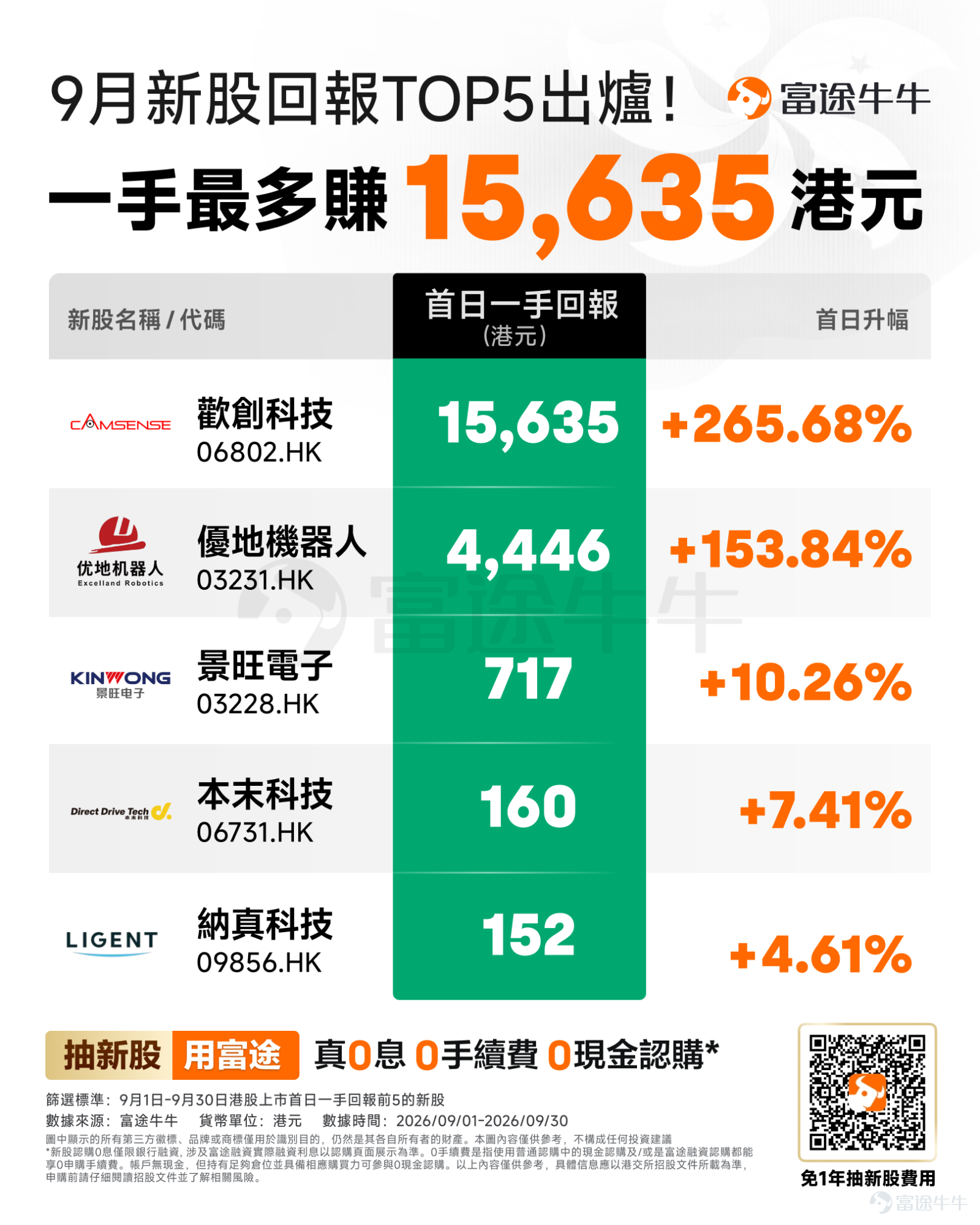
HK Stock IPO Monthly Report | September new listings surged up to nearly 266% on their debut; one lot of Huanchuang Technology yielded a profit of HKD 15,635
Enthusiasm for Hong Kong listings remained strong in September, with a total of 12 companies listing on the HKEX. The "head effect" in the HKEX IPO market was significant; large-cap new listings, as well as companies in hot sectors like AI and hard technology with scarce attributes, were more likely to attract capital favor. In contrast, stocks with high valuations and lacking unique scarcity saw lower market attention.
Amidst phased fluctuations in market sentiment, investor willingness to subscribe to new shares diverged. In terms of subscription multiples,$MECH-MIND ROBOT (09615.HK)$the public offering tranche saw an oversubscription ratio exceeding 3,835 times, ranking first on this month's subscription list;$CAMSENSE (06802.HK)$ranking second this month with 3,546.91 times;$MEDCAPTAIN (02041.HK)$ranking third with 436.37 times; followed by$DIRECT DRIVE (06731.HK)$、$EXCELLAND ROBOT (03231.HK)$and$KINWONG (03228.HK)$, with subscription multiples of 208.56, 140.02, and 94.25 times, respectively.
First-day gains for new listings weakened, with the break-issue rate (closing below IPO price) exceeding 58% in September.
As of September 30, a total of 115 companies have listed this year, with 26 breaking issue on their first day, resulting in a break-issue rate of 22.6%. Since the third quarter, first-day performance of HKEX new listings has weakened, and the break-issue rate has risen compared to the first half of the year. In June, 6 out of 24 companies broke issue (25%); in July, 7 out of 17 companies broke issue (41.2%); and in August, none of the 2 companies broke issue. In September, 7 out of 12 companies broke issue on their first day, marking a break-issue rate of 58.3%. Overall, the HKEX new share market this month showed a pattern of continuous supply expansion but significantly cooled subscription sentiment. Performance divergence on the first day intensified, indicating that high subscription热度 (enthusiasm) and cornerstone investor lists no longer guarantee listing profits.
Among the 12 newly listed companies, 6 belonged to the technology sector, 3 to the industrial sector, 1 to the consumer sector, 1 to healthcare, and 1 to raw materials. On the first day, 5 companies rose, including 3 from the technology sector, namely$CAMSENSE (06802.HK)$、$EXCELLAND ROBOT (03231.HK)$and$LIGENT (09856.HK)$; and 2 from the industrial sector, namely$KINWONG (03228.HK)$and$DIRECT DRIVE (06731.HK)$。
Supplier of spatial perception products for robot vacuums$CAMSENSE (06802.HK)$Listed today, closing up 265.68% on the first day. Excluding fees and commissions (same below), one lot yielded a profit of HKD 15,635. The company primarily supplies spatial perception components to robot vacuum manufacturers for integration into their devices, generating revenue from these sales. Based on 2025 revenue, HuanChuang Technology is the world's leading supplier of spatial perception solutions for intelligent robots, with the highest global shipment volume of LiDAR units and a global market share exceeding 50%.
Commercial robotics product company$EXCELLAND ROBOT (03231.HK)$Commercializes its core and applied technologies through robotic products, robotic modules, and RaaS (Robot-as-a-Service) and leasing arrangements. The subscription multiple during the public offering phase was 140.02x, with the stock closing up 153.84% on its listing debut; one lot yielded a profit of HKD 4,445.98. Supplier of optical communication and optical connectivity products$LIGENT (09856.HK)$Dedicated to the R&D, manufacturing, and sales of optical modules, optical chips, and optical network terminals. The subscription multiple was only 35.16x, with the stock rising 4.61% on the first day; one lot yielded a profit of HKD 151.98.
September 29: PCB manufacturer$KINWONG (03228.HK)$Closed up over 10% on the first day of listing, with one lot yielding a profit of HKD 716.97. The company holds a leading global position in automotive electronics PCBs and has strategically focused on the AI computing sector. On the same day, the "first stock for direct drive modules"$DIRECT DRIVE (06731.HK)$Rose over 7% on the first day of listing, with one lot yielding a profit of HKD 159.99. It is a robotics technology company with direct drive technology as its core competency, primarily engaged in the sale of robotic power modules in China, followed by the sale of robots.
September 1: Globally renowned fast-fashion cross-border e-commerce giant$SHEIN-W (00625.HK)$Officially listed on the Hong Kong Stock Exchange, raising over HKD 13.2 billion. The stock opened flat, dipped nearly 10% during intraday trading, and ultimately closed down slightly by 0.12% supported by the green shoe option. On the same day, a representative player in the embodied AI sector$MECH-MIND ROBOT (09615.HK)$Listed with subscription oversubscribed by over 3,835 times; closed down 1.87% on the first day of trading. Listed on September 7.$MEDCAPTAIN (02041.HK)$Public offering oversubscribed by more than 436 times; strong subscription demand. Plunged nearly 43% on the first day of listing. A leader in the storage sector.$LONGSYS (09976.HK)$Secured 14 industry giants as cornerstone investors; closed slightly down 1.02% on the first day of listing. Market views suggest that despite strong endorsements from industrial cornerstones, it is still difficult to avoid downward pressure on new listings in an environment of weak secondary market liquidity.
Reform of the HKEX new share system kicks off, marking the end of the "blind IPO subscription" era.
On September 16, John Lee released the "Chief Executive's 2026 Policy Address," proposing support for leading mainland and overseas companies, as well as high-quality emerging industry enterprises, to list in Hong Kong. The Hong Kong SFC also plans to launch consultations in 2027 on streamlining prospectus disclosure requirements, further clearing obstacles for high-quality overseas companies to list in Hong Kong. Additionally, it plans to consult on Chapter 18C for specialized and new technology companies and review market capitalization thresholds in the first half of next year.
On September 21, the HKEX officially released the consultation paper for the second phase of the review on the competitiveness of the listing mechanism: it proposes raising the threshold for major transactions from 25% to 50%, and increasing the equity threshold for connected transactions from 10% to 30%; the moratorium period for spin-off listings will be shortened from three years to one year; low-risk spin-off projects can be self-assessed by enterprises, and the guaranteed allocation quota for parent company shareholders will be abolished. This reform simplifies corporate capital operation processes. Coupled with the continuous optimization of the Chapter 18C listing channel for sci-tech innovation, it will facilitate IPOs in Hong Kong for hard-tech and emerging industry enterprises. In the long run, this will enrich the supply of new shares in the HK stock market and optimize the industrial structure of listed companies.
This series of regulatory relaxations has driven the HKEX IPO market into a boom cycle, while the market ecosystem is simultaneously undergoing reshaping.
Institutions state that the rising heat in the HKEX IPO market this year is essentially the result of the combined effects of three structural forces: institutional supply, industrial transformation, and shifts in capital flows. Regulatory reforms introduced by the HKEX, such as the dedicated channel for tech enterprises and confidential filing, have released institutional dividends. A large number of hard-tech companies have listed in Hong Kong, reshaping the industrial structure of the HK stock market.
However, rationality is still required behind the market prosperity; the era of "blind IPO subscriptions" has ended. Market logic is shifting from "whether a company can successfully list" to "whether it can sustain a liquidity premium after listing," and the divergence among individual stocks will intensify significantly. Investors need to abandon the "blind subscription" mindset and focus on verifying the commercial implementation, order quality, and revenue quality of targets. For spin-off listing targets, attention should also be paid to whether the parent company retains its substantive core business to avoid the risk of simple asset stripping for arbitrage. Priority should be given to scarce targets with genuine technical barriers and long-term liquidity potential.
Institutions note that IPO performance is influenced by multiple factors, including issuance pace, market sentiment, and pricing mechanisms. In addition to the prospectus, investors can refer to regulatory public feedback to assess a company's industry position and growth prospects. Cornerstone investors should be viewed as reference points only; high-quality cornerstone investors generally fall into three categories: professional public and private funds, strategic investors, and conservative overseas long-term funds. Participation by such institutions typically signals endorsement of the company's prospects and suggests a relatively more reasonable offering price. When screening for high-quality semi-new stocks for long-term holding, focus on three core dimensions: scarcity in niche sectors, secondary market liquidity, and corporate governance standards. It is not advisable to blindly chase hot sectors; instead, prioritize industries you are familiar with and conduct deep fundamental analysis.
At least HKD 480 billion! This year is poised to set a new record for IPO fundraising.
Deloitte points out that looking ahead to the fourth quarter, Hong Kong is well-positioned to break the historical record for total IPO fundraising set in 2010. By the end of this year, Hong Kong is expected to see approximately 160 new listings, raising at least HKD 480 billion. According to public data, there are currently over 500 companies in the IPO application pipeline, including several mega-listings with fundraising targets of at least HKD 10 billion each.
Ji Wenhe, National Managing Partner of Deloitte China's Capital Markets Services, stated that the Hong Kong IPO market has significantly benefited from robust market demand for AI and policy support for various sub-sectors of hard technology. Although recent market concerns suggest that domestic AI chips may face further export restrictions, and there is global debate on whether to slow the pace of AI R&D, Hong Kong stocks are expected to stand out in the global market by the end of 2026. A substantial pipeline of IPO applications, combined with the strong financing and refinancing needs of these high-tech enterprises, provides solid support for this optimistic outlook.
The golden season for subscribing to new stocks is here! Subscribe via Futu with 0% interest, 0 fees, and 0 cash deposit required. Participate in the current promotion for a chance to waive your new stock subscription fees for 1 year,Come try it out now >>

Editor/melody
Risk Disclaimer: The above content only represents the author's view. It does not represent any position or investment advice of Futu. Futu makes no representation or warranty.Read more

Comments (4)
to post a comment
5
24