Trump rings the opening bell at the White House! Predicts 'US stocks will soar to the moon'

Politician Holdings Tracker | Trump's July Portfolio Rebalancing Revealed! Reduces Microsoft and Amazon, Pivots to Marvell Technology and CrowdStrike
Trump's investment accounts underwent another round of intensive rebalancing in July.
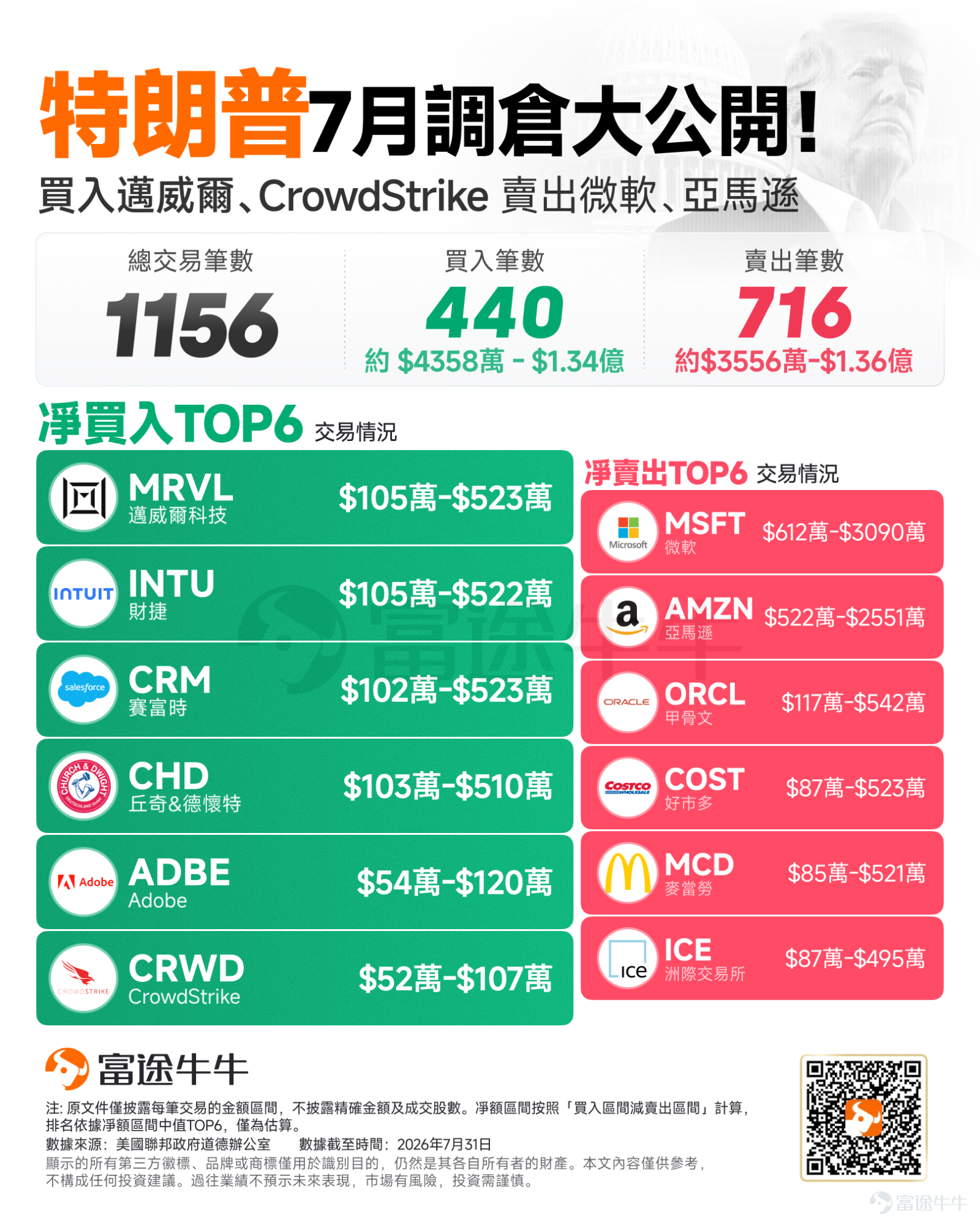
The latest financial disclosures show that Trump's accounts disclosed a total of in July 1,156 securities transactions, with the total transaction value estimated based on reporting ranges to be between $79 million and $270 million. Of this, purchase amounts totaled at least approximately $43.5 million, and sale amounts totaled at least approximately $35.5 million.
Since U.S. government financial disclosures only reveal value ranges for each transaction rather than exact execution prices, all aggregate totals and net buy/sell figures can only be estimated as ranges.
In terms of transaction count, July overall exhibited「a pattern of heavier selling and more concentrated buying」. According to compiled filing documents, there were approximately 440 purchases and 716 sales during the month; the total reported range for purchases was approximately $43.58 million to $134 million, while sales ranged from approximately $35.56 million to $136 million.
--
--
--
More noteworthy than the transaction volume is the shift in asset allocation behind this portfolio rebalancing: $Microsoft (MSFT.US)$、 $Amazon (AMZN.US)$Major tech stocks such as NVIDIA, Microsoft, Amazon, Oracle, Marvell Technology, and CrowdStrike saw significant reductions, with some capital flowing into AI semiconductors, enterprise software, cybersecurity, and defensive consumer stocks.
So, what are the key changes to watch in this round of portfolio rebalancing?
1. July Rebalancing Overview: Reduced holdings in large-cap tech stocks, with buying activity relatively concentrated.
Looking at individual stock trades, there were notable differences in the buy and sell directions of Trump-associated accounts in July.
Based on estimated ranges from filing data, $Marvell Technology (MRVL.US)$net purchases amounted to approximately $1.05 million to $5.23 million,ranking among the top net-buy targets. $Intuit (INTU.US)$ 、 $Salesforce (CRM.US)$ and consumer staples companies $Church & Dwight (CHD.US)$ also recorded significant net buying, $Adobe (ADBE.US)$ and $CrowdStrike (CRWD.US)$ with [Company Name] also entering the top 6 for net purchases.
These six companies span sectors including AI semiconductors, enterprise software, cybersecurity, and consumer staples, with tech stocks occupying the majority of positions.
In contrast, capital outflows were concentrated in certain large-cap tech and consumer leaders. Among them, $Microsoft (MSFT.US)$the estimated net sell-off amounted to approximately $6.12 million to $30.9 million, $Amazon (AMZN.US)$and approximately $5.22 million to $25.51 million,making them the two primary net sell-offs for the month. $Oracle (ORCL.US)$ 、 $Costco (COST.US)$ 、 $McDonald's (MCD.US)$ and $Intercontinental Exchange (ICE.US)$ also ranked among the top net sell-offs.
It is worth noting thatJuly 20 was a key date for this round of portfolio rebalancing.On that day, accounts under Trump’s name sold Microsoft and Amazon stocks worth $5 million to $25 million each, constituting the two largest equity transactions of the month, while also selling Oracle stocks worth $1 million to $5 million.
However, this was not a simple exit from tech stocks. On the same day, the account bought NVIDIA stocks worth $500,000 to $1 million, and purchased $Intuit (INTU.US)$ 、 $Marvell Technology (MRVL.US)$ and $Salesforce (CRM.US)$ stocks worth $1 million to $5 million each, as well as those of consumer goods company $Church & Dwight (CHD.US)$。
Moreover, the reduction in holdings of Microsoft and Amazon was not a complete exit. On July 23, the account repurchased $Microsoft (MSFT.US)$ stocks, as well as approximately $1,001 to $15,000 worth of $Amazon (AMZN.US)$ of stock.
Although the scale of the buyback was far smaller than the previous sell-off amount, this move indicates that, at least based on the trading records disclosed in July, the account did not completely abandon its relevant holdings but instead made significant position adjustments.
II. How to interpret this portfolio rebalancing? Three changes are worth noting
If we look at the July trades together, this round of adjustments presents three relatively obvious characteristics.
First, there was a reallocation within the tech sector, with some large platform stocks being reduced.
The most intuitive change is that $Microsoft (MSFT.US)$、 $Amazon (AMZN.US)$ and $Oracle (ORCL.US)$ stocks of major tech companies such as Amazon, Microsoft, Oracle, and NVIDIA were sold off on a large scale, while some funds flowed into the semiconductor, enterprise software, and cybersecurity sectors.
For example, $Marvell Technology (MRVL.US)$ Marvell Technology's core business involves data center interconnects and custom chips, which are closely related to AI infrastructure construction; $Intuit (INTU.US)$and$Salesforce (CRM.US)$CrowdStrike mainly targets the enterprise software market;$CrowdStrike (CRWD.US)$The focus was on cybersecurity.
This means that, based on July's trading structure, while the account reduced holdings in some leading tech stocks, it increased allocations to other segments of the technology supply chain.
However, this does not necessarily indicate that the portfolio manager is bearish on large-cap tech companies and bullish on niche tech stocks. Similar trading outcomes could result from reducing concentration in individual holdings, managing portfolio risk, or rebalancing according to a predetermined investment model.
Secondly, the shift was not entirely toward high-growth tech stocks; defensive assets also received allocations.
It is worth noting that $Church & Dwight (CHD.US)$ It was also one of the main net buy targets in July. Unlike AI semiconductor and enterprise software companies, this company focuses primarily on consumer staples, with revenue closely tied to daily household consumption demand, exhibiting business characteristics distinct from high-growth tech stocks.
This company and $Intuit (INTU.US)$ 、 $Marvell Technology (MRVL.US)$ and $Salesforce (CRM.US)$appeared simultaneously on the list of major net buys, reflecting that this round of portfolio adjustment was not simply a rotation from large-cap to small- and mid-cap tech stocks, but involved assets across different industries and risk profiles.
Furthermore, ETFs and bonds outside of equities were adjusted in tandem. For example, on July 8, accounts under Trump’s name purchased SPDR International Treasury Bond ETF, Fidelity Communication Services ETF, Vanguard Short-Term Bond ETF, and Vanguard Dividend Appreciation ETF, with values ranging from $1 million to $5 million each, while simultaneously selling several Treasury, communication services, and international treasury bond ETFs.
The account also purchased multiple municipal bonds and other fixed-income assets. Thus, July's trading activity involved not only stock rotation but also asset allocation adjustments across equities, ETFs, and bonds.
Third, some trades coincided with policy events on the same day.
Another detail drawing market attention is the sale on July 20 $Northrop Grumman (NOC.US)$ of stocks. Filings show that accounts under Trump’s name sold Northrop Grumman shares worth approximately $250,000 to $500,000 on that day.
On the same day, Trump signed an executive order on the security of the U.S. defense supply chain, tightening conditions for defense contractors to obtain exemptions for procuring certain critical materials and requiring enhanced tracking and risk management of critical supply chains.
The coincidence of these two events on the same day has attracted external scrutiny. However, it is important to emphasize that financial disclosures only reveal the transaction date and the value range, without specifying the exact timing of the trades, nor can the decision-making process behind these transactions be determined solely from the filing data.
The White House stated that Trump’s stock and bond portfolio is independently managed by a third-party financial institution, with related assets held in blind trust accounts and allocated through computerized portfolio models. Neither Trump nor his family can direct or influence specific investment decisions or the timing of trades.
3. Summary
Overall, the thousands of transactions in Trump’s accounts in July did not reflect a one-sided buying or selling trend, but rather a broad rebalancing involving multiple asset classes.
For investors, this filing serves better as a reference for observing changes in asset allocation: while holdings in large-cap tech platform stocks were reduced, the tech sector was not sold off entirely, with new allocations made to certain niche tech companies and defensive assets.
Notably, Trump’s high-frequency trading pattern, particularly the significant overlap between trade dates and his policy decisions, continues to be a focal point for both the market and regulatory bodies.
Risk Disclaimer: The above content only represents the author's view. It does not represent any position or investment advice of Futu. Futu makes no representation or warranty.Read more


Comments (9)
to post a comment
47
119