NVIDIA's revenue doubles, beating expectations; is the AI trade narrative making a comeback?

Options Income Strategy | Inclusion in S&P 500 Triggers Fund Rush! Bloom Energy Surges Nearly 10% in a Single Day
1. Bloom Energy: Inclusion in S&P 500 Ignites Buying Frenzy Among Index Funds, Leading to Volume-Backed Gains
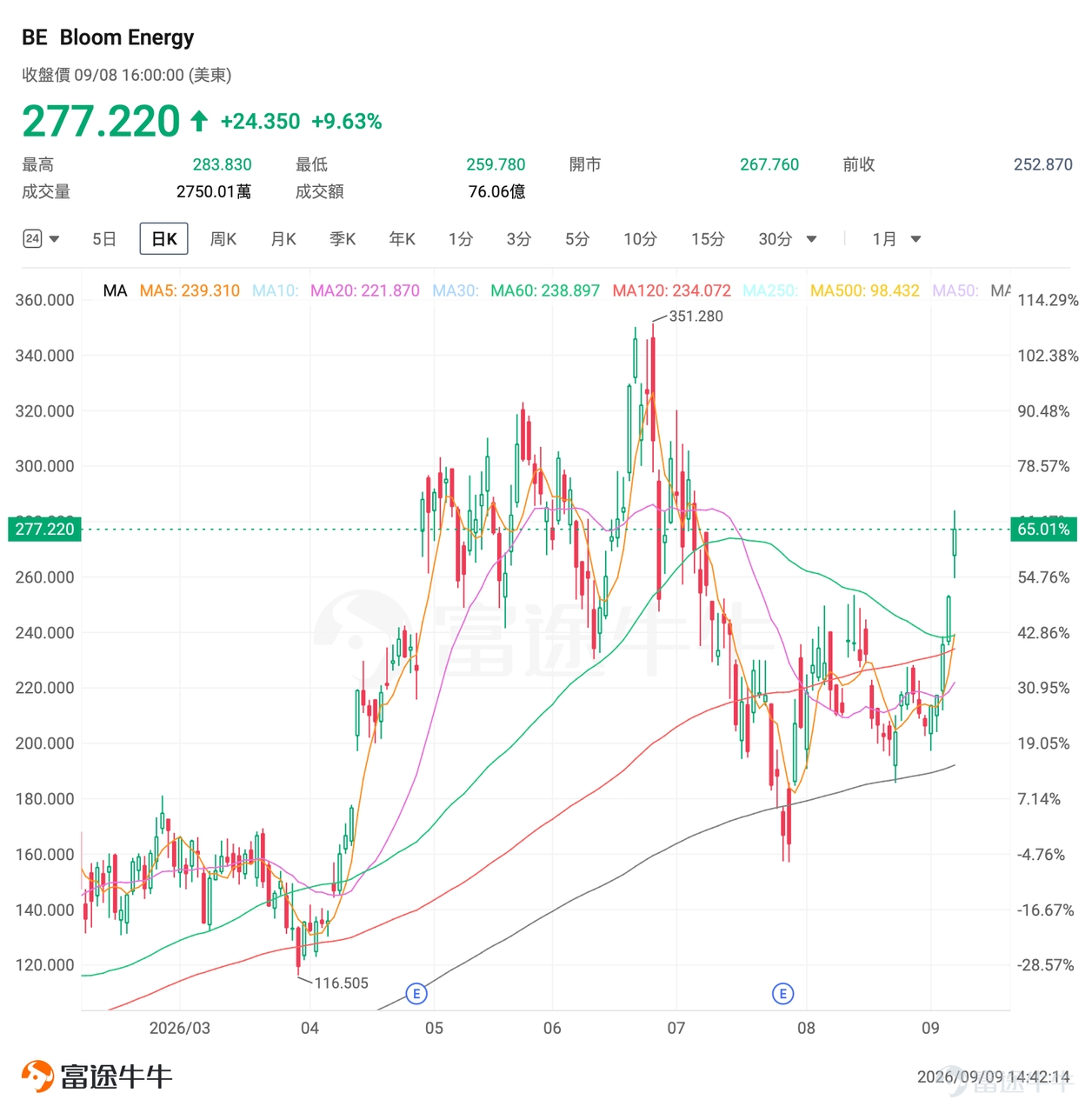
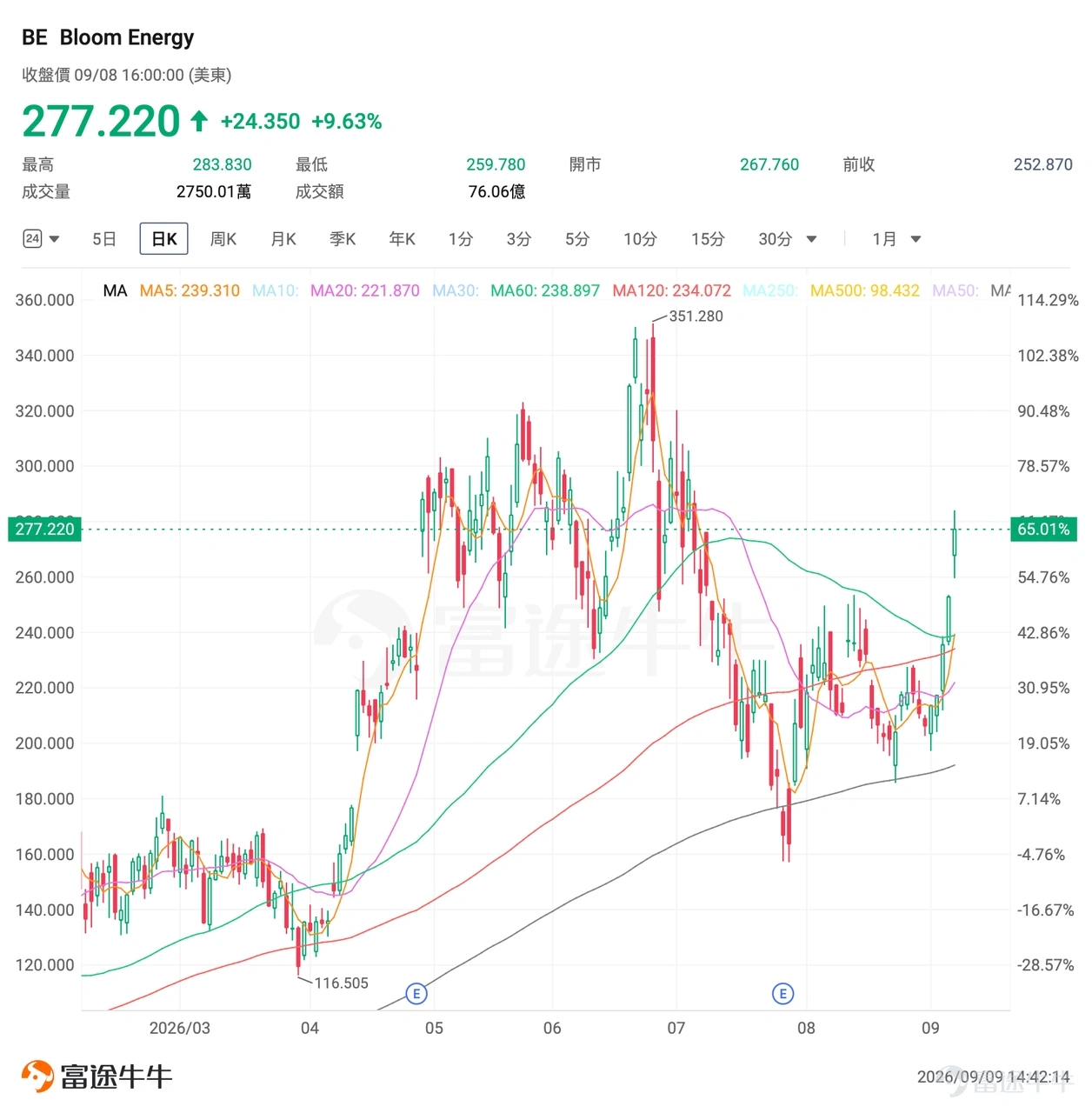
September 8 (Tuesday), $Bloom Energy (BE.US)$ Closed at $277.22, up 9.63% for the day. The intraday high reached $283.83, and the low was $259.78. Trading volume totaled $7.606 billion, with a volume ratio of 2.201 and a turnover rate of 9.857%, indicating significant volume expansion. Previously, on September 3 and 4, the stock rose by 8.41% and 7.35% respectively, rapidly climbing from around $213 to above $277.
Technical Analysis:
Short-term chart shows a breakout pattern with increased volume.On September 8, the stock closed at $277.22, decisively breaking above the upper boundary of the consolidation platform near $253 seen on September 4, and refreshing the highs of this rebound cycle. Immediate resistance levels are the intraday high of $283.83 and the psychological barrier at $300; further above lies the historical high zone at $351.28. Support levels to watch are first the breakout platform around $250, followed by the 60-day moving average near $238.
In terms of volume, trading value expanded significantly, indicating substantial capital inflow. The short-term trend shows a strong breakout with heavy volume, but given the large single-day gain and turnover rate approaching 10%, investors should be cautious of profit-taking leading to a pullback after the surge.
News Analysis:
The core catalyst is the adjustment of index constituents: BE will be included in the S&P 500 Index, effective later this month. The impact mechanism is that passive index funds tracking the S&P 500 must buy BE around the effective date, creating certain incremental buying pressure. The market is front-running this expected passive buying, which directly drove the 9.63% surge with heavy volume on September 8, accompanied by a simultaneous increase in options trading volume.
Major Bank Views:
Among 17 institutions, 52.94% rated it as Buy and 47.06% as Hold, with no Sell ratings. The average target price is $272.12, ranging from a high of $350 to a low of $176. Clear Street raised its target price to $330, and UBS reiterated its Buy rating while raising its target to $325, both viewing the S&P 500 inclusion as a positive catalyst.
2. Short Option Strategies
IV Analysis:
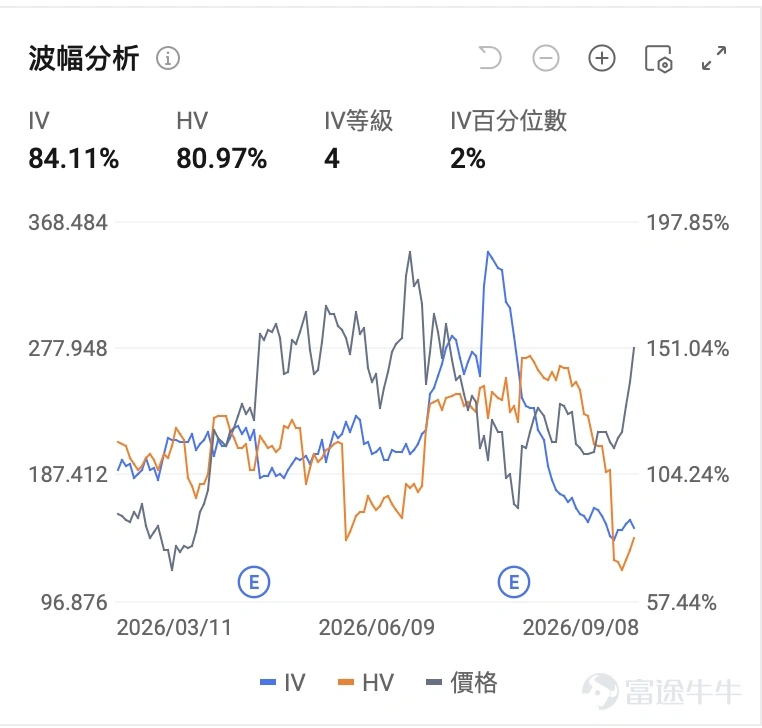
Current Implied Volatility (IV) is approximately 84.11%, and Historical Volatility (HV) is around 80.97%. While absolute levels remain high, providing ample premium for sellers, the IV historical percentile is only about 2%. This suggests that high volatility has become the norm, and current volatility is not expensive relative to its own history.
Sellers can still collect substantial premiums, but the 'volatility premium' relative to history is limited, making directional judgment and position management more critical.
Cash-Secured Put
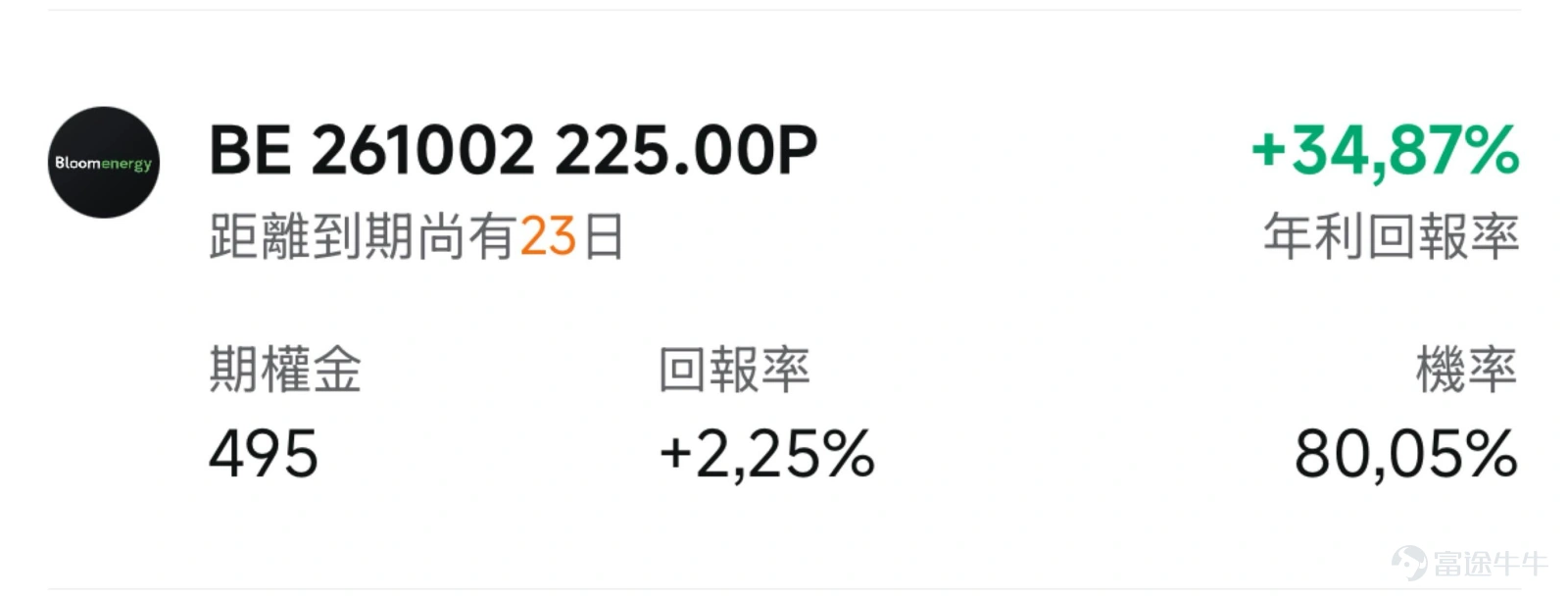
Sell 1 contract of BE Oct 2, 2026 $225 Put, and reserve sufficient cash for potential assignment.
Opportunity screening logic:
$Bloom Energy (BE.US)$ There is still support from certain buying driven by S&P 500 inclusion, but the risk of chasing highs is significant after a single-day surge of 9.63%. Investors without existing positions can sell out-of-the-money (OTM) Puts. If the stock continues to rise or consolidates at high levels, you keep the premium; if it pulls back to around $225, you can accumulate shares at a lower cost, which is a more comfortable strategy than chasing the rally.
Covered Call
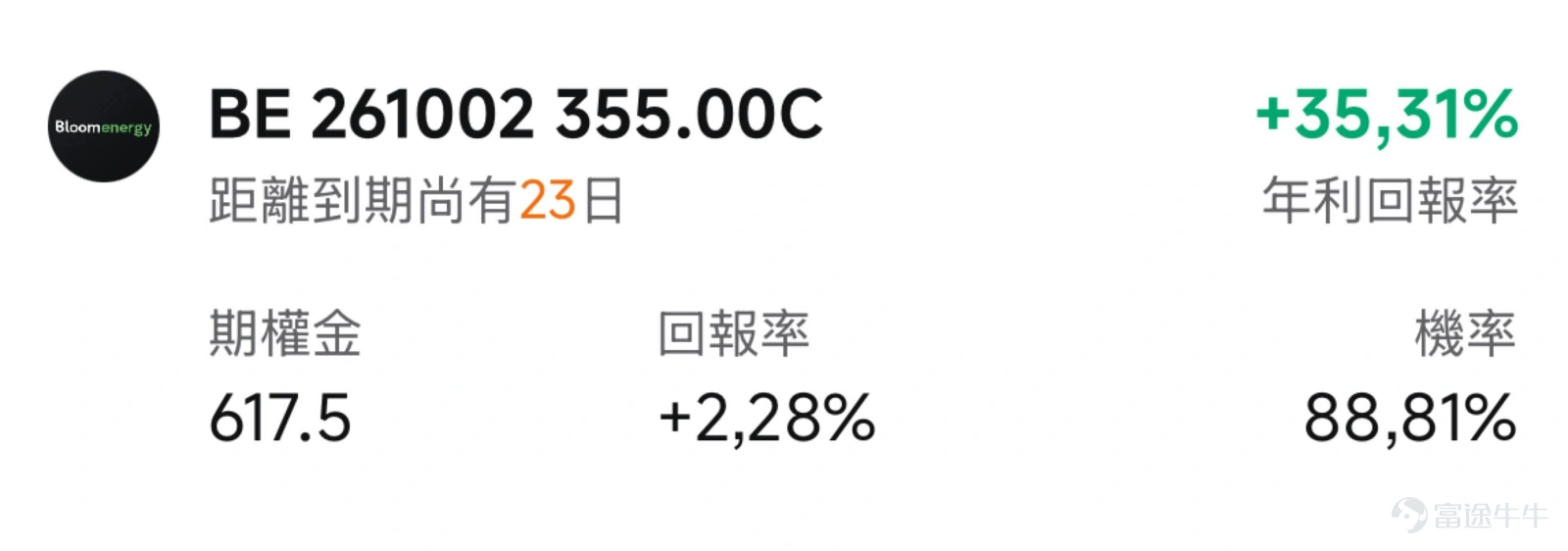
Opportunity screening logic:
Investors holding 100 shares face short-term pullback pressure after profit-taking rallies but may not want to sell prematurely. Selling Calls allows you to collect premiums and lower your cost basis; the premiums hedge against drawdowns during consolidation. If the stock rises above $355 and gets assigned, it effectively means taking profits around $355 and locking in阶段性 gains.
3. Risk Control Notes
Although short-option strategies generally have a high probability of profit, investors must still implement sound risk management:
- Position management is core. The biggest risk for sellers lies in black swan events. It is recommended that margin usage for a single underlying asset should not exceed 20% of total capital. Do not sell options beyond your capacity to absorb losses just to chase premiums.
- Pay attention to rolling positions for Covered Calls. When a Covered Call is deep in-the-money, if you remain bullish on the underlying stock, consider buying back the current option to close the position while simultaneously selling options with a further expiration date and a higher strike price. This avoids having the underlying stock forced to be sold at a low price.
- Cash-Secured Puts require vigilance against left-tail risks. If the stock price drops significantly due to deteriorating fundamentals, do not mechanically hold on. Instead, cut losses or roll down positions based on your risk tolerance.
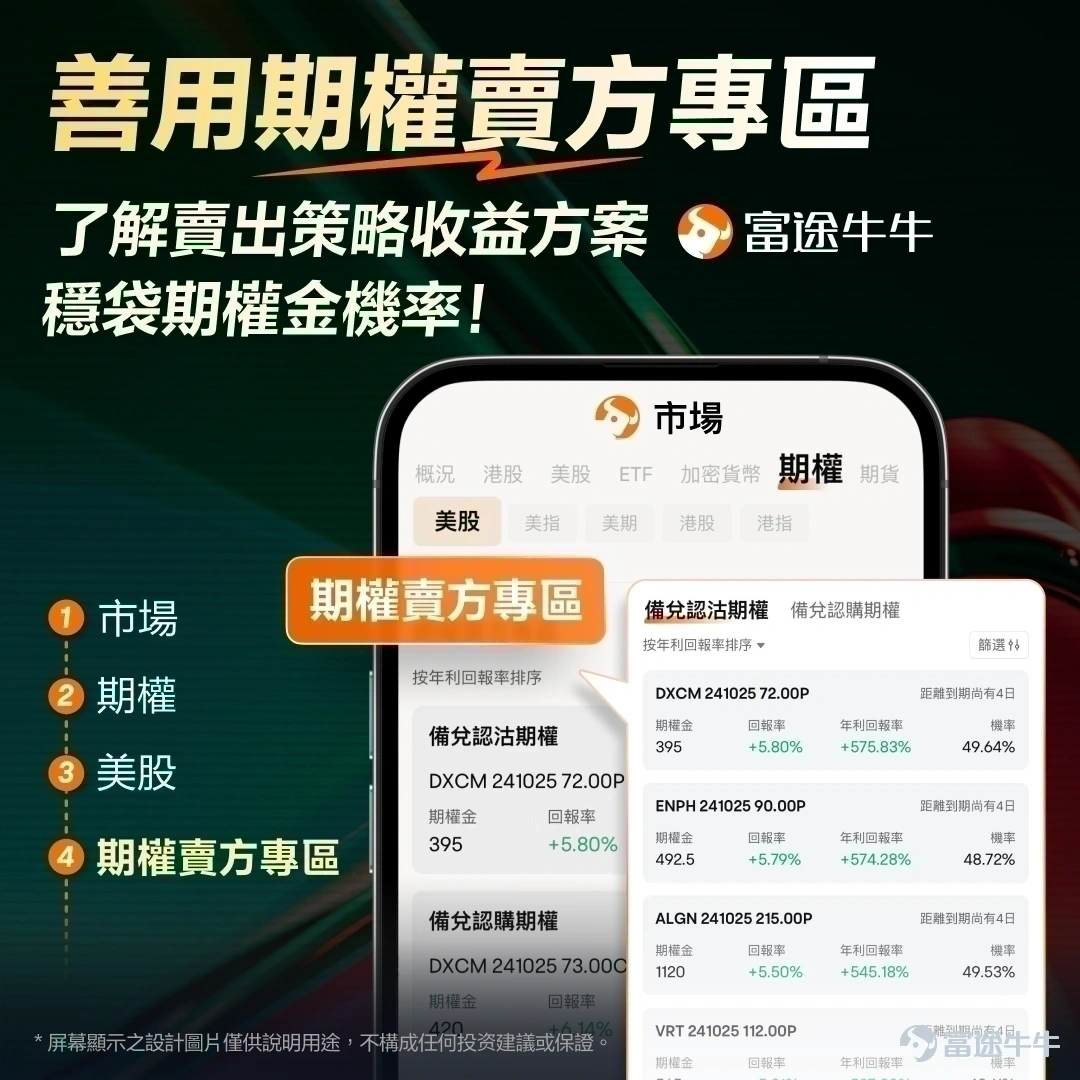
Make good use of the Option Seller Zone to understand income strategies for selling options,and earn option premiums!
Investors can openFutubull >> Market >> Options >> Seller Zone >> Filter, to filter for option underlyings that suit their risk appetite and investment needs.
The screening criteria for the option cases provided in this article are:
Stock Screening: Market Cap > $10 billion; IV > 70%; Total Option Volume > 60,000 contracts
Option Screening: Days to Expiration (DTE) 0-45 days; Probability of OTM > 70%; Return > 2%; Annualized Return > 30%; Volume > 100 contracts
Underlying Selection Rule: Sorted by probability, prioritizing underlying assets with higher probabilities. Probability refers to the likelihood that the sold option contract will not be exercised, i.e., the Out-of-the-Money (OTM) probability. A higher probability indicates a lower chance of being assigned, and thus a greater likelihood of securely collecting the option premium.
All data and information in the Option Seller Zone are for reference only and do not constitute any investment advice.
This content is for reference only and should not be regarded or construed as an offer, solicitation, invitation, or recommendation to buy or sell any investment products, nor as a basis for investment decisions. It should not be interpreted as professional advice. Option contracts are derivative products and are not suitable for all investors. You should carefully assess whether you are suitable for participating in such trading based on your own investment experience, investment objectives, financial resources, and other relevant conditions.
The risk of loss in trading option contracts can be substantial. In certain circumstances, the losses you incur may exceed the initial margin deposited. Even if you have set contingency orders, such as "stop-loss" or "limit" orders, losses may not be avoided. Market conditions may prevent these orders from being executed. You may be required to deposit additional margin within a short period. If you fail to provide the required amount within the specified time, your open positions may be liquidated. However, you will still be liable for any deficit in your account resulting from this. Therefore, before trading, you should study and understand options, and carefully consider whether such trading is suitable for you based on your financial situation and investment objectives. If you trade options, you should be familiar with the procedures for exercising options and at expiration, as well as your rights and obligations upon exercise and at expiration. "Futubull" is a one-stop financial investment and trading platform, with securities services provided by Futu Securities International (Hong Kong) Limited.
Risk Disclaimer: The above content only represents the author's view. It does not represent any position or investment advice of Futu. Futu makes no representation or warranty.Read more


Comments
to post a comment
5
10