NVIDIA appears at Goldman Sachs conference; is its stock poised to hit new highs?

OpenAI and Anthropic achieve successive breakthroughs! Is AI hardware returning to the main trading theme?
There was a prevailing view in the past that as AI models become more powerful and the cost per unit of computing power decreases, demand for AI hardware would eventually peak.
However, recent market trends appear to be breaking this logic.
On September 3, OpenAI launched its next-generation frontier model, GPT-6 Astra. The company claimed significant breakthroughs in areas such as computer operation, software engineering, cybersecurity, and scientific research.NVIDIA CEO Jensen Huang subsequently posted that "AGI has arrived",revealing that Astra's training utilized over 100,000 Grace Blackwell NVLink72 systems, with approximately 400,000 additional GPUs expected to come online sequentially. This sends a strong signal that NVIDIA's computing power supply will further increase.
A day later, Anthropic announced that Claude had completed the first complete formalized computer-verified proof of Fermat's Last Theorem. The model worked continuously for about 11 days, generating over 13 million lines of Lean code.
As AI begins to handle increasingly complex and long-duration tasks, will the demand for computing power decline, or will it instead be reignited?
The market has recently provided partial answers.
1. From NVIDIA to memory and optical communications, AI hardware is regaining strength.
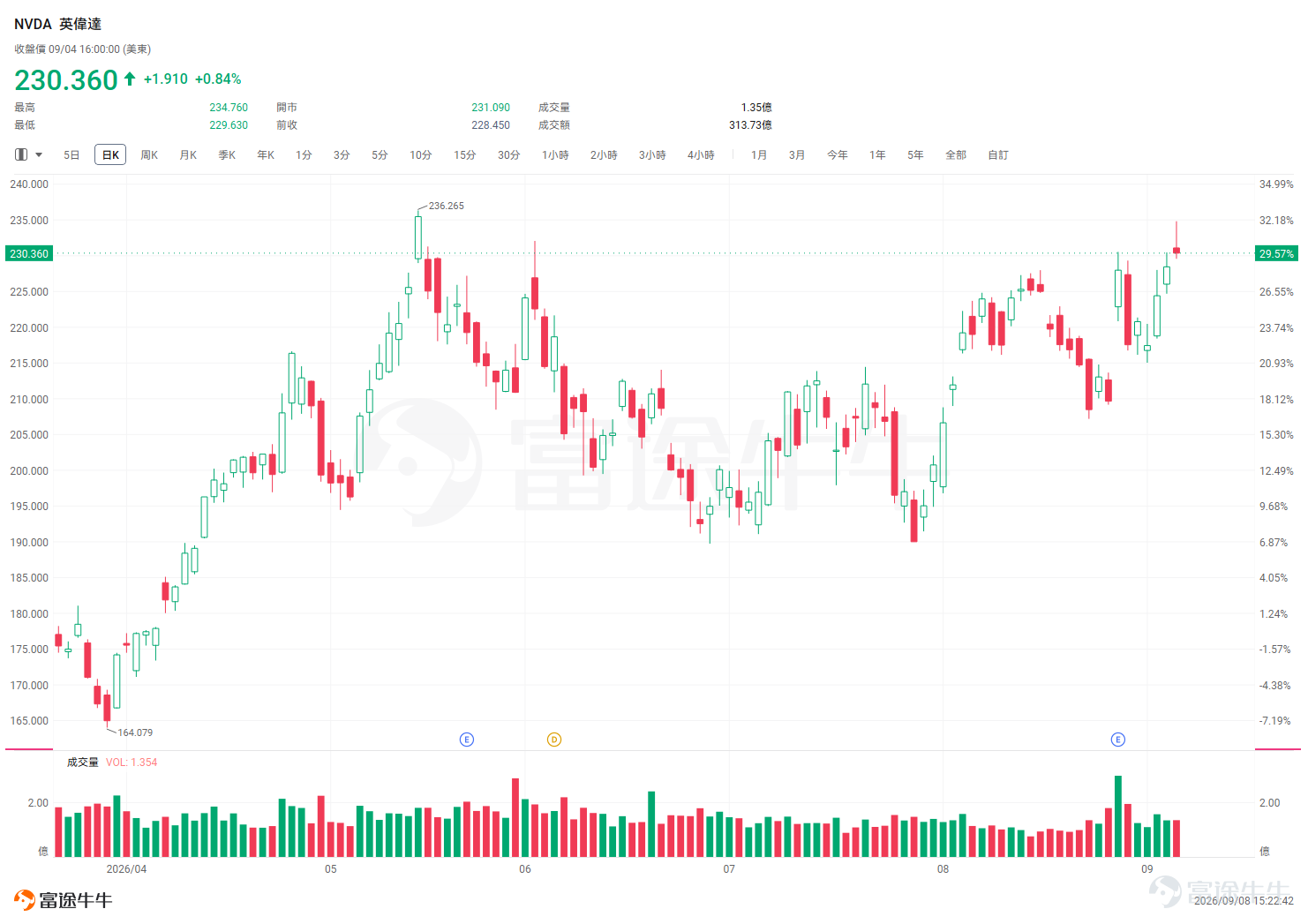
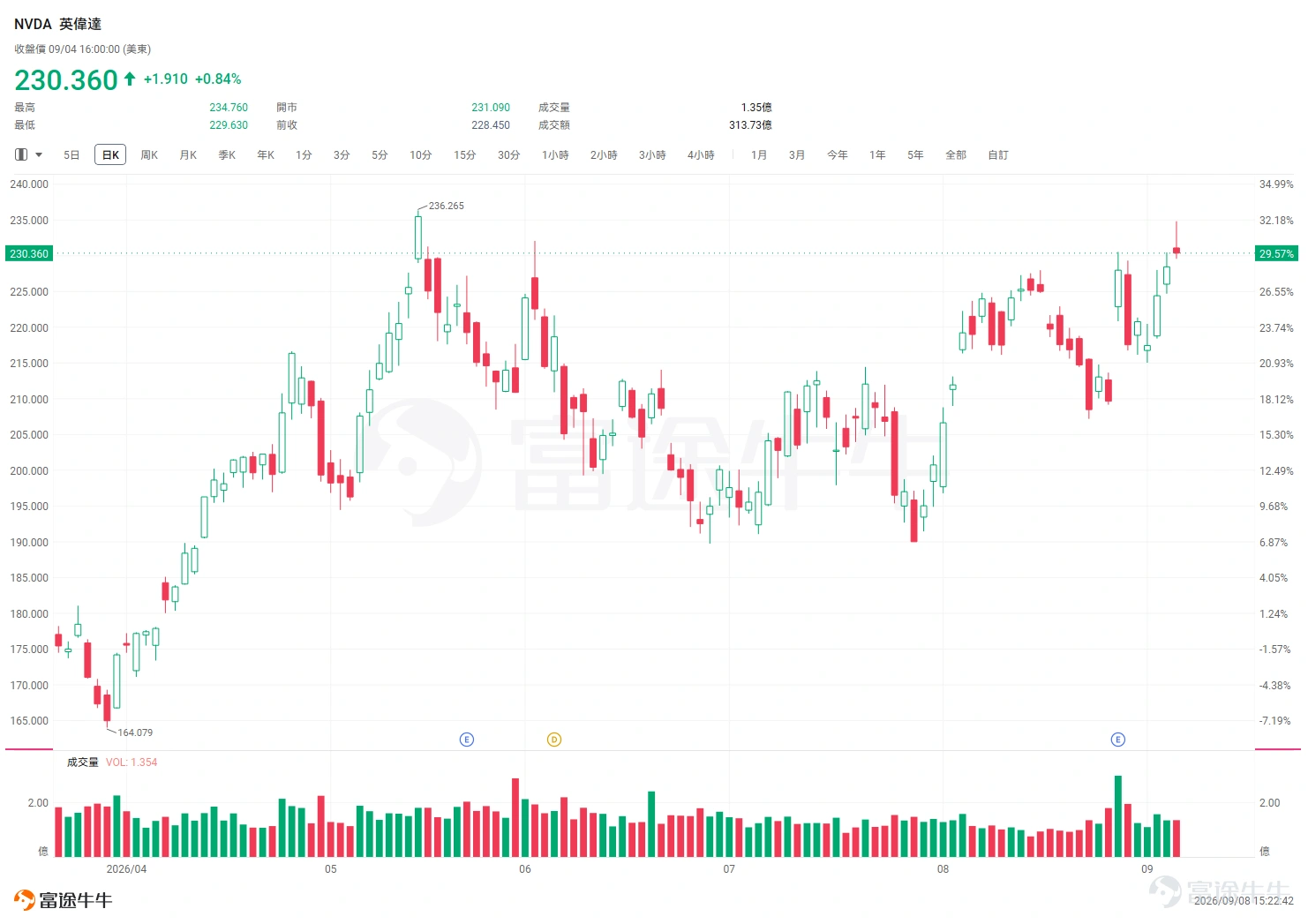
$NVIDIA (NVDA.US)$ NVIDIA is the most direct beneficiary of this rally. On September 4, NVIDIA closed at $230.36, up 0.84% for the day; it had previously risen 3.21% and 1.80% on September 2 and 3, respectively, bringing its stock price back close to its 52-week high.
However, what is more noteworthy about this market rally is not just NVIDIA itself, but the capitalis spreading from the GPU leader to the entire AI infrastructure supply chain.
First isMemory. On September 4, $Micron Technology (MU.US)$ closed up 6.10%, $SanDisk (SNDK.US)$ closed up approximately 11.9%; as AI models continue to evolve towards larger scales and longer context windows, the importance of HBM and high-capacity memory is rapidly increasing.
Next isOptical Communication and High-Speed Networking. On September 4, $Lumentum (LITE.US)$ closed up 4.00%, $Coherent (COHR.US)$ closed up 6.60%. As AI clusters expand from thousands to tens of thousands or even more GPUs, high-speed data transmission between GPUs will become a new bottleneck, making optical communication a critical supporting component for the expansion of AI computing power.
Meanwhile,Neocloud and AI powerare also starting to attract capital attention. On September 4, $CoreWeave (CRWV.US)$ closed up 5.68%, $IREN Ltd (IREN.US)$ closed up 7.27%; $Bloom Energy (BE.US)$ while the latter closed up 7.35%. The former benefited from demand for AI computing power leasing, while the latter corresponds to the increasingly prominent power shortage in AI data centers.
In other words, breakthroughs in model capabilities have not caused computing power demand to peak; instead, they may enable AI to undertake more complex, long-running tasks, further expanding demand for GPUs, memory, optical communication, cloud computing power, and electricity.
2. Why does a stronger model lead the market to buy more GPUs, memory, and optical communication equipment?
The core reason lies in the following:AI is shifting from "model training" to "continuous inference."
In the past, discussions on AI computing power focused more on how many GPUs were needed to train a larger model. But now,AI is beginning to enter the realms of inference, agents, and complex tasks that run autonomously for extended periods.
Anthropic's recent case involving Fermat's Last Theorem is a typical example. Claude did not generate the answer in a single pass; instead, it worked continuously for 11 days, leveraging multi-agent collaboration to complete complex mathematical formalization tasks.
This means that future compute demand cannot be evaluated solely based on single-inference costs, but must consideruser volume, task complexity, token consumption, and runtime. Even if the cost per token continues to decline, overall inference demand may still keep growing as long as AI can handle more numerous and complex tasks.
Anthropic's recent aggressive moves to secure compute resources further corroborate this trend. According to Reuters, as demand for Claude grows rapidly, Anthropic is actively locking in large-scale computing resources and signing major infrastructure agreements with partners such as $Microsoft (MSFT.US)$ 、 $NVIDIA (NVDA.US)$ .
Therefore, the market's subsequent trading logic may revolve around a longer industrial chain narrative:
Breakthroughs in model capabilities → AI handles more complex tasks → Growth in inference demand → Increased GPU demand → Data center expansion → Concurrent benefits for memory, networking, and power sectors.
3. What to watch next? AI demand may extend to memory, connectivity, cloud, and power sectors
If AI models continue to evolve toward larger scales, longer context windows, and complex applications like agents, the growth in compute demand will not be reflected solely in GPUs themselves,Instead, it is gradually transmitting to segments such as memory, network connectivity, cloud computing power, and electricity.
Previously, Niu Niu Jun has also outlined relevant supply chain information in articles multiple times. Interested fellow investors can click the link to view:
Specifically:
First, GPUs and AI servers.
GPUs remain one of the core hardware components of AI infrastructure.
$NVIDIA (NVDA.US)$ NVIDIA holds a significant position in the AI chip market, while server manufacturers like Dell meet the demand for deploying GPUs in data centers. However, what remains to be watched is whether AI capital expenditure can be sustained, and whether GPU supply can match the pace of data center construction.
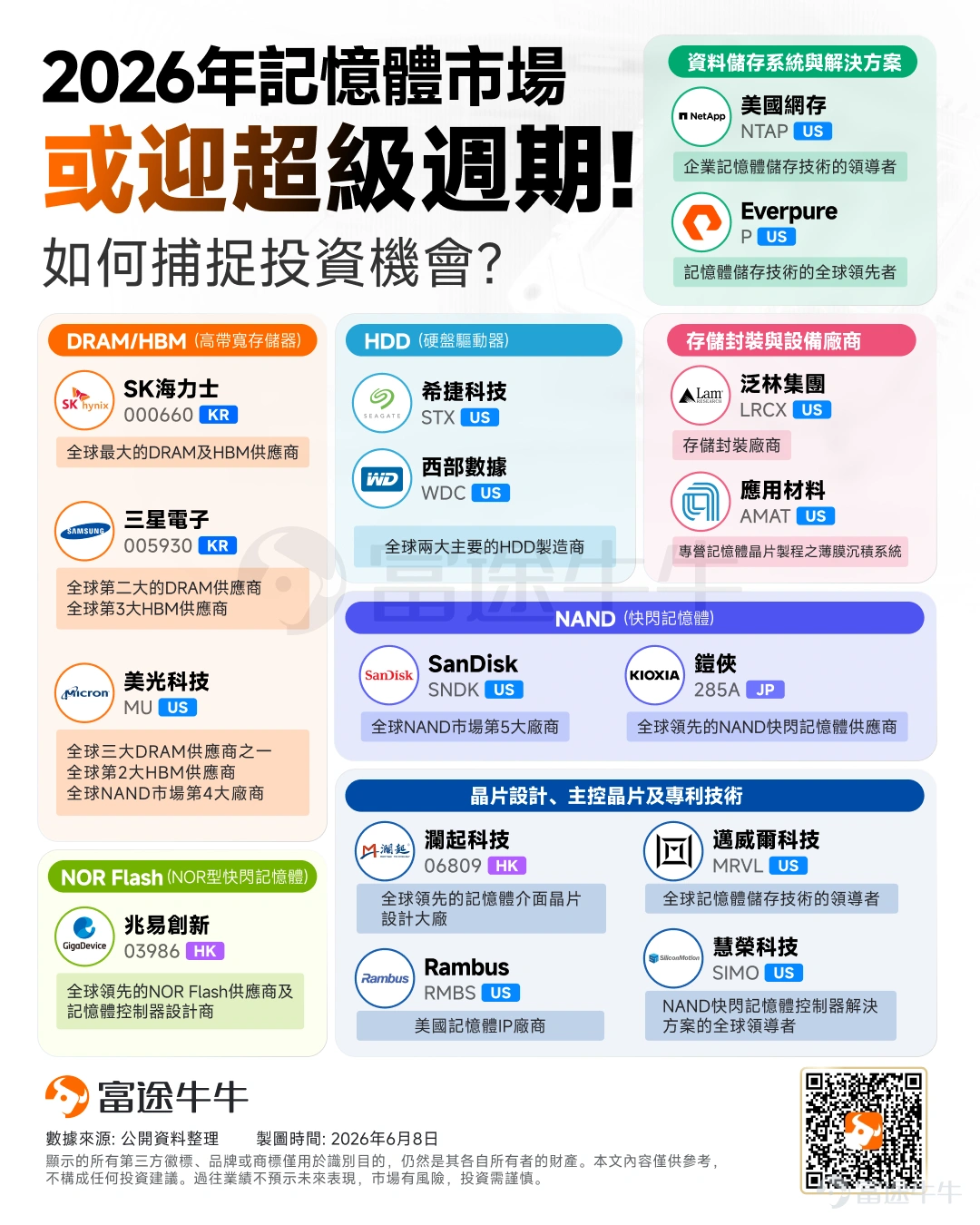
Second, HBM and memory.
As model parameters, context lengths, and AI inference tasks increase, the requirements for memory capacity and bandwidth are also rising, making HBM an important supporting component for high-end AI accelerators.
Therefore, $Micron Technology (MU.US)$ 、 $SK Hynix (000660.KR)$ 、 $Samsung Electronics (005930.KR)$ and $SanDisk (SNDK.US)$ memory manufacturers may continue to be influenced by changes in AI demand. However, memory prices, capacity expansion, and the balance between supply and demand remain important variables affecting related companies.
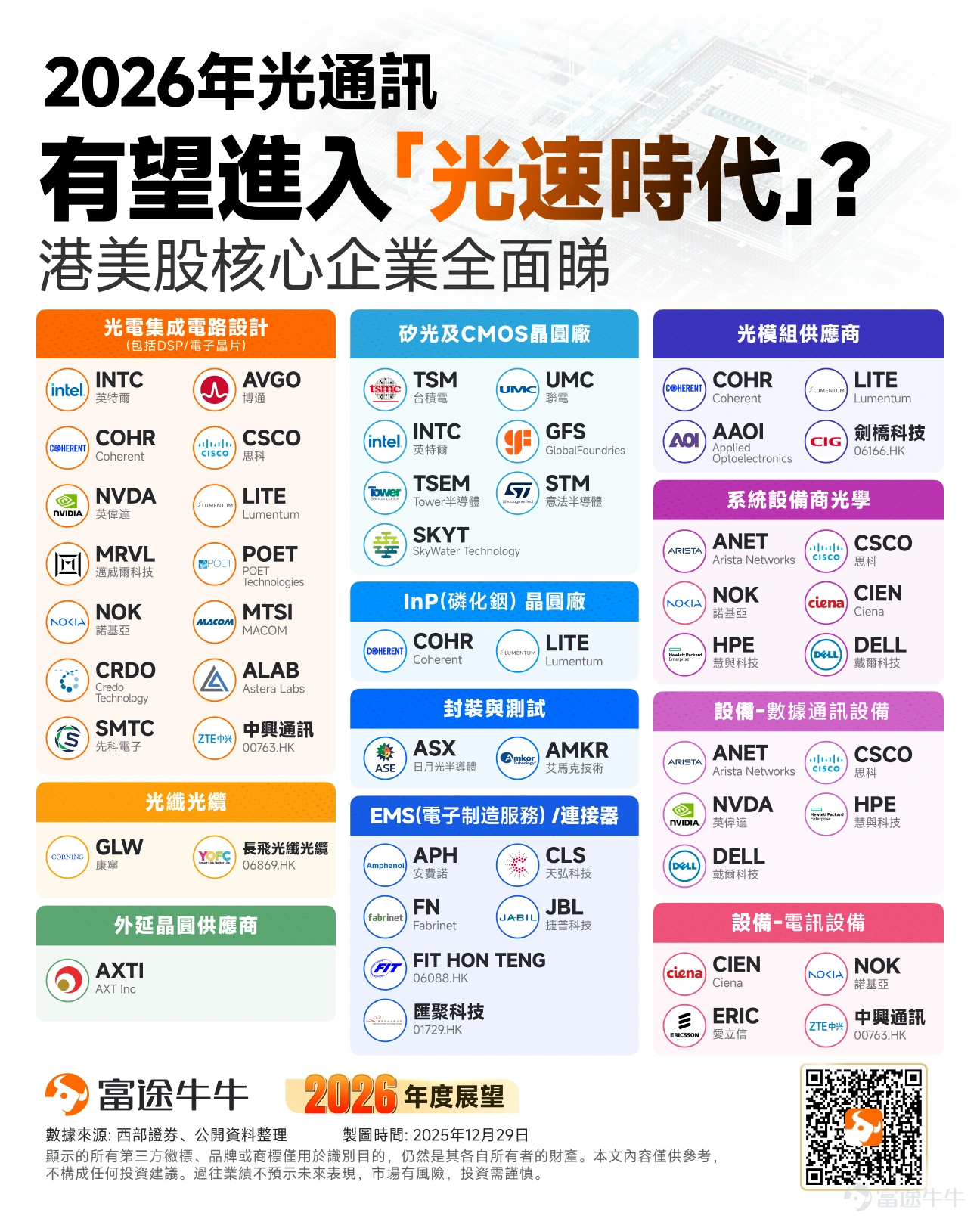
Third, optical communication and high-speed networks.
As the number of GPUs in AI data centers continues to grow, high-speed data transmission between GPUs has become increasingly critical. Technologies such as 800G and 1.6T optical modules, silicon photonics, Co-Packaged Optics (CPO), and high-speed switches are all likely to benefit from the network upgrade demands driven by the expansion of AI clusters.
$Lumentum (LITE.US)$ 、 $Coherent (COHR.US)$ 、 $Arista Networks (ANET.US)$ Companies such as [Name] operate in related segments including optical communications and networking equipment.
--
--
--
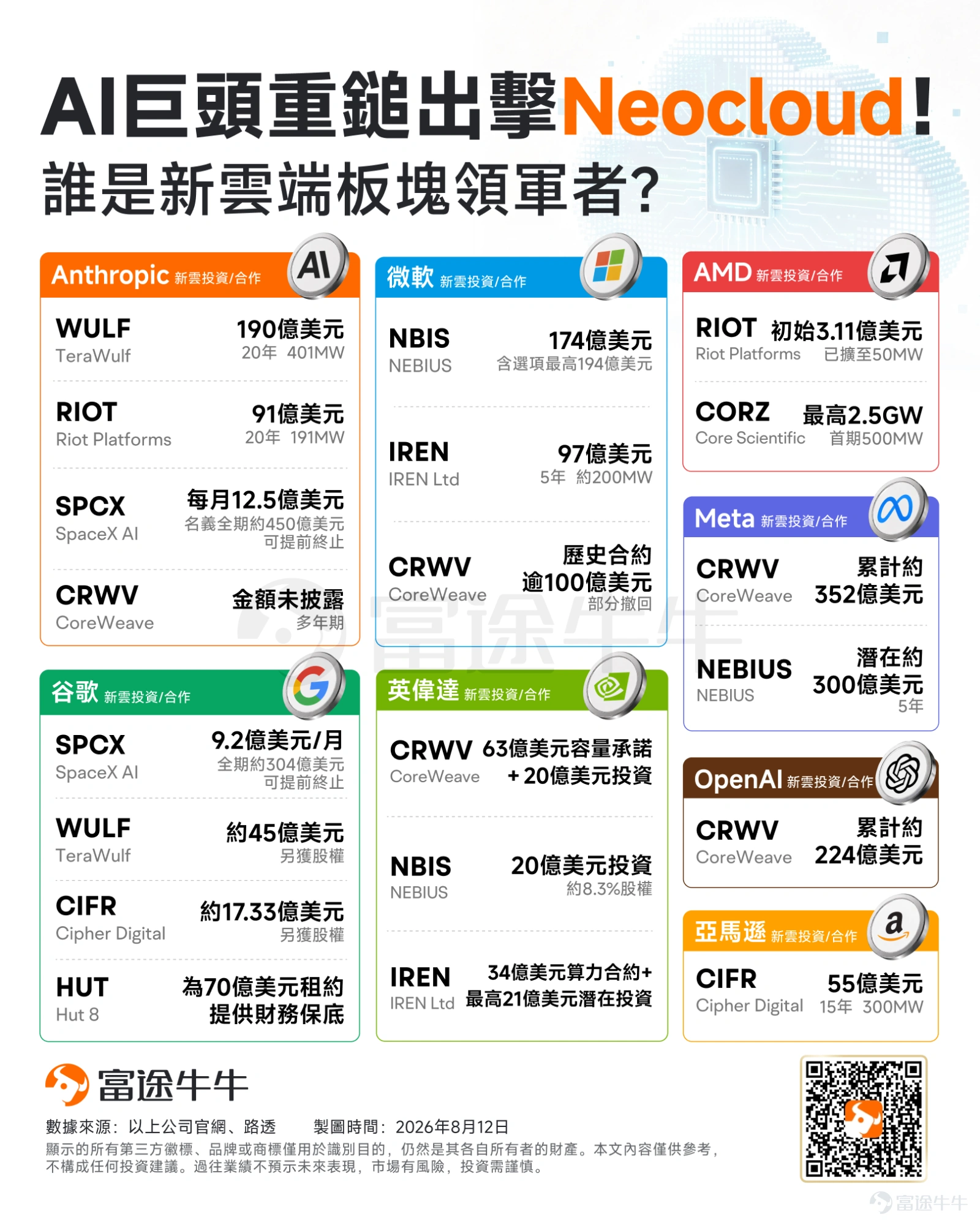
Fourth, Neocloud.
The rapid growth in demand for AI computing power has also opened up new market opportunities for Neocloud.
$CoreWeave (CRWV.US)$ 、 $IREN Ltd (IREN.US)$ Companies such as [Name] have emerged as alternative providers of computing power beyond traditional hyperscale cloud service providers by deploying GPU resources and offering cloud services to AI enterprises. The sustainability of this trend will largely depend on AI companies' demand for computing power, GPU utilization rates, as well as Neocloud's own capital expenditure and financing capabilities.
--
--
--
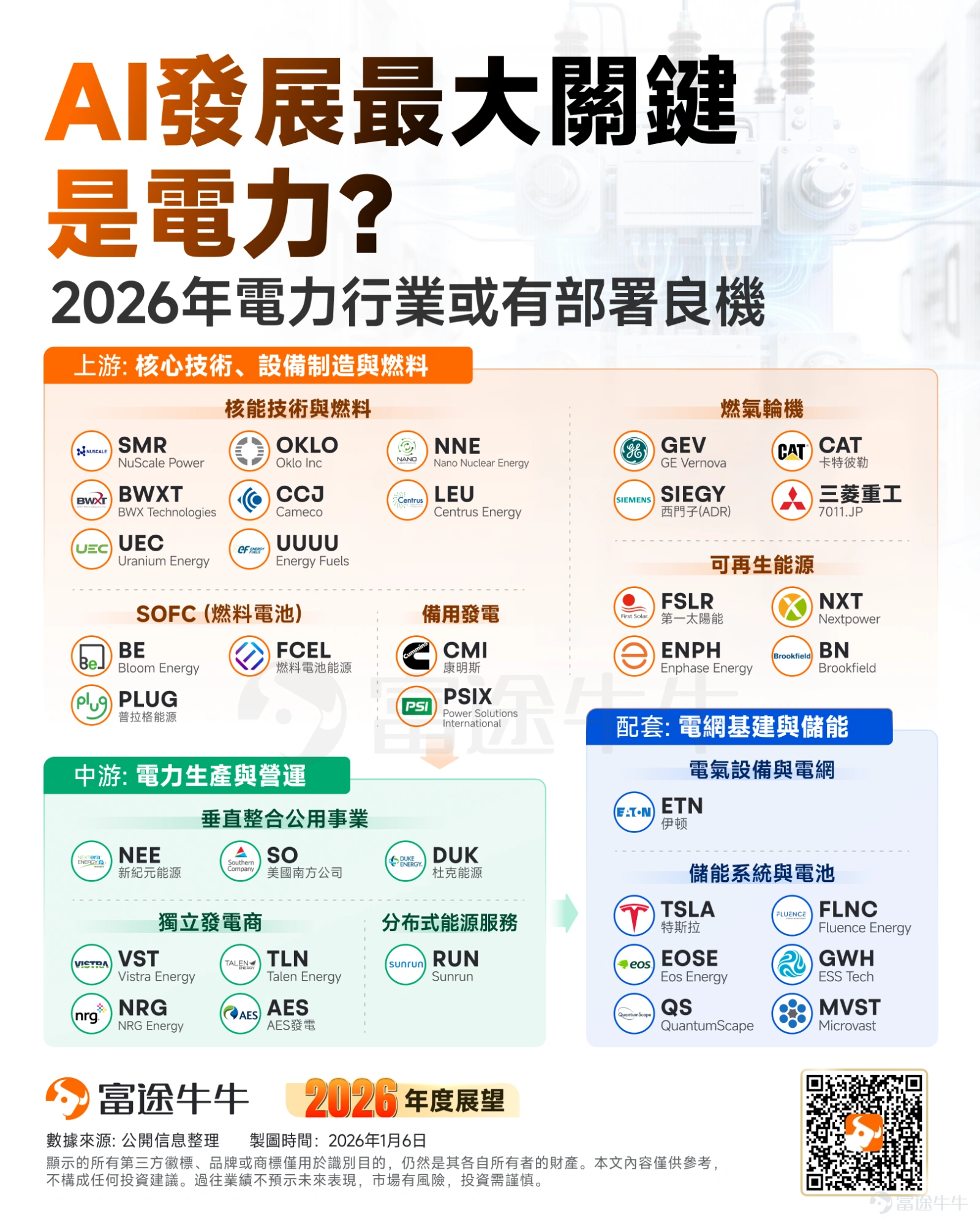
Fifth, Power and Energy.
As the power density of AI data centers continues to rise, power supply is becoming one of the key constraints on data center expansion. In addition to the traditional power grid, solutions such as natural gas power generation, nuclear power, energy storage, and on-site power supply are likely to garner increased attention in the future.
$Bloom Energy (BE.US)$ The recent strength in the stock prices of companies such as [Name] reflects that the market has begun to trade on the theme of power demand for AI data centers. However, whether this ultimate demand can translate into corporate profitability still depends on actual orders and project implementation.
--
--
--
4. Summary: AI Trading May Be Shifting from 'Models' to 'Hardware'
The recent resurgence in the AI hardware sector reflects renewed market focus on how incremental computing demand, following improvements in model capabilities, will transmit through the industrial supply chain.
Demand for AI infrastructure is gradually expanding, spanning GPUs, memory, optical communications, Neocloud, and power supply.
However, breakthroughs in models do not necessarily mean that all hardware demand will grow in sync. We still need to monitor fundamental changes, including AI capital expenditure, supply-demand dynamics, and corporate earnings.
If AI applications continue to expand, hardware demand is expected to extend further across the entire AI infrastructure chain.
Risk Disclaimer: The above content only represents the author's view. It does not represent any position or investment advice of Futu. Futu makes no representation or warranty.Read more


Comments (6)
to post a comment
54
96