
Moonshot AI: The Logic Behind Halved Monthly Active Users and Doubled Revenue
1. Why the halving of monthly active users (MAU) and the doubling of revenue did not stem from the same business line;
2. Four pieces of evidence indicating a shift in the revenue engine to usage-based token pricing;
3. The specific terms and interpretation of licensing royalty clauses built upon open-source weights;
4. The circular valuation issue where three model companies serve as mutual valuation anchors;
5. Comparability risks associated with the Annualized Recurring Revenue (ARR) metric.
I. The Scissors Gap Between MAU and Revenue
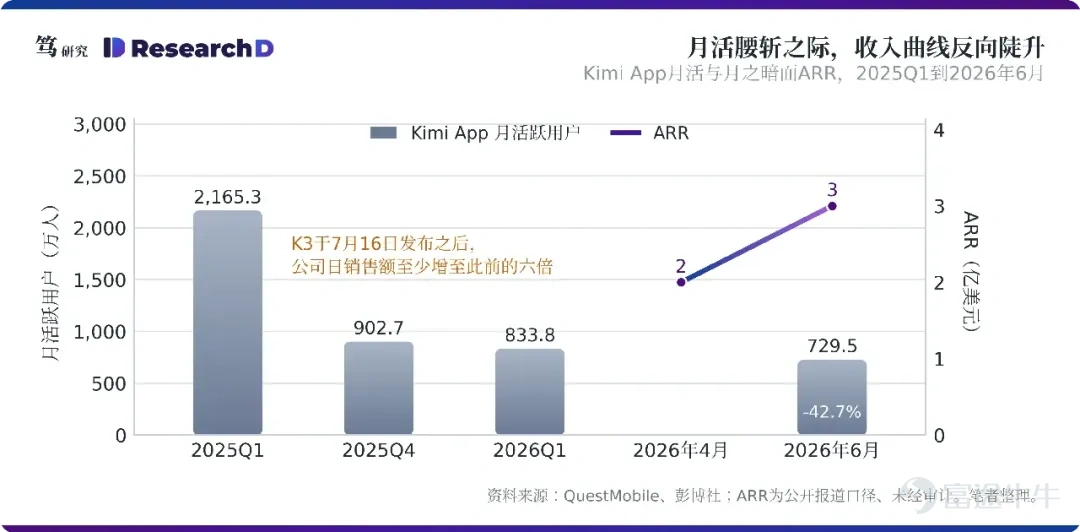
The divergence between MAU and revenue is more extreme than market narratives suggest. According to QuestMobile's H1 2026 ranking of AI-native app user bases, Kimi ranked ninth with 7.2946 million MAU, a year-over-year decline of 42.7%. Looking back, Kimi App's MAU fell from 21.653 million in Q1 2025 to 9.027 million in Q4, and further to 8.338 million in Q1 2026. Compared to the peak of approximately 36 million in October 2024, the drop exceeds 80%.
This decline was by no means accidental but rather the result of a strategic retreat. Kimi's user acquisition spending dropped from approximately RMB 150 million in Q1 2025 to less than RMB 100,000 in Q4. In February 2025, the company removed user growth from its quarterly targets, significantly slashed advertising spend, and halted derivative product lines such as Ohai and Noisee. The decay in MAU reflects a reallocation of resources, not a passive indicator of competitive failure.
Revenue trends during the same period moved in completely opposite directions. According to Bloomberg reports and company disclosures, Moonshot AI's ARR surpassed USD 200 million in April 2026 and reached USD 300 million in June, with API revenue accounting for over 70%. Following the release of K3 on July 16, the company's daily sales volume increased to at least six times its previous level.
This article argues that these two sets of data cannot be explained by the same business model. There is no identifiable causal link between a decaying domestic consumer-facing asset and a steeply rising revenue curve. Valuing both within the framework of a single Chinese AI application company is fundamentally flawed from the outset, causing all subsequent deductions to rest on erroneous analogies.

II. Core Judgment: It is not a transformation toward overseas expansion, but a change in the unit of account.
The core judgment of this article is that Moonshot AI's revenue engine has shifted from domestic consumer subscriptions to programming and agent tokens priced in USD based on usage, with an additional layer of licensing royalties built on top of open-source weights. The following four pieces of evidence are independent but point to the same conclusion.
First is the product structure. Kimi Code currently offers four membership tiers, priced at RMB 49, 99, 199, and 699 per month, respectively. Quotas refresh every seven days starting from the subscription date, do not accumulate if unused, and are subject to a rolling frequency cap every five hours. Once the subscription quota is exhausted, users switch to top-up packages charged based on actual usage, with rates approximating those of the company's open platform API. This is no longer the pricing structure of a subscription business, but rather that of wholesale token sales; the subscription serves merely as a prepaid account, with the true unit of measurement being the token. All four tiers are currently shown as 'waitlisted' on the official page, a detail that will be referenced later in our tracking signals.
Second is geography. According to SimilarWeb data, Kimi's current monthly visits are approximately 33 million, with the China region accounting for over 60%, down from 77% in September 2025. The company's figures are more direct: overseas paying users have grown fourfold, API revenue has increased by 400%, and the product has entered over 200 countries and regions. An internal letter at the end of 2025 also stated that since November 2025, overseas API revenue has quadrupled, with overseas income surpassing domestic income for the first time.
Third is third-party observation on the invocation side. K3 was released on the evening of July 16 and entered OpenRouter's daily top ten list within two days. OpenRouter's analysis of approximately 450 trillion tokens from January to June 2026 shows that DeepSeek's share rose from about 9% to around 18%, with minor discrepancies across different aggregation methods. The token share of Chinese models surpassed that of US models by the end of June; according to Bloomberg data, the ratio in the last week of June was 48% to 20%. The new traffic primarily comes from agent workloads rather than the earlier role-playing traffic. Open-source models are no longer just cheap alternatives but have entered production environments for programming and agents.
Fourth, and the most overlooked aspect, is the licensing layer. The K3 license is not the standard MIT license but a custom license based on the MIT text. Clause 2 stipulates that if the licensee or its affiliates operate a Model-as-a-Service (MaaS) business—providing third parties with model inference or fine-tuning access—and the combined total revenue of the licensee and its affiliates exceeds USD 20 million in any consecutive 12-month period, they must sign a separate agreement with Moonshot AI. Clause 3 requires commercial products with over 100 million monthly active users or monthly revenue exceeding USD 20 million to prominently display 'Kimi K3' in their interface. Clause 4 exempts two scenarios: pure internal use (where the software, its outputs, or underlying capabilities are not provided to third parties) and access via Moonshot AI's official products or its certified inference partners. The open version of Qwen 3.8-Max adopts a highly similar design, raising the threshold to USD 50 million and additionally listing AI office assistants as a trigger condition.
The sharpest aspect of the terms lies in the scope: the trigger line is based on the licensee's total combined revenue, not just revenue related to K3. This means that a cloud provider with annual revenue exceeding USD 20 million falls within the negotiation scope as soon as it begins reselling K3 inference, while the exemption clauses exclude self-built, self-used, and official channel scenarios. The constraints are precisely targeted at resellers and are not universal.
While the royalty split ratio has not been written into any public license text, the existence of such agreements is corroborated: US cloud computing company DigitalOcean has confirmed signing a commercial agreement with Moonshot AI; Chinasoft International's regulatory filing on July 20 disclosed an agreement regarding token revenue sharing and joint innovation cooperation, stipulating proportional sharing, though the specific ratio remains undisclosed.
According to our research, this design segments based on business model rather than user type: developers who deploy and fine-tune independently have zero obligations, whereas cloud providers engaging in large-scale resale of inference must secure a contract first. This is no longer MaaS, but a licensing layer atop open-source weights, with an economic nature closer to intellectual property licensing than cloud services. Since IP licensing and cloud services are fundamentally different asset classes in terms of valuation methods, the practice of using cloud service comparables is invalid from the start.
3. Why Comparable Companies Are Systematically Misaligned: Similarity Exists Only at One Layer
The market currently uses Zhipu and MiniMax as valuation anchors for Moonshot AI. This article argues that the issue lies in the fact that their similarities with Moonshot AI cover only one layer of the business, whereas the incremental growth comes precisely from layers beyond this. The premise for comparable companies to provide valuation insights is that the two businesses are sufficiently close in terms of pricing units, customer structure, cost structure, and revenue extrapolability, such that the market's pricing of one can be extrapolated to the other. If similarity is insufficient, multiples become mere numbers carrying no actionable information.
As broken down in Part II of this report, Moonshot AI’s current revenue consists of three layers: the base layer is wholesale token sales based on volume; the middle layer comprises developers and enterprise clients in overseas programming and agent scenarios; and the top layer involves licensing royalties built upon open-source weights. The economic nature of these three layers differs significantly, as do their cost structures, customer stickiness, and bargaining dynamics. Strictly speaking, this business requires not one but three sets of comparables. Consequently, any multiple derived from a single set of comparables can only reflect the pricing of one layer.
When comparing layer by layer, the correspondence between Zhipu/MiniMax and Moonshot AI holds only at the base layer. All three rely primarily on open platforms and APIs for revenue, price based on tokens, and are in a stage where inference costs account for a high proportion of expenses; thus, similarity at this layer is substantial. However, differences at the middle layer are significant: Moonshot AI’s revenue is concentrated in overseas programming and agent workloads, with customers being developers and enterprises whose payments are driven by workloads rather than seats. In contrast, the open platform revenues of Zhipu and MiniMax are more dispersed across scenarios and regions. As for the top layer, there are no counterparts among the two Hong Kong-listed peers. Licensing royalties are based on open-sourcing weights and resale thresholds, representing per-deal negotiated intellectual property licenses, which are fundamentally different from wholesale token revenue.
Comparables for the middle layer are readily available. Cursor’s scenario, customer base, and pricing model align highly with Moonshot AI’s shifted revenue engine: both focus on programming and agent workloads, serve paying overseas developers and enterprises, charge in USD based on volume, and have costs dominated by inference expenditures. The difference lies in Moonshot AI owning its model weights and occupying a higher position in the value chain, which points to a better cost structure rather than a reason to exclude it from the comparable set. The only remaining grounds for exclusion would be listing jurisdiction and nationality, neither of which affects cash flows. Ranked by business similarity, Cursor is closer than the two Hong Kong-listed peers, yet it has barely been included in domestic comparable sets.
Similarity at the base layer can be empirically verified without relying on analogical inference. Interim disclosures from Zhipu and MiniMax, along with public cost ranges for Cursor, have laid bare the gross margin structure of volume-based revenue. Although their business models, geographies, and development stages differ, their gross margins converge within the same range. This indicates that it is not a transient condition of any single company, but a structural outcome resulting from inference costs accounting for a significant share of revenue.

Based on this, the gross margin for programming and agent tokens generally falls between roughly 20% and 40%, far below the 80%+ typical of the software industry. Since similarity at this layer is established, it proves not that the comparable set was chosen correctly, but that this entire group of companies should not be valued as software firms. Software commands higher revenue multiples because marginal costs are near zero and scale expansion does not lead to proportional cost increases. Once inference costs consume a significant portion of revenue, this premise disappears, causing the reasonable range for multiples to shift downward overall. The economic nature of this business lies between cloud services and resale, rather than between software and platforms. The valuation anchor for cloud services rests on computing power cycles, while for resale it rests on price spreads; neither is related to software. Consequently, the error generated by applying software comparables is significant, not merely a matter of decimal precision.
The approach taken by sell-side analysts further corroborates this view. Following the release of K3, several institutions have downwardly revised the long-term valuation framework for this group of targets, lowering the reference terminal P/E ratio by one tier and adjusting target prices accordingly. Pricing a company based on a terminal P/E ratio four years out implies that there are no sufficiently similar business references in the near term; if usable anchors existed nearby, there would be no need to push the valuation benchmark so far into the future. This is an admission made in technical form.
This leads to the most critical point highlighted in this article: the current set of comparables covers Moonshot AI’s existing stock layer, while its incremental growth mainly comes from the uncovered middle and top layers. The middle layer is expanding rapidly, while the top layer has just begun to land deals individually and remains invisible externally. Using a comparable set that only covers the existing stock layer to price a company whose growth lies elsewhere results in errors not merely in the precision of multiples, but in the fundamental mismatch of the priced asset to the business itself. This holds true regardless of whether the final pricing is overvalued or undervalued.
4. Investment Implications
First, the extrapolatability of revenue stems from scarcity rents, not cost advantages...
Risk Disclaimer: The above content only represents the author's view. It does not represent any position or investment advice of Futu. Futu makes no representation or warranty.Read more
Comments
to post a comment
1