Simultaneous pressure on the Red Sea and the Strait of Hormuz drives international oil prices higher

ETF Battle | Risk-Off Sentiment Heats Up! How to Choose Defensive ETFs?
Tensions between the US and Iran have escalated again, pushing oil prices and bond yields higher in tandem. The main trading theme in global markets has shifted from "chasing growth" back to "risk mitigation."
As of September 2, Brent crude rose to around $95, hitting a high of over one month; the yield on the US 10-year Treasury note briefly climbed to approximately 4.81%, approaching a three-year high. Asian stock markets were generally under pressure, and gold failed to benefit from traditional safe-haven demand, instead falling to a three-week low amid a stronger US dollar and rising real interest rates. The market's current primary concern isGeopolitical conflicts driving up oil prices → renewed inflationary pressures → the Fed needing to maintain tighter monetary policythis chain of events.
For investors, this round of "risk mitigation" does not simply mean buying gold. Different risks require different ETF strategies.
If oil prices continue to rise? The most direct option is crude oil ETFs; for stability, consider energy stocks.
The source of market pressure in this round remains energy.
Renewed clashes between the US and Iran, coupled with market concerns over supply risks in the Strait of Hormuz, have pushed Brent crude prices to a five-week high. As long as the conflict does not significantly cool down, the geopolitical risk premium on crude oil is unlikely to disappear completely in the short term.
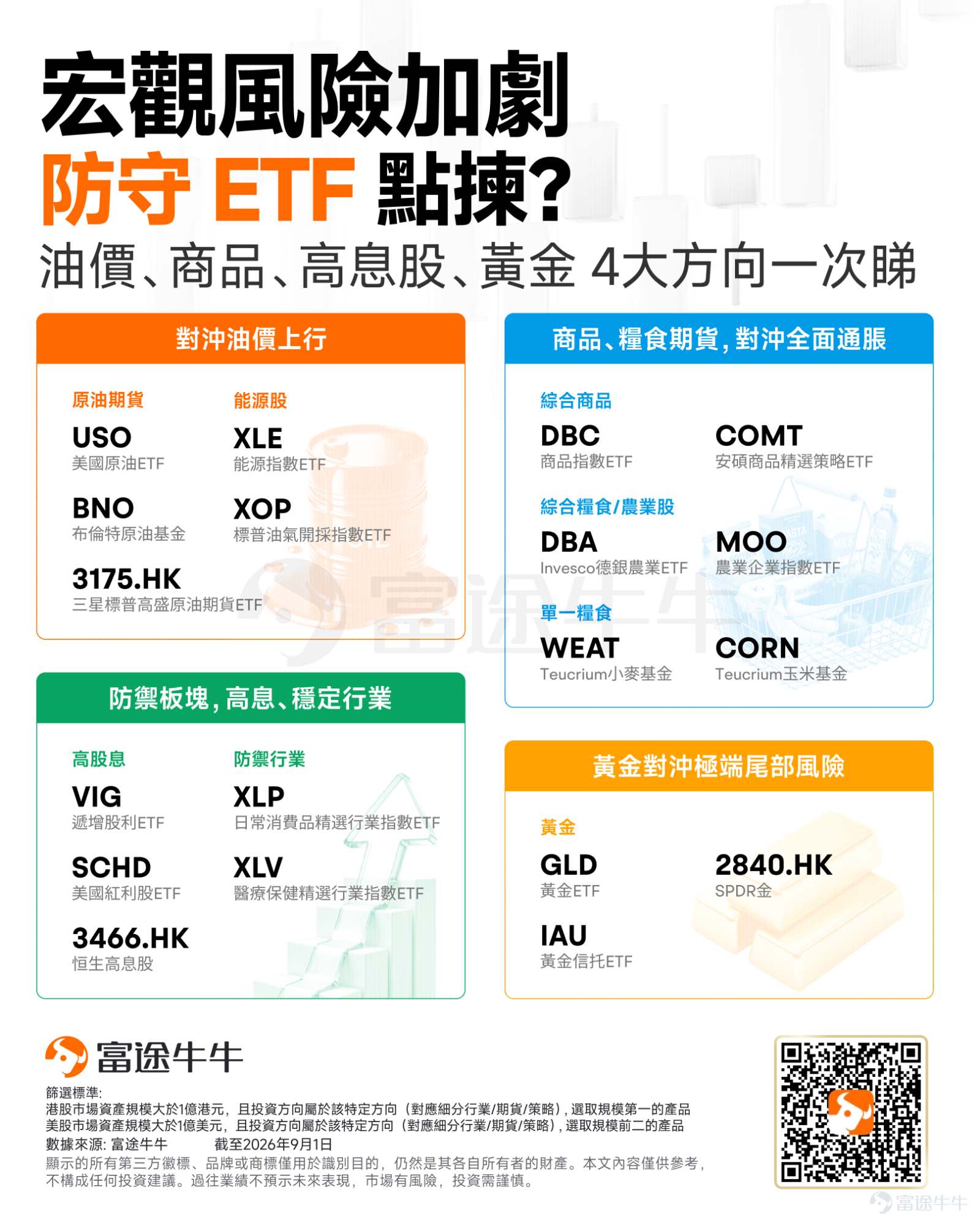
If you wishto directly track oil price fluctuations,US stock investors can consider $United States Oil Fund LP (USO.US)$、 $United Sts Brent Oil Fd Lp Unit (BNO.US)$ ; Hong Kong stocks also offer$Samsung S&P GSCI Crude Oil ER (03175.HK)$. Among them, USO primarily gains crude oil exposure through WTI futures, while 3175.HK is also a futures-based ETF. Note that the fund price may not perfectly synchronize with spot oil prices, and investors should also pay attention to roll costs and changes in the futures curve.
If you prefer to avoid the significant volatility of crude oil futures, consider shifting your focus toenergy sector ETFs. For example, $Energy Select Sector SPDR Fund (XLE.US)$ some tilt towards large integrated energy companies, $SPDR S&P Oil & Gas Exploration & Production ETF (XOP.US)$ while others concentrate on oil and gas exploration and production firms, which typically exhibit higher sensitivity to oil prices.
In simple terms:To bet directly on oil prices, look at crude oil futures ETFs; if you want to balance corporate earnings and shareholder returns, consider energy equity ETFs.

Worried not just about oil prices, but broad-based inflation? Commodities and agriculture ETFs can fill the gap.
If energy prices remain elevated for an extended period, the secondary impact will be rising costs in transportation, fertilizers, and production, which may eventually trickle through to food and other commodities.
In this scenario, rather than betting solely on crude oil, you might also considerbroad commodity ETFs. For example, $Invesco DB Commodity Index Tracking Fund (DBC.US)$ 、 $Ishares Us Etf Trust Commodities Select Strategy (COMT.US)$ , while also covering various commodities such as energy, metals, and agricultural products. Among them, COMT invests in a basket of commodities through a dynamic roll strategy, with its positioning inherently including risk diversification and inflation hedging.
If you wish to more directly capture grain and agricultural product prices, you can keep an eye on $Invesco DB Agriculture Fund (DBA.US)$agricultural ETFs, $Teucrium Wheat Fund ETV (WEAT.US)$wheat funds, $Teucrium Commodity Trust Corn Fd Shs (CORN.US)$corn funds。
However, this round of grain market movements is not driven solely by geopolitical factors.Extreme weather is emerging as the second key theme. High temperatures and drought in Europe have led to continuous downward revisions in corn production forecasts, with the EU's 2026/27 corn output projection dropping to multi-year lows. Corn and soybean producing regions in Northeast China have also been affected by heatwaves and flooding, while India saw 16% less rainfall than normal in August, with September still expected to be drier. Recently, global grain futures prices have shown notable strength.

Another approach is to invest in the agricultural supply chain. For example, $VanEck Agribusiness ETF (MOO.US)$Agriculture Enterprise ETF, which holds global agricultural companies involved in fertilizers, seeds, agricultural machinery, and agro-processing. It does not directly track grain prices, so its short-term explosive potential may not match that of commodity futures, but it is better suited for gaining overall exposure to the agricultural supply chain.
Looking ahead, factors to watch in this direction include not only the conflict itself, but alsowhether oil prices can remain at high levels, whether fertilizer and transportation costs will rise further, and whether food supplies have been substantially disrupted。
As stock market volatility intensifies, the focus for defensive strategies should be on "cash flow," not just high dividends
When the yield on the 10-year US Treasury note rises to near 4.8%, stocks with high valuations and a significant proportion of forward earnings often come under pressure first.
At this stage, if the portfolio still wishes to maintain equity exposure, it could shift moderately from high-volatility growth stocks tostocks with stable earnings and stronger cash flows。
For high-dividend opportunities, keep an eye on $Vanguard Dividend Appreciation ETF (VIG.US)$、 $Schwab US Dividend Equity ETF (SCHD.US)$ , and HK stock investors may also consider $Hang Seng High Dividend 30 Index ETF (03466.HK)$Among them, SCHD considers not only dividends but also corporate fundamentals and dividend sustainability; VIG focuses more on companies with a track record of consistently increasing dividends.

In terms of sectors, $Consumer Staples Select Sector SPDR Fund (XLP.US)$Consumer Staples ETFs, $The Health Care Select Sector SPDR® Fund (XLV.US)$Healthcare ETFsare also typical defensive sectors. Regardless of economic conditions, demand for food, daily necessities, and healthcare remains relatively stable, so earnings volatility is generally lower than in cyclical and high-valuation sectors like technology. XLP covers essential consumer companies in food, beverages, household products, etc.
However, keep in mind:High yields do not guarantee immunity from price declines. When US Treasury yields rise sharply, the risk-free rate itself competes with high-dividend stocks for capital. Therefore, what is truly worth selecting now is a combination of "dividends + earnings quality + cash flow," rather than simply chasing the highest yield.
Gold has fallen this time as well; does it still count as a safe haven?
The most noteworthy point in this market rally isStock markets fell, and gold prices dropped as well.。
The reason is not complicated: geopolitical risks have pushed up oil prices, leading to market concerns about a resurgence in inflation and further tightening by the Federal Reserve. Consequently, US Treasury yields and the US dollar rose simultaneously. Since gold itself does not generate interest, it faces selling pressure in the short term when real interest rates rise rapidly. On September 2, spot gold fell to its lowest level in over three weeks, precisely reflecting this dynamic.
However, this does not mean that gold has lost its safe-haven function.
If subsequent developments includefurther escalation of conflicts, heightened liquidity risks in financial markets, or US Treasury yields peaking and starting to decline,gold's allocation value may re-emerge.
For those looking to allocate via ETFs, keep an eye on $SPDR Gold ETF (GLD.US)$、 $iShares Gold Trust (IAU.US)$ ; there are also options in the Hong Kong stock market, $SPDR Gold Trust (02840.HK)$ with the primary objective of tracking the performance of physical gold prices.
Therefore,Currently, gold is better viewed as "tail-risk insurance" rather than a safe-haven trade guaranteed to rise in the short term.
Niu Niu Tips | Hedging ETFs: First ask yourself what you are hedging against?
The risks in the current market can actually be broken down quite simply:
If you are worried about further rises in oil prices,consider crude oil and energy ETFs;If you are concerned that rising oil prices will lead to broad-based inflation,look into commodities and agriculture ETFs;If you are worried about continued stock market volatility,you can increase exposure to high-quality dividend stocks and defensive sectors;If you are concerned about extreme tail risks arising from geopolitical conflicts,gold can still serve as portfolio insurance.
The two most critical variables ahead are:First, whether the US-Iran situation stabilizes and oil prices pull back;second, this Friday's US non-farm payrolls data. If employment figures remain strong, market expectations for Fed tightening could intensify further, meaning the pressure from high bond yields on equities and gold may not fully ease. Conversely, if the data weakens and bond yields peak, the current risk-off trade could reverse quickly.
Therefore, at this stage, rather than going "all-in" on hedging in one shot, it is more important to first clarify:what your portfolio is truly exposed to: oil prices, inflation, equity market volatility, or extreme tail risks.
Risk Disclosure: ETFs involve risks such as market risk, commodity futures risk, sector concentration, and exchange rate fluctuations. Some commodity and crude oil ETFs involve futures roll-over costs, so their long-term performance may not perfectly track spot prices. Please understand the product structure and associated risks before investing.
Risk Disclaimer: The above content only represents the author's view. It does not represent any position or investment advice of Futu. Futu makes no representation or warranty.Read more


Comments (4)
to post a comment
17
46