US Stock Market Talk | The Fed Resumes Rate Hikes After a Three-Year Pause! Is a New Shift Ahead for

Gold Pullback and Fed Credibility Restoration: Asset Pricing Amid a Rising Central Tendency in Capital Costs
At the Jackson Hole Annual Symposium, Fed Chair Powell's hawkish remarks quickly became the focal point of global markets. The market's most immediate reaction wasa stronger US dollar, a pullback in gold, and a sharp rise in short-term US Treasury yields.rather thanExpectations for a September rate hike also intensified significantly.
However, focusing solely on "whether there will be a 25-basis-point hike in September" may cause investors to miss the more significant implications of this speech.
From the perspective of asset price performance, US equities did not experience panic-driven corrections similar to those in 2022, while long-term US Treasury yields remained relatively restrained. The market does not seem concerned about hawkishness per se:rather, it questions whether the Fed still possesses the ability to stabilize inflation expectations and maintain monetary credibility amid expanding US fiscal deficits, surging AI-related capital expenditures, and a rising central tendency in long-term interest rates.
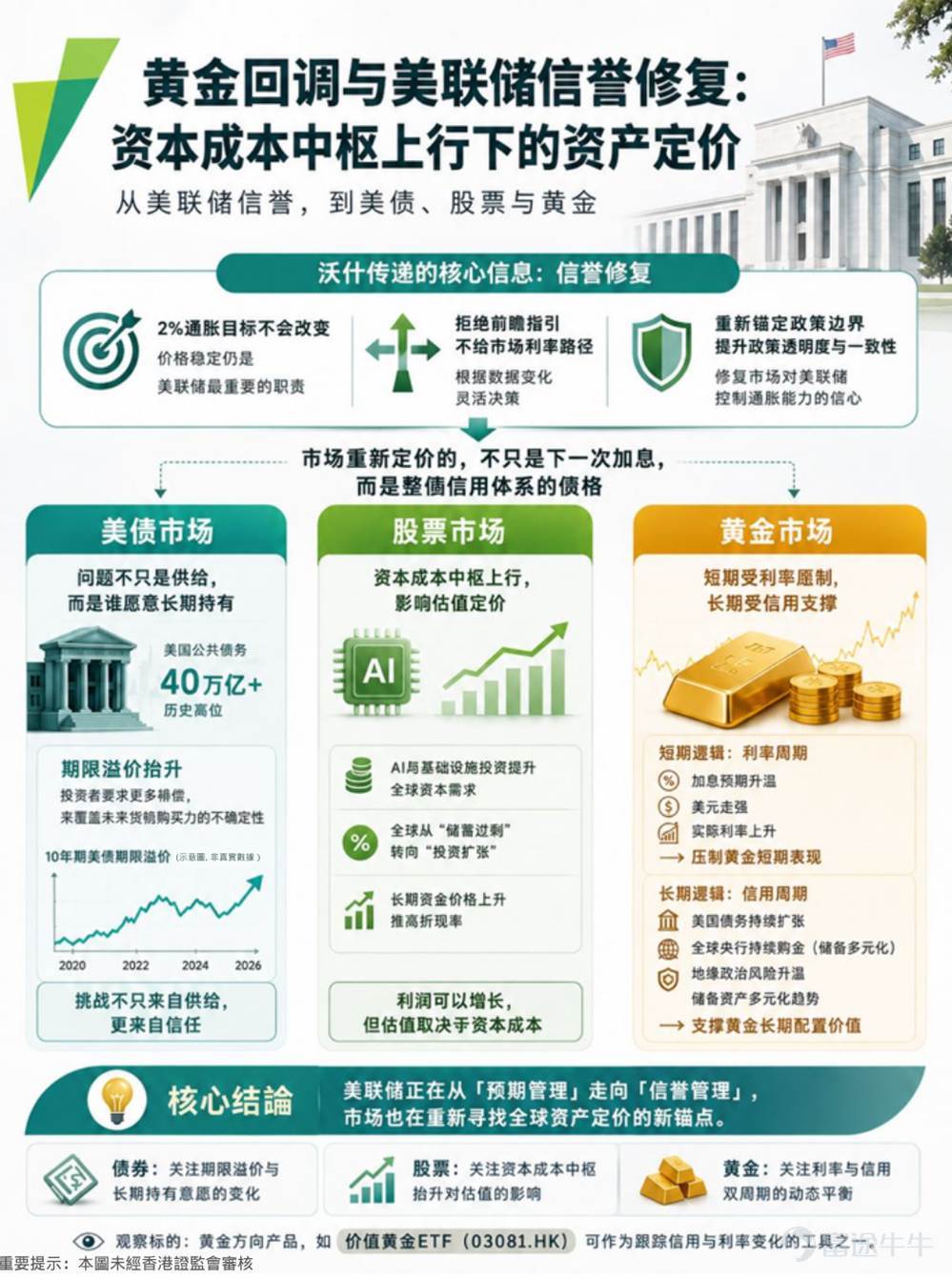
In other words, what the market is repricing may not be the next rate hike, but rather the pricing of the entire credit system.

🛡️ The market may be pricing not a rate hike, but Fed credibility
The most closely watched part of Waller's speech was his renewed emphasis that the 2% inflation target will not change, clearly stating thatprice stability remains the Fed's most important current mandate.。
On the surface, this appeared to be a typical hawkish stance. However, the market's reaction revealed more. Following the speech,short-end rates rose quickly, while long-end rates did not spiral out of control in tandem, and US equities did not experience heavy selling.This indicates that investors are no longer focused solely on interest rate changes, but rather onwhether long-term inflation expectations can be re-anchored.
In fact, the market's biggest confusion over the past few months has not been whether the Fed is leaning hawkish or dovish, but rather the increasing difficulty in gauging the boundaries of its policy. Since taking office, Waller has consistently emphasized reducing forward guidance and downplaying the market's reliance on the interest rate path. While this approach has enhanced policy flexibility, it has also, to some extent, heightened market uncertainty.
For the current market, a single rate hike is not frightening; what is alarming is that policy objectives are becoming increasingly blurred.
🏦 The issues with US Treasuries may not stem entirely from supply.
Recently, the $40 trillion scale of US debt has become a focal point of market discussion. Many analysts believe that,The root cause of the sustained rise in US Treasury yields lies in the widening fiscal deficit and the increased supply of government bonds.
However, if we continue to extrapolate along this line of reasoning, we find the logic incomplete.
The deterioration of US fiscal conditions did not begin recently, nor is the massive debt burden a new problem that emerged suddenly.If supply were the sole driver, the rise in long-end rates should have been a long-term and steady process, rather than accelerating abruptly in the recent period.
What may have truly changed is investors' willingness to hold long-term Treasury bonds.
For capital allocated to 10-, 20-, or even 30-year Treasury bonds, the core risk is not an economic slowdown in the coming quarters, but rather the inflation trajectory over the next decade or longer.
If investors believe the Federal Reserve can control inflation, current yields are already attractive;
but if they begin to doubt the central bank’s long-term commitment, they will not readily increase allocations even as interest rates rise.
Therefore, the most noteworthy change in the US Treasury market recently is not the level of interest rates themselves, but the rise in term premiums.
The market is beginning to demand greater compensation to cover uncertainties regarding future purchasing power.
From this perspective, the challenge facing the US Treasury market is not just supply pressure, but a crisis of confidence.
🏆 From Expectations Management to Credibility Management
Over the past fifteen years, one of the Federal Reserve’s most important innovations has beenPreliminary Guidance。
During the eras of Bernanke, Yellen, and Powell, the market gradually became accustomed to forecasting market movements by studying the Federal Reserve. Investors not only analyzed economic data itself but also focused on how the central bank would interpret such data.
This mechanism effectively reduced volatility and helped risk assets enjoy a long-term stable liquidity environment.
However, Waller appears to want to change this pattern.
In his speech,he reiterated that he would not provide a specific interest rate path to the market, but would instead make decisions based on changes in economic data.。He argued that if the market becomes overly reliant on central bank guidance, and the central bank becomes overly reliant on market feedback, it could easily lead to the so-called "hall of mirrors" effect, thereby amplifying policy errors.
The issue is that when the central bank reduces forward guidance, the market's focus on its policy principles tends to increase further.
For this reason, the significance of Waller's speech lies less in being more hawkish and more in being clearer. He re-emphasized policy responsibilities, inflation targets, and decision-making principles, allowing the market to once again see the boundaries of the Federal Reserve.
This is essentially an exercise in credibility repair.
A clear but restrained hawkish stance is better than a vague and wavering dovish one.
📉 The decline in gold prices is not solely due to expectations of rate hikes
Following Waller's remarks, gold became one of the most volatile assets.
The market typically views gold as a beneficiary of rate-cut trades, so many investors naturally attribute the recent decline to rising expectations of rate hikes.
However, relying solely on interest rates to explain gold's performance makes it increasingly difficult to account for its persistent record highs in recent years.
This is because gold is not fundamentally an interest-rate asset, but rather a credit asset.
Investors hold gold not for cash flow, but as a store of value independent of any sovereign credit. When the market believes the U.S. dollar system can maintain long-term stability, gold's appeal diminishes; conversely, when concerns arise about currency purchasing power, fiscal deficits, or sovereign credit issues, gold commands an additional premium.
From this perspective, the most significant impact of Waller's speech was not raising interest rate expectations, but rather restoring some market confidence in the Federal Reserve's ability to control inflation.
Improved expectations for U.S. dollar credit naturally weaken the short-term safe-haven demand for gold.
🔒 Waller may be able to suppress gold prices, but not necessarily reverse the broader trend.
Nevertheless, this does not mean that the long-term thesis for gold has changed.
Taking a longer-term view reveals that gold is currently pricing in two completely different logics.
The first logic stems from monetary policy.
Rising real interest rates and a strengthening US dollarandExpectations of interest rate hikes are intensifyingboth exert downward pressure on gold.
The second line of reasoning stems from the credit system.
The continuous expansion of US debt, the ongoing trend of global central banks purchasing gold, shifts in the geopolitical landscape, and the diversification of reserve assets are allcontinuously reinforcing gold's strategic allocation value.。
The sustained rally in gold over the past few years has largely been driven by the dominance of this second logic.
Therefore, even if Warsh's hawkish stance compresses gold's short-term risk premium, it may not necessarily alter the long-term strategic demand for gold.
Interest rate cycles influence gold's short-term price movements, while credit cycles determine its long-term trend.
Warsh can influence the interest rate cycle, but he may not be able to change the long-term direction of global credit revaluation.
Conclusion
Many investors view the Jackson Hole speech as a rehearsal for a September rate hike, but the deeper issue is that the Federal Reserve is attempting to shift from "expectations management" to "credibility management," while the market is searching for a new anchor for global asset pricing.
Investment inbond marketFor the US Treasury market, the question is no longer just about how much debt the US needs to issue, but rather who is willing to hold these bonds over the long term;Equity MarketsFor the AI sector, the key issue is not merely how much profit AI can generate, but rather at what cost of capital these profits should be valued; and forthe gold market,the core contradiction is no longer just about rate hikes versus rate cuts, but rather global investors' long-term assessment of monetary credibility.
From this perspective, the ongoing observational value of gold lies not only in its short-term price fluctuations, but in how it continuously reflects changes in interest rates, credit conditions, and the global asset pricing framework. Products such as $Value Gold ETF (03081.HK)$ gold-linked instruments serve as relatively direct proxies for tracking shifts along this main theme.
Sources: August 28, 2026, speech by Federal Reserve Chair Kevin Warsh at the Jackson Hole Annual Symposium; August 28–31, 2026, market reports from Reuters and CNBC on the US dollar, gold, US Treasury yields, and CME FedWatch interest rate expectations; August 28, 2026, US Treasury "Debt to the Penny" data, with total US federal debt at approximately $40.10 trillion; August 3, 2026, US Treasury estimates for marketable borrowing in Q3; August 2026, New York Fed Treasury Term Premia data; July 30, 2026, World Gold Council "Gold Demand Trends Q2 2026"
Disclaimer
· The above content is provided for reference purposes only and does not constitute, nor should it be construed as, an offer, solicitation, or recommendation to buy or sell any securities, investment products, or funds. This content is intended solely for persons in jurisdictions where the distribution or provision of such content is lawful. By accessing this content, you represent and warrant that the applicable laws and regulations of your jurisdiction permit you to do so.
· Investment involves risk. Past performance is not indicative of future results. The price of fund units/shares may go up or down, and past fund performance does not guarantee future returns. Investors should refer to the relevant fund prospectus for details and risk factors. Investors may not recover the full amount of their initial investment. The value of investments and any income derived from them (if any) may be volatile and subject to significant fluctuations over short periods.
The data and information used in preparing the above content were obtained by Value Partners Fund Management (Hong Kong) Limited ("Value Partners") from sources believed to be reliable. However, no representation or warranty is made as to the accuracy or completeness of any third-party data. Any forecasts or other forward-looking statements regarding future events or performance of countries, markets, or companies are not necessarily indicative and may differ materially from actual events or outcomes. Value Partners shall not be liable for any losses incurred by any person acting upon the information contained herein.
No person may reproduce or use the above content, including but not limited to text, images, audio, and video, for any public or commercial purpose without the prior permission of Value Partners. Any modification or use of the above content may infringe upon copyrights and/or intellectual property rights held by Value Partners, where applicable.
· Issued by Value Partners Funds Management Hong Kong Limited and Saxo Asset Management Hong Kong Limited. This content has not been reviewed by the Securities and Futures Commission.
$XAU/USD (XAUUSD.CFD)$ $USD/XAU (USDXAU.CFD)$$Gold (LIST1222.HK)$$Precious Metals (LIST0044.SH)$ $Bitcoin (BTC.CC)$$Ethereum (ETH.CC)$$S&P 500 Index (.SPX.US)$$Nasdaq Composite Index (.IXIC.US)$$NASDAQ 100 Index (.NDX.US)$$Dow Jones Industrial Average (.DJI.US)$$Hang Seng Index (800000.HK)$$Hang Seng TECH Index (800700.HK)$$Hang Seng China Enterprises Index (800100.HK)$$HKEX Tech 100 Index (800666.HK)$$NASDAQ 100 Index (.NDX.US)$$Russell 2000 Index (.RUT.US)$$PHLX Semiconductor Index (.SOX.US)$$U.S. 1-Year Treasury Bills Yield (US12M.BD)$$U.S. 10-Year Treasury Notes Yield (US10Y.BD)$$U.S. 30-Year Treasury Bonds Yield (US30Y.BD)$
Content Disclosure: Personal opinion
Risk Disclaimer: The above content only represents the author's view. It does not represent any position or investment advice of Futu. Futu makes no representation or warranty.Read more


Comments (8)
to post a comment
15
3