The world's first tokenized security IPO is currently open for subscription!

[WEB3.0 Investor Guide] A Comprehensive Overview of Tokenized Funds
As fintech and Real World Assets (RWA) accelerate their integration, traditional asset management is undergoing a foundational infrastructure revolution. Driven by regulatory initiatives from the Securities and Futures Commission (SFC) and the Hong Kong Monetary Authority (HKMA), tokenized funds are gradually entering the mainstream investor landscape, serving as a core bridge between Traditional Finance (TradFi) and Decentralized Finance (DeFi).
1. What is Tokenization?
Tokenization refers to recording and storing the rights or ownership of assets (including financial assets, physical assets, and even intangible assets) as digital tokens on a blockchain, enabling their transfer or trading on the blockchain.
2. What is a Tokenized Class?
A Tokenized Class refers to a distinct share or unit class established within an investment fund under its existing structure. This class converts fund ownership and interests into digital tokens on the blockchain, where each token (or fraction thereof) represents one fund unit in that class, providing investors with digital proof of ownership based on distributed ledger technology.
3. Operational Structure of Tokenized Funds?
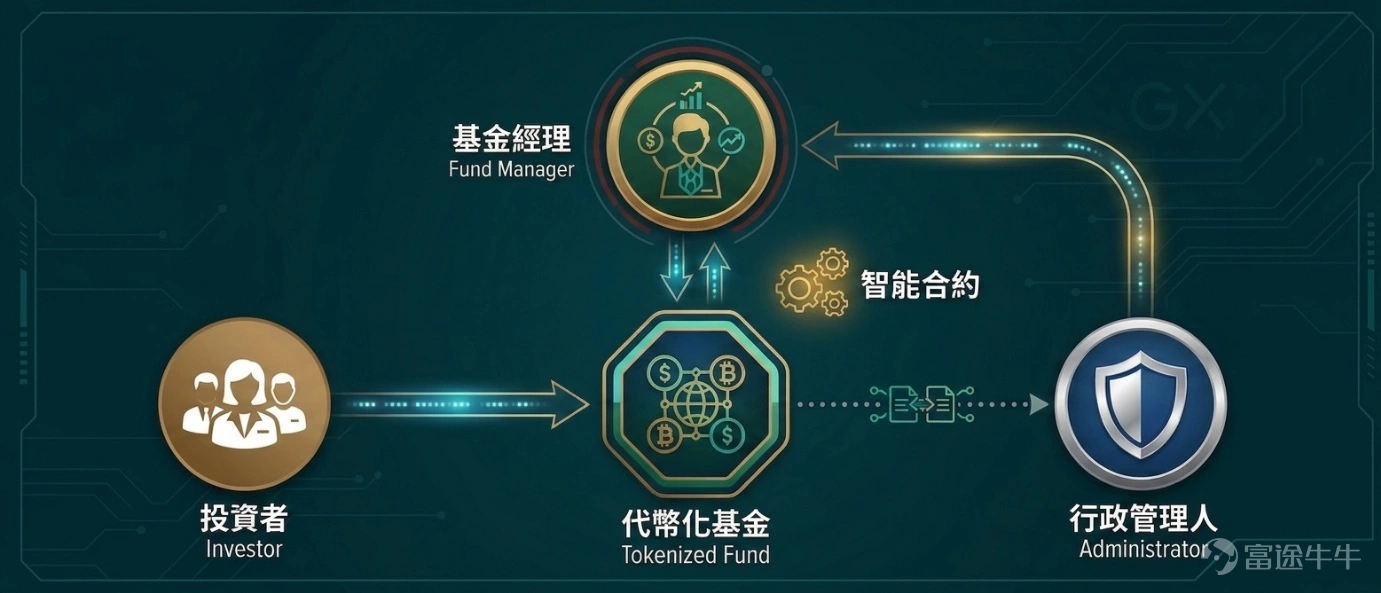
Tokenized funds typically adopt an operational structure that combines "off-chain physical assets" with "on-chain smart contracts":
In terms of operations and record-keeping, the direct register of shareholders maintained off-chain in book-entry form by the transfer agent (i.e., the administrator shown in the diagram) constitutes the formal record of ownership, while digital certificates stored on the blockchain serve as backup records. Despite the use of distributed ledger technology, final settlement (i.e., the point at which a transaction is considered final) still occurs off-chain; in the event of any discrepancies, the off-chain direct register of shareholders maintained by the transfer agent shall prevail. To maintain the licensed structure, tokens are classified as permissioned tokens, implementing signature approval and "whitelist" mechanisms at the smart contract level to authorize only registered wallets and prevent transactions involving unknown parties. Furthermore, tokens can only be minted or burned upon simultaneous instruction from the transfer agent and approval from the manager after consultation with the custodian.
4. What are the potential advantages and risks of tokenized funds?
Potential Advantages
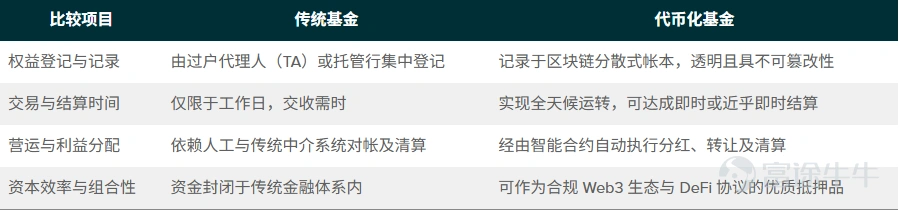
1. Enhance operational efficiency and reduce costs
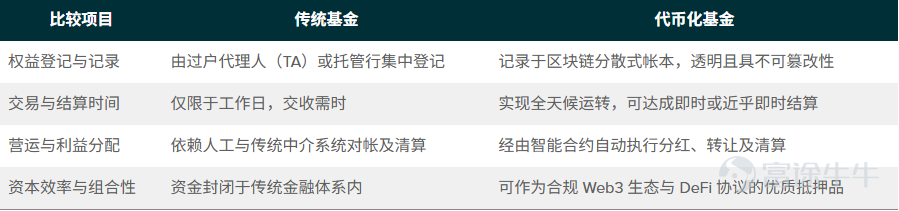
Blockchain technology effectively streamlines fund management and operational processes. By automatically executing predefined terms through smart contracts, it significantly reduces reliance on traditional intermediaries in key areas such as income distribution, fund redemptions, and compliance reviews. This not only prevents human operational errors but also maximizes transaction processing speed and operational efficiency.
2. Enhanced transparency
Blockchain technology grants tokenized funds greater transparency. Every transaction involving tokenized shares is recorded on a distributed ledger, accessible to network participants in real time. This transparent framework helps investors verify the authenticity and historical records of their holdings, substantially reducing the risk of fraud or mismanagement.
3. Improve tradability and liquidity
Tokenized funds have the potential to be listed on virtual asset trading platforms, with the prospect of enabling 24/7 uninterrupted trading in the future. This can significantly enhance asset liquidity, allowing investors to deploy capital and enter or exit the market more flexibly, thereby optimizing tradability.
Potential Risks
1. Underlying risks of blockchain technology
As an emerging technology, blockchain still faces uncertainties such as code security vulnerabilities and network forks, which may impact the stable operation and system compatibility of tokenized funds.
2. Security risks associated with digital assets
If an investor's private keys are lost, stolen, or leaked, it could lead to unauthorized illegal access, or even permanent loss of digital assets, posing significant risks to investor interests.
3. Risks Related to Dependence on Service Providers and Trading Platforms
Tokenized funds rely on various parties (including tokenization service providers, token custodians, and qualified distributors) to maintain the relevant operational infrastructure. If any of these parties cease to provide related services, operations may be adversely affected.
4. Regulatory and Application Challenges of Existing Laws
Regulations regarding blockchain are continuously evolving and developing, which may negatively impact the operations of tokenized funds in managing and offering tokenized shares. Meanwhile, compared with traditional funds and their distribution methods, the processing and recording of tokenized shares differ, which may make resolving issues related to tokenized shares under current laws more complex and difficult.
5. How Are Tokens Stored?
Tokens are stored in "blockchain wallets." A blockchain wallet is typically an application used to safeguard users' "private keys" and associated digital assets, and to execute asset transfers on the blockchain.
For tokenized funds, fund managers generally offer different wallet solutions to accommodate investors' varying needs for secure custody and asset management. These solutions vary in security levels, operational convenience, and investor preferences. The main common types include:
– Custodial Wallet
Provided by licensed third-party custodians, who manage private keys on behalf of investors. This solution is suitable for investors seeking operational simplicity and who do not wish to bear the responsibility of safeguarding private keys themselves.
UnderstoodGlobal X Hang Seng China Enterprises Covered Call Active ETF (3416)Relevant Information and Risk Disclosures:com.hk/zh-hant/...
-
This material is intended solely for Hong Kong investors and is for general market commentary and educational purposes only. It does not constitute a solicitation, offer, or recommendation to buy or sell any securities, virtual assets, or other financial instruments. The information contained herein has been obtained from sources believed to be reliable, but no guarantee is given. Mirae Asset Global Investments (Hong Kong) Limited does not warrant its accuracy or completeness and therefore accepts no liability for any losses arising from the use of this material. Investment involves risks. Past performance is not indicative of future results.
Investing in relevant actively managed covered call ETFs may involve potential risks (where applicable), including active investment management risk, futures contract risk, margin requirement risk, clearing house failure risk, concentration risk, securities lending transaction risk, currency risk, risk associated with capital payment distributions, trading risk, and liquidity risk of over-the-counter call options. Investors should refer to the details, including risk factors, set out in the fund prospectus of the relevant products.
The opinions and data discussed or mentioned herein are current as of the publication date. Certain statements in this content constitute our expectations and forward-looking statements. Such expectations, opinions, and views are based on numerous assumptions that may ultimately not materialize or prove correct, and are subject to change without notice. Investment involves risks. Past performance is not indicative of future results.
There is no guarantee that the fund’s performance will generate returns; it may produce no returns or result in a loss of principal. Investors should read the fund prospectus for details and risk factors before making any investment decision. Investors should ensure they fully understand the risks involved in investing in the fund and consider their own investment objectives and risk tolerance. Independent professional advice should be sought before making any investment. Investors are solely responsible for deciding whether to rely on the information contained herein.
We assume no responsibility for the content or accuracy of any third-party websites linked in this material. You agree that neither we nor any of our affiliates shall be liable for any damages or losses arising out of, or allegedly caused by or connected to, your use of or reliance on the content, products, or services of external websites. Accordingly, we disclaim all liability for linked websites.
This material is issued by Mirae Asset Global Investments (Hong Kong) Limited (licensed by the Securities and Futures Commission for Type 1, 4, and 9 regulated activities under the Securities and Futures Ordinance). This material has not been reviewed or approved by the Hong Kong Securities and Futures Commission or any other applicable regulatory authority in the jurisdiction. No part of this publication may be reproduced in any form or referenced in any other publication without the prior written consent of Mirae Asset Global Investments (Hong Kong) Limited.
Copyright ©️2026 Mirae Asset Global Investments. All rights reserved.
Risk Disclaimer: The above content only represents the author's view. It does not represent any position or investment advice of Futu. Futu makes no representation or warranty.Read more

Comments
to post a comment
1
1