HBM shortages drive up chip prices: Is the memory supercycle continuing?

Major reshuffle in the MSCI USA Index! SanDisk added. What signals does this adjustment send?
As the market approached the close on August 31, a highly representative scene unfolded in the US stock market.
$SanDisk (SNDK.US)$ During the session, the price dipped to a low of $1,449.50, falling more than 2% from the previous close at one point. However, it surged sharply in the final minutes, closing at $1,566.70, up 5.5% and near the day's high.Meanwhile, trading volume rapidly expanded to 23.3788 million shares, nearly triple that of the previous trading day.
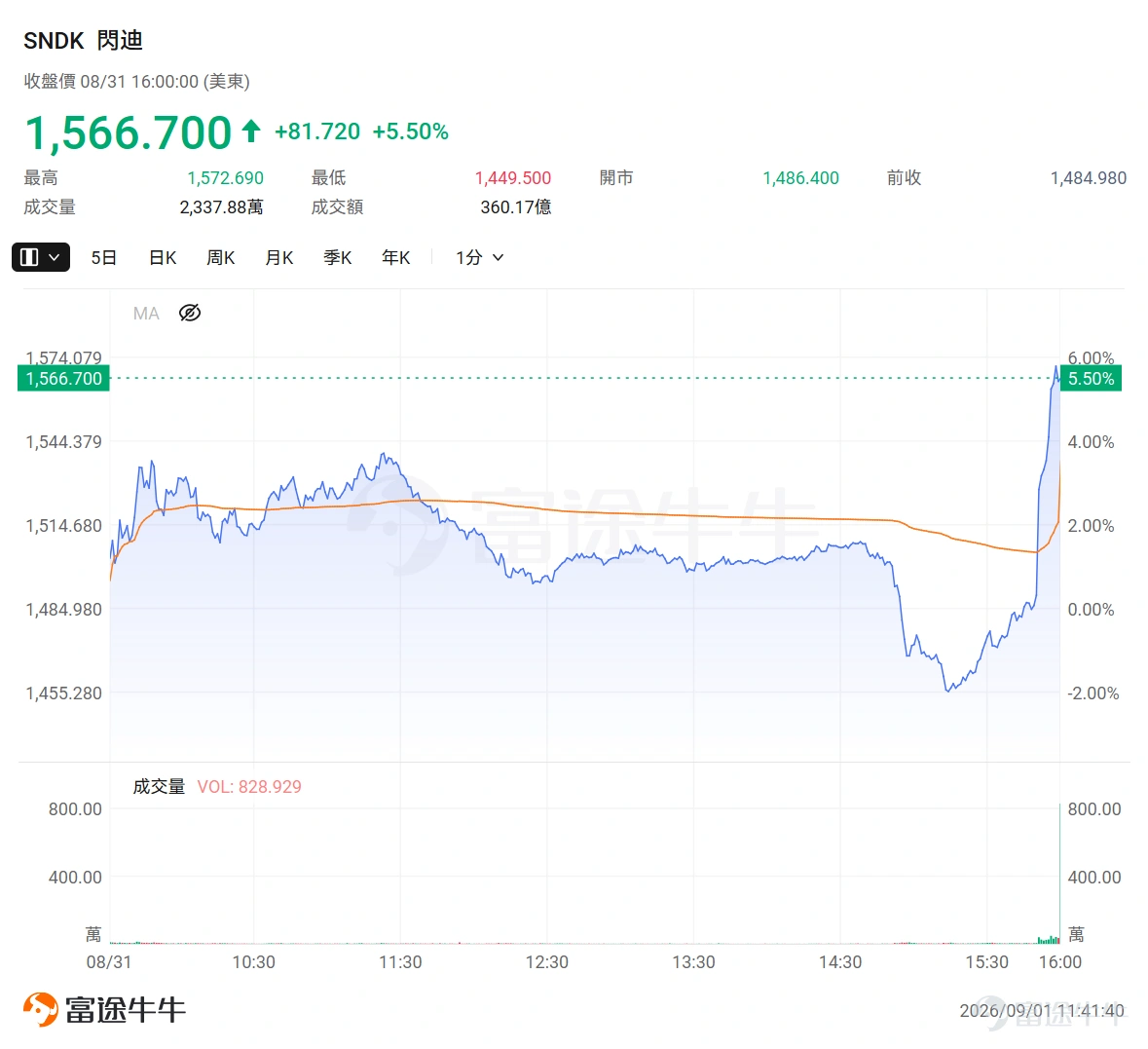
Such a steep late-session rally clearly does not reflect any sudden major changes in NAND prices or the company's fundamentals; it is more indicative of capital flow impact from index funds completing their position building during the closing phase. SanDisk was merely the most prominent stock in this round of MSCI adjustments.
MSCI USA Standard Index: 6 additions, 18 deletions
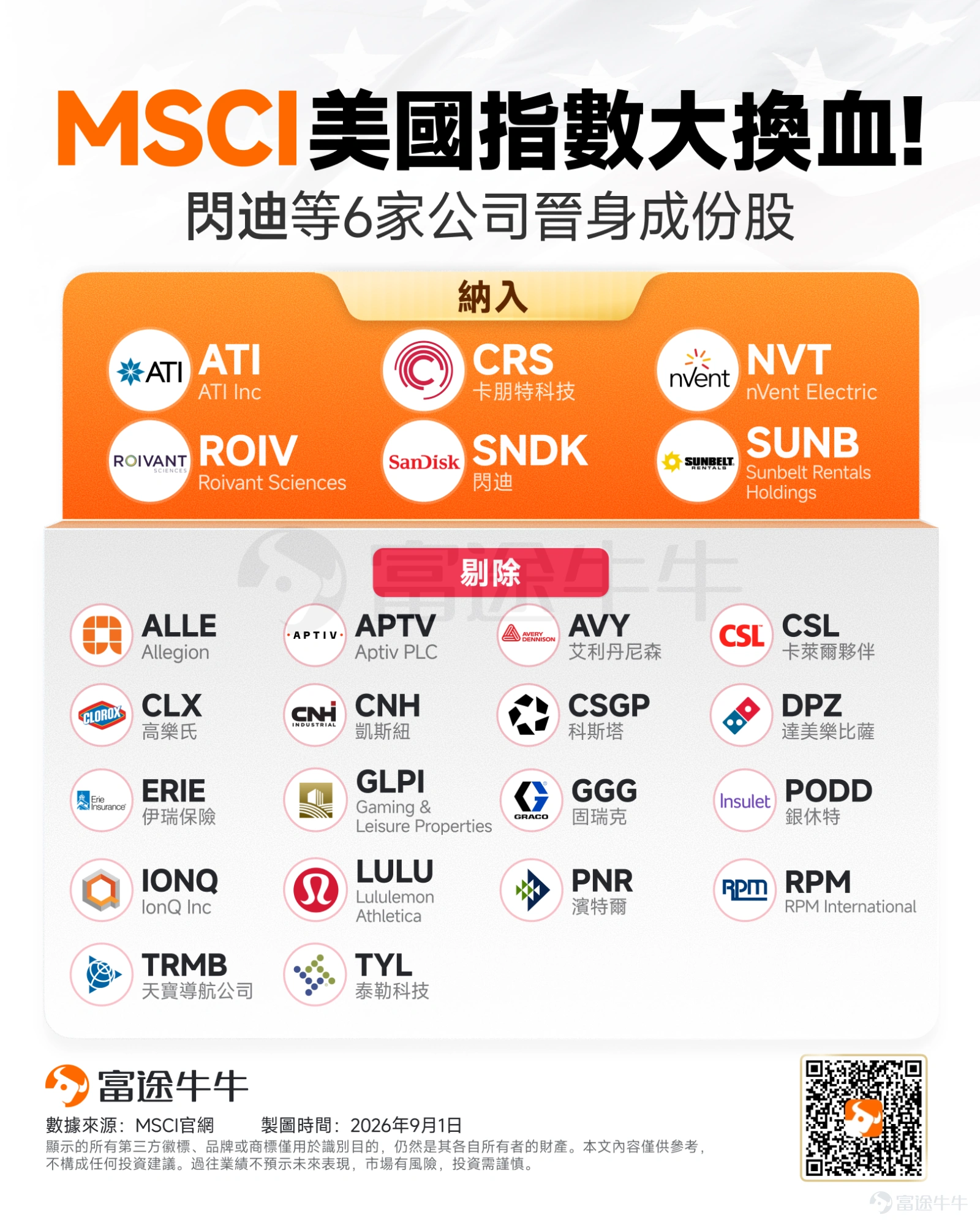
According to the index review results for August 2026 announced by MSCI, the MSCI USA Standard Index added six companies and removed eighteen. The relevant adjustments were implemented at the market close on August 31, with the new constituent list effective from September 1.
Removed companies:$Allegion (ALLE.US)$、$Aptiv PLC (APTV.US)$、$Avery Dennison (AVY.US)$、 $Carlisle Companies (CSL.US)$ 、$Clorox (CLX.US)$、$CNH Industrial (CNH.US)$、$CoStar (CSGP.US)$、 $Domino's Pizza (DPZ.US)$ 、$Erie Indemnity (ERIE.US)$、$Gaming and Leisure Properties Inc (GLPI.US)$、 $Graco (GGG.US)$、$Insulet (PODD.US)$、$IonQ Inc (IONQ.US)$ 、 $Lululemon Athletica (LULU.US)$、$Pentair (PNR.US)$、$RPM International (RPM.US)$、$Trimble (TRMB.US)$、 $Tyler Technologies (TYL.US)$。
--
--
--
Among them, $SanDisk (SNDK.US)$ 、 $Carpenter Technology (CRS.US)$ and $ATI Inc (ATI.US)$ They are also the three largest new constituents by total market capitalization in the entire MSCI World Index this time.
This means that the current adjustment is not just a routine rebalancing within the US market. Apart from Sunbelt, which is closer to a change in country classification, the other newly added companies have thereby entered the core institutional benchmark framework for large-cap and mid-cap stocks in global developed markets.
The list of additions reveals three main themes.
It is important to emphasize that MSCI is not an active fund manager, and inclusion in the index does not imply that MSCI subjectively "bullish" on a particular company. Index adjustments are primarily based on metrics such as free-float market capitalization, liquidity, investability, and market size ranking.However, the final list still objectively reflects the changes in relative market capitalization of different companies over a recent period.
First main theme: AI investment expands from chips to storage and electrical equipment
$SanDisk (SNDK.US)$ and $nVent Electric (NVT.US)$ , are the two companies most closely related to AI infrastructure among the newly added constituents.
SanDisk primarily provides NAND flash memory and data storage solutions, covering consumer electronics, enterprise storage, and cloud services. As data generated by AI training and inference continues to grow, the importance of storage within the entire AI infrastructure is also increasing.
However, unlike GPUs, NAND still exhibits significant cyclical characteristics. SanDisk's profitability depends not only on AI demand but is also influenced by industry inventory levels, supply expansion, and product pricing.
nVent operates further upstream in electrical connection and protection, with products covering cabinets, power distribution, liquid cooling connections, and data center infrastructure. The company has previously identified data centers and electric utilities as key growth markets, stating that AI data center construction is driving the expansion of its infrastructure business.
The simultaneous inclusion of both companies in the MSCI USA Standard Index demonstrates that the beneficiaries of AI capital expenditure are extending beyond computing chips to storage, power supply, power distribution, and physical data center infrastructure.
Second main theme: Aerospace materials are emerging as a new force
$Carpenter Technology (CRS.US)$ and $ATI Inc (ATI.US)$ Both are high-performance material companies deeply involved in the aerospace and defense supply chain.
Carpenter Technology primarily produces specialty alloys for aircraft engines, landing gear, defense, energy, and medical equipment; ATI provides titanium alloys, nickel-based superalloys, and other high-performance materials, with aerospace and defense as its core markets.
The key competitive advantages of such companies lie not only in the growth of downstream orders but also in long product certification cycles, complex manufacturing processes, and limited effective production capacity.
Against the backdrop of recovering aviation supply chains, rising demand for engine deliveries, and increased defense spending, production capacity and delivery capabilities among high-performance material companies have become scarcer, driving further improvements in profitability and market capitalization for related firms.
Notably, Carpenter Technology and ATI, along with SanDisk, were the three largest new additions by market cap in this MSCI World index rebalancing. The new U.S. forces entering global core benchmarks are no longer limited to software and internet companies but now also cover aerospace materials and advanced manufacturing.
Third Theme: Biopharma and the U.S. Real Economy
$Roivant Sciences (ROIV.US)$ Representing biopharmaceutical innovation, the company advances drug R&D and commercialization through its various "Vant" subsidiaries, focusing on autoimmune, inflammatory, and other disease areas. Compared to traditional large-cap stocks, Roivant’s valuation relies more heavily on clinical data, regulatory approvals, drug commercialization, and the efficiency of capital allocation across its pipeline.
$Sunbelt Rentals Holdings (SUNB.US)$ As a leader in equipment rental, its business is closely tied to U.S. infrastructure, manufacturing investment, non-residential construction, and industrial activity.
However, Sunbelt’s situation is somewhat unique. In March 2026, the company shifted its primary listing to the New York Stock Exchange while retaining a secondary listing in London. In this adjustment, Sunbelt was added to the MSCI USA Index and removed from the MSCI UK Index, which essentially reflects a change in country classification rather than a first-time entry into the broader MSCI World system.
Capital inflows were not limited to SanDisk, but new inclusions do not necessarily equate to price increases.
Judging by market performance on August 31, all six newly added stocks saw significant index rebalancing trades, though their stock price movements were not uniform.
$SanDisk (SNDK.US)$ Rose 5.5%, $nVent Electric (NVT.US)$ Rose approximately 1.5%; $Carpenter Technology (CRS.US)$ Closed flat, $Roivant Sciences (ROIV.US)$ Slightly declined by about 0.2%, $ATI Inc (ATI.US)$ Declined approximately 3.1%, $Sunbelt Rentals Holdings (SUNB.US)$ Declined approximately 1.2%.
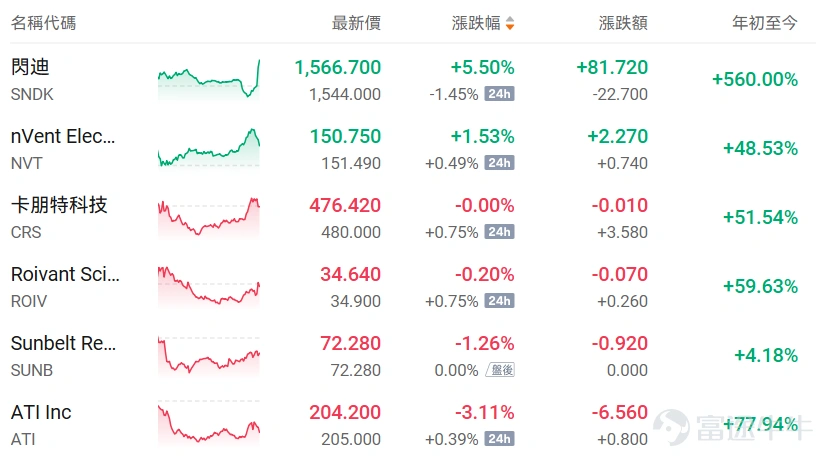
However, trading volume saw a significant increase across the board. Excluding SanDisk, the daily trading volume of the other five newly added stocks reached approximately 6 to 11 times their recent average levels. This indicates that MSCI-related capital was not concentrated solely on SanDisk but involved portfolio rebalancing across the entire list of new additions.
SanDisk stood out the most because an imbalance in buy orders during the closing phase directly pushed its stock price from negative to positive territory. However, the performance of other newly added stocks also demonstrates that inclusion in an index does not guarantee a rise in stock price.
The market may have priced in the expectation of inclusion in advance, and some capital may have taken profits as passive funds entered the market. Coupled with differences in broader market trends, sector performance, and individual stock liquidity, the resulting price directions were inconsistent.Therefore, the most certain impact of index adjustments is on trading volume and changes in shareholding structure, rather than a sustained rise in stock prices.
What is the long-term significance of being included in MSCI?
For newly added companies, the long-term significance of inclusion in the MSCI USA Standard Index is mainly reflected in three aspects.
First, the company enters a broader global institutional allocation framework.ETFs and index funds tracking the MSCI World, MSCI USA, and related indices need to hold these stocks according to the new weights.
Second, active institutions will also decide on overweights or underweights based on index weights,and the analyst coverage, institutional attention, and potential shareholder base for the company may expand accordingly.
Finally, sustained institutional holdings help improve stock liquidity and pricing efficiency,but this does not mean that passive capital will permanently and unidirectionally push up stock prices. Once the concentrated buying on the effective date of the adjustment is complete, the short-term catalyst from index-linked funds will significantly weaken.
However, SanDisk's late-session surge was merely the most visible trace of capital flow from this MSCI adjustment. What truly deserves attention is the structural shift in the US market revealed by the six newly added stocks: the AI rally is spreading from chips to memory storage and electrical equipment; the market cap status of aerospace materials and high-end manufacturing is rising; and biopharmaceuticals and real economy assets are beginning to enter higher-tier global institutional benchmark pools.
Risk Disclaimer: The above content only represents the author's view. It does not represent any position or investment advice of Futu. Futu makes no representation or warranty.Read more


Comments (3)
to post a comment
60
140