Hong Kong stocks are rebounding—what sectors deserve attention?

HK Stock Warrants & CBBC Notes | I won't chase the Hang Seng Index near 25,500; individual stocks offer better entry opportunities.
Let me start with the conclusion.
With the Hang Seng Index hovering around 25,500, I’m not in a rush to trade the index for now.
What’s more worth watching now is whether individual stocks have reached levels where it makes sense to enter positions.
I will prioritize monitoring:
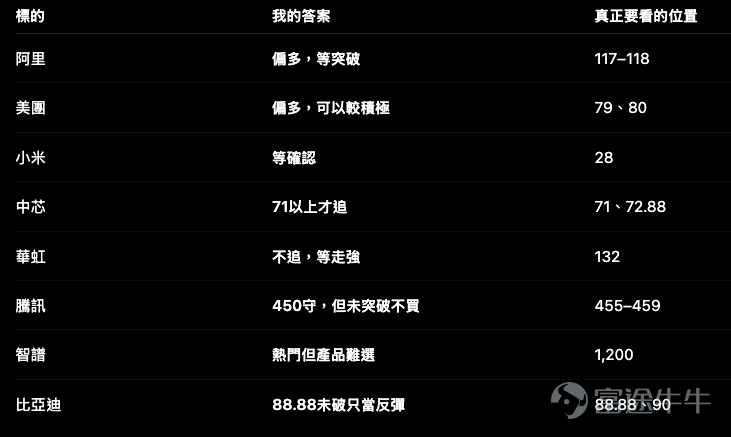
Alibaba, Meituan, Xiaomi, SMIC, Hua Hong Semiconductor, Tencent, Zhipu, BYD.
Not because these stocks are guaranteed to rise, but because their currentSupport, resistance, product liquidity, and term selection are all quite clear.For retail investors, this is far more useful than a vague statement like "bullish on the market outlook."
What you really need to know isn't "will it go up," but rather:
Which levels are worth trading?
If trading, should you use call options or CBBCs (Callable Bull/Bear Contracts)?
If your view turns out wrong, at which level should you cut losses?
Hang Seng Index reference approx. 25,567 points。
I will first look at four key levels:
– 25,000: First support level
– 24,400: Second support level
– 25,800: First resistance level
– 26,000: Second resistance level
Therefore, if the Hang Seng Index continues to hover around 25,400, 25,500, or 25,600, I will not open a position just for the sake of trading.
The only scenario that would truly change my stance is a breakout above 25,800.
If 25,800 hasn't been broken yet, buying bull certificates is essentially betting that it will break through later.
Waiting for the actual breakout might mean missing out on part of the move, but the direction will be much clearer.
Conversely,If it falls below 25,000, I will no longer adopt the 'wait for a breakout' strategy.
Many retail investors see the Hang Seng Index holding steady and think, 'Bull certificates should be a buy.' However, not falling does not mean an immediate rise.
The most troublesome aspect is that CBBCs have a mandatory call mechanism.
You might ultimately be right about the direction, but a single normal fluctuation along the way could already knock your position out.
If you have a preference, how would I choose?
For Bull Contract references, consider:
– 60338 UBS Group | Call Price 24,000 | Leverage approx. 15.7x
– 62647 Morgan Stanley | Call Price 24,600 | Leverage approx. 25.6x
I would lean towards the first one.
The reason is simple:
I would rather accept lower leverage in exchange for more breathing room.
A 25x leverage looks attractive, but the call price is also closer. Since the Hang Seng Index hasn't truly broken out yet, there's no need to compress my margin of error too much just for a few extra times of leverage.
If bearish:
- 67172 UBS Group | Call price 27,000 | Leverage approx. 17.5x
- 60061 BNP Paribas | Call price 27,200 | Leverage approx. 15.7x
But I won't actively chase bearish positions right now either.
With the 25,000 level still holding, I don't have sufficient reason to switch directly from 'waiting' to 'shorting'.
So the Hang Seng Index situation is actually quite simple right now:
I'll only start considering bullish positions above 25,800; I'll only reconsider bearish positions below 25,000. No rush in between.
Have you ever experienced a situation like this:
Knowing full well that the index hasn't broken out yet, but seeing leverage of over 20x, you can't resist buying in first?
Often, the problem isn't getting the direction wrong, but entering too early.
Alibaba 9988 $BABA-W (09988.HK)$ I remain bullish, but don't chase the price blindly around the 114 yuan level.
Alibaba reference price approx. 114.20 yuan。
My watchlist:
– Support: 114, 111.11
– Resistance: 116.99, 117.77
My strategy is straightforward:
If it holds above 114, I remain bullish. I will only become more aggressive upon a true breakout above 117–118.
If it breaks below the 111 level, I won't stubbornly insist it's just a shakeout.
Alibaba has a diverse product portfolio, which is an advantage.
Currently, there are approximately:
182 Call warrants, 78 Put warrants, 107 Callable Bull Contracts (CBCs), and 125 Callable Bear Contracts (CBBCs).
This doesn't mean you should choose randomly; rather, it means you actually have the basis to make comparisons.
Call warrant references:
– 13795 UBS Group | Strike 125.88 | Approx. 6.5x leverage
– 14014 Huatai | Strike 143 | Approx. 5.4x leverage
– 13752 DBS | Strike 145 | Approx. 4.3x leverage
I would personally look at the first one first.
The reason is not because it's issued by UBS Group, but rather:
With the underlying stock at HKD 114 and a strike price of 125.88, the leverage is approximately 6.5x, making the terms relatively easier to understand.
If you go too far out-of-the-money just to gain a bit more leverage, I actually think it's unnecessary.
For CBBCs, you can consider:
– 58777 UBS Group | Call Price 103 | Approx. 8.4x leverage
– 54239 Huatai | Call Price 108 | Approx. 13.1x leverage
If it were me, I would lean towards the one with a call price of 103.
With Alibaba at HKD 114, the instrument with a call price of 108 does offer higher leverage, but the pressure would be significantly greater during a normal pullback.
So the real question for Alibaba right now isn't 'will it rise'.
But rather:Do you want to bet on a breakout, or wait for a pullback before entering?
These two strategies should actually use different products.
Meituan 3690 $MEITUAN-W (03690.HK)$ If it holds above HK$78, I will be more aggressive than Tencent.
Meituan reference price approx. HK$78.90。
Its biggest advantage right now is:
Both support and resistance levels are very close to the current price.
- Support: 78.88, 78.80
- Resistance: 79, 80
So there's no need to project far ahead.
If it stabilizes above 79 and breaks through 80, I'll consider the short-term trend strengthening.
But if it fails to hold 78, I will withdraw my bullish view.
Call Warrant Reference:
- 28039 UBS Group | Strike 86.95 | Approx. 6.3x leverage
- 13395 Guotai Junan | Strike 99.3 | Approx. 6.8x leverage
- 16503 Macquarie Bank | Strike 123.46 | Approx. 5.8x leverage
I would clearly favor the first one.
Even with similar 5-6x leverage, a strike price of 86.95 versus 123.46 makes a world of difference.
Bull Contracts (CBCs):
- 60826 UBS Group | Call Price 68 | Approx. 5.6x leverage
- 55620 HSBC | Call Price 70 | Approx. 6.5x leverage
For short-term trading, I actually find Bull Contracts more straightforward.
I would lean more towards calls if you are willing to give the underlying stock a few more days.
So the real question is:Are you looking to bet on an immediate rise, or are you willing to wait a few days?
Product selection should vary depending on the trading horizon.
Xiaomi reference price approx. HKD 27.62。
No need to overcomplicate this one.
– Support: 26.88, 26.58
- Resistance levels: 28, 28.28
I won't chase the rally unless it stabilizes above 28 yuan. I'll only start seriously looking for a rebound once it holds steady at 28 yuan.
Call warrant references:
- 14314 UBS Group | Strike 29.98 | Approx. 6.0x leverage
- 15942 CITIC Securities | Strike 45 | Approx. 5.2x leverage
- 14495 Macquarie Bank | Strike 28.89 | Approx. 5.2x leverage
Comparing these three together is actually quite interesting.
If you only look at leverage, the three seem similar.
But one has a strike price of 29.98, another 28.89, and the third 45.
This is why relying solely on leverage can lead to trouble.
I'd rather keep an eye on the 28.89 or 29.98 levels than chase a strike price of 45 for similar ~5x leverage.
CBBCs (Callable Bull/Bear Contracts):
- 60379 UBS Group | Call Price 25 | ~8.5x leverage
- 62561 HSBC | Call Price 25 | ~8.4x leverage
These two are actually very suitable for comparison.
The call prices are similar, and so is the leverage.
So what should you look at next?
Street cargo (outstanding quantity), bid-ask spread, and quote stability.
Don't get hung up on a 0.1x difference in leverage.
SMIC reference approx. 70.75 yuan。
My outlook:
- Support: 67
- Resistance: 71, 72.88
I will only turn bullish above 71 yuan. A breakout above 72.88 would truly open up upside potential.
Call warrant references:
- 28641 UBS Group | Strike 83.93 | Approx. 4.2x leverage
- 15969 Macquarie | Strike 83.98 | Approx. 4.2x leverage
- 16479 Guotai Junan | Strike Price 108 | Approx. 4.2x leverage
If I had to choose one out of three, I would look at the first two first.
Since the underlying stock is at HK$70, there is no need to go for the HK$108 strike price with similar leverage.
Callable Bull/Bear Contracts (CBBCs):
- 55755 UBS Group | Call Price 65 | Approx. 10.4x leverage
- 58977 Huatai Securities | Call Price 65 | Approx. 9.7x leverage
This is actually another good example.
The call prices are the same, and the leverage is similar.
So, would you still just look at 'which one has 0.7x higher leverage'?
If so, you might want to reconsider:
Shouldn't we start focusing on the fundamentals of the product itself, rather than just looking at leverage figures?
Hua Hong Semiconductor (1347) $HUA HONG GRACE (01347.HK)$ : I'll wait for 132; I won't chase blindly around the 123 level.
Hua Hong reference approx. 123 yuan。
I'm watching:
– Support: 121.8, 120
– Resistance: 132, 133
This one is different from Meituan.
Its first significant resistance level is still quite far from the current price.
So, buying calls at 123 is essentially betting in advance that the price will climb all the way to 132.
I wouldn't do that.
Here’s what I would look for first:
Whether the 121–123 range can hold.
If it holds, I’ll maintain my bullish view. Only when it really starts pushing toward 128 or 130 will I reassess whether it’s worth chasing.
Call warrant references:
– 16715 UBS Group | Strike 133.88 | Approx. 2.2x leverage
– 16541 Citi | Strike 168.88 | Approx. 3.7x leverage
– 25420 DBS | Strike 188 | Approx. 3.7x leverage
Here is another point that retail investors often overlook.
That UBS Group leveraged product only has 2.2x leverage, which doesn't seem exciting enough.
But its strike price is 133.88.
The other two have 3.7x leverage, but their strike prices are already between 168 and 188.
So the real question is:
Do you want a Call option that tracks the underlying asset more closely, or do you just want to see a higher leverage figure?
Tencent (0700) $TENCENT (00700.HK)$ : 450 is holding, but since 455–459 hasn't been broken through, I'm still waiting.
Tencent reference price approx. HK$453。
– Support: 450, 449.8
- Resistance: 455, 458.88
So the outlook for this stock is very clear right now.
If it holds above 450, I'm not bearish. I'll only chase the breakout if it surpasses 455 to 459.
Call Warrants:
- 27993 UBS Group | Strike 500.5 | Approx. 5.1x leverage
- 13624 Guotai Junan | Strike 585 | Approx. 8.9x leverage
- 16828 Bank of China | Strike 508.88 | Approx. 6.6x leverage
If it were me, I would prioritize them as follows:
500.5 > 508.88 > 585
Not because of the issuer, but because I wouldn't deliberately buy a strike price of 585 just for 8.9x leverage.
CBBCs (Callable Bull/Bear Contracts):
– 58106 UBS Group | Call Price: 395 | Approx. 7.1x leverage
– 60622 Morgan Stanley | Call Price: 410 | Approx. 9.2x leverage
If you want to be more conservative, I would choose the one with a call price of 395.
Consider the one with a call price of 410 only if you are looking for short-term trading and can tolerate volatility.
So, Tencent actually faces a very simple question:
The HKD 455 level hasn't been broken yet, so why must you buy now?
Often, the best trade isn't about "which stock to buy," but rather "not buying until the right entry point is reached."
Zhipu AI 2513 $Z.AI (02513.HK)$ : The hottest pick, but also the one where it's easiest to buy the wrong product.
Zhipu AI reference approx. 1,195 yuan。
Its products are highly active, but the structure is incomplete.
There are many Calls and few Puts; some CBBCs (Bull Contracts) and even fewer BBCs (Bear Contracts).
Therefore, it belongs to a different product market than Alibaba and Tencent.
I will first look at:
Whether it can stabilize above 1,200 yuan.
Only if it stabilizes at 1,200 will I continue to look for upside potential.
Call reference:
– 28342 HSBC | Strike 2,500 | Approx. 3.4x gearing
– 15568 Citi | Strike 1,000 | Approx. 1.4x gearing
– DBS 28350 | Strike 3,813 | Approx. 4.9x leverage
These three examples already illustrate the point well.
Underlying stock price: HKD 1,195.
One call with a strike of 1,000, one at 2,500, and one at 3,813.
If you buy simply because you see "4.9x leverage," you may easily end up not knowing what you're actually buying.
Therefore, I will keep this one on my watchlist.
Being popular doesn't necessarily mean it's the best trade.
BYD 1211 $BYD COMPANY (01211.HK)$ : Since 88.88 hasn't been broken through, I'm treating this merely as a rebound.
BYD reference price approx. HKD 87.20。
- Support: 86, 86.99
- Resistance: 88.88, 90
My view is straightforward:
If it doesn't break through 88.88, I'll treat it as just a rebound. I'll only turn clearly bullish once it surpasses 90.
Many people fear that "waiting for a breakout means buying at a higher price."
But I see it differently:
Buying at 87 is betting on a breakout.
Buying at 90 is waiting for the market to prove itself first.
It may look like you're paying 3 units more, but in exchange, you get much clearer confirmation.
Sometimes, missing out on the initial gains is far more cost-effective than suffering significant losses from a premature entry.
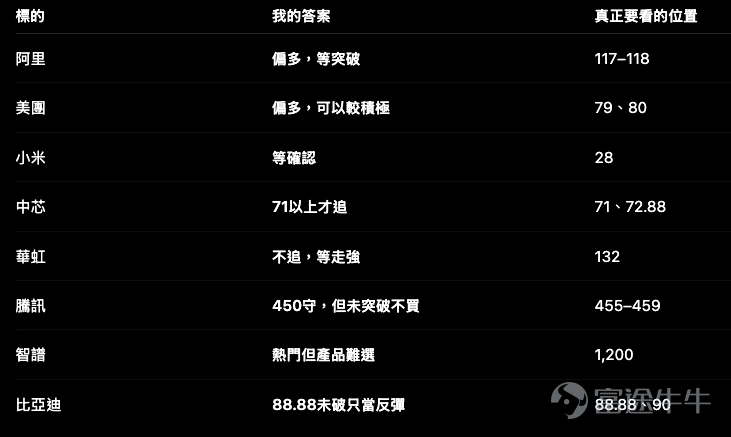
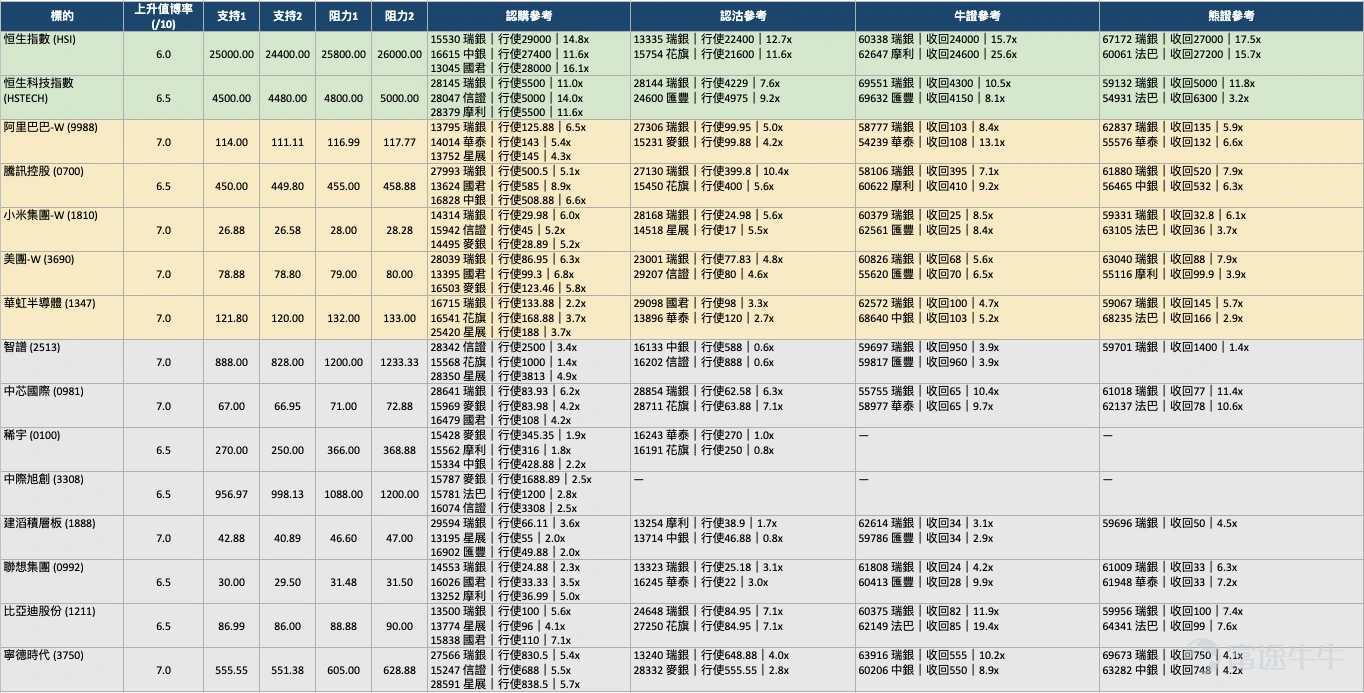
If you look solely at the "upside risk-reward ratio," there are actually quite a few decent candidates.
But that doesn't mean I would buy all of them.
The risk-reward ratio merely signals that a stock is worth researching; it is not a call to jump in immediately.
Before actually entering a position, I ask myself three questions:
Has the underlying stock reached an optimal entry point?
Do the product terms align with my intended holding period?
Where is my exit point if my analysis turns out to be wrong?
If I can't answer these three questions, I'd rather not trade at all.
On another note, I'm genuinely curious about this:
When selecting warrants or CBBCs, what do you typically look at first? Leverage, strike price, call price, or the issuer?
For many investors, the real source of losses isn't necessarily misjudging the underlying stock, but rather choosing the wrong product from the very first step.
Risk Disclaimer: The above content only represents the author's view. It does not represent any position or investment advice of Futu. Futu makes no representation or warranty.Read more

Comments
to post a comment
16
3