US CPI data released Wednesday! Combined with major Hong Kong stock earnings reports, what should yo

Rate hike expectations are heating up, yet cloud giants are bucking the trend! Who exactly is pocketing the profits from AI?
On August 28, Federal Reserve Chair Powell delivered his keynote address at the Jackson Hole Global Central Bankers Symposium for the first time, reaffirming that the 2% inflation target remains "firm and fixed," and warning that if inflation does not decline "clearly and sufficiently quickly" toward the target, the Fed "still has work to do."
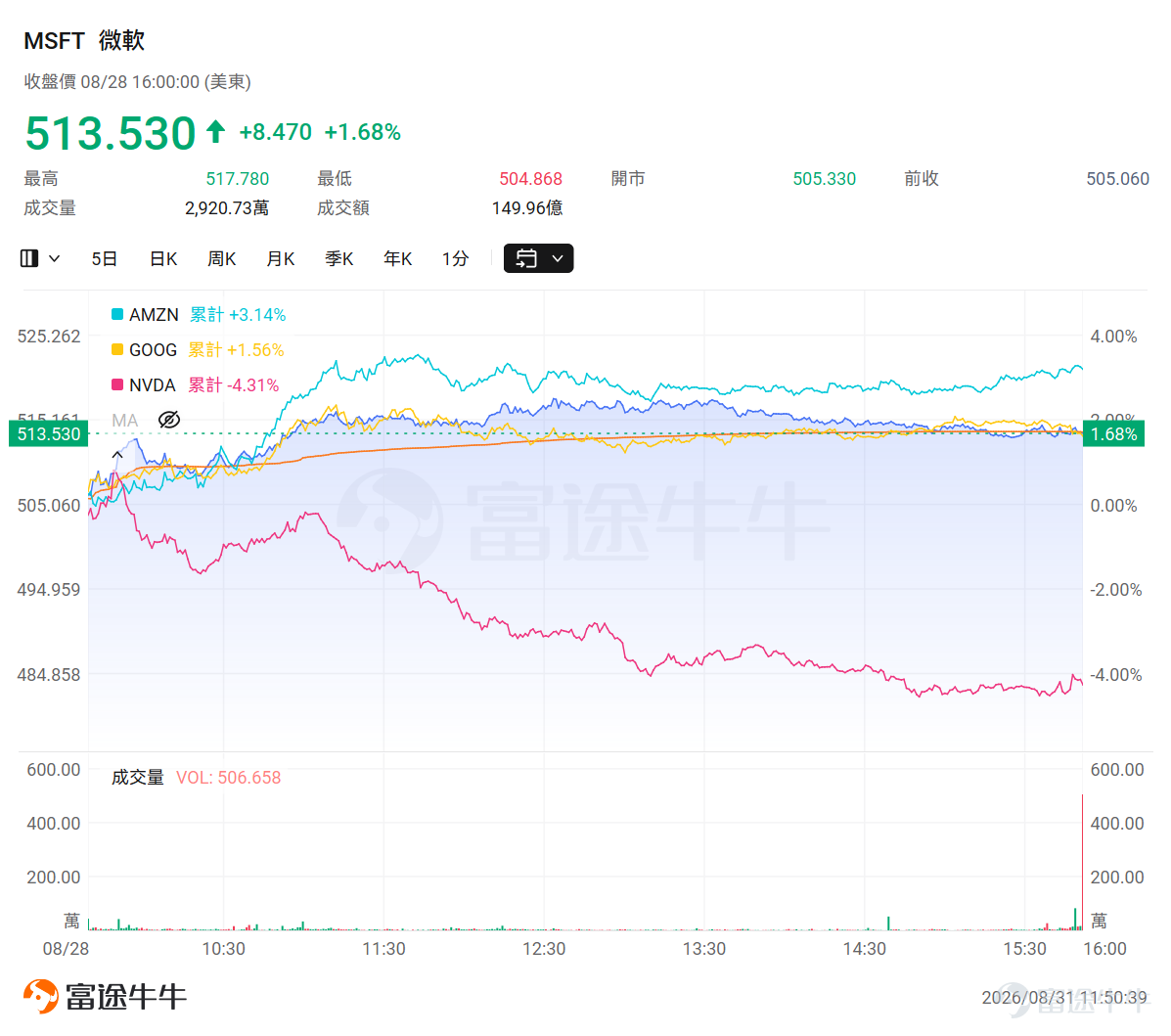
Spurred by this news, the market rapidly repriced September rate hike expectations. US stocks closed lower after volatile trading, but more noteworthy than the broader index decline was the divergence within the tech sector: AI computing power stocks saw widespread profit-taking, $NVIDIA (NVDA.US)$ closing down 4.57%, $Marvell Technology (MRVL.US)$ dropping over 10%,but software and cloud services bucked the trend and strengthened, $Amazon (AMZN.US)$rising 3.97%, $Alphabet-C (GOOG.US)$、 $Microsoft (MSFT.US)$up nearly 2%, $Salesforce (CRM.US)$gaining 1.57%.
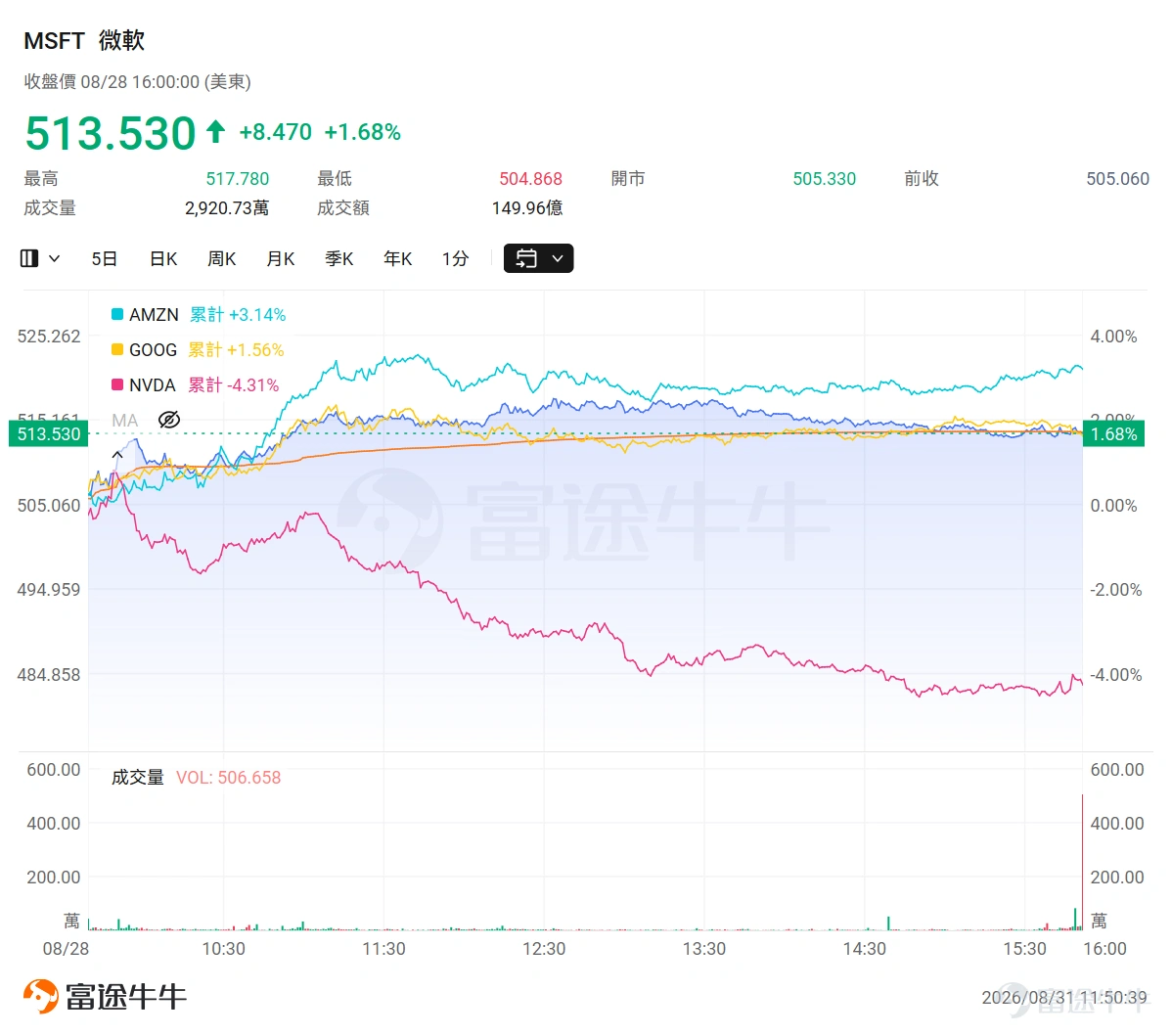
As interest rate expectations turn hawkish again, why have several hyperscale cloud service providers remained resilient? This raises a question worth paying closer attention to:AI commercialization is accelerating. How exactly is this revenue distributed across the industry chain?
Barclays' report, "A Primer on AI Lab & AI Hyperscaler Unit Economics," dissects the economic relationship between AI labs and cloud vendors from this perspective. The research highlights a key shift: paid inference services at AI labs have demonstrated profitability, while substantial model training and inference expenditures are also generating revenue and operating profit for cloud vendors.
Inference business starts to generate profits, but overall profitability remains elusive
According to Barclays' analysis, in 2026, increased demand for agent workflows and enterprise products, a higher share of API and enterprise customers, and improved token efficiency in task completion by models will drive up margins for paid inference.
In the two hypothetical labs, Lab A and Lab B, modeled in the report, paid inference margins are projected to rise from 14% and 18% in 2025 to 65% and 48% in 2026, respectively. These figures are Barclays' model estimates and do not represent disclosed financial statements of any specific companies.
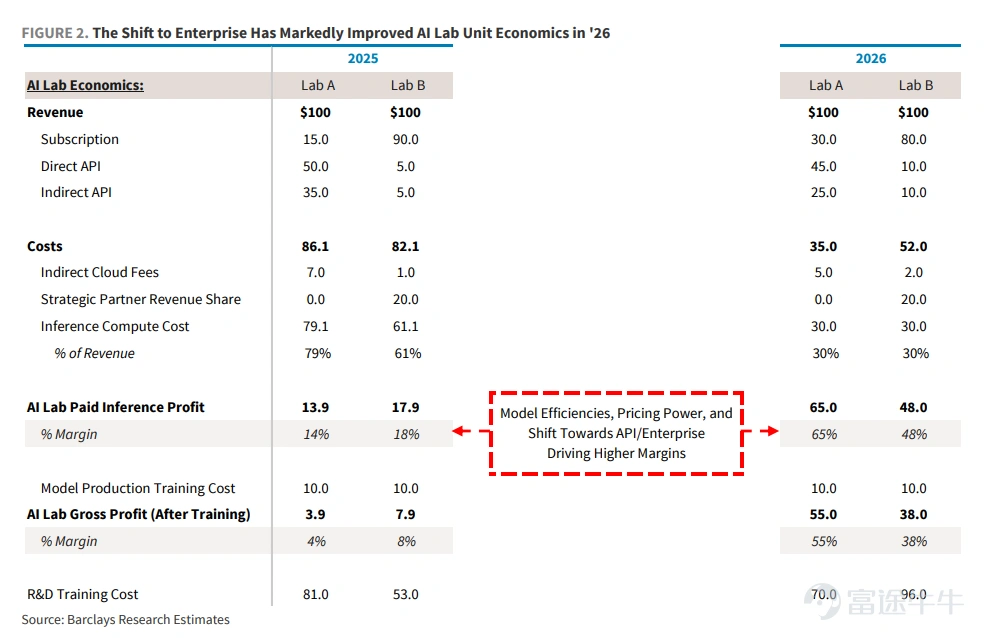
However, profits from inference services must still support continuous model iteration. After accounting for final model production and training costs, the report estimates gross margins for the two labs at 55% and 38%, respectively. However, most R&D and training expenses are listed separately, and inference costs exclude free users.
Therefore, improved economics in paid inference does not equate to overall profitability for AI labs.
For every $100 in AI revenue, how much profit does it generate for cloud vendors?
This also highlights the position of cloud providers in the current AI business model: as AI labs scale up their services and enhance model capabilities, they need to continuously purchase computing power for inference and training.These costs, in turn, become revenue for cloud providers.
Barclays estimates that, based on the product mix and partnership arrangements projected for 2026,for every $100 in revenue generated by AI labs, computing purchases related to inference, channel fees, and partnership revenue shares could generate approximately $35 to $40 in revenue for cloud providers, contributing around $10 to $20 in operating profit.
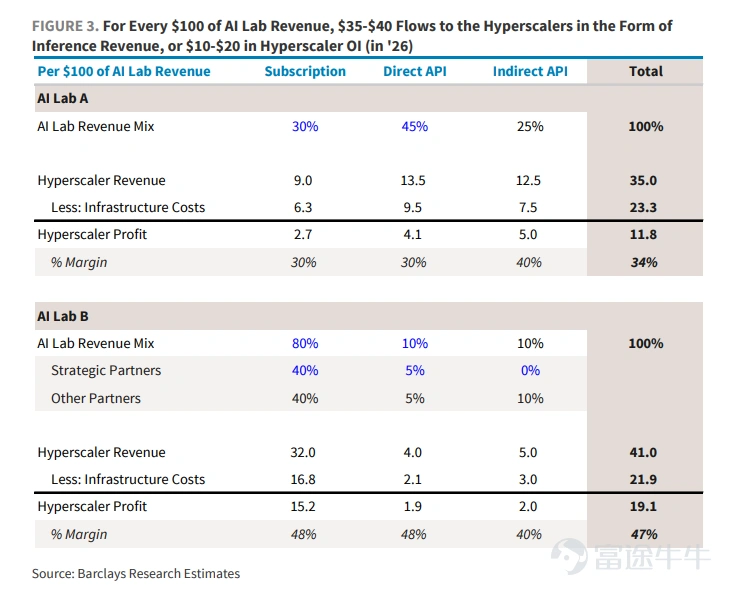
The significance of these figures is thatpaid demand for AI applications is already translating into financial performance for cloud providers through the channels of computing power procurement and partnership revenue sharing.Even if model companies continue to invest heavily in R&D, the cloud platforms fulfilling their computing needs can still generate revenue and profits from current services.
Moreover, the business opportunities captured by cloud providers extend beyond basic computing power. Barclays points out that agent subscription products often require higher-level software services such as databases; some strategic partnerships also include revenue-sharing arrangements. Under the indirect API model, cloud providers directly manage sales and settlement relationships with customers, thereby earning channel-related revenue.
Computing power, software services, and model distribution collectively constitute the ways in which cloud platforms participate in AI commercialization.
With both training and inference advancing simultaneously, where does the revenue support for cloud giants lie?
When training expenditures are included, the revenue scale captured by cloud providers becomes even more substantial.
Barclays predicts that in 2026, AI lab revenue will be approximately $137 billion, with inference costs around $58 billion and training costs around $66 billion, corresponding to roughly $124 billion in AI revenue for cloud providers.In other words, under this industry model, for every $1 of revenue generated by AI labs, combined spending on training and inference corresponds to approximately $0.90 in revenue for cloud providers.
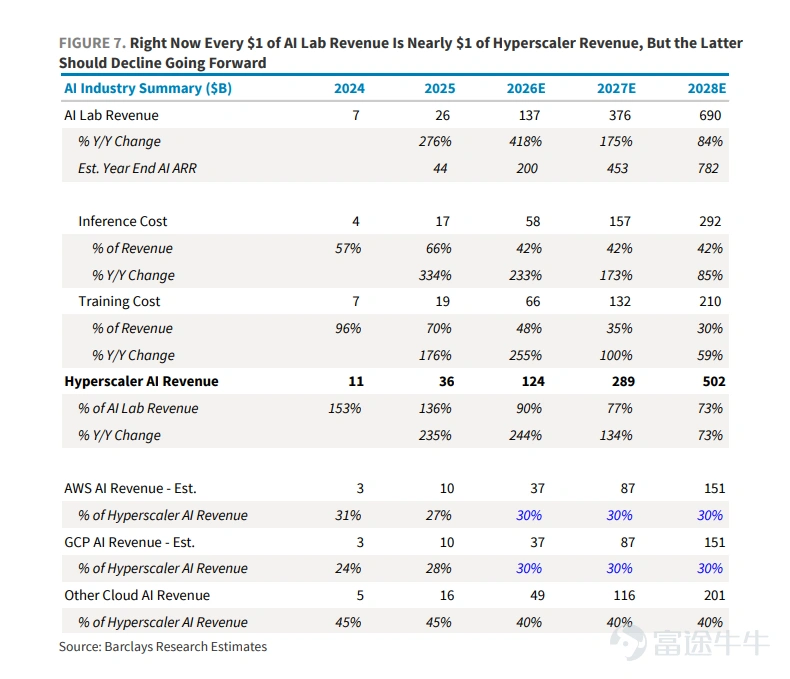
This reflects the total industry volume including training, which differs from the previously mentioned inference product model based on every $100 of revenue; furthermore, cloud revenue must deduct infrastructure costs to translate into profit.
For AWS, Azure, and Google Cloud, the growth in AI lab revenue therefore has direct business implications: on one hand, increased paid usage drives inference demand; on the other, model competition spurs training investment. Barclays expects the market share distribution among these platforms in AI lab compute spending to remain relatively stable over the next two years.
From this perspective, the relative strength of cloud giants following the Jackson Hole conference can be understood in light of the visibility of their AI revenue.Even as the market begins to reprice the possibility of rate hikes, demand for model training and inference continues to provide concrete revenue support for cloud businesses.
A single day's stock price movement is insufficient to prove a comprehensive rotation of capital into software, but this research report provides a basis for observing the fundamentals of cloud platforms.
Post-2028, market share and profit margins will face tests.
The current advantages of cloud providers are also constrained by time and conditions.
Barclays warns that as competition among frontier AI models intensifies and compute shortages ease, current profit margins for both AI labs and cloud providers may decline. Starting in 2028, traditional hyperscale cloud vendors may begin to lose some share of training and inference spending as infrastructure projects backed by commitments from AI labs come online.
The report’s industry forecasts also indicate that the ratio of cloud providers’ AI revenue to AI labs’ revenue will drop from 90% in 2026 to 77% in 2027 and 73% in 2028. However, the absolute revenue scale is still projected to grow from $124 billion to $289 billion, and further to $502 billion.
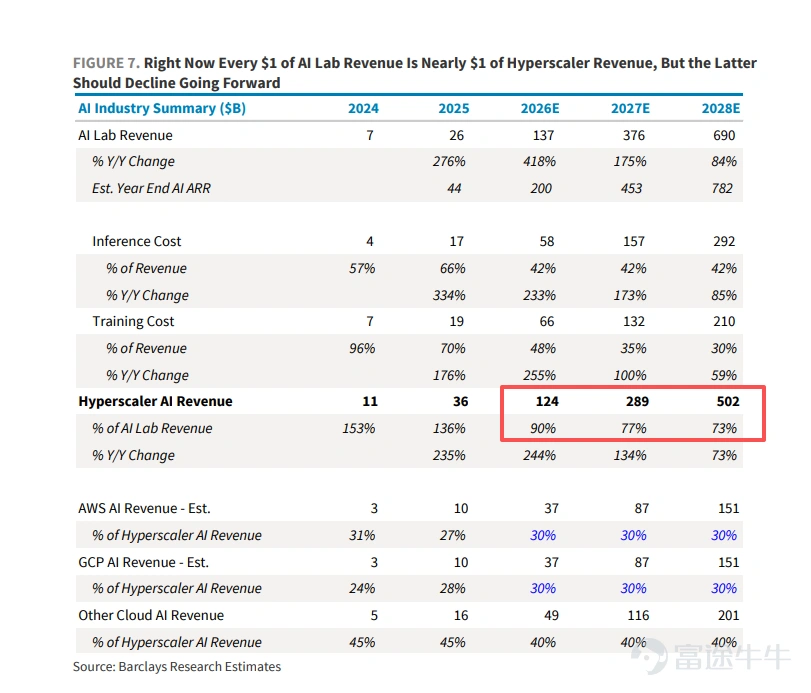
This highlights a noteworthy shift:Cloud providers’ revenue can continue to expand, but the proportion of cloud spending relative to AI labs’ revenue growth may gradually decline.
For cloud giants, the key challenges ahead are to verify whether AI labs’ revenue growth materializes, whether compute demand translates into operating profits, and how much customer spending existing platforms can retain amid new supply. These dynamics will determine whether the currently visible AI revenue can evolve into sustained earnings growth.
Risk Disclaimer: The above content only represents the author's view. It does not represent any position or investment advice of Futu. Futu makes no representation or warranty.Read more


Comments (5)
to post a comment
27
47