
$100 Options Opportunity Pool | Fed Adds Variables, Will Non-Farm Payrolls Set the Direction? NVIDIA Maintains Low Volatility
Hello fellow investors, welcome to this week's "Options Trading with $100" opportunity pool! Each week, we focus on clear market themes to highlight low-barrier options opportunities worth watching. We won't tell stories of overnight riches; instead, we discuss: what is the logic, is it worth paying attention to, and where are the risks.
This Week’s Market Focus
Last Friday, Federal Reserve Governor Warsh delivered a keynote speech at the Jackson Hole Global Central Bankers Symposium,sending more hawkish signals than in July, which directly triggered market turbulence.
Goldman Sachs remains skeptical about a "September rate hike," while JPMorgan stated that "we still need to watch the August Non-Farm Payrolls and CPI data"—this has pushedthe US Non-Farm Payrolls datainto the spotlight. Coupled with the previous preliminary annual benchmark revision downward by 79,000 jobs and the continued cooling of the labor market,Whether the Non-Farm Payrolls (NFP) data comes in strong or weak, it could be the pivotal move that sets the tone for the macro direction of the market.
Market moves driven by macro events are often "one-sided, volatile, and rapid," which is precisely the ideal environment for option buyers. In this issue, we focus on two areas:First, using broad-market ETFs (using SPY as an example) to bet on the macro direction triggered by the NFP report.;Second, NVIDIA, which broke the "earnings day curse" last week with a blockbuster earnings report.,With implied volatility falling further to extremely low levels, this may present another relatively favorable entry window.
Target #1: $SPDR S&P 500 ETF (SPY.US)$
SPY tracks the S&P 500 Index and is the instrument that best represents the overall sentiment of the US broad market. Moreover, SPYhas option contracts expiring every trading day,—meaning fellow investors can almost daily find contracts expiring on the same day or in the near term to express their short-term views on the broad market. This is particularly convenient when trading macro events like the NFP release, where the outcome is known on the same day. This Friday's NFP report is a key event for determining the macro direction: following Governor Waller's hawkish remarks, market nerves are already tense. The strength or weakness of the jobs data could directly determine the trajectory of Fed rate hike expectations and drive broad market sentiment. A figure that either exceeds or falls short of expectations is sufficient to amplify volatility.
If fellow investors are more concerned about the direction of the Nasdaq, which is dominated by tech stocks,tracking the Nasdaq-100 $Invesco QQQ Trust (QQQ.US)$ Options contracts expiring every trading day are also available, with a strategy similar to SPY but with a heavier weighting in tech stocks and typically higher volatility. Fellow investors can choose based on whether they prioritize the "broad market" or the "tech sector."
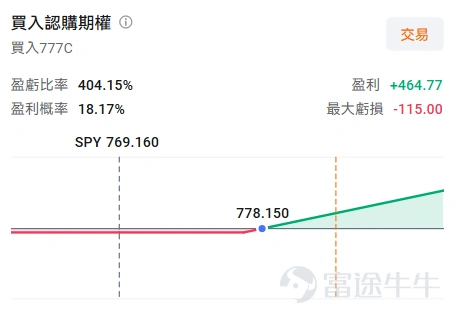
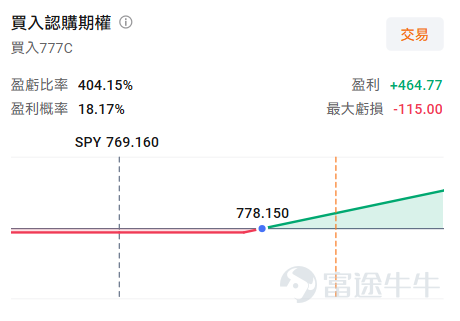
(The design images shown on screen are for illustrative purposes only and do not constitute investment advice or guarantees; market conditions change rapidly, and the displayed option prices do not reflect real-time data. Options shown are filtered around the $1 strike price.)
Bullish rationale:
If this Friday's non-farm payrolls data is moderate or even slightly misses expectations, it could alleviate market concerns about further Fed tightening. With rate hike expectations cooling, broad market sentiment may see a corrective rebound.
After NVIDIA's earnings report broke the 'earnings day curse,' the investment thesis for AI received strong validation once again. A recovery in heavyweight tech stocks could drive the broader market higher.
SPY is currently just a step away from its 52-week high of $779.37. If market sentiment aligns, there is still room for it to challenge and break through previous highs.
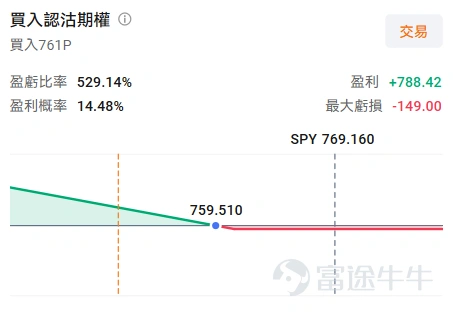
(The design images shown on screen are for illustrative purposes only and do not constitute investment advice or guarantees; market conditions change rapidly, and the displayed option prices do not reflect real-time data. Options shown are filtered around the $1 strike price.)
Bearish Thesis:
Wall's hawkish stance has already dampened market enthusiasm. If this Friday's non-farm payrolls data is strong and job resilience exceeds expectations, it will further reinforce Fed rate hike expectations, potentially pressuring the broad market lower due to fears of continuing rate increases.
The broad market has been consolidating at high levels. With macroeconomic uncertainty叠加 high valuations, any sign of rising rate hike expectations could trigger profit-taking pullbacks at the slightest disturbance.
Heavyweight tech stocks have seen significant gains previously. Once interest rate expectations shift and market risk appetite contracts, they are often the first to be affected, dragging down the entire broad market.
Additionally, besides ETF options like those on SPY, the market also offers options directly linked to indicesIndex Options(such as SPX). Both can express views on the broad market, but index options differ in contract specifications and settlement methods (cash settlement), with larger notional amounts per contract and higher entry barriers.
If fellow investors truly prefer the cash settlement and tax characteristics of index options but wish to lower the entry barrier, they can also keep an eye onMini S&P 500 Index Options $Mini Standard & Poor's 500 (.XSP.US)$ —Its contract size is one-tenth that of SPX, with a significantly smaller notional value. It also uses cash settlement, effectively acting as a "miniature version of SPX," making it more friendly to fellow investors with smaller capital who want to experience index options. However, overall, for fellow investors aiming for an entry cost around $100, ETF options like SPY offer more affordable unit prices, greater liquidity, and are better suited for small-capital practice. This is why we use SPY for our demonstrations.
Target #2: $NVIDIA (NVDA.US)$
We have already broken down this "market leader" in our previous review. A quick recap: it suffered seven consecutive daily declines before earnings, with the market shrouded in anxiety over the AI bubble narrative. Then, an explosive earnings report triggered an 8.7% single-day surge, adding $440 billion to its market cap in one day, while projecting a forward outlook of striving for $1 trillion in revenue by fiscal year 2028. Goldman Sachs traders simply noted, "Everything just seems good."
However, the good times didn't last—last Friday, Fed Chair Powell's hawkish remarks triggered a broad decline in US stocks, dragging down NVIDIA as the heavyweight market leader,falling nearly 5% in a single day along with the broader market, thereby giving back some of the gains made after the earnings report.This also shows that even as the "market leader," no matter how strong NVIDIA's fundamentals are, it is difficult to completely escape the gravitational pull of macroeconomic sentiment.
Why bring it up again today? The key lies inthe further decline in Implied Volatility (IV). During last Friday's review, the IV percentile was still at 4%; now, based on the latest volatility analysis data,IV rank and percentile have dropped to an extremely low level of 0%.What does this mean?
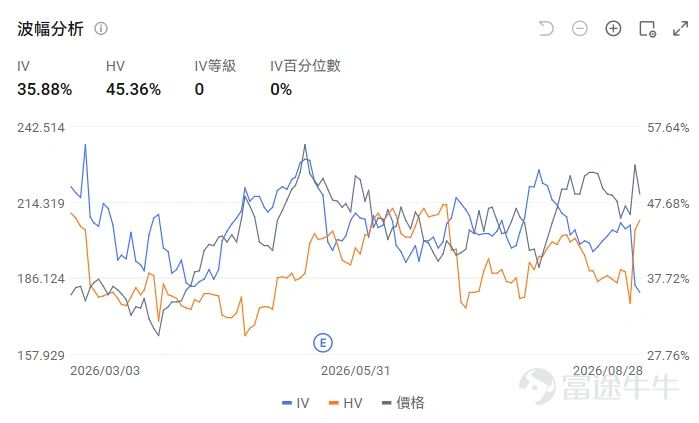
Let's review the concept: IV stands for Implied Volatility, which can be understood as "the market's expectation of future volatility," or the "uncertainty premium" embedded in option prices. With the most uncertain event—the earnings report—now behind us, IV has naturally fallen to its lowest level in the past year. In other words,NVIDIA options are currently relatively "cheap," with a low uncertainty premium and relatively controllable time decay.For fellow investors who have a clear directional view and want to bet on a medium-to-short-term trend with limited capital, this could be a relatively favorable entry point.
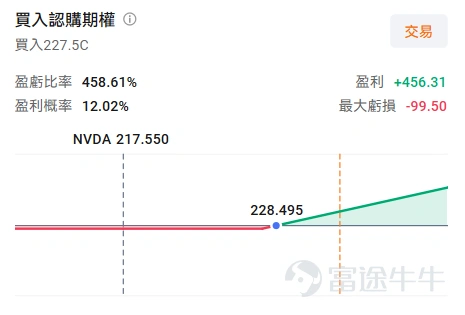
(The design images shown on screen are for illustrative purposes only and do not constitute investment advice or guarantees; market conditions change rapidly, and the displayed option prices do not reflect real-time data. Options shown are filtered around the $1 strike price.)
Bullish rationale:
The AI investment thesis has gained further validation post-earnings. NVIDIA's "monopoly" position in computing power remains solid, and its fiscal 2028 revenue target of $1 trillion has ignited new expectations on Wall Street.
The stock price pulled back on Friday. If you view this as a normal retracement after the post-earnings surge, buying a call option at the dip is relatively cost-effective.
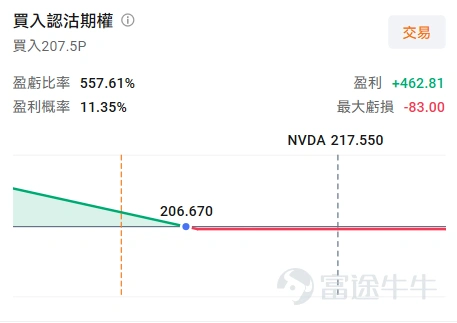
(The design images shown on screen are for illustrative purposes only and do not constitute investment advice or guarantees; market conditions change rapidly, and the displayed option prices do not reflect real-time data. Options shown are filtered around the $1 strike price.)
Bearish Thesis:
The positive earnings news has been fully priced in. With significant short-term gains, there is pressure for profit-taking.
If this Friday's non-farm payrolls data comes in strong and expectations for a hawkish Fed intensify, tech leaders are often the first to be impacted, and NVIDIA will likely not be spared.
After last Friday's market recap was published,Bai Dao Jun also noticed comments from fellow investors in the discussion section, stating that NVIDIA's stock price movements aren't volatile enough, and its options lack excitement, prompting a desire for greater elasticity.If you share this view, consider the following set of leveraged ETFs,but be aware that the risks are also higher. Make sure to understand them fully before making a decision.
$GraniteShares 2x Long NVDA Daily ETF (NVDL.US)$ 、 $T-Rex 2X Long Nvidia Daily Target ETF (NVDX.US)$ All areLeveraged ETFs that track twice the daily gains or losses of NVIDIAamplify the underlying stock's movements by two times, offering greater elasticity (last Friday at the US market close, both dropped about 9%, exactly double the ~4.5% drop in the underlying stock). Their share prices are also relatively lower, both in the double digits. However, leveraged ETFs carry unique risks:
daily reset: They track "single-day" double returns, not double returns over "a period of time." Holding for more than one day will result in deviation in actual returns.
Volatility decay: In volatile, choppy markets, daily resets cause compounding decay, potentially leading to a scenario where "the underlying stock hasn't fallen much, but the leveraged ETF has shrunk significantly" over the long term.
Therefore, leveraged ETFs (and their options) are more suitable fortrades with clear directional conviction and very short holding periods,not for long-term hold strategies. Trading options on them equates to "leverage on top of leverage," which can further amplify volatility and risk.
Important Notice
This week, both trading themes are tightly linked to macroeconomic events. Around the release of the Non-Farm Payrolls (NFP) data, the broader market and tech giants may experience significant volatility. If you misjudge the direction, option values could quickly drop to zero.
Options are contracts with expiration dates. As expiration approaches, time value decays faster. Even a slight pullback or stagnation in the underlying stock can cause option prices to evaporate rapidly.
There is a correlation between SPY and NVIDIA. As a heavyweight stock, NVIDIA's price movements impact the broader market. It is best not to treat these two assets as completely independent bets by heavily positioning in the same direction for both.
Regarding entry timing, if you plan to trade around the NFP report, pay attention to the volatility rhythm before the data release (published pre-market on Friday). Although NVIDIA's current implied volatility (IV) is extremely low, making it a relatively cost-effective entry environment, this also suggests that price action may remain flat. Do not go all-in. Understand the setup first before executing trades.
Let's focus on these two themes for this week. Direction, timing, and position sizing are all essential. See you in the review!
Not familiar with options basics? Study up before jumping in.
If concepts like 'What is a Long Call?' or 'How to interpret strike prices?' are still unclear when you read this opportunity pool, do not rush to place orders—take some time to solidify your fundamentals. We have compiled practical introductory resources here; we recommend saving them:

Finally, we’ve got a little perk for our fellow investors—feel free to claim it!Options Starter Pack~
*This promotion is exclusively available to invited Hong Kong users. Click to learn more.Detailed terms and conditions of the promotion >>
Disclaimer
This content does not constitute an offer, solicitation, recommendation, opinion, or any guarantee regarding any securities, financial products, or instruments. The risk of loss in trading options can be substantial. In certain circumstances, your losses may exceed the initial margin deposit. Even if you place contingent orders, such as 'stop-loss' or 'limit' orders, there is no assurance that losses will be avoided. Market conditions may prevent these orders from being executed. You may be required to deposit additional margin on short notice. If you fail to meet the required margin within the specified time, your open positions may be liquidated. Nevertheless, you remain liable for any deficit balance in your account resulting from such events. Therefore, you should thoroughly research and understand options before trading, and carefully consider whether such trading is suitable for you based on your financial condition and investment objectives. If you trade options, you should familiarize yourself with the procedures for exercising options and handling expiration, as well as your rights and obligations upon exercise or expiration.
Risk Disclaimer: The above content only represents the author's view. It does not represent any position or investment advice of Futu. Futu makes no representation or warranty.Read more

Comments
to post a comment
13
8