Options Hub: Oil prices break $100, PPI beats expectations! How to position with options for tonight

Quick Options Recap | NVIDIA Breaks the Curse with a Dramatic Comeback! How to Survive an IV Crush Amidst a One-Sided Surge?
Fellow investors, it's time for our Friday market review again. This week had only one protagonist— $NVIDIA (NVDA.US)$ 。
Last week, tech stocks were shrouded in anxiety. The logic behind AI trades was repeatedly questioned, and NVIDIA experienced a rare "seven-day losing streak" ahead of its earnings, shattering many investors' confidence. The market's biggest concern was whether this company, with the highest global market cap, would suffer a "sell-the-news" drop on earnings day.After all, the "earnings day curse" from the past few quarters remains fresh in everyone's memory—no matter how strong the results, the stock price still got hammered.
So, what happened? NVIDIA dispelled the gloom with a blockbuster earnings report.It surged 8.7% in a single day, with its market cap jumping by $440 billion, marking the largest single-day gain since April 2025.
This scenario of "continuous declines before earnings followed by a sharp and fierce reversal" is exactly the fertile ground option buyers love. In this issue, we'll break it down using a NVIDIA weekly call option—explaining why this surge generated real profits instead of having most gains eaten away by IV crush.
$NVIDIA (NVDA.US)$ A counterattack from the depths after seven consecutive days of declines: a low-IV call option ambush strategy
Let’s first clarify the narrative around the underlying stock.
Ahead of its earnings report, the sentiment surrounding NVIDIA was subdued.Seven consecutive trading sessions of declines have reignited loud debates about the "AI bubble." The market is simultaneously worried that AI capital expenditure has peaked and questioning NVIDIA’s ecosystem financing model of "revenue sharing in exchange for financing"—with some even suspecting it is playing games with "Balance Sheet as a Service." This pessimism, compounded by the historical shadow of earnings days, has kept many investors from entering positions before the report.
Then, the earnings report arrived.NVIDIA not only beat expectations but also presented a forward-looking outlook that prompted Wall Street to reprice the stock. The company indicated that revenue growth for the fiscal year ending January 2028 could exceed market expectations, aiming directly for $1 trillion in revenue for FY2028. Demand for AI computing power remains explosive, and NVIDIA’s "monopoly" status in the AI computing sector remains as solid as ever. Traders at Goldman Sachs wrote a single sentence in their market briefing: "Everything just seems good."
Thus, we witnessed a dramatic counterattack:NVIDIA surged nearly 9% in a single day, helping drive the Nasdaq up by 1.57%. Meanwhile, the software sector also delivered strong performance, with widespread gains across the board, $Salesforce (CRM.US)$while another stock soared 23% in a single day thanks to an impressive earnings report.Both hardware leaders and software earnings delivered positive surprises, sweeping away the gloom that had hung over the entire tech sector.NVIDIA has climbed to around $227, approaching its all-time high of $236.
The despair of seven consecutive days of declines was exchanged for a single day of euphoria.This is the classic pattern of an earnings-driven rally: when market sentiment is pushed to the extreme, a better-than-expected report triggers a vindictive rebound. And for option buyers, this kind of"one-sided, violent, and rapid"market movement is exactly the opportunity they have been dreaming of.
(The design image shown on screen is for illustrative purposes only and does not constitute any investment advice or guarantee. Market conditions change frequently; the displayed option prices do not reflect real-time data. Options shown are filtered based on an initial price below $3 per contract.)
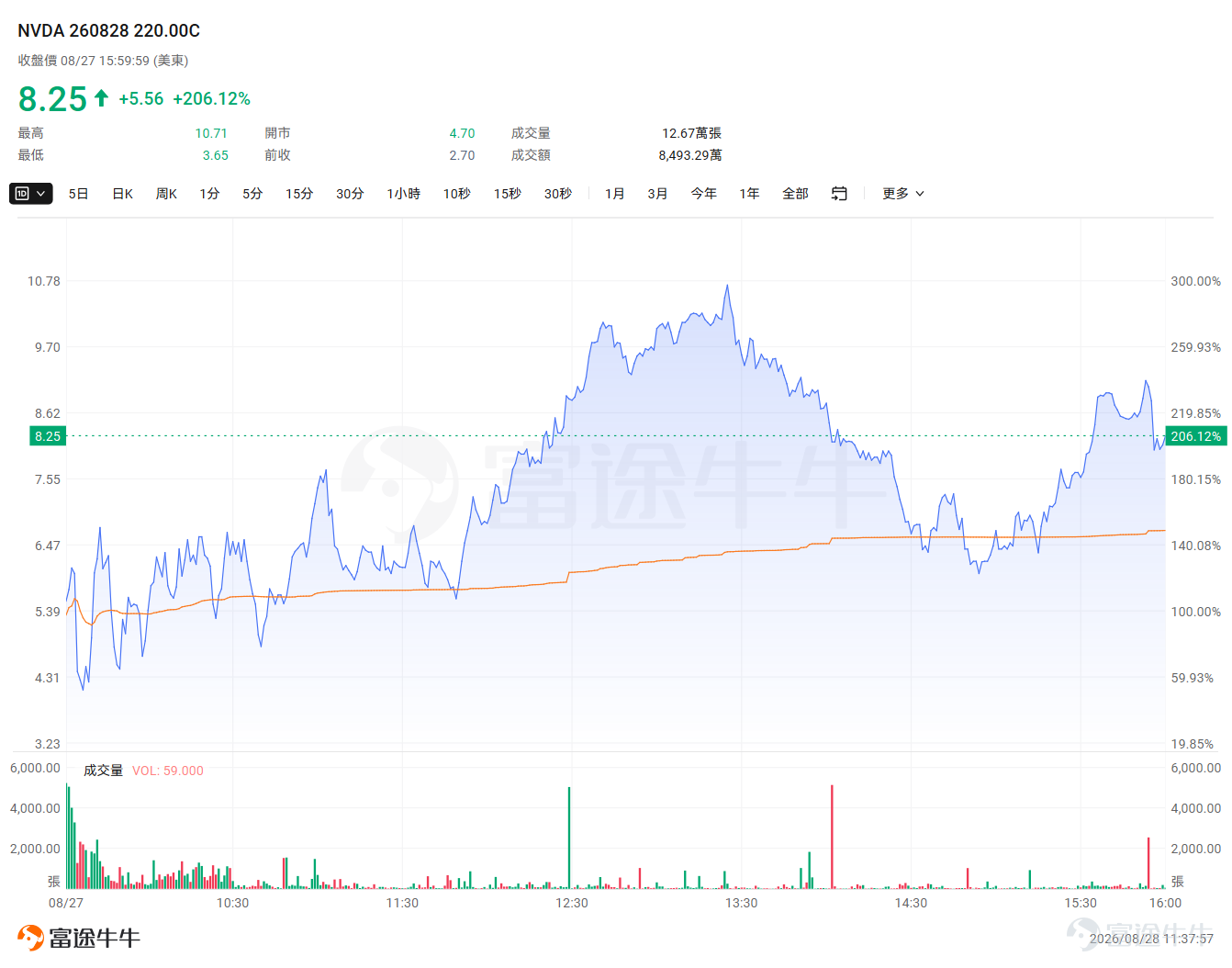
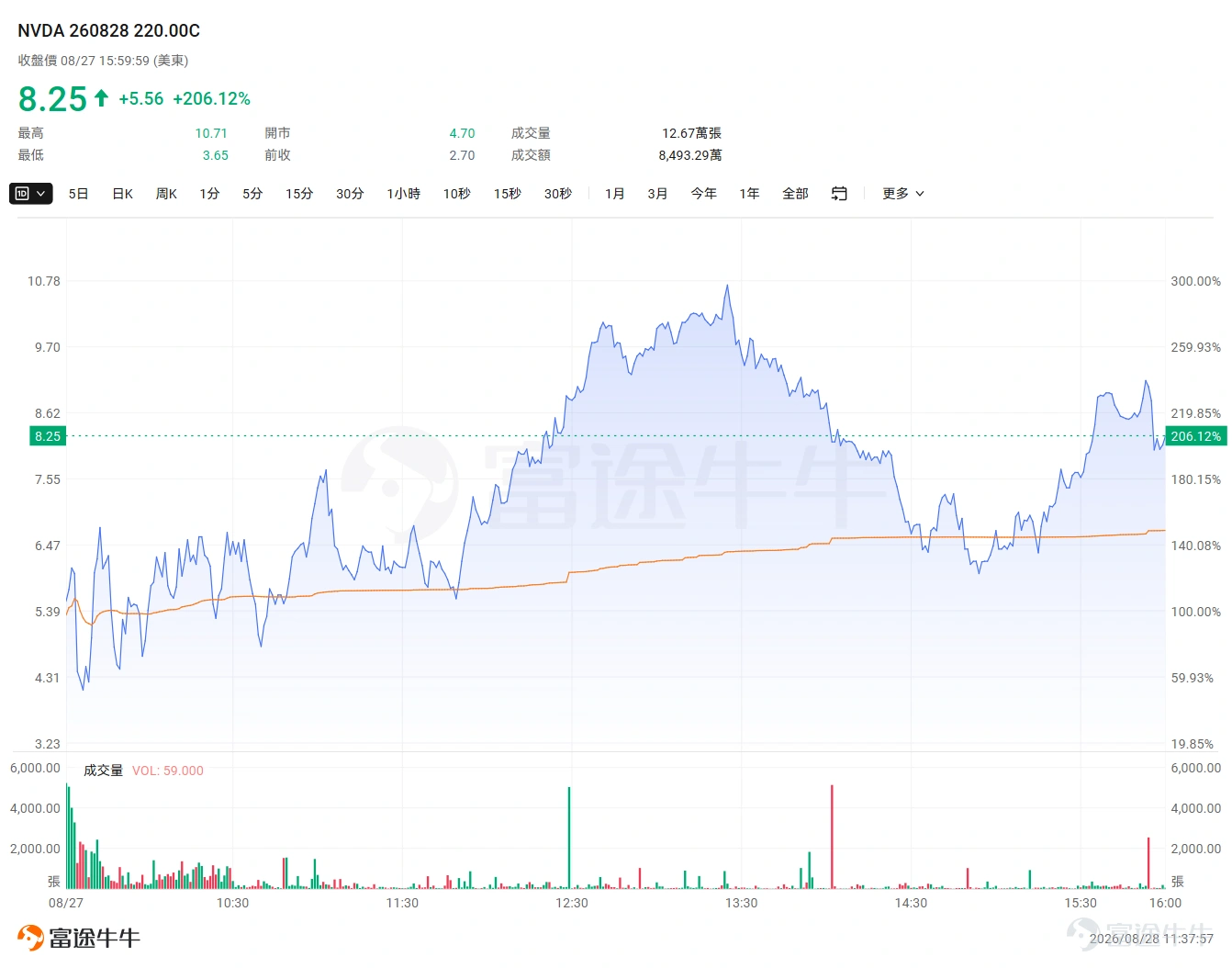
Let's break down this Call: NVDA 260828 220.00C
The contract we are looking at is—a NVIDIA call option with a strike price of $220, expiring on August 28, 2026.This is a standard "doomsday Call" with expiration just around the corner.
First, let's look at the data timeline:
Previous close (before earnings reaction): $2.70, which means the cost per contract was only$270—roughly the cost of a nice dinner for three to five friends.
Open: $4.70, doubling right at the open.
Intraday high reached $10.71, meaning the value of one contract once surged to$1,071。
Hit a low of $3.65, with wide-range fluctuations throughout the day.
Closed at $8.25, surging 206.12% (+$5.56) in a single day. One contract went from $270 to $825.
Let's crunch the numbers.If you had positioned one contract around $2.70 earlier, and it closed at $8.25, that’s slightly more than triple—$270 turned into $825, netting a profit of approximately $555. And if you were lucky and quick enough to exit near the intraday high of $10.71, that would be$270 turning into $1,071, nearly a fourfold return。
Of course, I must emphasize this again:This contract hit a high of $10.71 and a low of $3.65 during the day, showing massive volatility.
If you didn't exit at the $10.71 peak and watched it fall back to close at $8.25, your unrealized gains shrank from nearly 300% to 206%.This is the brutal reality of options trading: unrealized gains don't count; only realized profits matter. Especially since this is a "doomsday" contract expiring today (August 28), its time value is like the last few grains of sand in an hourglass. A slight dip in the underlying stock will cause the option's price to evaporate rapidly.
The real highlight this time: a strong unilateral rally that withstood the IV Crush.
This is the key lesson I most want to clarify for my fellow investors in this issue.
Many people buy earnings plays, correctly betting on the direction and seeing the stock surge as expected, only to check their accounts and find the options barely gained or even lost value. The culprit behind this frustrating scenario of "being right on direction but not making money" is...IV Crush。
Let's first review this term:IV stands for Implied Volatility, which can be understood as the market's expectation of future volatility—essentially the "uncertainty premium" embedded in the option's price. Before earnings reports, uncertainty about the results typically drives this uncertainty premium up, making options expensive. Once the earnings are released, uncertainty vanishes instantly, causing IV to plummet cliff-like. This automatic shrinkage in option prices is what we call an IV Crush.It acts like a flashbang: illuminating and inflating the option's price before earnings, only for the light to extinguish immediately once the results are out.
Speaking of which, I wonder if fellow investors still remember—In the issue from late July, we specifically used $Meta Platforms (META.US)$post-earnings examples to thoroughly explain the pitfall of "getting the direction right on earnings but still losing money."

For those interested, I strongly recommend going backto revisit it.:Back then, Meta's stock price clearly fell after its earnings report, dropping 8% in one go, yet many fellow investors who bought Puts watched helplessly as their options decreased in value instead of rising.This was because implied volatility (IV) was hyped up too high before the earnings release; once the results were out, the collapse in IV caused decay that completely wiped out the profits from getting the direction right.
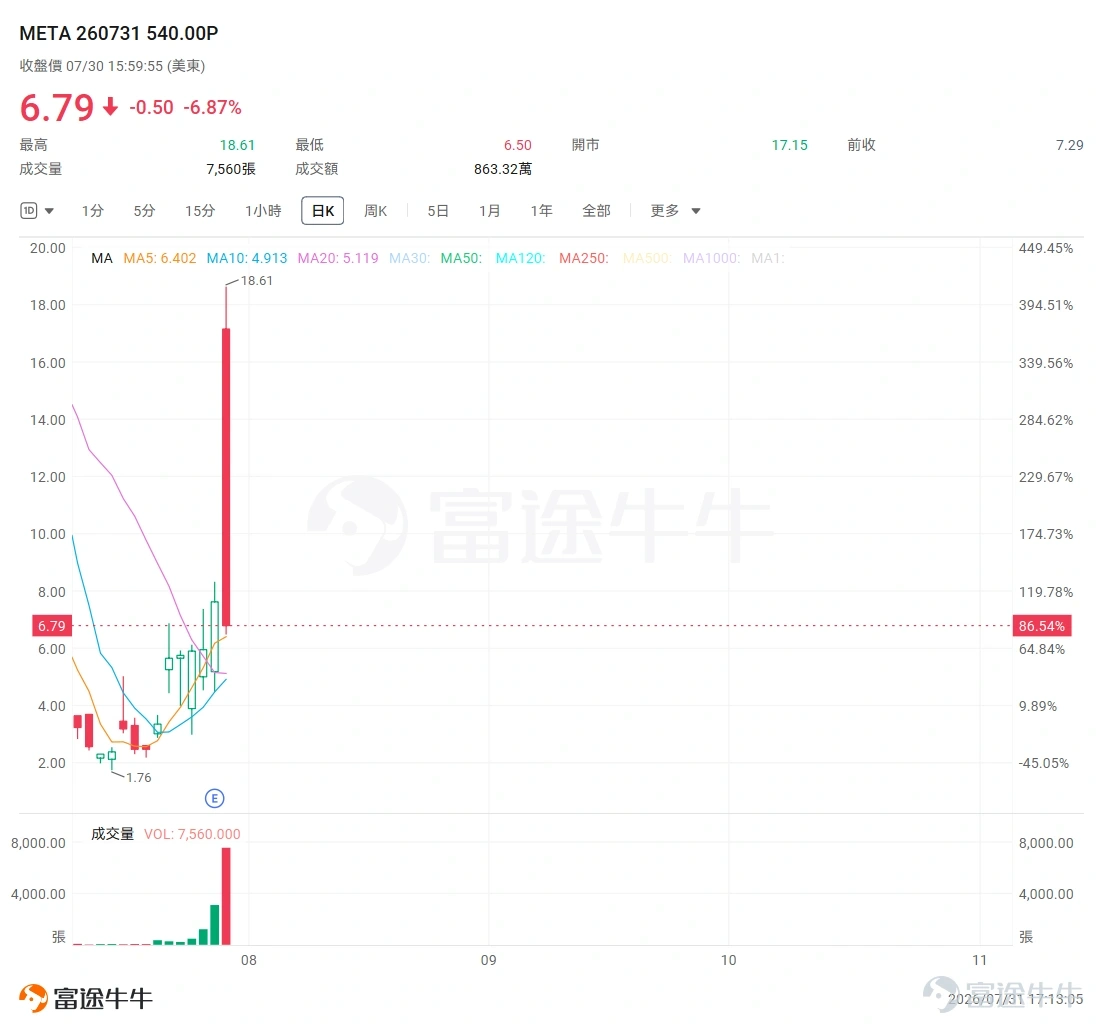
Meta's case was a classic example of "betting on the right direction but losing money"; this time with NVIDIA, it was precisely "betting on the right direction and making a profit." Despite both seeing significant post-earnings rallies, the vastly different outcomes came down to IV.
So, did that NVIDIA Call option completely avoid the flashbang? Not exactly—As you can see from the screenshot below, IV did indeed crash after the earnings release; this IV crush was very much a reality. But the key point is:This time, the IV crush was "overshadowed" by a much stronger unilateral surge in the stock price.
We actually mentioned in Monday's opportunity pool that NVIDIA's implied volatility (IV) was relatively low before its earnings report. What does this mean?It means the "uncertainty premium" embedded in these options was not substantial to begin with. So even if IV collapsed or deflated after the earnings release, the amount that could be squeezed out was relatively limited.
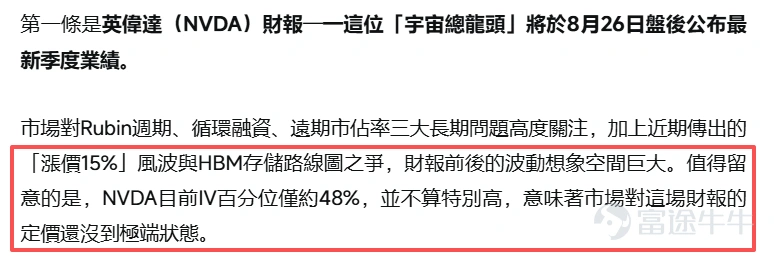
Thus, we witnessed a "tug-of-war":On one side, the IV crush pulled downward (deflating the options), while on the other, an 8.7% spike in the stock price aggressively pushed the options toward their intrinsic value. Since IV was not high before earnings and there wasn't much excess premium to deflate, while the directional momentum was strong enough,"Direction" ultimately won this tug-of-war—the growth in intrinsic value far outweighed the decay from the IV drop, allowing these calls to cleanly double or triple in value.
Conversely,if IV had been hyped to extreme levels before earnings, the downward pull from the IV crush would have been much stronger.Even if the stock price surges, the gains on this call option will be heavily discounted; in fact, profits from the directional move may not even cover the losses from the IV crush.Many fellow investors who "bet correctly on direction but made little profit or even lost money" fell victim to this combination of "high IV meeting an IV crush."
After the earnings release: The IV percentile dropped to 4%, making the environment more favorable for option buyers.
Let's look at the latest data:The IV rank has dropped to 4, and the IV percentile is also just 4%. What does this mean?It means NVIDIA's implied volatility is at an extremely low level compared to the past year—options are currently relatively "cheap."
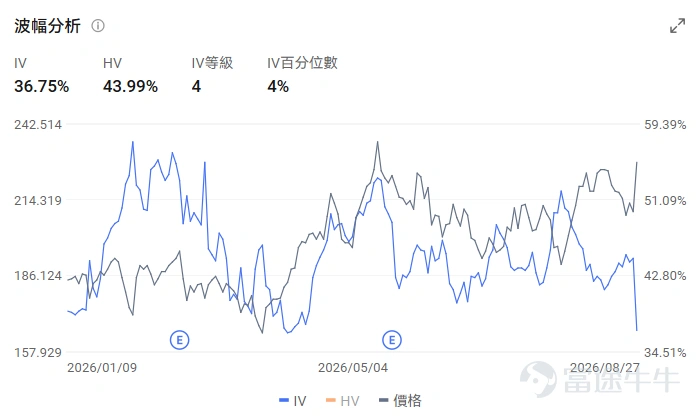
The event with the greatest uncertainty has passed, so IV has naturally retreated to low levels.For buyers, this is actually a relatively comfortable environment: whether buying calls or puts now, the "uncertainty premium" paid is very low, and time decay is relatively manageable. If you are looking to establish directional long or short positions after the earnings release, the current low-IV environment is much more cost-effective than the high-premium environment before earnings.
Of course, low implied volatility (IV) is a double-edged sword: low volatility expectations also imply that the market anticipates relatively flat price action ahead, so windfall profits from expiration-day moves won't happen every day.However, for fellow investors who have identified the right direction and want to use small capital to bet on a medium-to-short-term trend, low IV indeed offers a more favorable entry point. Keep this decision-making framework in mind:To determine whether it's worth entering as an option buyer, looking at the stock price direction alone is not enough; you also need to assess whether IV is expensive and whether its percentile rank is high.
In summary: the golden combination for option buyers is getting the direction right while IV has little premium left.
This week, NVIDIA gave us a textbook-level lesson—The seven-day decline reflected extreme pessimism in sentiment, while the reversal surge was an unexpected, aggressive recovery. Behind the $270 strike expiration-day Call soaring to $825, the real hero wasn't just "betting on the right direction," but also "low IV before earnings." Even though IV collapsed after the earnings report, the amount of premium that could be squeezed out was limited, and the gains from the directional move comfortably offset this round of IV crush.
Betting on the right direction but failing to make money often results from high IV that subsequently collapses; betting on the right direction and profiting usually comes down to "strong directional momentum combined with thin IV premium." This time, NVIDIA served as a perfect example of the latter.With the IV percentile dropping to an extremely low level of 4% after the earnings release, it has left a relatively cost-effective window for fellow investors looking to deploy long or short option positions.
Entering with a hundred dollars and gaining thousands—options indeed provide the possibility of leveraging small capital for big opportunities. Of course, high odds don't come for free; picking the right direction, timing, and managing position size are all essential. Understand first, then act. With the right rhythm, opportunities are never scarce. See you in the next review~
Not familiar with options basics? Study up before jumping in.
If concepts like "What is a Long Call?" or "How to interpret strike prices" are still a bit fuzzy when you read this review, don't rush to place orders—take some time to solidify your fundamentals first. Here are some practical introductory resources compiled for you; we recommend saving them:

Finally, we’ve got a little perk for our fellow investors—feel free to claim it!Options Starter Pack
*This promotion is exclusively available to invited Hong Kong users. Click to learn more.Detailed terms and conditions of the promotion >>
Disclaimer
This content does not constitute an offer, solicitation, recommendation, opinion, or any guarantee regarding any securities, financial products, or instruments. The risk of loss in trading options can be substantial. In certain circumstances, your losses may exceed the initial margin deposit. Even if you place contingent orders, such as 'stop-loss' or 'limit' orders, there is no assurance that losses will be avoided. Market conditions may prevent these orders from being executed. You may be required to deposit additional margin on short notice. If you fail to meet the required margin within the specified time, your open positions may be liquidated. Nevertheless, you remain liable for any deficit balance in your account resulting from such events. Therefore, you should thoroughly research and understand options before trading, and carefully consider whether such trading is suitable for you based on your financial condition and investment objectives. If you trade options, you should familiarize yourself with the procedures for exercising options and handling expiration, as well as your rights and obligations upon exercise or expiration.
Risk Disclaimer: The above content only represents the author's view. It does not represent any position or investment advice of Futu. Futu makes no representation or warranty.Read more


Comments (3)
to post a comment
13
5