Zhipu's earnings surge as AI commercialization breaks new ground! What are the opportunities?

Kimi seeks a 30% cut from US cloud providers: Are open-source models starting to collect rents?
1. The Facts: Cloud providers supply compute power and sell services, while Kimi demands up to a 30% revenue share.
According to a Reuters report on August 26, Kimi is in negotiations with three cloud giants—Microsoft, Amazon, and Google. These cloud providers would be responsible for hosting Kimi K3, supplying compute resources, and collecting payments from customers. In return, Kimi aims to take up to a 30% share of the service revenue related to K3. The negotiations are still in early stages, with no agreements signed yet. The main sticking points revolve around three issues: how to split the revenue, the extent of data access rights, and how to audit token usage. If successfully concluded, this would mark the first time a Chinese AI company has secured such a significant revenue-sharing arrangement with major US cloud providers.
It is crucial to distinguish between "listing" a model and establishing a "formal partnership," as they are two different things. K3 is an open-weight model with 2.8 trillion parameters. While the weights can be downloaded, most enterprises lack the capability to deploy it independently. Although third-party hosting is technically feasible, enterprise clients require more than just model access; they need unified billing, compliance adherence, Service Level Agreements (SLAs), and technical support. Therefore, Moonshot AI is not merely selling access to "use K3," but rather a comprehensive service package that includes the official version, enterprise-grade support, and co-selling privileges.
Historically, the norm for model companies has been either to purchase large amounts of compute power from cloud providers or to cede a portion of their revenue to cloud providers through investment agreements. In April 2026, Microsoft disclosed that OpenAI's revenue-sharing arrangement with Microsoft will continue until 2030, with external reports suggesting the share is approximately 20%. In contrast, Kimi's proposal flips this dynamic: cloud providers would initially bear the inference costs and handle customer acquisition, then pay up to a 30% "upstream royalty" to the model company. This represents a distinctly different direction.
Kimi's competitive edge rests on two pillars: performance and deployment barriers. K3 scored 1,679 points in the Frontend Arena, surpassing Claude Fable 5's 1,631 and GPT-5.6 Sol's 1,618. Its massive scale of 2.8 trillion parameters means only large platforms can afford and efficiently handle its deployment. However, leaderboard leadership typically lasts only a few months—which is precisely the key factor in determining whether the 30% deal will go through.
II. The "original" business model for open-source models: Abandon selling the model itself; sell ecosystem positioning.
Strictly speaking, K3, Llama, and some Qwen variants fall under "open weights," which may not fully meet the Open Source Initiative's definition of open-source AI. However, from a commercial research perspective, they face the same challenge: once weights are downloadable, it becomes difficult to maintain high pricing for model access alone. Vendors must shift monetization to APIs, cloud consumption, enterprise deployments, and ecosystem standards.
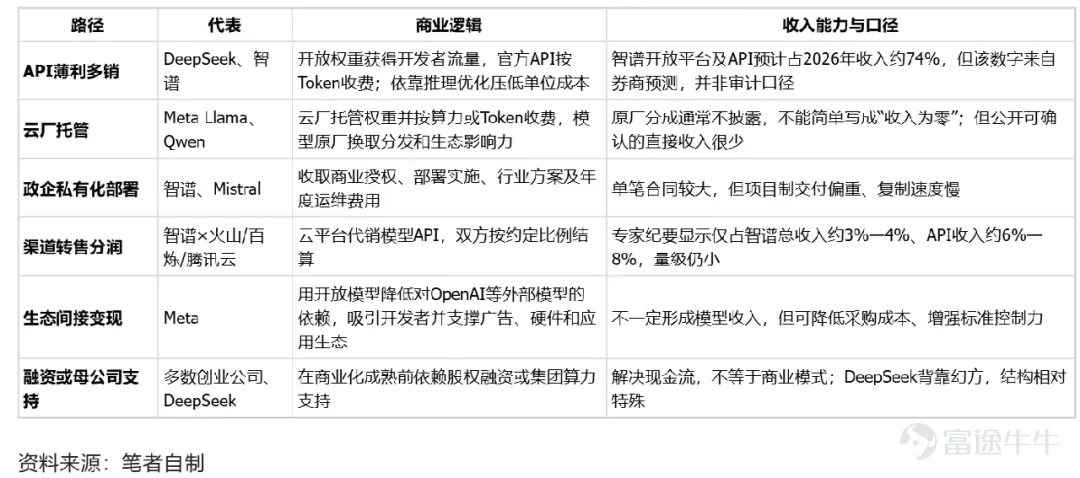
The original monetization pathways, ranked by actual revenue contribution
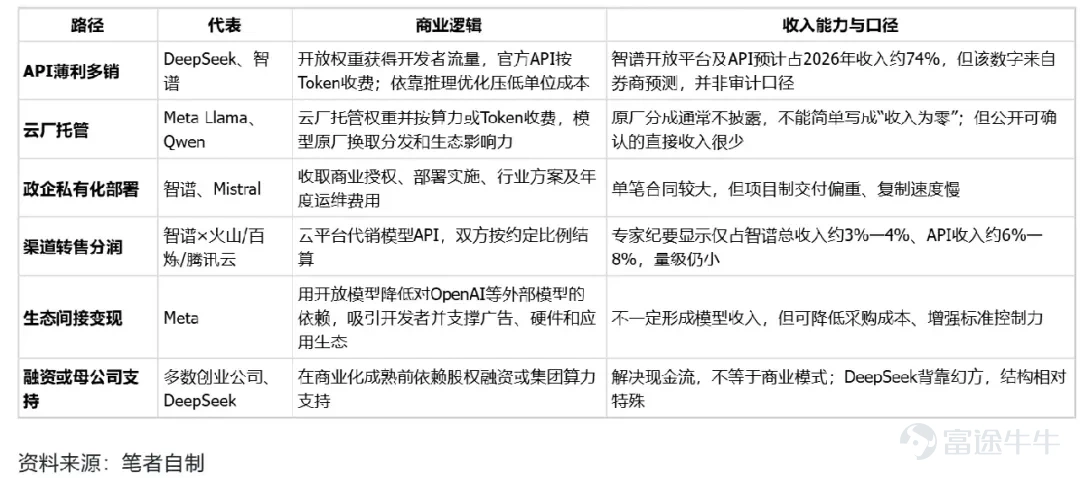
Why the "original model" generates less profit than closed-source models
Open-weight models are not incapable of generating revenue, but achieving direct monetization is generally more challenging than with closed-source models. There are three main reasons:
First, channel lock-in is impossible. Since weights are public, third-party inference providers can host the same weights and offer services independently, making it difficult for model companies to charge premium prices based solely on "access rights."
Second, price wars are intense. Models like DeepSeek have previously traded low prices for higher usage volume, continuously driving down the industry-wide per-token price, leaving no room for high unit prices.
Third, customer relationships are not held by the model providers. Client relationships are controlled by cloud providers and aggregator platforms like OpenRouter. While model companies know how many times their models have been downloaded, they often do not know who the end-users are, let alone leverage those relationships for cross-selling other services.
Some may cite OpenAI's data: approximately 1 billion weekly active users, with only about 50 million paid subscribers, resulting in a conversion rate of around 5%. This indeed suggests that free traffic is not easily monetized. However, note that one cannot infer "API payment rates are lower" simply because the subscription conversion rate is 5%, as these two user groups belong to different pools, making their denominators incomparable.
What has changed with the 30% revenue share for K3?
K3 aims to upgrade the old model of "indirectly monetizing open-source weights through ecosystem building" to directly collecting royalties based on cloud usage volume. Previously, models were offered for free to acquire users, while cloud providers earned from compute costs; now, Moonshot AI intends to add its own checkout counter to cloud bills—charging users based on their actual usage.
Its true innovation is not "entering channel sales for the first time"—Zhipu, Mistral, and Meta have already engaged in similar collaborations with cloud providers—but rather proposing a unified, transparent upstream royalty fee to the three major US cloud giants simultaneously. The combination of "unified + public" is what makes this new.
If this model proves viable, small users can still download for free, with only large MaaS platforms and heavy-use clients paying once their usage crosses a certain threshold. In essence, it separates "ecosystem expansion" from "commercial monetization" through "tiered pricing." The benefit is that both objectives can be pursued without conflict, but the cost is that the notion of "fully open" becomes diluted, leading developers to worry about whether licensing costs will continue to rise.
Model-building companies are beginning to claim a share of the value chain in the cloud sector. If K3 succeeds in securing this revenue, Qwen, GLM, and DeepSeek will have reasons to renegotiate as well. Conversely, if cloud providers simply host their own models and withhold traffic, the model layer will struggle to retain significant value.
3. Impact on Kimi: Shifting from self-operated services to channel revenue, with moderate short-term revenue elasticity
Shifting from "going global independently" to "collecting rent through channels"
This deal offers three layers of value to Moonshot AI:
First layer: Gaining entry into the procurement systems of overseas enterprises. Kimi lacks a global sales network, the ability to collect USD, and an overseas compliance framework. By joining the three major cloud platforms, it effectively taps into pre-approved corporate cloud budgets—it is much easier for customers to select a model within their existing cloud contracts than to separately procure APIs from a Chinese startup.
Second layer: Improving revenue quality. With deployment, inference, and delivery handled by cloud providers, Moonshot AI collects royalties based on usage volume, which is theoretically far lighter than building overseas compute infrastructure or maintaining an overseas sales team. However, a key question remains: what is the denominator for the 30% share? If the share is calculated based on the total revenue of K3 services, the value is substantial; if GPU costs, discounts, and channel fees are deducted first, or if the royalty applies only to the model's net revenue, the actual value of this income will be significantly reduced.
Third layer: Potential impact on Kimi's valuation. This negotiation could demonstrate that Moonshot AI is not merely a Chinese consumer-facing application but potentially a global model provider. Whether overseas revenue can be validated will determine whether the market values it as an internet application company or as a model platform capable of generating sustained royalty income—two entirely different valuation logics.
Short-term revenue elasticity: At the tens of millions of dollars level; it may exceed $100 million only after significant volume scaling.
SemiAnalysis estimates based on specific Agent workloads: The blended realized price for K3 is approximately $0.74 per million tokens, with service costs around $0.17. Note that $0.74 is not Kimi's official list price—the official rates are $0.30 for cached input, $3.00 for uncached input, and $15.00 for output per million tokens. The $0.74 figure is a "weighted average price under actual load," derived from cache rates and input/output structures. It is intended solely for scenario analysis and should not be treated as official pricing.
Table: Estimated revenue elasticity for Kimi driven by the three major US cloud platforms
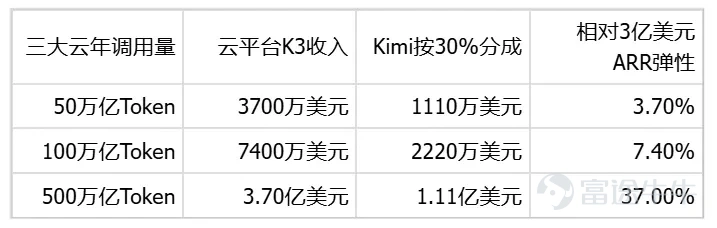
Note: Cloud platform revenue = (Token volume / 1,000,000) × $0.74; Kimi's share = Cloud platform revenue × 30%. Kimi's current Annual Recurring Revenue (ARR) is assumed to be approximately $300 million. Sources: SemiAnalysis, Kimi's official pricing, public information, and author's calculations.
Breaking down the allocation of every $1 in K3 revenue under this methodology: Kimi receives $0.30, inference costs are approximately $0.23, and the cloud providers retain a gross margin of about $0.47. Thus, the 30% take rate is not unacceptable for cloud providers—provided that SemiAnalysis's cost estimates hold true for real-world workloads and excluding additional sales and support expenses.
Under the base-case scenario, initial revenue is more likely to fall between $10 million and $20 million, contributing less than 10% to the $300 million ARR; the revenue share would exceed $100 million only when annual token usage approaches 500 trillion. Therefore, in the short term, the significance of this agreement lies in
......
Risk Disclaimer: The above content only represents the author's view. It does not represent any position or investment advice of Futu. Futu makes no representation or warranty.Read more

Comment (1)
to post a comment
9
6