
Decoding the 2026 Interim Report: When Volume-Based Procurement Leaders Start Earning Global Revenue
In the first half of 2026, the "growth narrative" of China's medical device industry is undergoing a shift.
On one front, volume-based procurement (VBP) is curbing excessive internal competition, with policies guiding the industry from "price wars" toward "quality competition." On the other, overseas expansion is accelerating: as domestic VBP enters deeper waters, more medical device companies are turning their attention abroad, with high-value consumables firms evolving their global strategies from "testing the waters" to "deep cultivation."
Amid intensifying industry divergence, vascular intervention leader ZCT Medical (2190.HK), listed in Hong Kong, delivered its interim results: revenue for the first half of 2026 rose 31.1% year-on-year, net profit increased by 47.8%, and overseas revenue surged by 349.3%.
More noteworthy than the growth rates themselves is the change in growth structure. Domestic operations remained robust, with profit growth consistently outpacing revenue growth; meanwhile, the share of overseas business in total revenue rose to 11.2%, becoming an不可忽视 (non-negligible) source of incremental growth.
Previously, the market largely viewed ZCT Medical through the lens of "domestic substitution." Today, as it progressively builds its overseas brand, channels, and local operational capabilities, ZCT Medical is transitioning from a vascular intervention company primarily reliant on expansion in the Chinese market to a global platform driven by both domestic and international engines.
Understanding how this transition occurred and whether it can translate into sustained growth is key to interpreting ZCT Medical's interim report.
From Scale Expansion to Profit Realization: The Dual-Click Channel Continues to Deliver
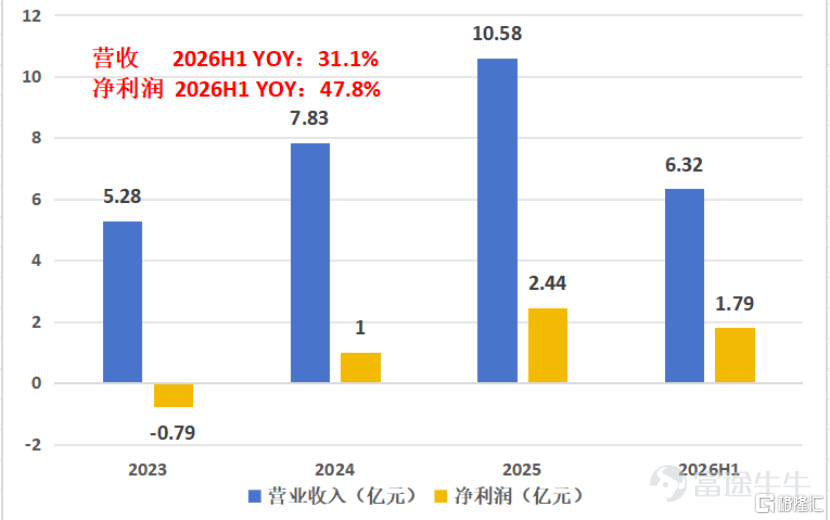
In the first half of 2026, Zhongchuang Tongqiao reported a net profit of RMB 179 million, a year-on-year increase of 47.8%, significantly exceeding the 31.1% growth rate of operating revenue for the same period. The net profit margin rose to 28.3%, further solidifying the "scale expansion + profit realization" dual-engine effect.
Chart 1: Company Revenue and Profitability Performance

Data Source: WIND, compiled by Gelonghui
The fact that profit growth continues to outpace revenue growth is no coincidence; it is driven by the resonance of three underlying factors.
Revenue Side: Resilient performance through the cycle.
In the first half of 2026, the company recorded revenue of RMB 632 million, a year-on-year increase of 31.1%, maintaining the 42% compound annual growth rate (CAGR) seen from 2023 to 2025. Amid the normalization of centralized procurement, the company is offsetting downward price pressure by expanding sales volume.demonstrating strong resilience。
By business segment, growth is driven by the dual engines of neurovascular intervention and peripheral vascular intervention, with new products ramping up in volume.
In the first half of 2026, neurovascular intervention revenue reached RMB 366 million, up 20.2% year-on-year. Mature products such as the Qilin flow diverter continued to see stable volume growth, while the Feilong embolization support stent, the first domestic DFT-material product, began contributing to revenue. Peripheral vascular intervention revenue amounted to RMB 247 million, a 40.0% year-on-year increase, driven by the sequential volume ramp-up of venous lines and hemodialysis access products, combined with the consolidation of Optimed, raising its revenue share to 39.1%.
Expense Side: Release of scale effects and continuous optimization of expense control.
Despite rapid revenue growth, the company maintained disciplined expense management. In the first half of 2026, the R&D expense ratio decreased from 25.2% to 16.8%, and the administrative expense ratio dropped to 10.2%, reflecting simultaneous revenue expansion and effective cost control.
Profit Side: Gross margin rose by 2.2 percentage points against the trend, primarily driven by product mix upgrades.
Against the backdrop of normalized centralized procurement, the company's gross margin increased from 71.2% to 73.4%, placing it in the upper-middle range among peers. This counter-trend performance was underpinned by continuous manufacturing improvements, supply chain optimization, and a strategic shift toward high-margin innovative products. New products such as the Feilong embolization support stent and keel balloons began to ramp up in volume, effectively offsetting price pressures on procured products.
Chart 2: Gross Margins of Comparable Companies

Data Source: WIND, compiled by Gelonghui
More than 349%: Zhuchuang Tongqiao’s second growth curve begins to reflect in financial statements
If domestic operations have validated Zhuchuang Tongqiao’s "resilience"—expanding scale and sustaining profitability amid the normalization of centralized procurement—then its overseas business demonstrates the company’s "sharpness," proactively entering global markets to expand growth boundaries.
In the first half of the year, the company’s international revenue reached RMB 70.6 million, a year-on-year surge of 349.3%. Its share of total revenue jumped from 3.3% to 11.2%, with overseas income more than quadrupling compared to the same period last year. Internationalization has thus transitioned from a "strategic narrative" to "financial reality."
Chart 3: Company’s Overseas Sales Revenue and Share of Revenue from Core Regions

Source: Company announcements, compiled by GeLunHui
The key variable driving this explosion was the efficient execution of the acquisition of Germany’s Optimed.
Historically, Chinese medical device companies expanding overseas primarily followed a "product export" model. This approach involved selling goods abroad through distributors, featuring an asset-light structure and rapid launch. However, this path has inherent bottlenecks: lack of channel control, weak brand recognition, and margins eroded by intermediaries, leaving overseas markets as merely "incremental" rather than a "stronghold."
Zhuchuang Tongqiao chose a different path: "system export." By establishing roots overseas through mergers and acquisitions, despite higher costs and longer cycles, this strategy offers significant value: direct channel control, solid brand recognition, and retention of profits without dilution by intermediaries. Consequently, overseas markets have become a true "strategic fulcrum" for leveraging global growth.
The essential difference lies in the underlying logic: product export follows a trade logic focused on arbitrage, whereas system export follows an industrial logic aimed at securing pricing power and brand premium. $ZYLOXTB (02190.HK)$
In April 2026, Zhuchuang Tongqiao completed the acquisition of a 60% stake in the German med-tech firm Optimed. With decades of深耕 (deep cultivation) in the European market, Optimed holds a 20% market share for venous stents in Germany, is a established leader in ureteral stents, and maintains long-term collaborations with top European hospital groups. Through this controlling acquisition, Zhuchuang Tongqiao gained a comprehensive suite of localized operational capabilities in Europe, spanning direct sales teams, customer relationships, brand recognition, supply chain, and compliance systems. Building such capabilities organically could take years, and they remain inaccessible through mere trade models.
Using M&A to leverage globalization already has mature precedents in the medical device industry.In 2008, Mindray acquired the patient monitoring business of US-based Datascope, thereby entering the high-end markets in Europe and the US and strengthening its local direct sales capabilities. In 2018, Weigao acquired Argon Medical, gaining a foothold in the high-value interventional sector and accessing a global sales network. The underlying logic of such transactions is to shorten the development cycle for products, channels, and local teams through M&A. Upgrading from "product export" to "system export," Zylox-Tonbridge is replicating this leapfrog path.
Acquisition is just the beginning; integration is the key.
Post-closing, the sales and marketing teams of both parties were rapidly merged into a unified global organization, extending channel coverage to 135 countries and regions. More notably, the implementation of direct sales capabilities has been significant: in Germany and France, two of the top 10 global medical device markets, the company completed the transition from distribution to direct sales in just two months, securing its first batch of direct sales orders in July. Currently, the company's sales network covers over 80% of local Group Purchasing Organizations (GPOs) and has entered several leading hospital groups. From closing the deal to switching channels and finally "winning orders," Zylox-Tonbridge established a closed loop for localized operations in less than six months.
Beyond channels, business boundaries are also expanding in tandem.
The dual-brand strategy of "Zylox-Tonbridge + optimed" provides a foundation for sharing customer and channel resources across different product lines. optimed continues to leverage its brand recognition and customer base accumulated in the European market, while Zylox-Tonbridge introduces its own product matrix through the local platform, opening up cross-selling opportunities while retaining existing market advantages. Furthermore, optimed's original urology business has contributed 27% of overseas revenue, further diversifying overseas income sources. Consequently, the company's overseas business is shifting from mere product output to synergistic operations involving multiple brands and product lines.
The next step is to integrate the global supply chain.
From a medium-to-long-term perspective, after channel integration resolves the issue of product access to global markets, the next challenge is how to serve global markets more efficiently. Leveraging its production base layout in China and Germany, the company is poised to optimize global resource allocation, forming a supply chain pattern of "global sourcing, global manufacturing, and global delivery." Thus, the synergies from M&A will extend further from the revenue side to the cost and efficiency sides.
Summary
Through this interim report, Zylox-Tonbridge's growth logic is shifting: Domestically, the winding down of centralized procurement and the move against "involution" are returning competition to fundamentals of product and efficiency, allowing the company to solidify its baseline market share and profits. Overseas, the integrated global operational platform and sales footprint open up a longer growth cycle—the former determines the performance floor, while the latter raises the growth ceiling.
In the past, the market was accustomed to evaluating high-value consumables companies based on the centralized procurement cycle, but Zylox-Tonbridge has offered another answer through consistently delivered performance: Centralized procurement can be a predicament, but also a springboard for market leaders to leap in share; going global can be just a narrative, or it can be a growth engine written into the financial statements. According to WIND data, the global peripheral intervention market is approximately $10 billion, and the neuro-intervention market is about $7 billion, with China accounting for less than 20% of each. The ceiling for overseas expansion has far from been reached.
From a valuation perspective, the company's current P/E ratio (TTM) is 21.51x, still in the lower-middle range of the past five years (data as of the close on August 27). The market may have recognized a Chinese leader in vascular intervention, but has not yet fully priced in the possibility of its leap to a global platform. The significance of this interim report lies precisely here: it not only confirms current growth but also moves the "global platform" concept from imagination to verification.
Chart 4: Company P/E Band

Data source: Wind, compiled by Gelonghui. Data as of August 27.
Risk Disclaimer: The above content only represents the author's view. It does not represent any position or investment advice of Futu. Futu makes no representation or warranty.Read more

Comments
to post a comment
1