"SaaS Doomsday" Meets Earnings Counterattack! Can the Software Rally Broaden?

Major rebound in US software stocks! IGV hits a new year-to-date high. Which companies are being repriced by AI?
Since the beginning of this year, the market has been concerned that generative AI would bypass traditional software, leading enterprises to reduce SaaS subscriptions,even giving rise to the so-called "SaaS apocalypse."
These concerns are not unfounded. If AI Agents become the primary interface for enterprise employees to handle coding, customer service, marketing, and data analytics, some software companies reliant on "per-seat pricing" could indeed face risks such as reduced seat counts, diminished pricing power, or even being disintermediated by upper-layer AI interfaces.
However, the latest round of earnings reports offers another perspective:AI has not broadly bypassed traditional software; instead, it is amplifying the value of a group of enterprise software platforms.
Platforms that truly control enterprise data, core workflows, and customer access points have not only avoided being replaced by AI but have begun leveraging AI to increase average revenue per user (ARPU), boost product usage, and unlock new revenue streams.
Software ETFs are soaring; what is the market trading on?
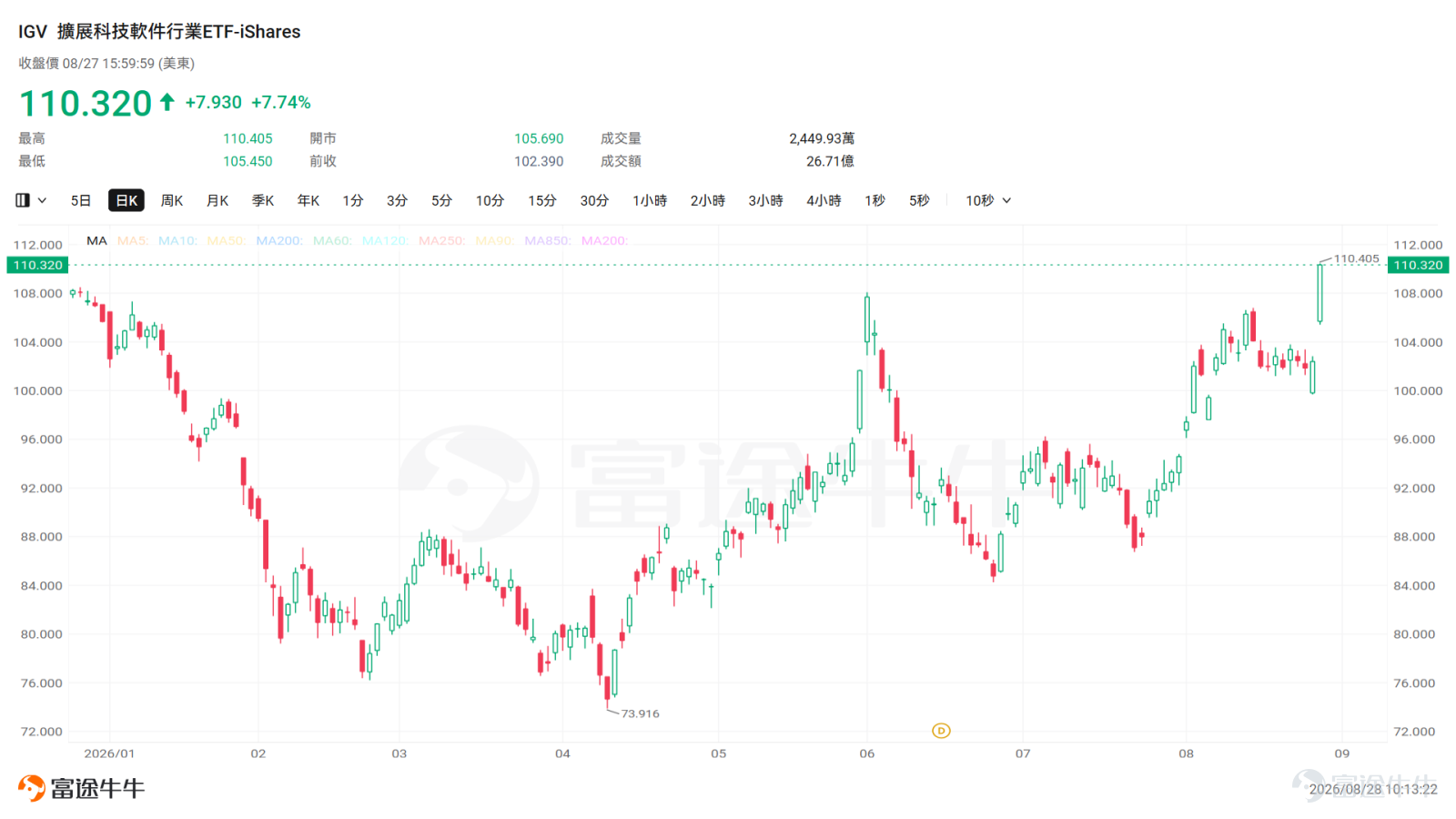
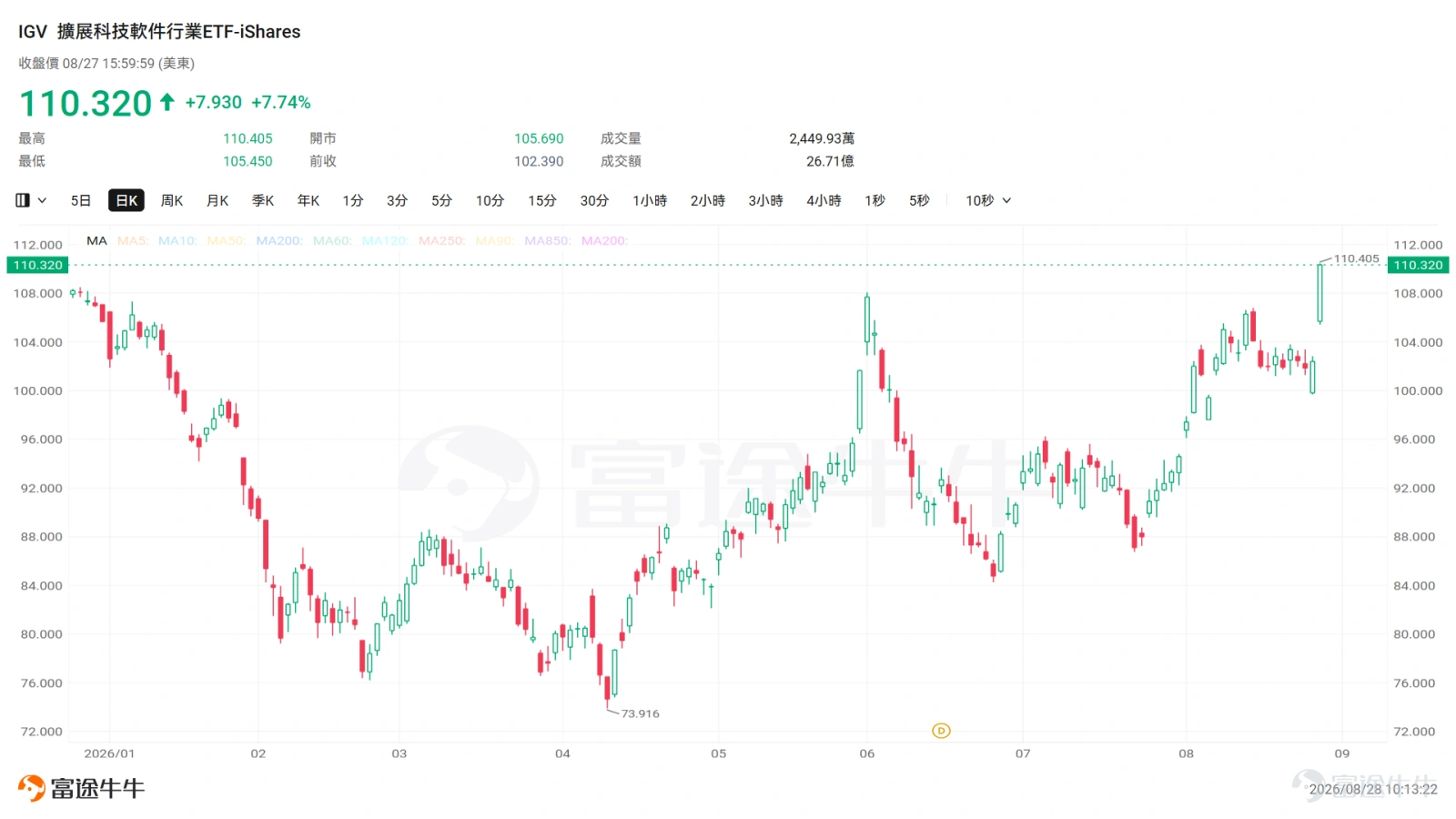
On August 27, $iShares Expanded Tech-Software Sector ETF (IGV.US)$ Surging 7.74% to hit a new year-to-date high, IGV has rebounded more than 43% from its yearly low.
--
--
--
This is not a short-term anomaly driven by a single company, $Salesforce (CRM.US)$ 、 $CrowdStrike (CRWD.US)$ as software leaders rallied sharply after reporting earnings, $ServiceNow (NOW.US)$ 、 $Palo Alto Networks (PANW.US)$ pulling similar peers along with them, indicating that capital is reassessing AI's impact on the entire enterprise software industry.
Reuters noted that strong results from companies like Salesforce have alleviated market concerns about AI disrupting the traditional software industry, prompting funds to flow back into software stocks that had previously faced concentrated selling.
In other words, the market is trading not just on earnings beats, but on a concentrated repair of valuations for software stocks that had been excessively depressed.
Just how "explosive" were the earnings for software stocks in this cycle?
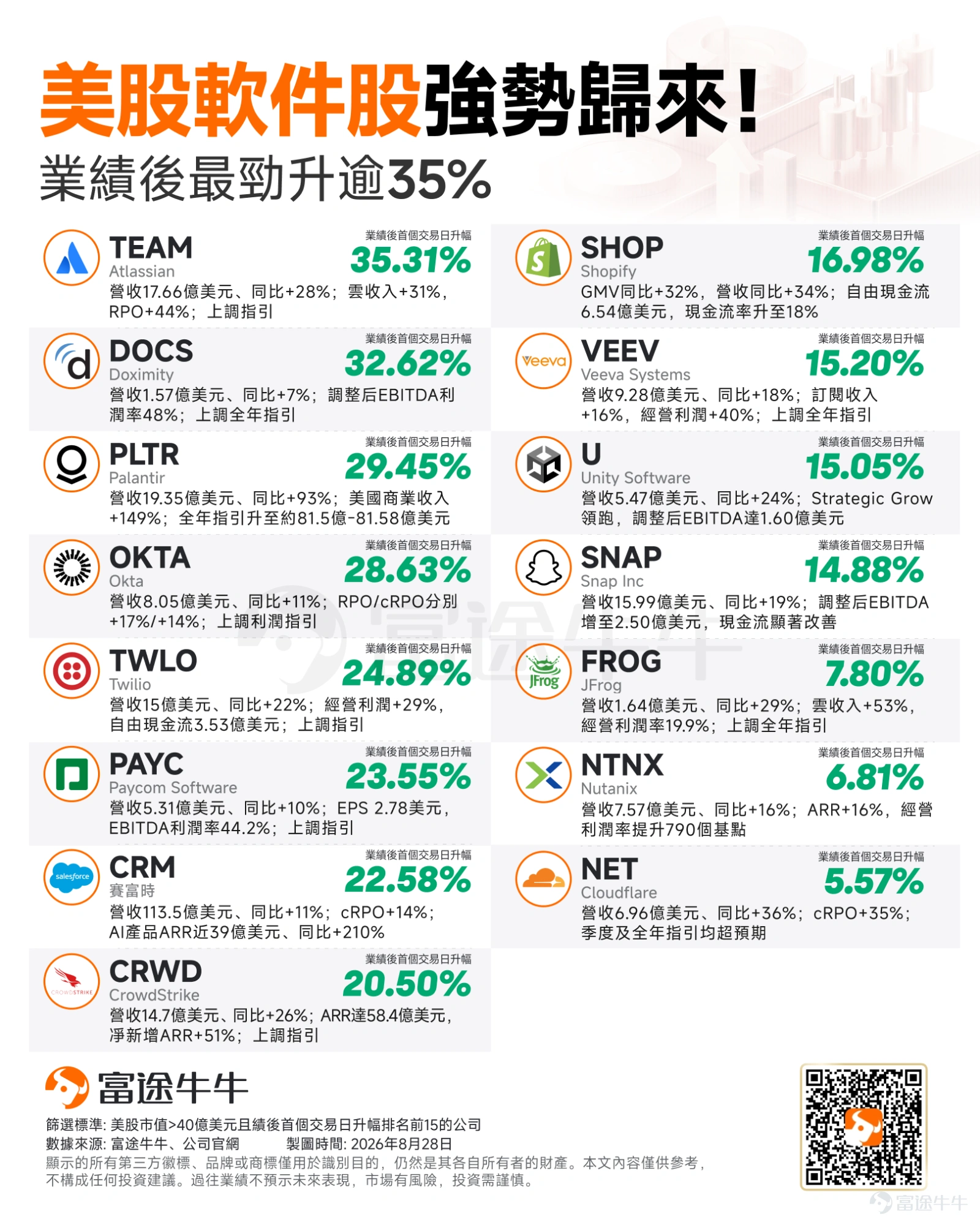
A review of the recent earnings season reveals that this rally is not a indiscriminate chase of all software stocks by the market,but rather capital concentrating rewards on three types of companies: those with re-accelerating revenue or orders, those whose AI products are beginning to generate quantifiable revenue, and those showing significant improvement in profit margins and free cash flow.
--
--
--
Category 1: Revenue and orders are re-accelerating, proving that corporate IT spending has not disappeared.
The most obvious commonality in this round of rebound is that many companies not only exceeded revenue expectations, but also saw acceleration in forward-looking indicators such as orders, remaining performance obligations (RPO), and annual recurring revenue.
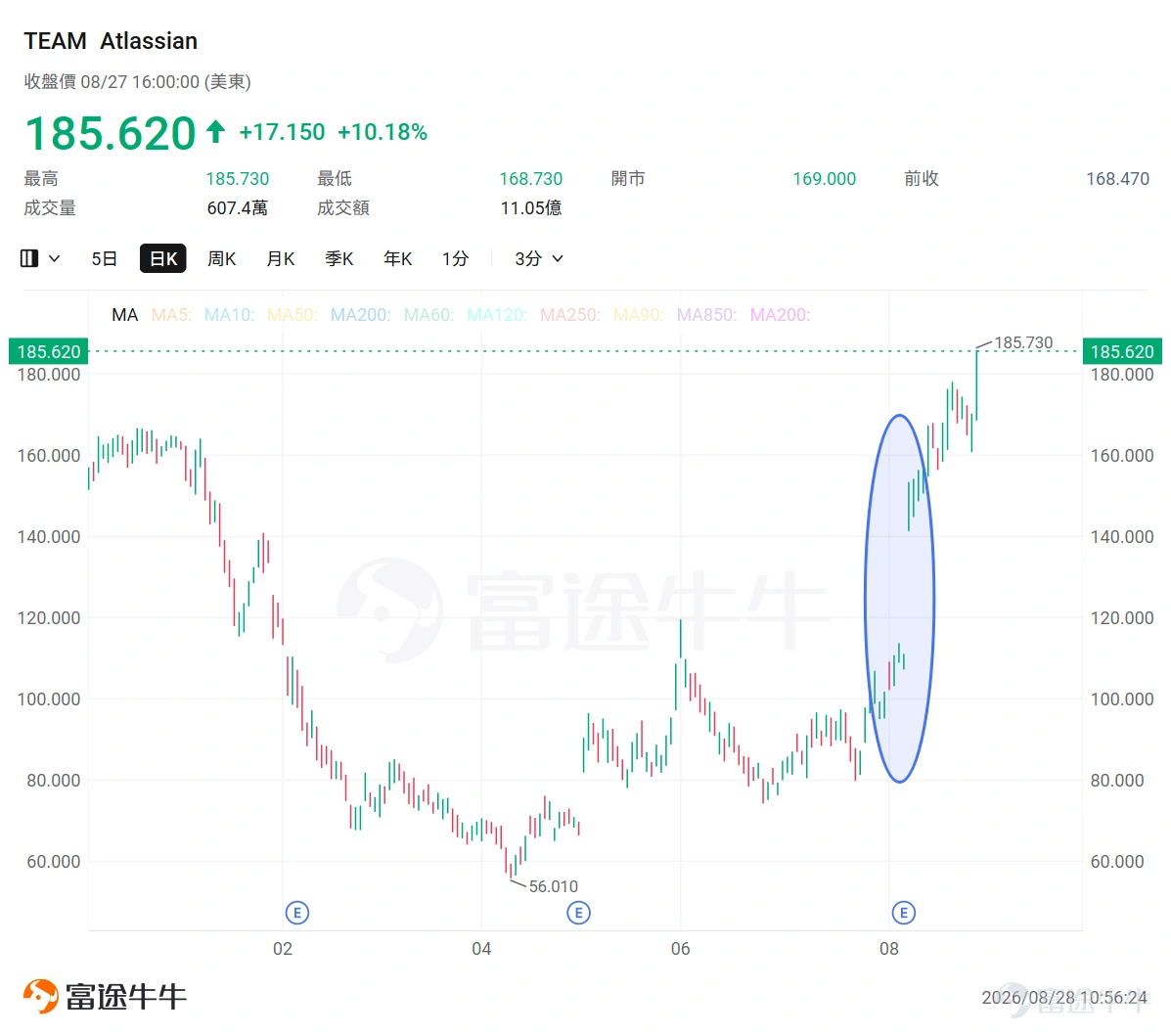
$Atlassian (TEAM.US)$ Shares surged 35.31% post-earnings. The company reported quarterly revenue of $1.766 billion, a 28% year-over-year increase; cloud revenue grew 31%, remaining performance obligations (RPO) increased 44%, and full-year guidance was raised.
--
--
--
These figures reflect that enterprise customers have not stopped purchasing collaboration and development tools due to AI; instead, they are accelerating their consolidation onto cloud platforms. For Atlassian, AI is more likely to serve as a tool to enhance product stickiness and average revenue per user (ARPU), rather than replacing its workflow entry point.
$Cloudflare (NET.US)$ [Palantir] also exhibited similar characteristics, with revenue up 36% year-over-year and committed RPO (cRPO) up 35%. Both quarterly and full-year guidance exceeded expectations, driving a 5.57% post-earnings stock price increase. CrowdStrike recorded 26% revenue growth, with ARR reaching $5.84 billion and net new ARR growing 51%.
These companies collectively demonstrate that when software platforms control key enterprise gateways such as security, networking, identity authentication, and collaboration workflows, AI is unlikely to bypass them. Instead, it may drive increased enterprise spending on data, security, and infrastructure.
Category 2: AI transitions from narrative to revenue, prompting the market to re-rate valuations
Over the past two years, nearly all software companies have been talking about AI. However, the market is no longer concerned with merely 'having AI products,' but rather whether AI can genuinely generate new orders, paying users, and recurring revenue.
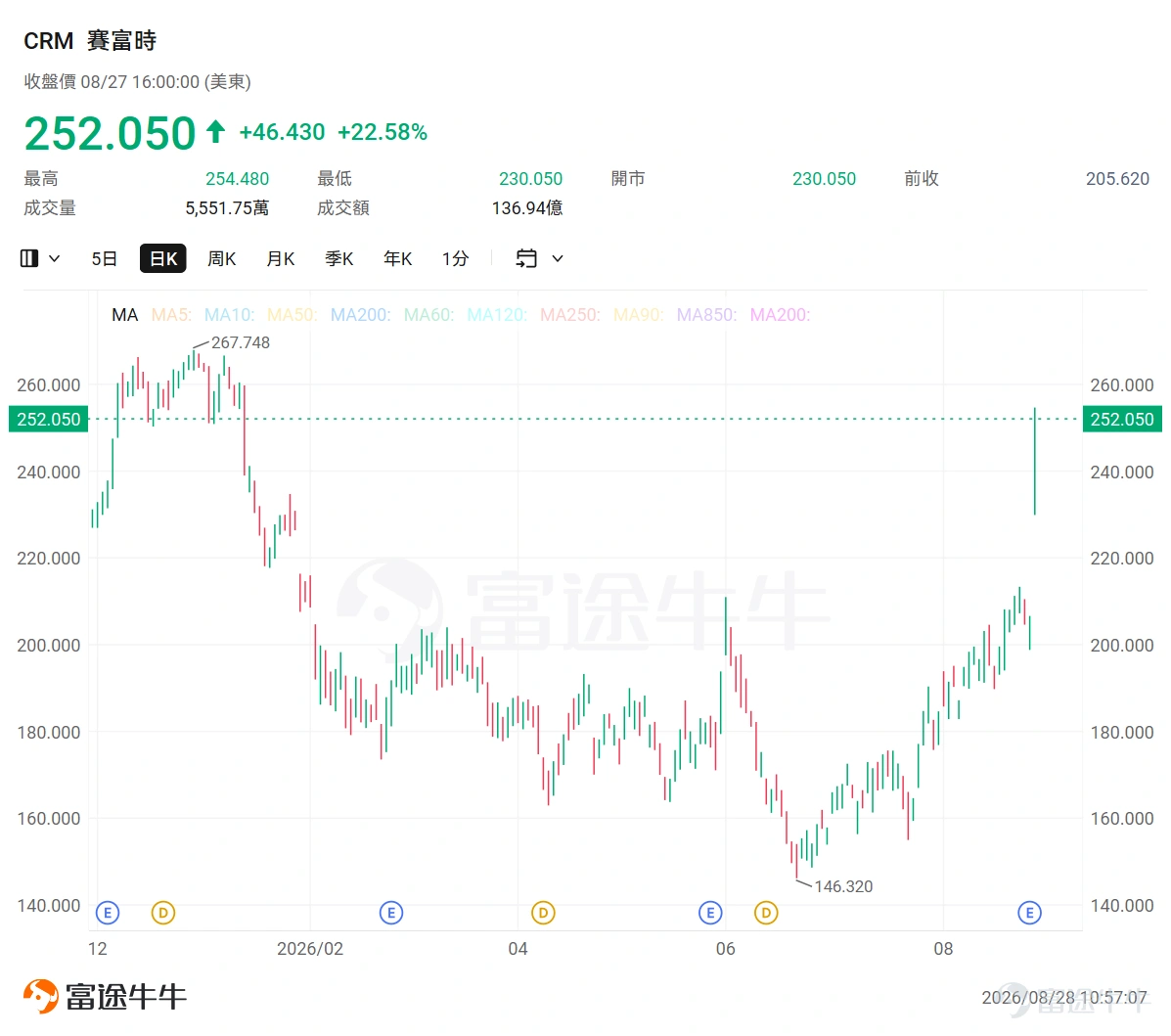
$Salesforce (CRM.US)$ [Salesforce] is the most typical example, reporting quarterly revenue of $11.35 billion, an 11% year-over-year increase; cRPO grew 14%, and AI product ARR approached $3.9 billion, surging 210% year-over-year. This drove a 22.58% post-earnings rise in its stock price.
--
--
--
This implies that Salesforce's contribution from AI is gradually shifting from product launches and concept demonstrations to revenue verifiable in financial statements. As enterprises seek to deploy AI customer service, sales assistants, and automated workflows, Salesforce's customer data, CRM systems, and enterprise gateway have become its most important competitive moats.
Additionally, Salesforce announced an expanded strategic partnership with Anthropic to launch 'Claudeforce,' deeply integrating Claude's reasoning capabilities with Salesforce's enterprise-grade data, workflows, and governance systems.
$Palantir (PLTR.US)$showed more outstanding performance,The company's quarterly revenue reached $1.935 billion, a 93% year-over-year increase, with U.S. commercial revenue up 149%. It raised its full-year guidance to approximately $8.15 billion. Following the earnings announcement, the stock price surged 29.45%.
Palantir's core advantage lies not just in the large language models themselves, but in its ability to integrate enterprise data, decision-making processes, and AI models for direct deployment in government, defense, and commercial scenarios. The market is beginning to realize that companies are willing to pay not for a generic chatbot, but for a system that can access internal data, transform workflows, and generate measurable returns.
Therefore, the AI valuation premium for software companies in the future will depend more on three questions: whether AI revenue can be disclosed separately, whether it can drive customer expansion, and whether it can improve renewal rates and average revenue per user (ARPU).
Category 3: Beyond growth, cash flow and profitability have re-emerged as the main themes
Another significant change in this earnings season is that the market is no longer paying solely for revenue growth; it also places high importance on profit margins and free cash flow.
$Doximity (DOCS.US)$ Revenue increased 7% year-over-year, a growth rate that was not particularly standout, but adjusted EBITDA margin reached 48%, and full-year guidance was raised. The stock price surged 32.62% after the results.
$Twilio (TWLO.US)$ Revenue grew 22% year-over-year, operating profit increased 29%, and free cash flow reached $353 million, leading to a 24.99% rise in the stock price. Shopify saw GMV grow 32% and revenue increase 34%, with free cash flow reaching $654 million and the free cash flow margin rising to 18%.
$Paycom Software (PAYC.US)$ 、 $Unity Software (U.US)$ 、 $Snap Inc (SNAP.US)$ 、 $JFrog (FROG.US)$ and $Nutanix (NTNX.US)$ It follows the same logic: maintaining revenue growth while unlocking more profits and cash flow through cost control, business structure optimization, and improved operational efficiency.
This indicates that the valuation framework for software stocks is changing. The market is willing to pay a premium for AI and high growth, but only on the condition that growth ultimately translates into profits, rather than relying on continuous spending to generate low-quality revenue.
Wall Street Major Banks: SaaS Is Not Disappearing, but Divergence Has Just Begun
Goldman Sachs believes that market predictions regarding the demise of the SaaS business model are overly pessimistic, but acceleration in competition driven by AI will indeed cause significant divergence.
Their research indicates that previous valuations of software stocks implied revenue growth rates of 15% to 20% by 2028; after significant corrections, current valuations now imply revenue growth rates of only 5% to 10%. Goldman Sachs argues that the market's repricing of software stocks has been too broad-brush rather than selective based on companies' business models and competitive moats, which反而 creates opportunities for firms with solid fundamentals.
In terms of long-term market potential, Goldman Sachs expects AI Agents to expand the overall software market size by at least 20%. By 2030, the global application software market could reach $780 billion, with a compound annual growth rate (CAGR) of approximately 13%, among which agent-related products may account for more than 60% of the entire market.
However, major banks are not turning universally optimistic.
Morgan Stanley raised its price target for Salesforce following its earnings release but maintained a Neutral rating, as the market still needs more evidence that AI products are driving sustained acceleration in revenue. This suggests that while one quarter's results can repair market confidence, truly rebuilding long-term valuations will require multiple quarters of verified AI revenue and order data.
In the cybersecurity sector, Oppenheimer and UBS Group believe that CrowdStrike's performance indicates the industry may be in the early stages of a multi-year investment cycle driven by AI security risks. Both institutions have raised their price targets for CrowdStrike to $250.
Therefore, the latest round of earnings does not completely disprove the 'SaaS apocalypse,' but rather demonstrates that the market's previous practice of selling off all software companies indiscriminately was likely overly pessimistic.
In other words, capital is shifting from a 'broad exodus from software stocks' to 'seeking platforms capable of converting AI into revenue, orders, and cash flow.'
AI will not save every software company, but it may strengthen platforms that truly possess data, workflow integration, enterprise entry points, and distribution capabilities.The era of broad-based rallies and declines in software stocks may have ended, but the repricing of high-quality platforms may just be beginning.
Risk Disclaimer: The above content only represents the author's view. It does not represent any position or investment advice of Futu. Futu makes no representation or warranty.Read more


Comments (7)
to post a comment
50
171