NVIDIA's revenue doubles, beating expectations; is the AI trade narrative making a comeback?
Value Partners AI Watch | Reading the Second Half of AI Through Leader Earnings: The Infrastructure Build-Out Cycle Is Far From Over
In the early hours of August 27 (Beijing time), the three major US stock indices closed slightly lower, with the Dow Jones Industrial Average $Dow Jones Industrial Average (.DJI.US)$ falling 0.21%, the Nasdaq Composite $Nasdaq Composite Index (.IXIC.US)$ down 0.08%, and the S&P 500 Index $S&P 500 Index (.SPX.US)$ dropping 0.02%, indicating that overall market risk appetite remains cautious. Against this backdrop, NVIDIA released its latest earnings report.
Unlike previous quarters, where stock prices suffered from "buy the rumor, sell the news" dynamics or even triggered consecutive pullbacks in tech stocks following earnings releases, the stock price stabilized relatively after this announcement. This market reaction has prompted investors to reconsider:Why is capital still willing to pay a valuation premium for the AI infrastructure sector amid muted overall risk appetite?
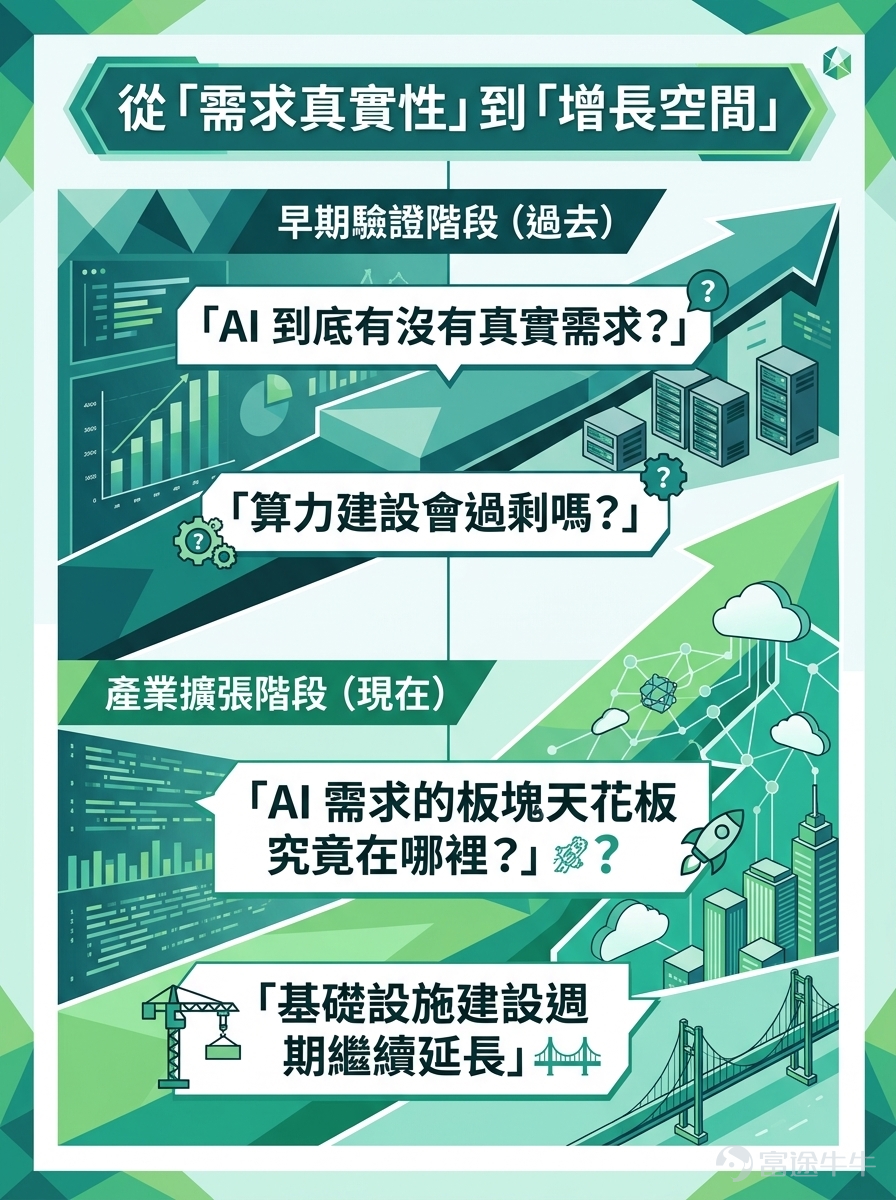
1. A Paradigm Shift in Market Logic: From "Demand Authenticity" to "Growth Ceiling"
Looking back at the past few quarters, the capital markets have exhibited a contradictory stance toward the AI sector: on one hand, leading computing power companies have consistently delivered impressive results; on the other, secondary market stock reactions have been lukewarm or even corrective. The essence of this phenomenon lies in the fact that capital markets do not price past historical performance but rather future growth expectations. For industry-leading enterprises at the core of the sector, merely beating expectations has become the default baseline; outperformance alone no longer suffices to impress highly forward-looking institutional investors.
Over the past year, the biggest shadow hanging over the AI industry has never been whether chips could be sold, but rather whether the hundreds of billions of dollars in annual capital expenditure (Capex) by tech giants are creating genuine productivity or simply overdrawing demand in a "Great Leap Forward" style. As super cloud service providers (CSPs) such as Microsoft, Meta, Alphabet, and Amazon continue to ramp up data center construction, the market has repeatedly debated several core concerns: Is global computing capacity construction facing oversupply? Is investment in data centers approaching a peak? Can the commercialization loop of AI applications support such massive upstream hardware investments?
The strong signals released by this earnings report and accompanying industry information fundamentally refute the market's pessimistic assumptions. Large tech customers remain in a robust expansion phase regarding AI infrastructure investment, and the high prosperity of the data center business directly indicates that the current AI computing power construction cycle is continuing. From the underlying logic of institutional research, this has effectively driven a critical mindset shift in the capital markets:
- The Past (Early Validation Phase): The core debate in the market centered on whether there is genuine demand for AI and whether the build-out of computing power would lead to severe overcapacity.
- The Present (Industry Expansion Phase): Market discussions have now fully shifted to questions such as "How high is the ceiling for AI demand across various sectors?" and "How long will this infrastructure construction cycle be extended?"
As the market's focus shifts from verifying the authenticity of demand to assessing its growth potential, it signals that the AI industry has officially moved past the early concept validation stage and entered the second half characterized by scaled expansion.
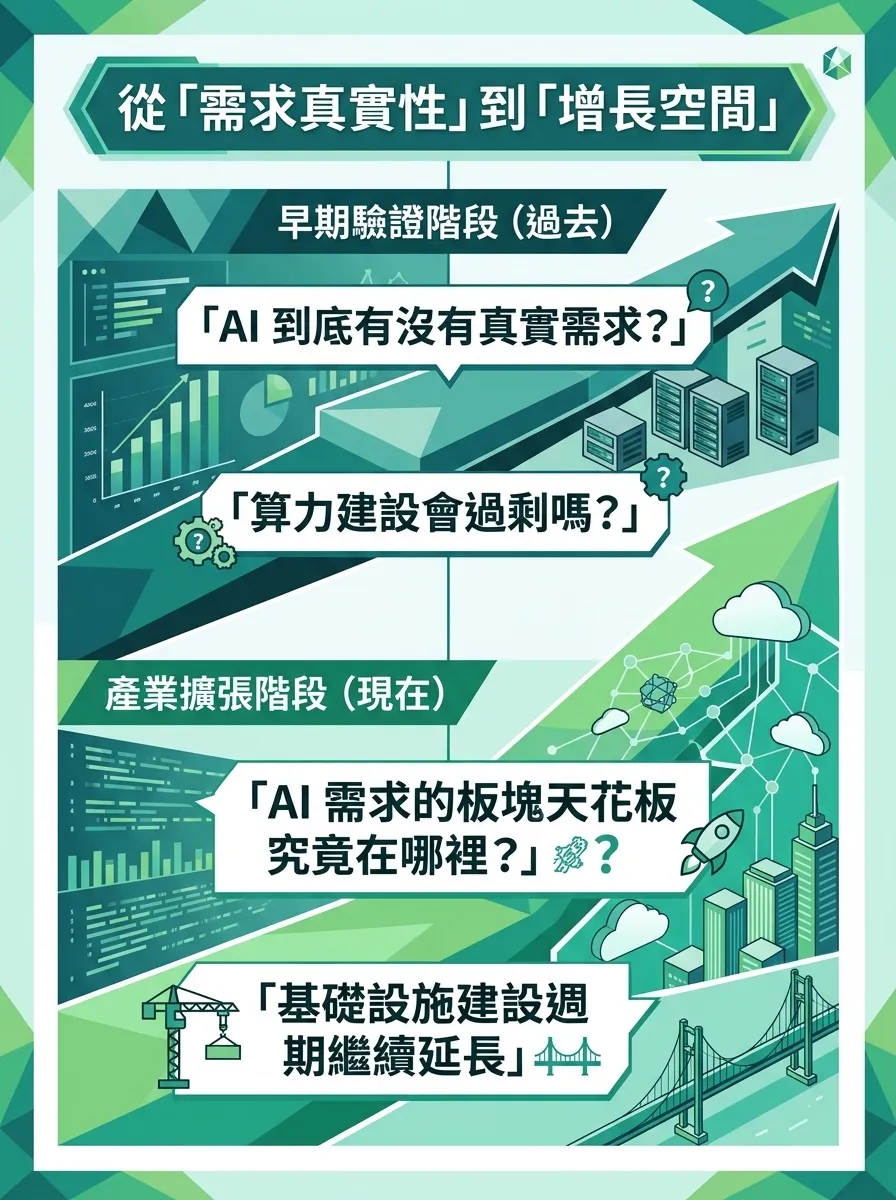
II. Three Critical Details That Capital Markets Are Truly Focusing On for the Next Cycle
A review of discussions among mainstream institutions and buy-side analysts following earnings releases reveals that attention has long since moved beyond short-term performance fluctuations. Capital markets always trade on the future, with a sharp focus on three underlying logics that will determine whether the global technology supply chain can sustain its momentum over the next two to three years:
1. Seamless Iteration of Hardware Architecture and the Relay of Computing Power
Within the semiconductor and computing power supply chains, institutions are less concerned about sluggish sales of existing products and more worried about a potential "performance vacuum" and demand gaps during the transition between old and new technological architectures. Therefore, the primary dimension for assessing the health of AI infrastructure lies in the speed at which next-generation hardware architectures are implemented according to roadmaps and the efficiency of production ramp-ups.
Taking the Blackwell architecture and its subsequent platforms as an example, the market is closely validating whether high-density system integration, advanced process packaging (such as CoWoS), and complex thermal dissipation bottlenecks have been effectively addressed to ensure the stability of computing clusters during large-scale deliveries. Furthermore, whether more advanced computing platforms (such as new generations equipped with HBM4 memory) can seamlessly take over within the next two years is key to determining whether the global hardware investment curve remains continuous without sudden downturns. Only when downstream customers demonstrate a sustained willingness to lock in next-generation roadmaps can institutions be confident that the industrial cycle possesses sufficient long-tail effects.
2. Diversification of the Buyer Base: From "Oligopoly by Giants" to "Industry-Wide Penetration"
Over the past two years, global AI computing power procurement has been highly concentrated, heavily reliant on capital expenditure from a few hyperscale cloud service providers (CSPs). Such a monolithic buyer structure poses significant volatility risks—once a cloud giant cuts Capex due to constrained free cash flow or mismatched short-term ROI, the upstream hardware supply chain faces sharp valuation corrections and earnings declines.
However, latest industry data indicates that the buyer structure for AI computing power is undergoing profound structural changes, gradually evolving into a "Hyperscale Cloud Providers + High-Performance Computing (AI Cloud) Operators + Large Enterprise Clients + Sovereign AI" multi-engine driven landscape. On one hand, countries in the Middle East, Europe, and parts of Asia are elevating "sovereign computing power" to a national strategic level, investing heavily in building localized AI data centers. On the other hand, leading enterprises in vertical industries such as autonomous driving, pharmaceutical R&D, financial modeling, and industrial manufacturing are shifting from renting cloud services to directly purchasing dedicated computing clusters. The decentralization and diversification of the buyer base have significantly enhanced the risk resistance and resilience of the entire AI computing cycle.
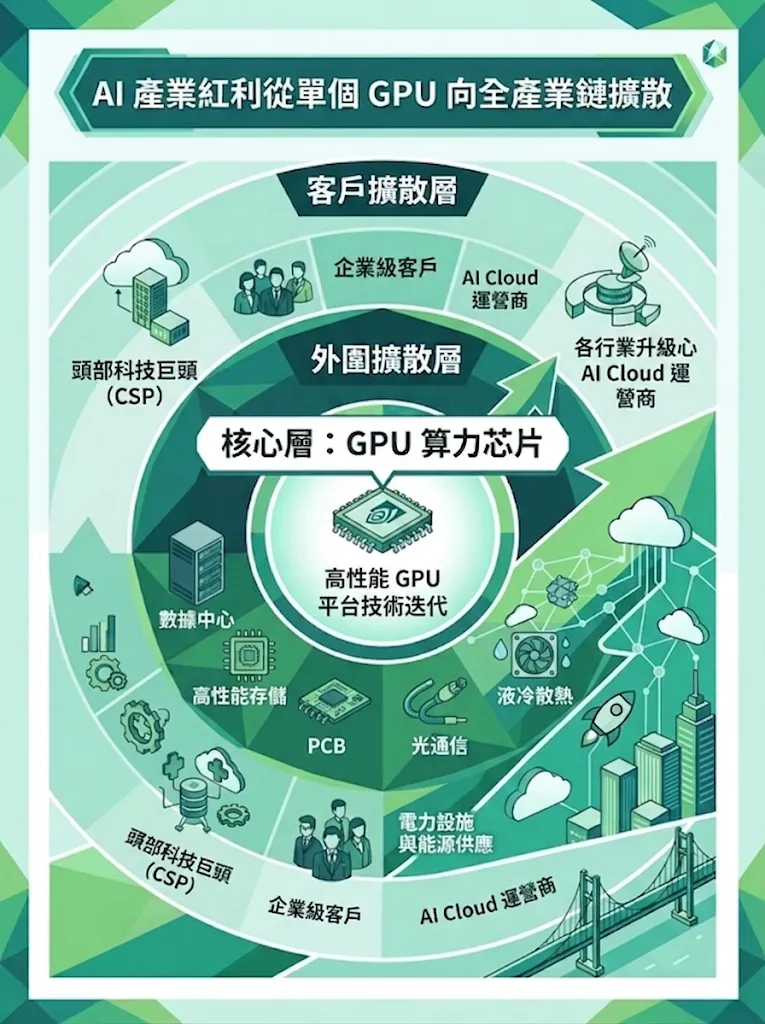
3. Spillover Effects of Hardware Dividends: From Single-Chip Arbitrage to Full-Chain Value Distribution
As AI model parameters grow exponentially, competition for computing power has long moved beyond the narrow scope of "single GPU performance," evolving into a system-level engineering challenge at the rack or even data center level. Merely increasing the compute density of chips alone can no longer resolve bottlenecks in data transmission and energy consumption, causing performance constraints in computing clusters to rapidly shift toward external systems.
This has triggered a rewrite of value distribution across the AI supply chain.High Bandwidth Memory (HBM), high-speed optical communications (such as 800G/1.6T optical modules and silicon photonics technology), high-density liquid cooling systems, high-frequency PCB substrates, as well as underlying power management and electrical infrastructure supply,are becoming the "decisive factors" determining whether computing clusters can operate at full capacity. Capital markets have keenly recognized that the substantial capital dividends generated by computing infrastructure build-outs are accelerating their spread from the single chip segment to peripheral supply chains, including server OEMs, liquid cooling solution providers, gateway equipment vendors, and even power utility operators. Institutional investors buying leaders in the computing space are not just betting on individual company profits, but on the overall valuation premium derived from the extended lifecycle of AI infrastructure.
Conclusion: Seizing the structural opportunities in the second half of the AI cycle
Taken together, the market reaction following the release of the leading company's earnings report was not merely a "bonus" for impressive results. Rather, it reflects global capital placing new bets on the emerging consensus that "the entire AI infrastructure cycle will be significantly extended."
The shift from "skepticism about computing power oversupply" to "reassessing the growth ceiling" represents not only a rational repair of sentiment in the secondary market but also a paradigm shift in the industrial development cycle. For global capital markets now and in the future, the clearest signal is evident: the historical mission of the second half of the AI industry is no longer to prove the existence of demand, but to explore how far this prosperity cycle, driven by technological变革 and infrastructure, can go.
In this context, the marginal returns from simply chasing short-term earnings games are diminishing, whilegrasping long-term trends such as the iteration of computing architecture, the diversification of buyer structures, and the spillover benefits across the entire industry chain (e.g., optical modules, liquid cooling, and power infrastructure)will be the core underlying logic and foundation for institutional investors positioning themselves in the second half of the AI industry.
Data Source: This article primarily references publicly disclosed financial reports and earnings call information from NVIDIA, and synthesizes public market data from Futu News, Cailian Press, Reuters, and Bloomberg.
Disclaimer
· The above content is provided for reference purposes only and does not constitute, nor should it be construed as, an offer, solicitation, or recommendation to buy or sell any securities, investment products, or funds. This content is intended solely for viewing by persons in any jurisdiction where the distribution or provision of such content is lawful. By accessing this content, you represent and warrant that the laws and regulations applicable in your jurisdiction permit you to access such content.
· Investing involves risk. Past performance is not indicative of future results. The price of fund units/shares may rise or fall, and historical fund performance does not guarantee future returns. Investors should refer to the relevant fund prospectus for details and risk factors. Investors may not recover their full principal investment. The value of investments and any income derived therefrom (if any) may be volatile and subject to significant fluctuations over short periods.
· The data and information used to prepare the above content were obtained by Value Partners Asset Management Hong Kong Limited ('Value Partners') from sources believed to be reliable. However, no representation or warranty is made regarding the accuracy or completeness of data sourced from third parties. Any forecasts or other forward-looking statements concerning future events or performance of countries, markets, or companies are not necessarily indicative and may differ materially from actual events or outcomes. Value Partners assumes no liability for any losses incurred by any person acting on the data contained herein.
· No person may reproduce or use the above content—including but not limited to text, images, audio, and video—for any public or commercial purpose without the prior permission of Value Partners. Any modification or use of the above content may infringe upon copyrights and/or intellectual property rights held by Value Partners (where applicable).
· Publisher: Value Partners Asset Management Hong Kong Limited. This content has not been reviewed by the Securities and Futures Commission.
$Dow Jones Industrial Average (.DJI.US)$ $Nasdaq Composite Index (.IXIC.US)$ $S&P 500 Index (.SPX.US)$ $Hang Seng Index (800000.HK)$ $Hang Seng TECH Index (800700.HK)$ $Hang Seng China Enterprises Index (800100.HK)$ $HKEX Tech 100 Index (800666.HK)$ $NASDAQ 100 Index (.NDX.US)$ $Russell 2000 Index (.RUT.US)$ $PHLX Semiconductor Index (.SOX.US)$
Content Disclosure: Personal opinion
Risk Disclaimer: The above content only represents the author's view. It does not represent any position or investment advice of Futu. Futu makes no representation or warranty.Read more


Comments
to post a comment
7
2