"SaaS Doomsday" Meets Earnings Counterattack! Can the Software Rally Broaden?

"Guardian AI" is the real money-printing machine! CRWD and OKTA earnings both exploded. Which cybersecurity stocks are worth watching?
After the US market close on August 26, $Cybersecurity (LIST2570.US)$ the sector saw a wave of catalysts, $CrowdStrike (CRWD.US)$ and $Okta (OKTA.US)$ with both companies delivering better-than-expected Q2 results on the same day, building on their strong performance after $Fortinet (FTNT.US)$ raising full-year guidance,market attention on the AI cybersecurity niche is rapidly heating up.
- CrowdStrike: Record net new ARR; AI detection business nearly tripled quarter-over-quarter
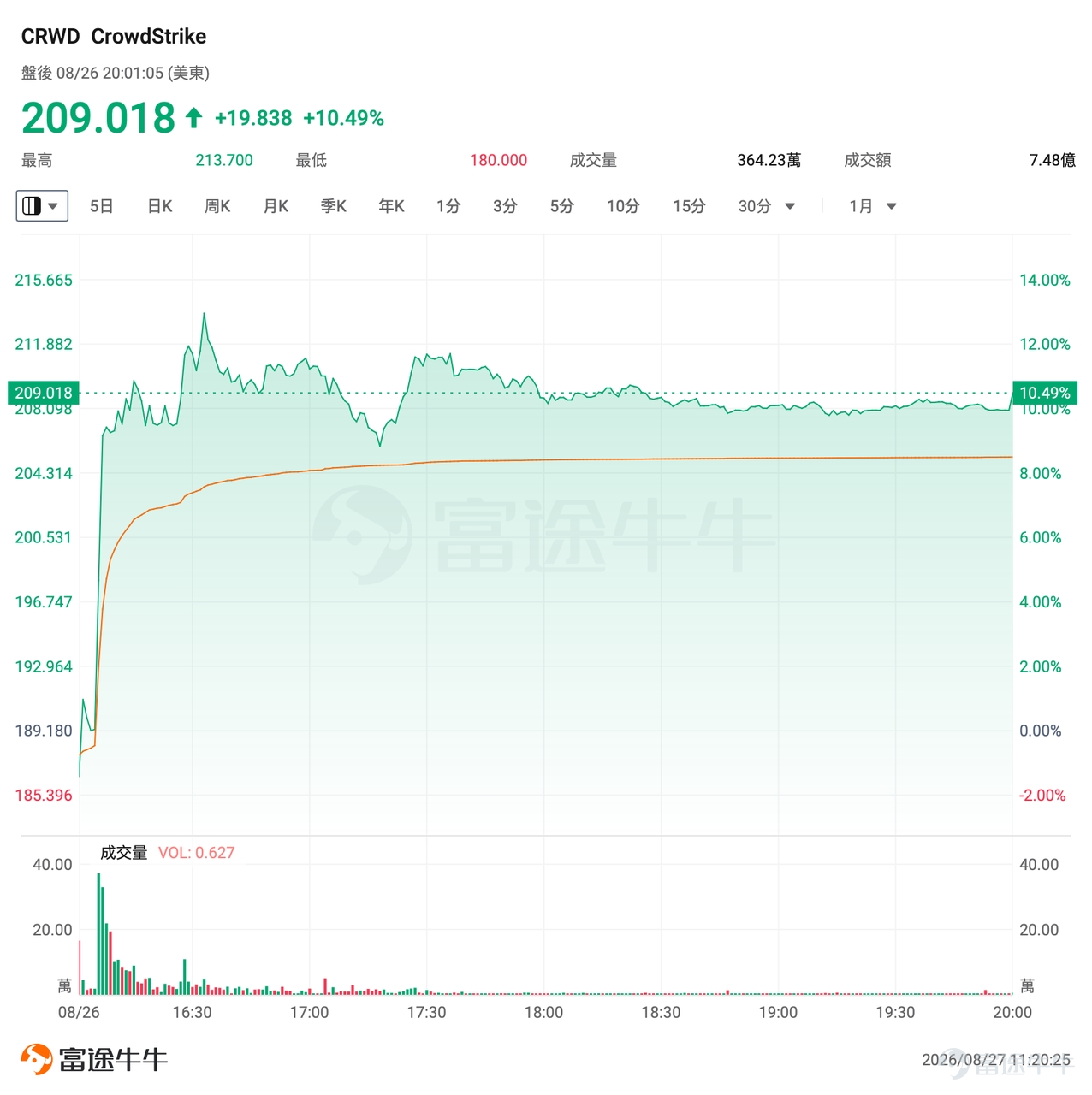
$CrowdStrike (CRWD.US)$ Q2 revenue was $1.47 billion (+26%), and adjusted EPS was $0.31, both beating expectations; quarterly net new Annualized Recurring Revenue (ARR) reached $333 million (+51%), hitting a company record; management also raised full-year guidance. The stock rose nearly 10% in after-hours trading following the earnings release.

The company defined this strong performance as a "Mythos Moment," believing that the threat landscape driven by frontier AI has significantly boosted demand for premium cybersecurity tools, accelerating the formation of the AI cybersecurity wave.
- Okta: RPO expanded to $48.6 billion, full-year guidance raised for the second time this year
Leader in identity security $Okta (OKTA.US)$ Q2 revenue reached $805 million (+11%), and adjusted EPS was $1.05, both beating market expectations; Remaining Performance Obligations (RPO) hit $4.86 billion, up 17% year-over-year, reflecting the resilience of long-term subscription contracts. The full-year revenue target range is now projected at $3.216–$3.226 billion (the second upward revision for this fiscal year). After the earnings release, the stock price surged over 20% in after-hours trading.

Prior to this, on July 29, $Fortinet (FTNT.US)$ delivered an impressive performance: Q2 revenue was $2.05 billion, a 26% year-over-year increase, accompanied by an upward revision of the full-year 2026 revenue guidance.
All three companies in the cybersecurity sector exceeded expectations, pointing to the same trend: corporate security spending in the AI era is shifting from being "optional" to "essential."
A generational leap in AI security demand
The underlying logic driving this rally is the structural shift in cybersecurity demand in the AI era.
The attack surface is expanding. The deployment of large language models, the launch of AI agents, and the widespread adoption of AI-assisted coding are all simultaneously expanding enterprises' digital attack surfaces.In a 2026 research report, Morgan Stanley analysts pointed out that approximately 14% of organizations have already experienced AI-related security incidents; currently, about 80%–90% of cyberattacks exhibit AI-generated characteristics. As attack costs continue to decline, real-time detection and response capabilities on the defense side have become increasingly critical.
The incremental market is opening up.Morgan Stanley estimates that AI will drive up to $220 billion in incremental security demand. If AI security spending intensity eventually converges with IT spending intensity, the AI security market size is expected to expand from the current ~$16 billion to over $45 billion, with a CAGR of 30%–40%. Gartner also predicts that global AI cybersecurity spending will exceed $51 billion by 2026.This implies that AI security is becoming a sub-sector within the AI industry chain with high certainty and accelerating growth, second only to computing power chips.
The platformization trend is strengthening.Corporate IT budgets are limited, and CIO surveys show that cybersecurity is one of the last IT spending categories to be cut. However, procurement logic is shifting from "stacking dozens of point solutions" to "integrated platforms + curated best-of-breed components."Vendors with runtime protection capabilities, proprietary data advantages, and flexible consumption-based pricing are better positioned to consolidate their market share in the AI era.
From the $CrowdStrike (CRWD.US)$ acceleration in ARR, $Okta (OKTA.US)$ expansion in RPO, $Fortinet (FTNT.US)$ rebound in product revenue,Earnings beats are not driven by individual companies grabbing market share, but by a systemic release of demand across the entire industry.
For investors, the key focus now should be: which sub-sectors have deeper moats, and which companies' upcoming earnings reports can further validate this trend?
Which companies in the US cybersecurity sector are worth watching?

--
--
--
Threat Detection:
$CrowdStrike (CRWD.US)$ :Global leader in Endpoint Detection and Response (EDR/XDR),The Falcon platform builds its moat through cloud-native architecture and a threat intelligence network.
$Palo Alto Networks (PANW.US)$ :One of the world's largest cybersecurity platform companies,Synergy across three major business lines: Prisma (cloud security), Cortex (threat detection), and Strata (network firewalls). The acquisition of CyberArk, completed in 2026, fills the gap in identity security, giving its platform strategy a unique advantage in the AI era.
$SentinelOne (S.US)$ : An AI-native endpoint security vendor. Its Singularity platform leverages a proprietary AI engine to achieve automated threat detection and response. With a differentiated positioning in the SME and cloud-native workload segments, it is one of CrowdStrike's main competitors in the endpoint market.
$Akamai (AKAM.US)$ : Starting with CDN and edge computing, it holds an advantage in global edge nodes for distributed application and API security protection.
IT Services & Consulting:
$Infosys (INFY.US)$ : An Indian IT services giant; cybersecurity consulting and managed services are key components of its enterprise digitalization business, benefiting from the growing global demand for outsourced corporate security.
$Leidos (LDOS.US)$ : A U.S. government and defense contractor with cybersecurity as one of its core competencies. It has deep expertise in federal-level threat intelligence and Zero Trust architecture deployment, supported by the relatively stable public sector budget.
$Booz Allen Hamilton Holding Corp (BAH.US)$ : A top-tier U.S. management consulting and technology services firm. Cybersecurity is a core segment of its services for government and commercial clients, backed by long-standing client relationships in the defense and intelligence sectors.
$Parsons (PSN.US)$ : Focuses on cybersecurity and engineering services for critical infrastructure, establishing professional barriers in Operational Technology (OT) security across industries such as transportation, energy, and defense.
Cloud Security:
$Cloudflare (NET.US)$ : A global edge cloud platform where low-latency response capabilities at edge nodes serve as a core competitive advantage in areas such as AI application gateways, DDoS protection, and API security.
$Okta (OKTA.US)$ : The leader in independent identity management, with two major product lines—Workforce Identity and Customer Identity—covering authentication for both enterprise employees and external users.AI agents and non-human identity management represent its next growth curve, while its independent positioning offers unique value to large enterprises.
$Zscaler (ZS.US)$ : A leader in Zero Trust Network Access (ZTNA) and Security Service Edge (SSE),In the AI era, demand for Zero Trust architecture remains robust amid remote work and hybrid cloud scenarios.
$Rubrik (RBRK.US)$ : A data security and backup/recovery platform with technological leadership in ransomware protection and immutable data storage.The need for securing backups of AI training data and workloads opens up new growth opportunities.
$Datadog (DDOG.US)$ : A cloud monitoring and observability platform with synergistic advantages in end-to-end monitoring and security integration for AI applications.
Cybersecurity Providers:
$Cisco (CSCO.US)$ : The global leader in networking equipment, with its SecureX platform and Talos threat intelligence team forming the foundation of its security business. It holds channel and customer scale advantages in the integrated deployment of enterprise network infrastructure and security.
$Gen Digital (GEN.US)$ : Formed by the merger of NortonLifeLock and Avast, it focuses on consumer and small business security, boasting a large user base in endpoint protection and personal privacy protection.
$Fortinet (FTNT.US)$ : Its core consists of firewall hardware and the FortiOS operating system, with FortiGate leading in NGFW (Next-Generation Firewall) market share. Its SASE business is growing rapidly,The "Networking + Security" convergence strategy offers cost advantages in AI data center interconnection scenarios.
$A10 Networks (ATEN.US)$ : Specializes in Application Delivery Controllers (ADC) and DDoS protection, serving telecom operators and large enterprises in traffic management and security for 5G, cloud, and AI workloads.
$F5 Inc (FFIV.US)$ : A leader in application delivery and security, with deep expertise in API security, Web Application Firewalls (WAF), and load balancing through its BIG-IP and NGINX product lines. AI-powered API gateway security is its new strategic entry point.
$Check Point Software (CHKP.US)$ : An established Israeli cybersecurity vendor. Its Quantum Security Gateways and Infinity architecture cover network, cloud, mobile, and IoT sectors. It holds a stable market share and demonstrates sustained profitability in the large enterprise firewall market.
Vulnerability Management:
$Tenable Holdings (TENB.US)$ : The leader in vulnerability management. Its Nessus scanner and Tenable One exposure management platform help enterprises continuously assess their attack surface. New types of vulnerabilities introduced by AI code generation are driving the evolution of vulnerability management from periodic scanning to continuous exposure management.
$Rapid7 (RPD.US)$ : A provider of vulnerability management, SIEM (Security Information and Event Management), and penetration testing services. Its InsightVM and InsightIDR platforms offer strong cost-performance advantages in the small and medium-sized enterprise (SME) market.
Data Security and Analytics:
$Varonis Systems (VRNS.US)$ : Focuses on Data Security Posture Management (DSPM), helping enterprises identify, classify, and protect access to sensitive data. In the fields of AI training data governance and insider threat detection, data visibility is a foundational capability, where Varonis possesses significant professional depth.
Biometric Authentication:
$Clear Secure (YOU.US)$ : A US provider of expedited airport security screening services, featuring a unique business model in cross-verifying physical and digital identities. As the risk of identity fraud rises in the AI era, demand for biometrics as a strong authentication method is expected to grow in tandem.
Upcoming Earnings Calendar to Watch
The current earnings season is not yet over. The upcoming results from leading cloud security and platform companies will further test the sustainability of AI security demand:
- $SentinelOne (S.US)$ 、 $Rubrik (RBRK.US)$ : Will report earnings after the market close on Thursday, August 27, 2026
- $Palo Alto Networks (PANW.US)$ : Will report earnings after the market close on Tuesday, September 1, 2026
Summary
Cybersecurity in the AI era is undergoing a shift from compliance-driven to business-driven adoption—the pace at which enterprises deploy AI directly determines the speed at which security budgets are released. $CrowdStrike (CRWD.US)$ 、 $Okta (OKTA.US)$ 、 $Fortinet (FTNT.US)$ 's consecutive beats against expectations have provided initial yet strong earnings validation for this thesis.
For investors, the current phase is better suited for tracking the sector from a demand-side verification perspective, focusing on trends in leading indicators such as ARR/RPO, and continuing to look for industry-wide resonance signals in the upcoming earnings reports.
 Fellow investors, are you bullish on cybersecurity stocks?
Risk Disclaimer: The above content only represents the author's view. It does not represent any position or investment advice of Futu. Futu makes no representation or warranty.Read more


Comments (2)
to post a comment
76
238