NVIDIA's revenue doubles, beating expectations; is the AI trade narrative making a comeback?

70% is not the demand ceiling, but the capacity ceiling! NVIDIA rarely provides long-term guidance; which supply chain players stand to benefit the most?
After the market close on August 26, $NVIDIA (NVDA.US)$ the company delivered results that once again exceeded market expectations.
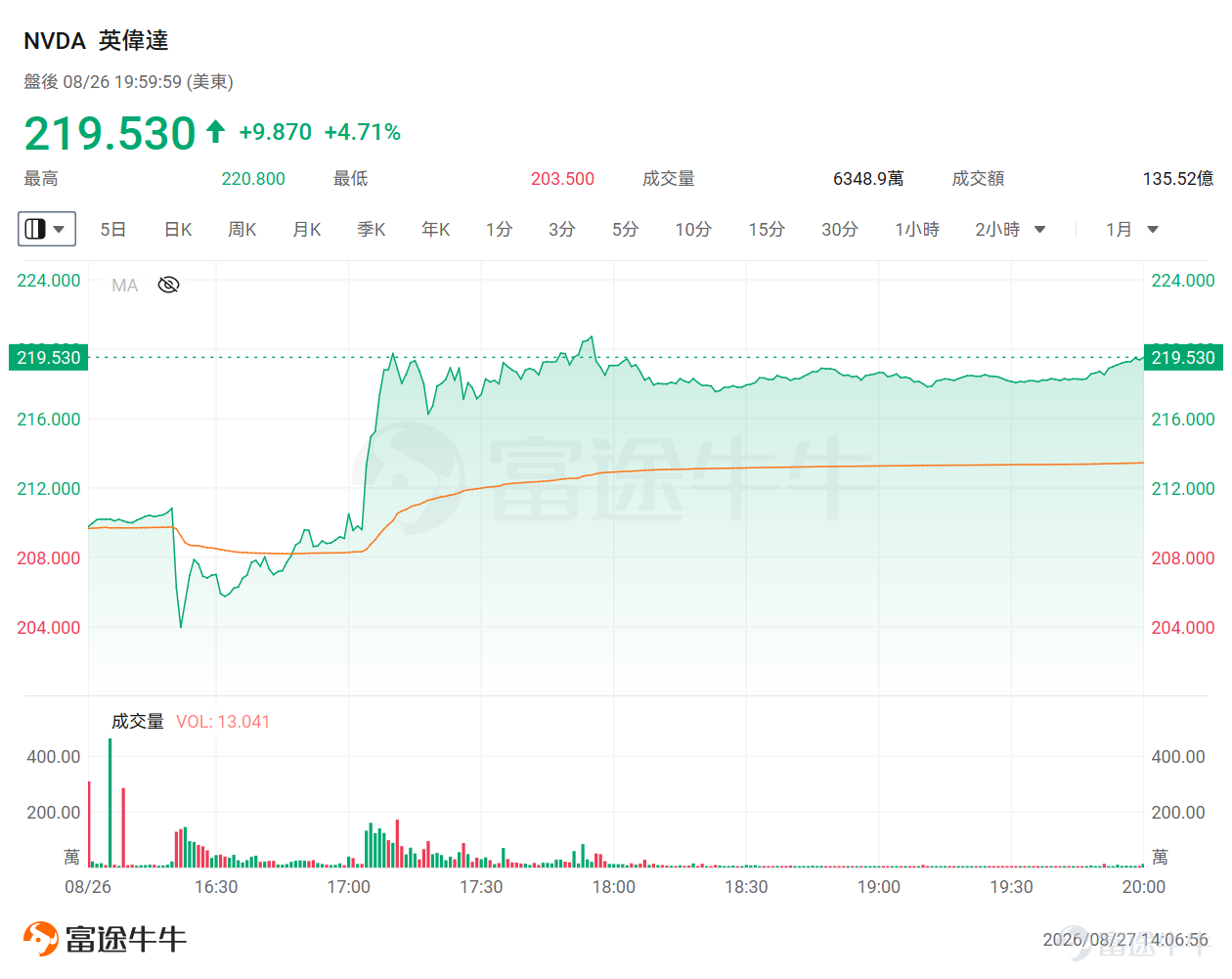
Following the earnings release, NVIDIA's stock initially fell more than 2% in after-hours trading, but quickly reversed course during the conference call, ultimately rising over 4%.

--
--
--
The reversal in market sentiment was driven by the earnings report highlighting NVIDIA's current profitability, while the conference call reassured the market that the demand for AI computing power is far from over.
More importantly,NVIDIA provides growth guidance a full year in advance for the first time: FY2028 revenue is projected to grow by approximately 70%.And this figure is not the ceiling for demand, but rather the maximum deliverable capacity of the current supply chain.
How strong are NVIDIA's financial results?
NVIDIA's revenue for Q2 FY2027 reached $96.22 billion, up 106% year-over-year and 18% quarter-over-quarter, marking the fourth consecutive quarter of accelerating growth. Among these, the Data Center business remains the primary growth engine:
Data Center revenue was $89.02 billion, up 117% year-over-year;
Revenue from hyperscale cloud providers was $48.71 billion, up 102% year-over-year;
Revenue from AI cloud, industrial, and enterprise customers was $40.31 billion, up 138% year-over-year;
Both GAAP and non-GAAP gross margins stood at 75%;
Non-GAAP earnings per share (EPS) were $2.22, up 120% year-over-year.
The Data Center business already accounts for approximately 92.5% of NVIDIA's total revenue, yet growth has not slowed despite the expanded scale.Furthermore, the company expects Q3 revenue to reach $108 billion, with a variance of ±2%, marking the first time in its history that it has surpassed the $100 billion mark, representing a year-over-year growth of nearly 90%.
What is the most standout aspect of these results?
First, revenue growth for fiscal year 2028 is projected at 70%, significantly exceeding market expectations.
NVIDIA provided revenue guidance a full year in advance for the first time, projecting approximately 70% revenue growth for fiscal year 2028, which is notably higher than the pre-earnings market consensus of around 45%.During the earnings call, Jensen Huang characterized this wave of AI computing investment as a "once-in-a-generation" platform-level transformation. Huang emphasized that the 70% growth figure is merely "constrained by production capacity," and that driven by the widespread adoption of Agentic AI, actual market demand is growing at a rate far exceeding 100%.
In other words, 70% represents not the ceiling of demand, but the current ceiling of production capacity.The market had previously worried about a slowdown in the growth of AI capital expenditures and that NVIDIA's performance had peaked, but this guidance answers those concerns: demand remains close to doubling, and the true constraint on revenue growth is the supply chain.
Additionally, NVIDIA expects Q3 gross margin to be approximately 74%, after which it will bottom out at 71% to 72% in Q4, citing memory price increases that are "far exceeding previous expectations" and continue to climb. The company anticipates that price adjustment measures will take effect in Q1 of fiscal year 2028, at which point gross margins will stabilize at 72% to 73%.
Second, NVIDIA is no longer relying solely on a few cloud computing giants.
This quarter, revenue from hyperscale cloud providers grew by 102%, while revenue from AI cloud, industrial, and enterprise customers grew by 138%, with the latter showing even faster growth.
This means that beyond Microsoft, Amazon, Google, and Meta, emerging cloud providers, sovereign AI initiatives, AI-native companies, and traditional enterprises are becoming a second wave of demand.
Even as some cloud vendors continue to develop their own in-house chips, a large number of customers still lack the capability to integrate GPUs, CPUs, networking, storage, and software on their own.NVIDIA offers a complete AI factory, not just a single GPU, which constitutes its core competitive advantage against in-house chip solutions.
Third, Vera Rubin has entered the volume production phase.
The new-generation Vera Rubin platform has entered full-scale mass production and is expected to contribute approximately 20% of data center revenue in the third quarter, potentially becoming NVIDIA's fastest-ramping product in its history.
Vera Rubin is not a single chip, but an AI factory comprising the Rubin GPU, Vera CPU, NVLink, Spectrum-X networking, BlueField DPU, and AI storage.
NVIDIA disclosed that each gigawatt of data center capacity corresponded to approximately $18 billion in revenue opportunity during the Hopper era, rising to $25 billion in the Blackwell era, and further reaching approximately $40 billion in the Vera Rubin era.This implies that the ramp-up of Rubin will not only benefit GPUs but also simultaneously drive demand for memory, advanced packaging, servers, networking, optical communications, storage, power supplies, and liquid cooling.
Fourth, a $279 billion procurement commitment confirms that upstream supply remains severely constrained.
To ensure smooth delivery for future growth, NVIDIA has significantly increased its commitments for supply and production capacity procurement.Related commitments increased from $119 billion in the previous quarter to $279 billion, representing a quarterly increase of $160 billion.Management explicitly stated thatthe incremental funds are primarily used for procurement and storage.

Of this amount, approximately $267 billion will be executed sequentially from the remainder of fiscal year 2027 through fiscal year 2029. This indicates that the AI supply chain is not suffering from insufficient demand, but is still competing for production capacity of HBM, DRAM, and other critical components. NVIDIA is even willing to sign multi-year contracts in advance and sacrifice short-term gross margins in exchange for supply certainty over the next two years.
Fifth, networking and CPUs have become new growth engines.
NVIDIA's networking business hit a new historical high this quarter, with Spectrum-X Ethernet revenue growing approximately 2.6 times year-over-year. Meanwhile, as Agentic AI requires inference, planning, and multiple tool calls, demand for CPUs is also growing rapidly. Management expects Vera CPU revenue to more than double by fiscal year 2028.
NVIDIA is evolving from a GPU company into an AI infrastructure platform covering GPUs, CPUs, networking, storage, and software.
Which companies benefit from these results?
Based on the financial results and information released during the conference call, the order of beneficiaries in the industry chain is roughly: Storage & HBM > Advanced Process Nodes & Packaging > AI Servers > CPO & High-Speed Networking > Power & Liquid Cooling. Previously"NVIDIA Hits the Accelerator: Vera Rubin Enters Full Mass Production, Who Will Capture the Next Wave of Dividends?"We have also previously mapped out the relevant industry chain:

--
--
--
First main theme: Memory—most direct exposure with the highest certainty
Memory is the sector with the most direct and certain benefits from this earnings season. The incremental increase in NVIDIA's $279 billion supply and capacity commitments primarily stems from memory procurement, meaning that HBM, DRAM, and server memory are simultaneously benefiting from rising demand and price increases.
The three major memory manufacturers have all entered the Vera Rubin supply system: $SK hynix (SKHY.US)$ : Has established a multi-year partnership with NVIDIA, jointly developing HBM4, SOCAMM2, and next-generation AI memory; $Micron Technology (MU.US)$ : HBM4, SOCAMM2, and PCIe Gen6 SSDs have entered mass production, explicitly designated for Vera Rubin; $Samsung Electronics (005930.KR)$ : Has already mass-produced HBM4 for Rubin GPUs, while supplying SOCAMM2 and enterprise-grade SSDs for Vera CPUs and AI servers.
This industry chain is driven by the dual logic of 'volume growth' and 'price increases.'NVIDIA's 70% revenue growth first implies a continued significant surge in HBM demand; meanwhile, tight supply and long-term locked orders help memory manufacturers maintain pricing power and profitability.
Second main theme: Advanced Packaging—the core capacity bottleneck for Rubin's volume ramp-up
With Vera Rubin entering full-scale mass production, there is increased demand for wafers using advanced process nodes, CoWoS packaging, packaging substrates, and testing capacity. The foundry and packaging companies that stand to benefit directly mainly include: $Taiwan Semiconductor (TSM.US)$ 、 $ASE Technology (ASX.US)$ 、 $Amkor Technology (AMKR.US)$ 。
Among them, Taiwan Semiconductor is a core partner for NVIDIA in advanced chip manufacturing and advanced packaging; SPIL, a subsidiary of ASE Technology, has also been included in NVIDIA's silicon photonics and CPO ecosystem. Amkor is an industry beneficiary of the expansion in advanced packaging, but it should not be simply viewed as a core foundry for Rubin at this stage.
As Taiwan Semiconductor, memory manufacturers, and packaging plants continue to expand capacity, related equipment companies will see second-order benefits, including: $Applied Materials (AMAT.US)$ 、 $Lam Research (LRCX.US)$ 、 $KLA Corp (KLAC.US)$ 、 $ASML Holding (ASML.US)$ 、 $Kulicke & Soffa Industries (KLIC.US)$ 、 $Onto Innovation (ONTO.US)$ 、 $Camtek (CAMT.US)$ 、 $ASMPT (00522.HK)$ 。
The testing segment also includes $Teradyne (TER.US)$ 、 $FormFactor (FORM.US)$ and $Cohu Inc (COHU.US)$ ; for packaging substrates and upstream materials, keep an eye on $KB LAMINATES (01888.HK)$ 、 $KINGBOARD HLDG (00148.HK)$ and $TTM Technologies (TTMI.US)$ 。
However, note that these equipment and material companies primarily benefit from the overall capacity expansion of the AI semiconductor industry, which does not necessarily mean they have all secured direct orders from NVIDIA.
Third investment theme: Optical Communication and CPO—Beneficiaries are beginning to diverge
NVIDIA's networking business hit new highs, with Spectrum-X Ethernet revenue growing approximately 2.6x year-over-year. CPO switches designed for Vera Rubin have also entered mass production.
The optical communication ecosystem benefiting directly includes $Coherent (COHR.US)$ 、 $Lumentum (LITE.US)$ 、 $Fabrinet (FN.US)$ 、 $Corning (GLW.US)$ 、 $Suzhou TFC Optical Communication (300394.SZ)$ 、 $ZJ INNOLIGHT (03308.HK)$ and $Eoptolink Technology Inc., (300502.SZ)$ . Among them, Tfc Communications mainly benefits from demand for CPO optical components and connectivity; InnoLight and Eoptolink continue to benefit from the ramp-up in volume of 800G and 1.6T pluggable optical modules.
As CPO penetration increases, value within the supply chain will gradually shift toward silicon photonics chips, external laser sources, optical engines, and precision packaging. $Credo Technology (CRDO.US)$ 、 $MACOM Technology Solutions (MTSI.US)$ and $Astera Labs (ALAB.US)$ Manufacturers of high-speed connectivity chips are also expected to benefit from the expansion of GPU clusters.
Fourth investment theme: 800V DC power—a new industrial direction driven by Vera Rubin
As the power density of AI racks continues to rise, traditional data center power architectures are beginning to upgrade to 800V DC to reduce power conversion losses and copper usage.
This supply chain is currently in the early stages of introduction and initial volume ramp-up, primarily divided into three segments.
Wide-bandgap power semiconductors: $STMicroelectronics (STM.US)$ 、 $ON Semiconductor (ON.US)$ 、 $Navitas Semiconductor (NVTS.US)$ 、 $Power Integrations (POWI.US)$ 、 $Wolfspeed (WOLF.US)$ 、 $INFINEON TECHNOLOG (IFNNY.US)$ 、 $INNOSCIENCE (02577.HK)$ 、 $SICC (02631.HK)$ 、 $Rohm (6963.JP)$ 、 $Fuji Electric (6504.JP)$ The 800V DC architecture will increase demand for SiC, GaN, and high-voltage power devices. However, whether various companies can enter NVIDIA's mass production solutions still depends on specific orders and certification validation.
Power management, gate drivers, and protection: $Monolithic Power Systems (MPWR.US)$ 、 $Analog Devices (ADI.US)$ 、 $Texas Instruments (TXN.US)$ 、 $Alpha & Omega Semiconductor (AOSL.US)$ 、 $Vicor (VICR.US)$ 、 $Microchip Technology (MCHP.US)$ 、 $Renesas Electronics (6723.JP)$ 。
Connectors, power modules, and busbars: $Flex Ltd (FLEX.US)$ 、 $Amphenol (APH.US)$ 、 $TE Connectivity (TEL.US)$ 、 $nVent Electric (NVT.US)$ 、 $Methode Electronics (MEI.US)$ 、 $Shenzhen Megmeet Electrical (002851.SZ)$ 。
While this sector offers significant growth potential, compared to memory and servers, 800V DC is currently more of a mid-term industry trend; short-term earnings contributions need to be closely monitored.
The Fifth Main Investment Theme: Energy, Power Distribution, and Thermal Management—Shifting from Thematic Trading to Actual Infrastructure Build-out
NVIDIA has begun calculating AI factory revenue opportunities in gigawatts, signaling that power supply, distribution, and cooling have become growth bottlenecks beyond just GPUs.
NVIDIA has already included $Vertiv Holdings (VRT.US)$ 、 $Eaton (ETN.US)$ 、 $Trane Technologies (TT.US)$ , Schneider Electric, and $SIEMENS AG (SIEGY.US)$ companies in its Vera Rubin DSX reference design. Consequently, this theme is no longer just about AI power concepts but has entered the stages of product design and project implementation.
For instance, $Vertiv Holdings (VRT.US)$ covers data center power supplies and liquid cooling, $Eaton (ETN.US)$ covers power distribution and electrical equipment, $GE Vernova (GEV.US)$ benefits from power generation and grid infrastructure construction, $Trane Technologies (TT.US)$ while directly participates in temperature control and cooling systems for large-scale data centers.
$Caterpillar (CAT.US)$ and $National Grid (NGG.US)$ Other companies stand to benefit more from backup power generation, gas-fired power generation, and grid expansion, representing a second-order play on AI data center construction.
Sixth Investment Theme: Computing Power Systems — Directly benefiting from Rubin deliveries
Vera Rubin is expected to contribute approximately 20% of data center revenue in the third quarter. Companies most directly positioned to handle full-system and rack deliveries include: $Dell Technologies (DELL.US)$ 、 $Hewlett Packard Enterprise (HPE.US)$ 、 $Super Micro Computer (SMCI.US)$ 、 $LENOVO GROUP (00992.HK)$ etc.
What should we watch for next?
Although this earnings report confirmed that AI demand remains robust, NVIDIA has also paid a clear price for its growth.
The company expects its gross margin to drop to 74% in the third quarter and further bottom out at 71%-72% in the fourth quarter, mainly due to rising memory costs and the initial production costs of Vera Rubin. Management expects to raise prices starting in Q1 of fiscal year 2028, with gross margins有望 recovering to 72%-73%.
Therefore, the following four indicators warrant close monitoring: whether Vera Rubin can contribute approximately 20% of data center revenue in Q3; whether gross margins can hold at 71%-72% in Q4; whether gross margins can recover to 72%-73% after price hikes in Q1 next year; and whether the $279 billion purchase commitment can be smoothly converted into revenue rather than becoming inventory pressure.
Overall, the most important signal from this earnings report is: AI computing demand has not peaked, and NVIDIA's growth ceiling is currently determined by supply rather than customer demand.
NVIDIA is trading short-term gross margins and massive purchase commitments for capacity certainty over the next two years. In this battle for supply, HBM and memory manufacturers are the first to benefit, while advanced packaging, servers, CPO, power infrastructure, and liquid cooling will continue to see expanded benefits as Vera Rubin ramps up volume.
Risk Disclaimer: The above content only represents the author's view. It does not represent any position or investment advice of Futu. Futu makes no representation or warranty.Read more


Comments (5)
to post a comment
83
208