Welcome Zone | Claim your 100,000 anniversary reward and kickstart your investment journey!

Must-read for new investors | Don't want to guess market tops and bottoms every day? Dollar-cost averaging into ETFs might be the perfect "lazy starter strategy" for beginners
Are there any new fellow investors who open Futubull, see the market rise, and think: " I should have bought it yesterday!"; Then the next day when it drops, you think: "Good thing I didn't buy, but is this the bottom now?"; After it falls for a few more days, you start to worry: "Is it going to crash to hell?"; When it rebounds, you slap your thigh in regret: "Missed it again..."
I should have bought it yesterday!"; Then the next day when it drops, you think: "Good thing I didn't buy, but is this the bottom now?"; After it falls for a few more days, you start to worry: "Is it going to crash to hell?"; When it rebounds, you slap your thigh in regret: "Missed it again..."For new investors entering the market, the most common issue isn't a lack of effort, but rather an excessive desire to buy at the absolute lowest price. But honestly, even many seasoned traders struggle to consistently time market tops and bottoms. Instead of being led by the nose by daily market fluctuations, why not start with a simpler, less stressful approach:Monthly Contribution ETF。
Today, Futubull breaks down for everyone: why new investors should consider dollar-cost averaging into ETFs, how other fellow investors are doing it, and how to set up automatic monthly investments step-by-step on Futubull.
What are the benefits of dollar-cost averaging into ETFs? Let's clarify two things first
Monthly Investment Plan: No need to keep asking, "Is it too expensive to buy right now?"
The core logic of a Monthly Investment Plan isDollar-Cost Averaging (DCA), which simply means:Invest a fixed amount every month, regardless of market fluctuations. When prices are high, you buy fewer shares; when prices are low, you buy more shares. Over the long term, this automatically lowers your average holding cost, so you don't have to guess "where the top or bottom is."
Here’s a straightforward example: Suppose a high-quality ETF is priced at $100 in the first month, and you invest $1,000 to buy 10 shares. In the second month, the market corrects, and the price drops to $50. With the same $1,000, you can now buy 20 shares, bringing your average holding cost down to $66.7. By the third month, when the market recovers and the price returns to $100, those who bought in a lump sum at the high point have just broken even, while you have already realized a 50% profit!
This is the greatest advantage of dollar-cost averaging (DCA):Don't panic during market dips; instead, view them as a "limited-time offer" and a golden opportunity to accumulate shares. As long as you stick with high-quality assets in a long-term uptrend, continuing your DCA will allow your portfolio to rebound first when the market recovers. Many beginners lose money with DCA because they get scared and stop contributions during market downturns, missing the chance to lower their average cost basis. By the time the market rises again, they realize they've fallen behind from the start.
Of course, Futubull wants to make this clear:DCA does not guarantee profits, nor does it mean you won't incur losses. If the market declines over the long term, your account will still show unrealized losses.The main benefit of DCA is helping beginners reduce the pressure of "timing the market incorrectly" with a lump-sum investment, turning investing into a disciplined habit.
For investment beginners, DCA has another advantage: you don't need to start with a large capital outlay. You can set a comfortable contribution amount based on your monthly income, savings, and daily expenses. Most importantly, invest only with spare cash, ensuring it doesn't affect your rent, mortgage payments, daily living expenses, or emergency fund.
ETFs: No need to struggle to pick "god-tier stocks" right from the start
Another pain point for beginners is deciding what to buy. Investing in individual stocks requires analyzing company performance, industry trends, management, valuation, competitive landscape, and more—just thinking about it can be overwhelming. It's not that beginners shouldn't research individual stocks, but starting with a heavy position in a single company concentrates risk significantly.
andAn ETF is more like an "investment basket"An ETF typically tracks a specific index, market, or theme. Buying an ETF is, to some extent, equivalent to buying a basket of assets rather than betting on a single company. For example, some ETFs track broad market indices, while others focus on specific sectors or themes. For beginners, ETFs can help reduce the concentration risk of "picking the wrong single stock." However, ETFs also rise and fall; their risks, volatility, fees, holdings, and dividend policies vary. Be sure to review the details carefully before buying.
In simple terms:If you don't want to guess the market daily—consider dollar-cost averaging (DCA); if you don't want to pick individual stocks right away—look into ETFs; if you want to start small to build investment habits—DCA into ETFs can be a great entry option.
Which ETFs are fellow investors buying via DCA? It turns out this is how profitable investors do it
No amount of theory is as direct as real cases from fellow investors. Futubull has collected several DCA ETF experiences shared by community members. They started with modest capital but succeeded through persistence. Newbie investors may find their mindset and approach helpful 👇
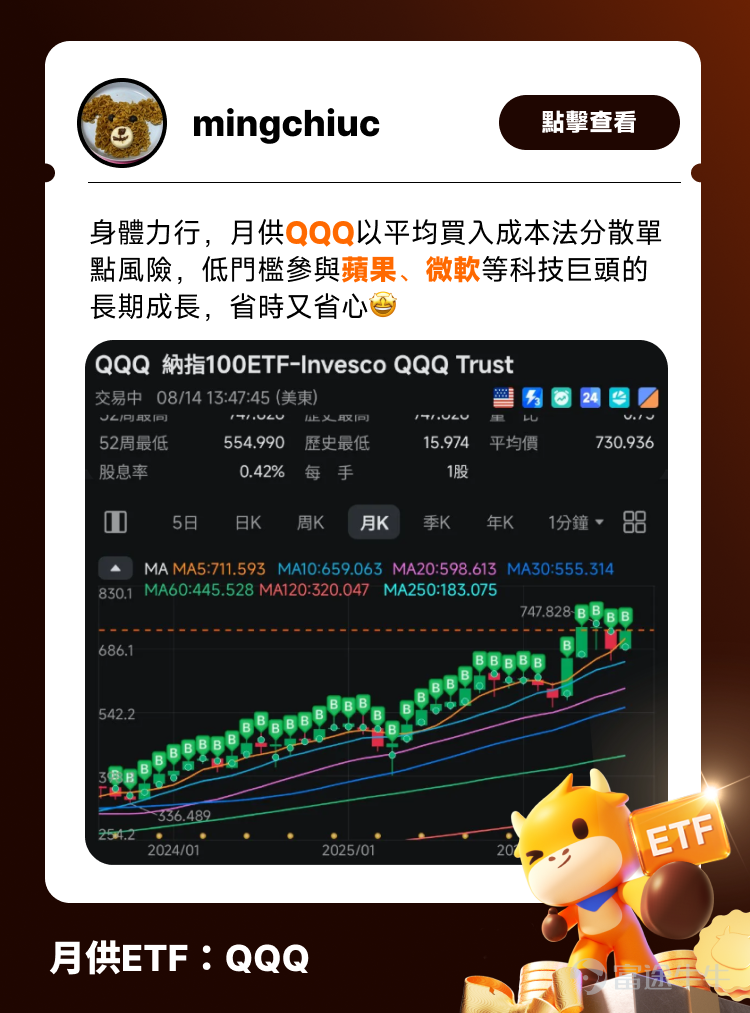
@mingchiuc: Putting it into practice with DCA $Invesco QQQ Trust (QQQ.US)$ Use dollar-cost averaging to diversify single-point risk, allowing low-threshold participation in the long-term growth of tech giants like Apple and Microsoft, saving both time and worry 🤩.
![Are there any new fellow investors who open Futubull, see the market rise, and think: "[My Eyes!]I should have bought it yesterday!"; Then the next day when it drops, you think: "[Nose Pick]Good thing I didn't buy, but is this the bottom now?"; After it falls for a few more days, you start to worry: "[Surprise]Is it going to crash to hell?"; When it rebounds, you slap your thigh in regret: "[Cry]Missed it again..." For new investors entering the market, the most common issue isn't a lack of effort, but rather an excessive desire to buy at the absolute lowest price. But honestly, even many seasoned traders struggle to consistently time market tops and bottoms. Instead of being led by the nose by daily market fluctuations, why not start with a simpler, less stressful approach:[Share Link: Monthly Contribution ETF]。 Today, Futubull breaks down for everyone: why new investors should consider dollar-cost averaging into ETFs, how other fellow investors are doing it, and how to set up automatic monthly investments step-by-step on Futubull. What are the benefits of dollar-cost averaging into ETFs? Let's clarify two things first Monthly Investment Plan: No need to keep asking, "Is it too expensive to buy right now?" The core logic of a Monthly Investment Plan isDollar-Cost Averaging (DCA), which simply means:Invest a fixed amount every month, regardless of market fluctuations. When prices are high, you buy fewer shares; when prices are low, you buy more shares. Over the long term, this automatically lowers your average holding cost, so you don't have to guess "where the top or bottom is." Here's a straightforward example: Suppose a high-quality ETF is priced at $100 in the first month, and you invest $1,000 to get 10 shares; in the second month, the market corrects, and the price drops to...](https://nnqimage.futunn.com/sns_client_feed/999986/20260827/web-1787814040157-p2NtVEAHRt.png/big?area=1&is_public=true&imageMogr2/ignore-error/1/format/webp)
@231715953: I usually DCA into $Vanguard S&P 500 ETF (VOO.US)$ and $Invesco QQQ Trust (QQQ.US)$ , treating them as core long-term holdings: VOO helps me diversify across large-cap US companies, while QQQ allows me to participate in the long-term trends of technology and growth stocks. The goal of DCA is not to chase short-term fluctuations, but to accumulate positions over time and slowly build compound interest. Using VOO as the core and QQQ as a growth-oriented satellite allocation is a common long-term strategy; however, the ratio should be determined based on your investment horizon and risk tolerance.
![Are there any new fellow investors who open Futubull, see the market rise, and think: "[My Eyes!]I should have bought it yesterday!"; Then the next day when it drops, you think: "[Nose Pick]Good thing I didn't buy, but is this the bottom now?"; After it falls for a few more days, you start to worry: "[Surprise]Is it going to crash to hell?"; When it rebounds, you slap your thigh in regret: "[Cry]Missed it again..." For new investors entering the market, the most common issue isn't a lack of effort, but rather an excessive desire to buy at the absolute lowest price. But honestly, even many seasoned traders struggle to consistently time market tops and bottoms. Instead of being led by the nose by daily market fluctuations, why not start with a simpler, less stressful approach:[Share Link: Monthly Contribution ETF]。 Today, Futubull breaks down for everyone: why new investors should consider dollar-cost averaging into ETFs, how other fellow investors are doing it, and how to set up automatic monthly investments step-by-step on Futubull. What are the benefits of dollar-cost averaging into ETFs? Let's clarify two things first Monthly Investment Plan: No need to keep asking, "Is it too expensive to buy right now?" The core logic of a Monthly Investment Plan isDollar-Cost Averaging (DCA), which simply means:Invest a fixed amount every month, regardless of market fluctuations. When prices are high, you buy fewer shares; when prices are low, you buy more shares. Over the long term, this automatically lowers your average holding cost, so you don't have to guess "where the top or bottom is." Here's a straightforward example: Suppose a high-quality ETF is priced at $100 in the first month, and you invest $1,000 to get 10 shares; in the second month, the market corrects, and the price drops to...](https://nnqimage.futunn.com/sns_client_feed/999986/20260827/web-1787814136163-1TIui9jssN.png/big?area=1&is_public=true&imageMogr2/ignore-error/1/format/webp)
@富多多多: In the past, when trading US stocks, I always tried to "time the bottom" to buy on dips. However, since the S&P 500 often trends upward in the long run, waiting for pullbacks often led to missing out on gains. Later, I adjusted my mindset and chose this ETF, which focuses on high dividends and options strategies: $NEOS S&P 500 HIGH INCOME ETF (SPYI.US)$ My current position is already up +7.12% (diluted cost basis $50.607), and I'm steadily receiving monthly cash flow, which has significantly reduced my psychological stress.
![Are there any new fellow investors who open Futubull, see the market rise, and think: "[My Eyes!]I should have bought it yesterday!"; Then the next day when it drops, you think: "[Nose Pick]Good thing I didn't buy, but is this the bottom now?"; After it falls for a few more days, you start to worry: "[Surprise]Is it going to crash to hell?"; When it rebounds, you slap your thigh in regret: "[Cry]Missed it again..." For new investors entering the market, the most common issue isn't a lack of effort, but rather an excessive desire to buy at the absolute lowest price. But honestly, even many seasoned traders struggle to consistently time market tops and bottoms. Instead of being led by the nose by daily market fluctuations, why not start with a simpler, less stressful approach:[Share Link: Monthly Contribution ETF]。 Today, Futubull breaks down for everyone: why new investors should consider dollar-cost averaging into ETFs, how other fellow investors are doing it, and how to set up automatic monthly investments step-by-step on Futubull. What are the benefits of dollar-cost averaging into ETFs? Let's clarify two things first Monthly Investment Plan: No need to keep asking, "Is it too expensive to buy right now?" The core logic of a Monthly Investment Plan isDollar-Cost Averaging (DCA), which simply means:Invest a fixed amount every month, regardless of market fluctuations. When prices are high, you buy fewer shares; when prices are low, you buy more shares. Over the long term, this automatically lowers your average holding cost, so you don't have to guess "where the top or bottom is." Here's a straightforward example: Suppose a high-quality ETF is priced at $100 in the first month, and you invest $1,000 to get 10 shares; in the second month, the market corrects, and the price drops to...](https://nnqimage.futunn.com/sns_client_feed/999986/20260827/web-1787814142191-n4AtJxMgaV.png/big?area=1&is_public=true&imageMogr2/ignore-error/1/format/webp)
You may have noticed that the fellow investors mentioned above are using dollar-cost averaging to invest in broad-market index ETFs like the S&P 500 and Nasdaq-100. There are several practical reasons behind this:
✅Built-in "survival of the fittest" mechanism
Broad-market indices periodically rebalance their constituents—underperforming companies are removed, and new high-quality companies are added. You aren't betting on the fate of a single company, but rather on a basket of continuously updated top-tier enterprises, so you don't need to worry about "picking the wrong stock."
✅Risk diversification with relatively controlled volatility
Broad-market indices cover multiple industries and hundreds of companies, resulting in relatively mild volatility. This makes it easier for you to "stick with your contributions"—and consistency is the key to successful dollar-cost averaging.
✅No need to study sector rotation, saving time and effort
Choosing sector ETFs requires predicting "which sector will outperform the market in the future," a task even professional investors may struggle with. Broad-market indices already include leaders from various industries; you participate in tech booms and consumer recoveries alike, without needing to spend time chasing hot trends.
✅Lower fees, more cost-effective for long-term holding
Broad-market index ETFs typically have lower management fees (some as low as 0.03%), helping you save significantly on hidden costs over the long term. Compared to active funds or thematic ETFs, this advantage is even more pronounced in long-term strategies like dollar-cost averaging.
![Are there any new fellow investors who open Futubull, see the market rise, and think: "[My Eyes!]I should have bought it yesterday!"; Then the next day when it drops, you think: "[Nose Pick]Good thing I didn't buy, but is this the bottom now?"; After it falls for a few more days, you start to worry: "[Surprise]Is it going to crash to hell?"; When it rebounds, you slap your thigh in regret: "[Cry]Missed it again..." For new investors entering the market, the most common issue isn't a lack of effort, but rather an excessive desire to buy at the absolute lowest price. But honestly, even many seasoned traders struggle to consistently time market tops and bottoms. Instead of being led by the nose by daily market fluctuations, why not start with a simpler, less stressful approach:[Share Link: Monthly Contribution ETF]。 Today, Futubull breaks down for everyone: why new investors should consider dollar-cost averaging into ETFs, how other fellow investors are doing it, and how to set up automatic monthly investments step-by-step on Futubull. What are the benefits of dollar-cost averaging into ETFs? Let's clarify two things first Monthly Investment Plan: No need to keep asking, "Is it too expensive to buy right now?" The core logic of a Monthly Investment Plan isDollar-Cost Averaging (DCA), which simply means:Invest a fixed amount every month, regardless of market fluctuations. When prices are high, you buy fewer shares; when prices are low, you buy more shares. Over the long term, this automatically lowers your average holding cost, so you don't have to guess "where the top or bottom is." Here's a straightforward example: Suppose a high-quality ETF is priced at $100 in the first month, and you invest $1,000 to get 10 shares; in the second month, the market corrects, and the price drops to...](https://nnqimage.futunn.com/sns_client_feed/999986/20260827/web-1787814421465-Vj2ejdHVTB.png/big?area=1&is_public=true&imageMogr2/ignore-error/1/format/webp)
Step-by-step guide to starting ETF recurring investments on Futu
We've covered so many benefits, but how do you actually get started? It's actually super simple—let Bull show you how to get it done in just a few minutes!
Step 1: Open the Futubull App
Ensure you have opened a Futu Securities account (if you haven't, be sure to take advantage of the latest account opening promotions!)
Step 2: Enter the Recurring Investment Zone
OpenFutubullthe App, and in thesearch barenterMonthly Investment Planto access the zone.
Step 3: Create a Monthly Investment Plan
Click "Create Monthly Investment", then:
- Select stock/ETF ticker: For example, enter the ticker of your preferred ETF (available for both HK and US ETFs)
- Set investment amount: Minimum HKD 1,000 for HK stocks; minimum USD 10 for US stocks
- Select investment frequency: Choose your desired frequency, such as weekly or monthly investments
- Select payment method: You can use your securities account balance or bank eDDA for deduction
Step 4: Confirm and Submit
Read and agree to the relevant agreements. Once you have confirmed that the information is correct, click "Confirm" to complete the setup!
Step 5: Sit back and let time work for you
After the setup is complete, the system will automatically execute purchases based on your specified cycle. You can modify the amount, pause, or terminate the plan at any time within the App.
![Are there any new fellow investors who open Futubull, see the market rise, and think: "[My Eyes!]I should have bought it yesterday!"; Then the next day when it drops, you think: "[Nose Pick]Good thing I didn't buy, but is this the bottom now?"; After it falls for a few more days, you start to worry: "[Surprise]Is it going to crash to hell?"; When it rebounds, you slap your thigh in regret: "[Cry]Missed it again..." For new investors entering the market, the most common issue isn't a lack of effort, but rather an excessive desire to buy at the absolute lowest price. But honestly, even many seasoned traders struggle to consistently time market tops and bottoms. Instead of being led by the nose by daily market fluctuations, why not start with a simpler, less stressful approach:[Share Link: Monthly Contribution ETF]。 Today, Futubull breaks down for everyone: why new investors should consider dollar-cost averaging into ETFs, how other fellow investors are doing it, and how to set up automatic monthly investments step-by-step on Futubull. What are the benefits of dollar-cost averaging into ETFs? Let's clarify two things first Monthly Investment Plan: No need to keep asking, "Is it too expensive to buy right now?" The core logic of a Monthly Investment Plan isDollar-Cost Averaging (DCA), which simply means:Invest a fixed amount every month, regardless of market fluctuations. When prices are high, you buy fewer shares; when prices are low, you buy more shares. Over the long term, this automatically lowers your average holding cost, so you don't have to guess "where the top or bottom is." Here's a straightforward example: Suppose a high-quality ETF is priced at $100 in the first month, and you invest $1,000 to get 10 shares; in the second month, the market corrects, and the price drops to...](https://nnqimage.futunn.com/sns_client_feed/999986/20260827/web-1787814445204-FBekfWye2S.png/big?area=1&is_public=true&imageMogr2/ignore-error/1/format/webp)
For beginners just entering the market, the greatest value of monthly ETF investment plans lies not only in simplifying the investment process but also in helping you build the right investment mindset and habits. You won't need to stress over daily market fluctuations or lose your footing due to temporary volatility. By choosing high-quality broad-based index targets,and sticking to your disciplined monthly investments, time will become your best friend.。
。![Are there any new fellow investors who open Futubull, see the market rise, and think: "[My Eyes!]I should have bought it yesterday!"; Then the next day when it drops, you think: "[Nose Pick]Good thing I didn't buy, but is this the bottom now?"; After it falls for a few more days, you start to worry: "[Surprise]Is it going to crash to hell?"; When it rebounds, you slap your thigh in regret: "[Cry]Missed it again..." For new investors entering the market, the most common issue isn't a lack of effort, but rather an excessive desire to buy at the absolute lowest price. But honestly, even many seasoned traders struggle to consistently time market tops and bottoms. Instead of being led by the nose by daily market fluctuations, why not start with a simpler, less stressful approach:[Share Link: Monthly Contribution ETF]。 Today, Futubull breaks down for everyone: why new investors should consider dollar-cost averaging into ETFs, how other fellow investors are doing it, and how to set up automatic monthly investments step-by-step on Futubull. What are the benefits of dollar-cost averaging into ETFs? Let's clarify two things first Monthly Investment Plan: No need to keep asking, "Is it too expensive to buy right now?" The core logic of a Monthly Investment Plan isDollar-Cost Averaging (DCA), which simply means:Invest a fixed amount every month, regardless of market fluctuations. When prices are high, you buy fewer shares; when prices are low, you buy more shares. Over the long term, this automatically lowers your average holding cost, so you don't have to guess "where the top or bottom is." Here's a straightforward example: Suppose a high-quality ETF is priced at $100 in the first month, and you invest $1,000 to get 10 shares; in the second month, the market corrects, and the price drops to...](https://nnqimage.futunn.com/sns_client_feed/999986/20260827/web-1787814554852-gAczfJ4Di4.png/big?area=1&is_public=true&imageMogr2/ignore-error/1/format/webp)
Risk Disclaimer: The above content only represents the author's view. It does not represent any position or investment advice of Futu. Futu makes no representation or warranty.Read more


Comments
to post a comment
12
13