Hong Kong stocks are rebounding—what sectors deserve attention?

The Hang Seng Index (HSI) has returned to 25,650; I will first assess whether the breakout is genuine or false. Nvidia delivered strong earnings, but the key for US stocks lies in whether the market is willing to chase the rally: HK & US Markets | My Take
Yesterday, the HK and US markets actually shared a striking similarity:The indices showed no clear directional move, but underlying capital flows have already started making choices.
The HSI closed at 25,652 points yesterday, up 141 points or 0.6%, while the Hang Seng TECH Index rose 0.8%. Turnover was approximately HKD 254.8 billion. Stocks like Xiaomi, Alibaba, Ping An, and China Life Insurance performed well, but the market did not see a broad-based rally; on the other hand, some stocks faced significant pressure. This indicates that the current HK market can no longer be interpreted simply as "if the HSI rises, everything goes up."
The US market warrants deeper reflection. The Dow Jones fell 0.21%, the S&P 500 closed nearly flat, and the Nasdaq 100 rose just 0.05%, yet Nvidia's reported earnings remained very strong. The question is no longer about whether AI demand is robust, but rather:
With such strong growth, is the market still willing to pay higher prices?
So today, I will give my answer upfront:
Maintain a bullish bias on HK stocks, but note that the HSI has not yet completed its breakout. While the fundamentals of US AI remain strong, strong earnings do not mean all tech stocks are worth chasing.
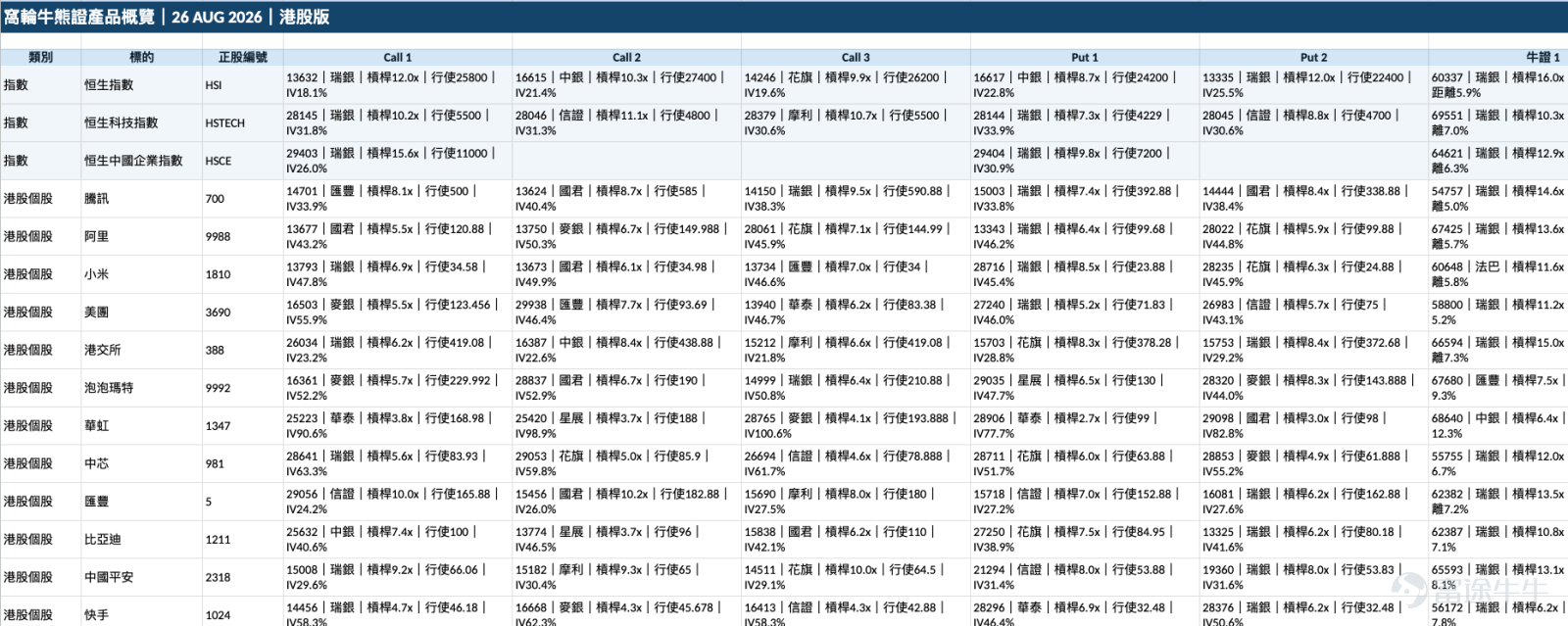
Regarding the HK stock warrants and callable bull/bear contracts (CBBCs) mentioned in today's article, I will only select a few representative terms for explanation.If you want to directly compare Calls, Puts, Callable Bull/Bear Contracts (CBBCs) across different stocks, you can click“Warrant and Callable Bull/Bear Contract (CBBC) Product Overview”and then review the product terms for each one individually.
![Yesterday, the HK and US markets actually shared a striking similarity:The indices showed no clear directional move, but underlying capital flows have already started making choices. The HSI closed at 25,652 points yesterday, up 141 points or 0.6%, while the Hang Seng TECH Index rose 0.8%. Turnover was approximately HKD 254.8 billion. Stocks like Xiaomi, Alibaba, Ping An, and China Life Insurance performed well, but the market did not see a broad-based rally; on the other hand, some stocks faced significant pressure. This indicates that the current HK market can no longer be interpreted simply as "if the HSI rises, everything goes up." The US market warrants deeper reflection. The Dow Jones fell 0.21%, the S&P 500 closed nearly flat, and the Nasdaq 100 rose just 0.05%, yet Nvidia's reported earnings remained very strong. The question is no longer about whether AI demand is robust, but rather: With such strong growth, is the market still willing to pay higher prices? So today, I will give my answer upfront: Maintain a bullish bias on HK stocks, but note that the HSI has not yet completed its breakout. While the fundamentals of US AI remain strong, strong earnings do not mean all tech stocks are worth chasing. Regarding the HK stock warrants and callable bull/bear contracts (CBBCs) mentioned in today's article, I will only select a few representative terms for explanation.If you want to directly compare Calls, Puts, Callable Bull/Bear Contracts (CBBCs) across different stocks, you can click[Share Link: “Warrant and Callable Bull/Bear Contract (CBBC) Product Overview”]and then review the product terms for each one individually. 1. Hang Seng Index: The level of 25,650 merely represents a return to the median axis; it does not yet constitute a "completed breakout." Hang Seng Index $Hang Seng Index (800000.HK)$ Yesterday's closing quote ...](https://nnqimage.futunn.com/sns_client_feed/1162342/20260827/web-1787789897880-5mAYRcQhVT.png/big?area=1&is_public=true&imageMogr2/ignore-error/1/format/webp)
1. Hang Seng Index: The level of 25,650 merely represents a return to the median axis; it does not yet constitute a "completed breakout."
Hang Seng Index $Hang Seng Index (800000.HK)$ closed yesterday at 25,652.97 points, almost exactly touching the Bollinger Band median line at 25,653.62 points。
This level easily creates an illusion: with yesterday's 141-point rise, has the broader market regained strength?
My answer remains:
Shifted from bearish to neutral bias, but a new upward wave has not been confirmed.
Currently, I am focusing on three key levels:
![Yesterday, the HK and US markets actually shared a striking similarity:The indices showed no clear directional move, but underlying capital flows have already started making choices. The HSI closed at 25,652 points yesterday, up 141 points or 0.6%, while the Hang Seng TECH Index rose 0.8%. Turnover was approximately HKD 254.8 billion. Stocks like Xiaomi, Alibaba, Ping An, and China Life Insurance performed well, but the market did not see a broad-based rally; on the other hand, some stocks faced significant pressure. This indicates that the current HK market can no longer be interpreted simply as "if the HSI rises, everything goes up." The US market warrants deeper reflection. The Dow Jones fell 0.21%, the S&P 500 closed nearly flat, and the Nasdaq 100 rose just 0.05%, yet Nvidia's reported earnings remained very strong. The question is no longer about whether AI demand is robust, but rather: With such strong growth, is the market still willing to pay higher prices? So today, I will give my answer upfront: Maintain a bullish bias on HK stocks, but note that the HSI has not yet completed its breakout. While the fundamentals of US AI remain strong, strong earnings do not mean all tech stocks are worth chasing. Regarding the HK stock warrants and callable bull/bear contracts (CBBCs) mentioned in today's article, I will only select a few representative terms for explanation.If you want to directly compare Calls, Puts, Callable Bull/Bear Contracts (CBBCs) across different stocks, you can click[Share Link: “Warrant and Callable Bull/Bear Contract (CBBC) Product Overview”]and then review the product terms for each one individually. 1. Hang Seng Index: The level of 25,650 merely represents a return to the median axis; it does not yet constitute a "completed breakout." Hang Seng Index $Hang Seng Index (800000.HK)$ Yesterday's closing quote ...](https://nnqimage.futunn.com/sns_client_feed/1162342/20260827/web-1787790023537-g19dNR806a.png/big?area=1&is_public=true&imageMogr2/ignore-error/1/format/webp)
The RSI is around 53–54, indicating it is neither overheated nor particularly strong. Therefore, the biggest issue right now is not "is there room for upside," but ratherwhether it is worth chasing high-leverage products at current mid-range levels.。
My answer is no, it is not worth it.
![Yesterday, the HK and US markets actually shared a striking similarity:The indices showed no clear directional move, but underlying capital flows have already started making choices. The HSI closed at 25,652 points yesterday, up 141 points or 0.6%, while the Hang Seng TECH Index rose 0.8%. Turnover was approximately HKD 254.8 billion. Stocks like Xiaomi, Alibaba, Ping An, and China Life Insurance performed well, but the market did not see a broad-based rally; on the other hand, some stocks faced significant pressure. This indicates that the current HK market can no longer be interpreted simply as "if the HSI rises, everything goes up." The US market warrants deeper reflection. The Dow Jones fell 0.21%, the S&P 500 closed nearly flat, and the Nasdaq 100 rose just 0.05%, yet Nvidia's reported earnings remained very strong. The question is no longer about whether AI demand is robust, but rather: With such strong growth, is the market still willing to pay higher prices? So today, I will give my answer upfront: Maintain a bullish bias on HK stocks, but note that the HSI has not yet completed its breakout. While the fundamentals of US AI remain strong, strong earnings do not mean all tech stocks are worth chasing. Regarding the HK stock warrants and callable bull/bear contracts (CBBCs) mentioned in today's article, I will only select a few representative terms for explanation.If you want to directly compare Calls, Puts, Callable Bull/Bear Contracts (CBBCs) across different stocks, you can click[Share Link: “Warrant and Callable Bull/Bear Contract (CBBC) Product Overview”]and then review the product terms for each one individually. 1. Hang Seng Index: The level of 25,650 merely represents a return to the median axis; it does not yet constitute a "completed breakout." Hang Seng Index $Hang Seng Index (800000.HK)$ Yesterday's closing quote ...](https://nnqimage.futunn.com/sns_client_feed/1162342/20260827/web-1787790086115-ts7cJFzcZC.png/big?area=1&is_public=true&imageMogr2/ignore-error/1/format/webp)
2. Hang Seng Index CBBCs: I prefer to maintain a wider call price distance.
The Hang Seng Index is the best example today of why you should separate "direction" from "product selection."
![Yesterday, the HK and US markets actually shared a striking similarity:The indices showed no clear directional move, but underlying capital flows have already started making choices. The HSI closed at 25,652 points yesterday, up 141 points or 0.6%, while the Hang Seng TECH Index rose 0.8%. Turnover was approximately HKD 254.8 billion. Stocks like Xiaomi, Alibaba, Ping An, and China Life Insurance performed well, but the market did not see a broad-based rally; on the other hand, some stocks faced significant pressure. This indicates that the current HK market can no longer be interpreted simply as "if the HSI rises, everything goes up." The US market warrants deeper reflection. The Dow Jones fell 0.21%, the S&P 500 closed nearly flat, and the Nasdaq 100 rose just 0.05%, yet Nvidia's reported earnings remained very strong. The question is no longer about whether AI demand is robust, but rather: With such strong growth, is the market still willing to pay higher prices? So today, I will give my answer upfront: Maintain a bullish bias on HK stocks, but note that the HSI has not yet completed its breakout. While the fundamentals of US AI remain strong, strong earnings do not mean all tech stocks are worth chasing. Regarding the HK stock warrants and callable bull/bear contracts (CBBCs) mentioned in today's article, I will only select a few representative terms for explanation.If you want to directly compare Calls, Puts, Callable Bull/Bear Contracts (CBBCs) across different stocks, you can click[Share Link: “Warrant and Callable Bull/Bear Contract (CBBC) Product Overview”]and then review the product terms for each one individually. 1. Hang Seng Index: The level of 25,650 merely represents a return to the median axis; it does not yet constitute a "completed breakout." Hang Seng Index $Hang Seng Index (800000.HK)$ Yesterday's closing quote ...](https://nnqimage.futunn.com/sns_client_feed/1162342/20260827/web-1787790126627-HG2bMLJlXs.png/big?area=1&is_public=true&imageMogr2/ignore-error/1/format/webp)
The most important factor here is not which instrument has the highest leverage, but rather:
How much call risk are you willing to take in exchange for higher leverage?
If my current view on the Hang Seng Index is merely a "range-bound bias," I do not need to prove my bullish conviction by buying a bull contract with a call price only ~2% away.
Because this easily leads to a scenario retail investors dread most:
Getting the direction right in the end, but having the product called away first.
So today's strategy for Hang Seng Index products is clear:
It's fine to be bullish, but don't risk it all with tight stop-losses.
If you want to compare more Hang Seng Index bull contracts, bear contracts, and terms with different call distances, you can click directly on “Warrant and Callable Bull/Bear Contract (CBBC) Product Overview”, where representative products are grouped together, making it much easier than searching for them one by one.
3. HK Stock Short Selling: The rebound is real, but short sellers haven't fully exited yet
Today, you can't just look at price rises and falls for individual HK stocks.
I will pay special attention to a new core signal:
When stock prices rise, does short selling decrease simultaneously?
If a stock:
- Share price rises
- Trading volume increases
- Short interest declines
I would have more confidence in this kind of rebound.
But if:
- Share price rises
- Short interest ratio actually increases
This indicates that some market participants remain skeptical about this upward trend.
Therefore, for every HK stock today, I analyze the underlying shares, short selling data, and derivatives (warrants/callable contracts) together, rather than treating them as three separate factors.
4. Alibaba: The worst phase of the placement may be over, but I still won't chase high-leverage call options.
When the placement news broke, the market initially priced in the dilution. Later, as management increased their holdings and the market reassessed AI capital expenditure, the share price began to recover.
The real question now is:
Has the market shifted from focusing solely on the dilutive effect of the placement to re-evaluating AI investments?
My current answer is:There are early signs of this shift.
Therefore, I prefer holding Alibaba's underlying shares.
However, regarding warrants and CBBCs, I would not buy the most out-of-the-money, highest-leverage Calls simply because I am bullish.
Currently, Alibaba Calls generally offer an effective leverage of about 5x to 7x, with implied volatility (IV) mostly hovering around the high 40s to 50. For me, a more reasonable approach is:
– Choose strike prices that are not too far out-of-the-money;
- Avoid excessively short time to expiration;
- Implied Volatility (IV) should not be significantly higher than that of comparable products;
- Sufficient leverage is all that is needed.
At times like these, it’s not about who takes the biggest risks, but rather whois least likely to lose due to product terms even when their directional view is correct.。
If you want to compare different Call options, Put options, and CBBCs for Alibaba, I won’t clutter the main text with a dozen products; simply click “Warrant and Callable Bull/Bear Contract (CBBC) Product Overview” for a much clearer view.
![Yesterday, the HK and US markets actually shared a striking similarity:The indices showed no clear directional move, but underlying capital flows have already started making choices. The HSI closed at 25,652 points yesterday, up 141 points or 0.6%, while the Hang Seng TECH Index rose 0.8%. Turnover was approximately HKD 254.8 billion. Stocks like Xiaomi, Alibaba, Ping An, and China Life Insurance performed well, but the market did not see a broad-based rally; on the other hand, some stocks faced significant pressure. This indicates that the current HK market can no longer be interpreted simply as "if the HSI rises, everything goes up." The US market warrants deeper reflection. The Dow Jones fell 0.21%, the S&P 500 closed nearly flat, and the Nasdaq 100 rose just 0.05%, yet Nvidia's reported earnings remained very strong. The question is no longer about whether AI demand is robust, but rather: With such strong growth, is the market still willing to pay higher prices? So today, I will give my answer upfront: Maintain a bullish bias on HK stocks, but note that the HSI has not yet completed its breakout. While the fundamentals of US AI remain strong, strong earnings do not mean all tech stocks are worth chasing. Regarding the HK stock warrants and callable bull/bear contracts (CBBCs) mentioned in today's article, I will only select a few representative terms for explanation.If you want to directly compare Calls, Puts, Callable Bull/Bear Contracts (CBBCs) across different stocks, you can click[Share Link: “Warrant and Callable Bull/Bear Contract (CBBC) Product Overview”]and then review the product terms for each one individually. 1. Hang Seng Index: The level of 25,650 merely represents a return to the median axis; it does not yet constitute a "completed breakout." Hang Seng Index $Hang Seng Index (800000.HK)$ Yesterday's closing quote ...](https://nnqimage.futunn.com/sns_client_feed/1162342/20260827/web-1787790363222-8AUaBTthUB.png/big?area=1&is_public=true&imageMogr2/ignore-error/1/format/webp)
5. Tencent: Not the strongest performer yesterday, but its derivative products are easier to select.
However, from the perspective of warrants and CBBCs, I actually prefer Tencent.
The reason is that the implied volatility (IV) of Tencent calls is generally around 30-40%, which is not as expensive as some high-beta tech stocks.
This means:
You don't need the underlying stock to suddenly surge 5% tomorrow for the product to have a chance of performing well.
So Tencent is a typical case:
The underlying stock isn't the strongest performer, but the derivatives offer decent value for money.
I will maintain my preference, but wait for a better entry point rather than chasing the price.
![Yesterday, the HK and US markets actually shared a striking similarity:The indices showed no clear directional move, but underlying capital flows have already started making choices. The HSI closed at 25,652 points yesterday, up 141 points or 0.6%, while the Hang Seng TECH Index rose 0.8%. Turnover was approximately HKD 254.8 billion. Stocks like Xiaomi, Alibaba, Ping An, and China Life Insurance performed well, but the market did not see a broad-based rally; on the other hand, some stocks faced significant pressure. This indicates that the current HK market can no longer be interpreted simply as "if the HSI rises, everything goes up." The US market warrants deeper reflection. The Dow Jones fell 0.21%, the S&P 500 closed nearly flat, and the Nasdaq 100 rose just 0.05%, yet Nvidia's reported earnings remained very strong. The question is no longer about whether AI demand is robust, but rather: With such strong growth, is the market still willing to pay higher prices? So today, I will give my answer upfront: Maintain a bullish bias on HK stocks, but note that the HSI has not yet completed its breakout. While the fundamentals of US AI remain strong, strong earnings do not mean all tech stocks are worth chasing. Regarding the HK stock warrants and callable bull/bear contracts (CBBCs) mentioned in today's article, I will only select a few representative terms for explanation.If you want to directly compare Calls, Puts, Callable Bull/Bear Contracts (CBBCs) across different stocks, you can click[Share Link: “Warrant and Callable Bull/Bear Contract (CBBC) Product Overview”]and then review the product terms for each one individually. 1. Hang Seng Index: The level of 25,650 merely represents a return to the median axis; it does not yet constitute a "completed breakout." Hang Seng Index $Hang Seng Index (800000.HK)$ Yesterday's closing quote ...](https://nnqimage.futunn.com/sns_client_feed/1162342/20260827/web-1787790402065-mxM8BYUUcf.png/big?area=1&is_public=true&imageMogr2/ignore-error/1/format/webp)
6. Xiaomi: The underlying stock has stronger momentum, but the market is already charging you a higher premium for volatility.
If we look solely at the momentum of the underlying stock, I would admit that Xiaomi is stronger.
However, the IV of many Xiaomi calls is already around 45-50%.
This essentially means the market is already telling you:
"I know this stock will consolidate, so I'm asking for a higher premium."
So if Xiaomi rises again today, I wouldn't be surprised.
But if it's just a slow grind higher, calls might not necessarily be more profitable than those on Tencent.
Therefore, I draw a clear distinction between the two:
Underlying stock explosiveness: Xiaomi is stronger.
Warrant/structured product value: Tencent offers better comfort/risk-reward.
This is also why I hope that when you look at “Warrant and Callable Bull/Bear Contract (CBBC) Product Overview” them, don't just focus on leverage, but consider IV, strike price, and call distance together.
![Yesterday, the HK and US markets actually shared a striking similarity:The indices showed no clear directional move, but underlying capital flows have already started making choices. The HSI closed at 25,652 points yesterday, up 141 points or 0.6%, while the Hang Seng TECH Index rose 0.8%. Turnover was approximately HKD 254.8 billion. Stocks like Xiaomi, Alibaba, Ping An, and China Life Insurance performed well, but the market did not see a broad-based rally; on the other hand, some stocks faced significant pressure. This indicates that the current HK market can no longer be interpreted simply as "if the HSI rises, everything goes up." The US market warrants deeper reflection. The Dow Jones fell 0.21%, the S&P 500 closed nearly flat, and the Nasdaq 100 rose just 0.05%, yet Nvidia's reported earnings remained very strong. The question is no longer about whether AI demand is robust, but rather: With such strong growth, is the market still willing to pay higher prices? So today, I will give my answer upfront: Maintain a bullish bias on HK stocks, but note that the HSI has not yet completed its breakout. While the fundamentals of US AI remain strong, strong earnings do not mean all tech stocks are worth chasing. Regarding the HK stock warrants and callable bull/bear contracts (CBBCs) mentioned in today's article, I will only select a few representative terms for explanation.If you want to directly compare Calls, Puts, Callable Bull/Bear Contracts (CBBCs) across different stocks, you can click[Share Link: “Warrant and Callable Bull/Bear Contract (CBBC) Product Overview”]and then review the product terms for each one individually. 1. Hang Seng Index: The level of 25,650 merely represents a return to the median axis; it does not yet constitute a "completed breakout." Hang Seng Index $Hang Seng Index (800000.HK)$ Yesterday's closing quote ...](https://nnqimage.futunn.com/sns_client_feed/1162342/20260827/web-1787790436634-i6mfTITnq6.png/big?area=1&is_public=true&imageMogr2/ignore-error/1/format/webp)
7. Ping An, China Life: Financial stocks are starting to outperform, which is worth paying attention to more than a pure tech rebound.
Yesterday, Ping An $PING AN (02318.HK)$ China Life Insurance $CHINA LIFE (02628.HK)$ have both shown significant performance.
This is actually a point I value highly.
If the entire market relies solely on tech stocks to rise, the breadth of this rebound remains limited.
But if insurance and financial sectors start to take the baton, it signals that capital is broadening out.
Ping An
The implied volatility (IV) of Ping An products is relatively moderate compared to tech stocks, with many calls around 30%.
So while it may not be the most exciting play, it has one advantage:
The product cost is more reasonable.
If the underlying stock maintains stable upward momentum, I would be more willing to trade Ping An than many high-IV tech stocks.
![Yesterday, the HK and US markets actually shared a striking similarity:The indices showed no clear directional move, but underlying capital flows have already started making choices. The HSI closed at 25,652 points yesterday, up 141 points or 0.6%, while the Hang Seng TECH Index rose 0.8%. Turnover was approximately HKD 254.8 billion. Stocks like Xiaomi, Alibaba, Ping An, and China Life Insurance performed well, but the market did not see a broad-based rally; on the other hand, some stocks faced significant pressure. This indicates that the current HK market can no longer be interpreted simply as "if the HSI rises, everything goes up." The US market warrants deeper reflection. The Dow Jones fell 0.21%, the S&P 500 closed nearly flat, and the Nasdaq 100 rose just 0.05%, yet Nvidia's reported earnings remained very strong. The question is no longer about whether AI demand is robust, but rather: With such strong growth, is the market still willing to pay higher prices? So today, I will give my answer upfront: Maintain a bullish bias on HK stocks, but note that the HSI has not yet completed its breakout. While the fundamentals of US AI remain strong, strong earnings do not mean all tech stocks are worth chasing. Regarding the HK stock warrants and callable bull/bear contracts (CBBCs) mentioned in today's article, I will only select a few representative terms for explanation.If you want to directly compare Calls, Puts, Callable Bull/Bear Contracts (CBBCs) across different stocks, you can click[Share Link: “Warrant and Callable Bull/Bear Contract (CBBC) Product Overview”]and then review the product terms for each one individually. 1. Hang Seng Index: The level of 25,650 merely represents a return to the median axis; it does not yet constitute a "completed breakout." Hang Seng Index $Hang Seng Index (800000.HK)$ Yesterday's closing quote ...](https://nnqimage.futunn.com/sns_client_feed/1162342/20260827/web-1787790480196-kkD4BL9mwH.png/big?area=1&is_public=true&imageMogr2/ignore-error/1/format/webp)
China Life Insurance
China Life Insurance has stronger momentum, but precisely because it is rising so quickly, you should pay extra attention to Implied Volatility (IV) and the call distance when chasing products.
So my thinking is:
Ping An = More comfortable product structure.
China Life Insurance = Stronger underlying stock momentum.
If you want a detailed comparison of Calls and CBBCs on both sides, you can still directly check “Warrant and Callable Bull/Bear Contract (CBBC) Product Overview”, without relying on impressions to pick products.
![Yesterday, the HK and US markets actually shared a striking similarity:The indices showed no clear directional move, but underlying capital flows have already started making choices. The HSI closed at 25,652 points yesterday, up 141 points or 0.6%, while the Hang Seng TECH Index rose 0.8%. Turnover was approximately HKD 254.8 billion. Stocks like Xiaomi, Alibaba, Ping An, and China Life Insurance performed well, but the market did not see a broad-based rally; on the other hand, some stocks faced significant pressure. This indicates that the current HK market can no longer be interpreted simply as "if the HSI rises, everything goes up." The US market warrants deeper reflection. The Dow Jones fell 0.21%, the S&P 500 closed nearly flat, and the Nasdaq 100 rose just 0.05%, yet Nvidia's reported earnings remained very strong. The question is no longer about whether AI demand is robust, but rather: With such strong growth, is the market still willing to pay higher prices? So today, I will give my answer upfront: Maintain a bullish bias on HK stocks, but note that the HSI has not yet completed its breakout. While the fundamentals of US AI remain strong, strong earnings do not mean all tech stocks are worth chasing. Regarding the HK stock warrants and callable bull/bear contracts (CBBCs) mentioned in today's article, I will only select a few representative terms for explanation.If you want to directly compare Calls, Puts, Callable Bull/Bear Contracts (CBBCs) across different stocks, you can click[Share Link: “Warrant and Callable Bull/Bear Contract (CBBC) Product Overview”]and then review the product terms for each one individually. 1. Hang Seng Index: The level of 25,650 merely represents a return to the median axis; it does not yet constitute a "completed breakout." Hang Seng Index $Hang Seng Index (800000.HK)$ Yesterday's closing quote ...](https://nnqimage.futunn.com/sns_client_feed/1162342/20260827/web-1787790506445-DwCTX7Q8md.png/big?area=1&is_public=true&imageMogr2/ignore-error/1/format/webp)
8. HKEX: The fundamentals are sound, but that doesn't necessarily mean it's worth chasing Calls at today's price.
The rebound in trading volume for Hong Kong stocks is $HKEX (00388.HK)$ certainly good news for HKEX.
But "good fundamentals" and "worth chasing at the current price level" are two different issues.
If the stock price has already priced in some of the good news and short selling remains active, I would wait first.
So here is the current stance on HKEX:
Underlying stock: Neutral bias.
Derivatives: No rush.
This approach of "watching the stock but holding off on derivatives" is actually the key judgment I want to maintain throughout this series.
![Yesterday, the HK and US markets actually shared a striking similarity:The indices showed no clear directional move, but underlying capital flows have already started making choices. The HSI closed at 25,652 points yesterday, up 141 points or 0.6%, while the Hang Seng TECH Index rose 0.8%. Turnover was approximately HKD 254.8 billion. Stocks like Xiaomi, Alibaba, Ping An, and China Life Insurance performed well, but the market did not see a broad-based rally; on the other hand, some stocks faced significant pressure. This indicates that the current HK market can no longer be interpreted simply as "if the HSI rises, everything goes up." The US market warrants deeper reflection. The Dow Jones fell 0.21%, the S&P 500 closed nearly flat, and the Nasdaq 100 rose just 0.05%, yet Nvidia's reported earnings remained very strong. The question is no longer about whether AI demand is robust, but rather: With such strong growth, is the market still willing to pay higher prices? So today, I will give my answer upfront: Maintain a bullish bias on HK stocks, but note that the HSI has not yet completed its breakout. While the fundamentals of US AI remain strong, strong earnings do not mean all tech stocks are worth chasing. Regarding the HK stock warrants and callable bull/bear contracts (CBBCs) mentioned in today's article, I will only select a few representative terms for explanation.If you want to directly compare Calls, Puts, Callable Bull/Bear Contracts (CBBCs) across different stocks, you can click[Share Link: “Warrant and Callable Bull/Bear Contract (CBBC) Product Overview”]and then review the product terms for each one individually. 1. Hang Seng Index: The level of 25,650 merely represents a return to the median axis; it does not yet constitute a "completed breakout." Hang Seng Index $Hang Seng Index (800000.HK)$ Yesterday's closing quote ...](https://nnqimage.futunn.com/sns_client_feed/1162342/20260827/web-1787790541711-b22flM5Czm.png/big?area=1&is_public=true&imageMogr2/ignore-error/1/format/webp)
9. Innovent Bio: It rose too quickly yesterday; today, the focus shouldn't be on its strength, but on how much risk-reward potential remains.
Innovent Bio $INNOVENT BIO (01801.HK)$ Such strong-performing stocks are most likely to trigger FOMO among retail investors.
Watching it rise yesterday, the most natural thought today is:
"Will I miss out again if I don't chase?"
But instead, I would ask:
It already surged significantly yesterday; how high a price are you willing to pay today to chase this momentum?
If implied volatility (IV) is also spiking, it becomes even harder to chase warrant prices.
Therefore, even if the underlying stock remains strong, I would categorize such a stock as:
Wait for a pullback; do not chase the rally.
![Yesterday, the HK and US markets actually shared a striking similarity:The indices showed no clear directional move, but underlying capital flows have already started making choices. The HSI closed at 25,652 points yesterday, up 141 points or 0.6%, while the Hang Seng TECH Index rose 0.8%. Turnover was approximately HKD 254.8 billion. Stocks like Xiaomi, Alibaba, Ping An, and China Life Insurance performed well, but the market did not see a broad-based rally; on the other hand, some stocks faced significant pressure. This indicates that the current HK market can no longer be interpreted simply as "if the HSI rises, everything goes up." The US market warrants deeper reflection. The Dow Jones fell 0.21%, the S&P 500 closed nearly flat, and the Nasdaq 100 rose just 0.05%, yet Nvidia's reported earnings remained very strong. The question is no longer about whether AI demand is robust, but rather: With such strong growth, is the market still willing to pay higher prices? So today, I will give my answer upfront: Maintain a bullish bias on HK stocks, but note that the HSI has not yet completed its breakout. While the fundamentals of US AI remain strong, strong earnings do not mean all tech stocks are worth chasing. Regarding the HK stock warrants and callable bull/bear contracts (CBBCs) mentioned in today's article, I will only select a few representative terms for explanation.If you want to directly compare Calls, Puts, Callable Bull/Bear Contracts (CBBCs) across different stocks, you can click[Share Link: “Warrant and Callable Bull/Bear Contract (CBBC) Product Overview”]and then review the product terms for each one individually. 1. Hang Seng Index: The level of 25,650 merely represents a return to the median axis; it does not yet constitute a "completed breakout." Hang Seng Index $Hang Seng Index (800000.HK)$ Yesterday's closing quote ...](https://nnqimage.futunn.com/sns_client_feed/1162342/20260827/web-1787790573363-3vODfpHGdF.png/big?area=1&is_public=true&imageMogr2/ignore-error/1/format/webp)
10. XPeng: After a sharp rebound, watch whether short interest declines in tandem.
A single-day gain of 7% or 8% is attractive, but what truly changed my perspective was not the one-day surge, but rather:
– Whether trading volume can be sustained;
– Whether short selling has decreased;
– Whether the stock price can hold above the breakout level.
Only when all three factors appear together will I upgrade a "rebound" to a "strengthening trend."
If the stock price rises but short interest remains high, I won't chase the rally too quickly.
![Yesterday, the HK and US markets actually shared a striking similarity:The indices showed no clear directional move, but underlying capital flows have already started making choices. The HSI closed at 25,652 points yesterday, up 141 points or 0.6%, while the Hang Seng TECH Index rose 0.8%. Turnover was approximately HKD 254.8 billion. Stocks like Xiaomi, Alibaba, Ping An, and China Life Insurance performed well, but the market did not see a broad-based rally; on the other hand, some stocks faced significant pressure. This indicates that the current HK market can no longer be interpreted simply as "if the HSI rises, everything goes up." The US market warrants deeper reflection. The Dow Jones fell 0.21%, the S&P 500 closed nearly flat, and the Nasdaq 100 rose just 0.05%, yet Nvidia's reported earnings remained very strong. The question is no longer about whether AI demand is robust, but rather: With such strong growth, is the market still willing to pay higher prices? So today, I will give my answer upfront: Maintain a bullish bias on HK stocks, but note that the HSI has not yet completed its breakout. While the fundamentals of US AI remain strong, strong earnings do not mean all tech stocks are worth chasing. Regarding the HK stock warrants and callable bull/bear contracts (CBBCs) mentioned in today's article, I will only select a few representative terms for explanation.If you want to directly compare Calls, Puts, Callable Bull/Bear Contracts (CBBCs) across different stocks, you can click[Share Link: “Warrant and Callable Bull/Bear Contract (CBBC) Product Overview”]and then review the product terms for each one individually. 1. Hang Seng Index: The level of 25,650 merely represents a return to the median axis; it does not yet constitute a "completed breakout." Hang Seng Index $Hang Seng Index (800000.HK)$ Yesterday's closing quote ...](https://nnqimage.futunn.com/sns_client_feed/1162342/20260827/web-1787790603925-uJ2irEgvWR.png/big?area=1&is_public=true&imageMogr2/ignore-error/1/format/webp)
11. CMOC Group: Its value lies not just in its price increase, but in helping me gauge market breadth.
If resource stocks strengthen simultaneously, it is actually healthier for the Hang Seng Index than having just two or three large-cap tech stocks propping up the market.
Is this HK stock rebound supported by participation from more sectors?
If the answer is yes, the credibility of the Hang Seng Index breaking through 25,900 will naturally be higher.
![Yesterday, the HK and US markets actually shared a striking similarity:The indices showed no clear directional move, but underlying capital flows have already started making choices. The HSI closed at 25,652 points yesterday, up 141 points or 0.6%, while the Hang Seng TECH Index rose 0.8%. Turnover was approximately HKD 254.8 billion. Stocks like Xiaomi, Alibaba, Ping An, and China Life Insurance performed well, but the market did not see a broad-based rally; on the other hand, some stocks faced significant pressure. This indicates that the current HK market can no longer be interpreted simply as "if the HSI rises, everything goes up." The US market warrants deeper reflection. The Dow Jones fell 0.21%, the S&P 500 closed nearly flat, and the Nasdaq 100 rose just 0.05%, yet Nvidia's reported earnings remained very strong. The question is no longer about whether AI demand is robust, but rather: With such strong growth, is the market still willing to pay higher prices? So today, I will give my answer upfront: Maintain a bullish bias on HK stocks, but note that the HSI has not yet completed its breakout. While the fundamentals of US AI remain strong, strong earnings do not mean all tech stocks are worth chasing. Regarding the HK stock warrants and callable bull/bear contracts (CBBCs) mentioned in today's article, I will only select a few representative terms for explanation.If you want to directly compare Calls, Puts, Callable Bull/Bear Contracts (CBBCs) across different stocks, you can click[Share Link: “Warrant and Callable Bull/Bear Contract (CBBC) Product Overview”]and then review the product terms for each one individually. 1. Hang Seng Index: The level of 25,650 merely represents a return to the median axis; it does not yet constitute a "completed breakout." Hang Seng Index $Hang Seng Index (800000.HK)$ Yesterday's closing quote ...](https://nnqimage.futunn.com/sns_client_feed/1162342/20260827/web-1787790636628-t3CfXtpX8i.png/big?area=1&is_public=true&imageMogr2/ignore-error/1/format/webp)
12. Shenzhou International $SHENZHOU INTL (02313.HK)$ : The broader market is rising, yet it is falling, which is precisely why one shouldn't buy blindly today.
Not all stocks rose yesterday.
This is why I continue to emphasize stock selection today.
If a stock remains weak even during a broad market rebound, the key question isn't "is it a bargain because it has fallen so much," but rather:
Why is capital still avoiding it even as the broader market improves?
Therefore, I am in no hurry to buy the dip on such stocks.
![Yesterday, the HK and US markets actually shared a striking similarity:The indices showed no clear directional move, but underlying capital flows have already started making choices. The HSI closed at 25,652 points yesterday, up 141 points or 0.6%, while the Hang Seng TECH Index rose 0.8%. Turnover was approximately HKD 254.8 billion. Stocks like Xiaomi, Alibaba, Ping An, and China Life Insurance performed well, but the market did not see a broad-based rally; on the other hand, some stocks faced significant pressure. This indicates that the current HK market can no longer be interpreted simply as "if the HSI rises, everything goes up." The US market warrants deeper reflection. The Dow Jones fell 0.21%, the S&P 500 closed nearly flat, and the Nasdaq 100 rose just 0.05%, yet Nvidia's reported earnings remained very strong. The question is no longer about whether AI demand is robust, but rather: With such strong growth, is the market still willing to pay higher prices? So today, I will give my answer upfront: Maintain a bullish bias on HK stocks, but note that the HSI has not yet completed its breakout. While the fundamentals of US AI remain strong, strong earnings do not mean all tech stocks are worth chasing. Regarding the HK stock warrants and callable bull/bear contracts (CBBCs) mentioned in today's article, I will only select a few representative terms for explanation.If you want to directly compare Calls, Puts, Callable Bull/Bear Contracts (CBBCs) across different stocks, you can click[Share Link: “Warrant and Callable Bull/Bear Contract (CBBC) Product Overview”]and then review the product terms for each one individually. 1. Hang Seng Index: The level of 25,650 merely represents a return to the median axis; it does not yet constitute a "completed breakout." Hang Seng Index $Hang Seng Index (800000.HK)$ Yesterday's closing quote ...](https://nnqimage.futunn.com/sns_client_feed/1162342/20260827/web-1787790702518-af7cXFbfXf.png/big?area=1&is_public=true&imageMogr2/ignore-error/1/format/webp)
![Yesterday, the HK and US markets actually shared a striking similarity:The indices showed no clear directional move, but underlying capital flows have already started making choices. The HSI closed at 25,652 points yesterday, up 141 points or 0.6%, while the Hang Seng TECH Index rose 0.8%. Turnover was approximately HKD 254.8 billion. Stocks like Xiaomi, Alibaba, Ping An, and China Life Insurance performed well, but the market did not see a broad-based rally; on the other hand, some stocks faced significant pressure. This indicates that the current HK market can no longer be interpreted simply as "if the HSI rises, everything goes up." The US market warrants deeper reflection. The Dow Jones fell 0.21%, the S&P 500 closed nearly flat, and the Nasdaq 100 rose just 0.05%, yet Nvidia's reported earnings remained very strong. The question is no longer about whether AI demand is robust, but rather: With such strong growth, is the market still willing to pay higher prices? So today, I will give my answer upfront: Maintain a bullish bias on HK stocks, but note that the HSI has not yet completed its breakout. While the fundamentals of US AI remain strong, strong earnings do not mean all tech stocks are worth chasing. Regarding the HK stock warrants and callable bull/bear contracts (CBBCs) mentioned in today's article, I will only select a few representative terms for explanation.If you want to directly compare Calls, Puts, Callable Bull/Bear Contracts (CBBCs) across different stocks, you can click[Share Link: “Warrant and Callable Bull/Bear Contract (CBBC) Product Overview”]and then review the product terms for each one individually. 1. Hang Seng Index: The level of 25,650 merely represents a return to the median axis; it does not yet constitute a "completed breakout." Hang Seng Index $Hang Seng Index (800000.HK)$ Yesterday's closing quote ...](https://nnqimage.futunn.com/sns_client_feed/1162342/20260827/web-1787790737358-CzCI6kS1Fz.png/big?area=1&is_public=true&imageMogr2/ignore-error/1/format/webp)
If you want to move directly from this analysis framework to specific products, you can click on the "Warrants and CBBC Product Overview." The article explains "how I think," while the product overview helps you compare "how to choose if you decide to trade."
13. US Stocks: Nvidia is not the only focus; I am more interested in seeing whether the AI rally is broadening.
The market is already aware of Nvidia's strong earnings.
What is truly worth watching today is:
Can these strong results lift the entire AI supply chain?
If only NVDA is strong while MU, MRVL, AVGO, and AMD fail to follow, it actually signals that the market rally is narrowing.
Only if memory, networking, ASIC, and AI cloud infrastructure stocks rise together does it indicate that capital is still willing to diffuse into second-tier names.
14. Nvidia: Fundamentals are solid, but today is not a case of simply "chasing the beat."
Rather, the market's expectations have risen to the point where:
Good results aren't enough; they must exceed even the highest expectations.
Therefore, my stance on NVDA remains:
Fundamentals: Bullish.
Stock Price: Wait for market confirmation.
Strategy: Do not chase highly leveraged calls just because of an earnings beat.
If the terms of the HK-listed NVDA warrants/structured products are unattractive, I'd rather skip the trade.
![Yesterday, the HK and US markets actually shared a striking similarity:The indices showed no clear directional move, but underlying capital flows have already started making choices. The HSI closed at 25,652 points yesterday, up 141 points or 0.6%, while the Hang Seng TECH Index rose 0.8%. Turnover was approximately HKD 254.8 billion. Stocks like Xiaomi, Alibaba, Ping An, and China Life Insurance performed well, but the market did not see a broad-based rally; on the other hand, some stocks faced significant pressure. This indicates that the current HK market can no longer be interpreted simply as "if the HSI rises, everything goes up." The US market warrants deeper reflection. The Dow Jones fell 0.21%, the S&P 500 closed nearly flat, and the Nasdaq 100 rose just 0.05%, yet Nvidia's reported earnings remained very strong. The question is no longer about whether AI demand is robust, but rather: With such strong growth, is the market still willing to pay higher prices? So today, I will give my answer upfront: Maintain a bullish bias on HK stocks, but note that the HSI has not yet completed its breakout. While the fundamentals of US AI remain strong, strong earnings do not mean all tech stocks are worth chasing. Regarding the HK stock warrants and callable bull/bear contracts (CBBCs) mentioned in today's article, I will only select a few representative terms for explanation.If you want to directly compare Calls, Puts, Callable Bull/Bear Contracts (CBBCs) across different stocks, you can click[Share Link: “Warrant and Callable Bull/Bear Contract (CBBC) Product Overview”]and then review the product terms for each one individually. 1. Hang Seng Index: The level of 25,650 merely represents a return to the median axis; it does not yet constitute a "completed breakout." Hang Seng Index $Hang Seng Index (800000.HK)$ Yesterday's closing quote ...](https://nnqimage.futunn.com/sns_client_feed/1162342/20260827/web-1787790855415-s2GeV8XlJp.png/big?area=1&is_public=true&imageMogr2/ignore-error/1/format/webp)
15. Micron: I will actually pay close attention to it today.
Nvidia's strong data once again confirms demand for AI servers, while High Bandwidth Memory (HBM) remains a critical component across the entire supply chain.
So if MU can maintain its strength, I would interpret it as follows:
The AI trade is no longer just about buying GPUs; it is beginning to expand into memory.
Even if there are no suitable HK-listed warrants/structured products, it is still worth discussing.
![Yesterday, the HK and US markets actually shared a striking similarity:The indices showed no clear directional move, but underlying capital flows have already started making choices. The HSI closed at 25,652 points yesterday, up 141 points or 0.6%, while the Hang Seng TECH Index rose 0.8%. Turnover was approximately HKD 254.8 billion. Stocks like Xiaomi, Alibaba, Ping An, and China Life Insurance performed well, but the market did not see a broad-based rally; on the other hand, some stocks faced significant pressure. This indicates that the current HK market can no longer be interpreted simply as "if the HSI rises, everything goes up." The US market warrants deeper reflection. The Dow Jones fell 0.21%, the S&P 500 closed nearly flat, and the Nasdaq 100 rose just 0.05%, yet Nvidia's reported earnings remained very strong. The question is no longer about whether AI demand is robust, but rather: With such strong growth, is the market still willing to pay higher prices? So today, I will give my answer upfront: Maintain a bullish bias on HK stocks, but note that the HSI has not yet completed its breakout. While the fundamentals of US AI remain strong, strong earnings do not mean all tech stocks are worth chasing. Regarding the HK stock warrants and callable bull/bear contracts (CBBCs) mentioned in today's article, I will only select a few representative terms for explanation.If you want to directly compare Calls, Puts, Callable Bull/Bear Contracts (CBBCs) across different stocks, you can click[Share Link: “Warrant and Callable Bull/Bear Contract (CBBC) Product Overview”]and then review the product terms for each one individually. 1. Hang Seng Index: The level of 25,650 merely represents a return to the median axis; it does not yet constitute a "completed breakout." Hang Seng Index $Hang Seng Index (800000.HK)$ Yesterday's closing quote ...](https://nnqimage.futunn.com/sns_client_feed/1162342/20260827/web-1787790883801-gEEGEnW4FN.png/big?area=1&is_public=true&imageMogr2/ignore-error/1/format/webp)
16. Marvell: It is testing whether second-tier AI capital is willing to follow.
If GPU demand continues to explode, how to achieve high-speed data transmission between servers and chips becomes a key issue as well.
So MRVL isn't just "tagging along with NVDA's rise."
It is testing:
whether capital is willing to rotate out of the safest bet, NVDA, into second-tier AI beneficiaries.
![Yesterday, the HK and US markets actually shared a striking similarity:The indices showed no clear directional move, but underlying capital flows have already started making choices. The HSI closed at 25,652 points yesterday, up 141 points or 0.6%, while the Hang Seng TECH Index rose 0.8%. Turnover was approximately HKD 254.8 billion. Stocks like Xiaomi, Alibaba, Ping An, and China Life Insurance performed well, but the market did not see a broad-based rally; on the other hand, some stocks faced significant pressure. This indicates that the current HK market can no longer be interpreted simply as "if the HSI rises, everything goes up." The US market warrants deeper reflection. The Dow Jones fell 0.21%, the S&P 500 closed nearly flat, and the Nasdaq 100 rose just 0.05%, yet Nvidia's reported earnings remained very strong. The question is no longer about whether AI demand is robust, but rather: With such strong growth, is the market still willing to pay higher prices? So today, I will give my answer upfront: Maintain a bullish bias on HK stocks, but note that the HSI has not yet completed its breakout. While the fundamentals of US AI remain strong, strong earnings do not mean all tech stocks are worth chasing. Regarding the HK stock warrants and callable bull/bear contracts (CBBCs) mentioned in today's article, I will only select a few representative terms for explanation.If you want to directly compare Calls, Puts, Callable Bull/Bear Contracts (CBBCs) across different stocks, you can click[Share Link: “Warrant and Callable Bull/Bear Contract (CBBC) Product Overview”]and then review the product terms for each one individually. 1. Hang Seng Index: The level of 25,650 merely represents a return to the median axis; it does not yet constitute a "completed breakout." Hang Seng Index $Hang Seng Index (800000.HK)$ Yesterday's closing quote ...](https://nnqimage.futunn.com/sns_client_feed/1162342/20260827/web-1787790918869-MPMZ4UmqFB.png/big?area=1&is_public=true&imageMogr2/ignore-error/1/format/webp)
17. Broadcom: It doesn't necessarily have to show the strongest reaction, but it serves as a key test for the breadth of the AI rally.
If Nvidia remains strong while AVGO fails to follow suit, I would conclude that the market remains highly concentrated.
If AVGO, MRVL, and MU can all keep pace, the AI rally will be much healthier.
![Yesterday, the HK and US markets actually shared a striking similarity:The indices showed no clear directional move, but underlying capital flows have already started making choices. The HSI closed at 25,652 points yesterday, up 141 points or 0.6%, while the Hang Seng TECH Index rose 0.8%. Turnover was approximately HKD 254.8 billion. Stocks like Xiaomi, Alibaba, Ping An, and China Life Insurance performed well, but the market did not see a broad-based rally; on the other hand, some stocks faced significant pressure. This indicates that the current HK market can no longer be interpreted simply as "if the HSI rises, everything goes up." The US market warrants deeper reflection. The Dow Jones fell 0.21%, the S&P 500 closed nearly flat, and the Nasdaq 100 rose just 0.05%, yet Nvidia's reported earnings remained very strong. The question is no longer about whether AI demand is robust, but rather: With such strong growth, is the market still willing to pay higher prices? So today, I will give my answer upfront: Maintain a bullish bias on HK stocks, but note that the HSI has not yet completed its breakout. While the fundamentals of US AI remain strong, strong earnings do not mean all tech stocks are worth chasing. Regarding the HK stock warrants and callable bull/bear contracts (CBBCs) mentioned in today's article, I will only select a few representative terms for explanation.If you want to directly compare Calls, Puts, Callable Bull/Bear Contracts (CBBCs) across different stocks, you can click[Share Link: “Warrant and Callable Bull/Bear Contract (CBBC) Product Overview”]and then review the product terms for each one individually. 1. Hang Seng Index: The level of 25,650 merely represents a return to the median axis; it does not yet constitute a "completed breakout." Hang Seng Index $Hang Seng Index (800000.HK)$ Yesterday's closing quote ...](https://nnqimage.futunn.com/sns_client_feed/1162342/20260827/web-1787790949786-0NQf2kyx5K.png/big?area=1&is_public=true&imageMogr2/ignore-error/1/format/webp)
18. AMD: If it significantly lags behind, I would instead wonder if there is a mispricing opportunity.
The market easily conflates:
"Nvidia wins"
Interpret it directly as:
AMD loses.
But as long as the demand for AI computing power continues to expand, there is still room for second-source suppliers.
So AMD $Advanced Micro Devices (AMD.US)$ If it's being overlooked simply because Nvidia is too dominant, I would actually start paying attention.
![Yesterday, the HK and US markets actually shared a striking similarity:The indices showed no clear directional move, but underlying capital flows have already started making choices. The HSI closed at 25,652 points yesterday, up 141 points or 0.6%, while the Hang Seng TECH Index rose 0.8%. Turnover was approximately HKD 254.8 billion. Stocks like Xiaomi, Alibaba, Ping An, and China Life Insurance performed well, but the market did not see a broad-based rally; on the other hand, some stocks faced significant pressure. This indicates that the current HK market can no longer be interpreted simply as "if the HSI rises, everything goes up." The US market warrants deeper reflection. The Dow Jones fell 0.21%, the S&P 500 closed nearly flat, and the Nasdaq 100 rose just 0.05%, yet Nvidia's reported earnings remained very strong. The question is no longer about whether AI demand is robust, but rather: With such strong growth, is the market still willing to pay higher prices? So today, I will give my answer upfront: Maintain a bullish bias on HK stocks, but note that the HSI has not yet completed its breakout. While the fundamentals of US AI remain strong, strong earnings do not mean all tech stocks are worth chasing. Regarding the HK stock warrants and callable bull/bear contracts (CBBCs) mentioned in today's article, I will only select a few representative terms for explanation.If you want to directly compare Calls, Puts, Callable Bull/Bear Contracts (CBBCs) across different stocks, you can click[Share Link: “Warrant and Callable Bull/Bear Contract (CBBC) Product Overview”]and then review the product terms for each one individually. 1. Hang Seng Index: The level of 25,650 merely represents a return to the median axis; it does not yet constitute a "completed breakout." Hang Seng Index $Hang Seng Index (800000.HK)$ Yesterday's closing quote ...](https://nnqimage.futunn.com/sns_client_feed/1162342/20260827/web-1787790981928-x2qFkTz5iT.png/big?area=1&is_public=true&imageMogr2/ignore-error/1/format/webp)
19. CoreWeave: A High-Beta Proxy for AI Capital Expenditure
CoreWeave $CoreWeave (CRWV.US)$ It’s fine that this type of stock doesn’t have Hong Kong turbo warrants or CBBCs.
It is itself a very direct sentiment proxy for AI CapEx.
If Nvidia reports strong demand, and AI cloud infrastructure stocks like CoreWeave and NEBIUS rise together, it signals that the market believes:
AI capital expenditure is still expanding, not just enjoyed by the market leaders.
![Yesterday, the HK and US markets actually shared a striking similarity:The indices showed no clear directional move, but underlying capital flows have already started making choices. The HSI closed at 25,652 points yesterday, up 141 points or 0.6%, while the Hang Seng TECH Index rose 0.8%. Turnover was approximately HKD 254.8 billion. Stocks like Xiaomi, Alibaba, Ping An, and China Life Insurance performed well, but the market did not see a broad-based rally; on the other hand, some stocks faced significant pressure. This indicates that the current HK market can no longer be interpreted simply as "if the HSI rises, everything goes up." The US market warrants deeper reflection. The Dow Jones fell 0.21%, the S&P 500 closed nearly flat, and the Nasdaq 100 rose just 0.05%, yet Nvidia's reported earnings remained very strong. The question is no longer about whether AI demand is robust, but rather: With such strong growth, is the market still willing to pay higher prices? So today, I will give my answer upfront: Maintain a bullish bias on HK stocks, but note that the HSI has not yet completed its breakout. While the fundamentals of US AI remain strong, strong earnings do not mean all tech stocks are worth chasing. Regarding the HK stock warrants and callable bull/bear contracts (CBBCs) mentioned in today's article, I will only select a few representative terms for explanation.If you want to directly compare Calls, Puts, Callable Bull/Bear Contracts (CBBCs) across different stocks, you can click[Share Link: “Warrant and Callable Bull/Bear Contract (CBBC) Product Overview”]and then review the product terms for each one individually. 1. Hang Seng Index: The level of 25,650 merely represents a return to the median axis; it does not yet constitute a "completed breakout." Hang Seng Index $Hang Seng Index (800000.HK)$ Yesterday's closing quote ...](https://nnqimage.futunn.com/sns_client_feed/1162342/20260827/web-1787791059961-5LhBYTl4EW.png/big?area=1&is_public=true&imageMogr2/ignore-error/1/format/webp)
20. Salesforce: The AI trade is shifting from "buying chips" to "who can actually generate profits"
As AI development progresses, the market is beginning to ask another question:
After spending so much on GPUs, can software companies truly turn AI into revenue?
If Salesforce can drive growth with its AI products, it signals that the AI trade is moving from infrastructure to commercialization.
This is a crucial layer.
![Yesterday, the HK and US markets actually shared a striking similarity:The indices showed no clear directional move, but underlying capital flows have already started making choices. The HSI closed at 25,652 points yesterday, up 141 points or 0.6%, while the Hang Seng TECH Index rose 0.8%. Turnover was approximately HKD 254.8 billion. Stocks like Xiaomi, Alibaba, Ping An, and China Life Insurance performed well, but the market did not see a broad-based rally; on the other hand, some stocks faced significant pressure. This indicates that the current HK market can no longer be interpreted simply as "if the HSI rises, everything goes up." The US market warrants deeper reflection. The Dow Jones fell 0.21%, the S&P 500 closed nearly flat, and the Nasdaq 100 rose just 0.05%, yet Nvidia's reported earnings remained very strong. The question is no longer about whether AI demand is robust, but rather: With such strong growth, is the market still willing to pay higher prices? So today, I will give my answer upfront: Maintain a bullish bias on HK stocks, but note that the HSI has not yet completed its breakout. While the fundamentals of US AI remain strong, strong earnings do not mean all tech stocks are worth chasing. Regarding the HK stock warrants and callable bull/bear contracts (CBBCs) mentioned in today's article, I will only select a few representative terms for explanation.If you want to directly compare Calls, Puts, Callable Bull/Bear Contracts (CBBCs) across different stocks, you can click[Share Link: “Warrant and Callable Bull/Bear Contract (CBBC) Product Overview”]and then review the product terms for each one individually. 1. Hang Seng Index: The level of 25,650 merely represents a return to the median axis; it does not yet constitute a "completed breakout." Hang Seng Index $Hang Seng Index (800000.HK)$ Yesterday's closing quote ...](https://nnqimage.futunn.com/sns_client_feed/1162342/20260827/web-1787791086332-reNufgEOL5.png/big?area=1&is_public=true&imageMogr2/ignore-error/1/format/webp)
21. CrowdStrike: As AI becomes more widespread, demand for cybersecurity will also increase
AI is not just driving demand for computing power.
With increased data volumes, greater enterprise deployment, and an expanded attack surface, the cybersecurity sector stands to benefit as well.
So for CRWD, $CrowdStrike (CRWD.US)$ if its earnings and guidance are both strong, it is not just an isolated software stock, but another leg of AI-related capital expenditure.
![Yesterday, the HK and US markets actually shared a striking similarity:The indices showed no clear directional move, but underlying capital flows have already started making choices. The HSI closed at 25,652 points yesterday, up 141 points or 0.6%, while the Hang Seng TECH Index rose 0.8%. Turnover was approximately HKD 254.8 billion. Stocks like Xiaomi, Alibaba, Ping An, and China Life Insurance performed well, but the market did not see a broad-based rally; on the other hand, some stocks faced significant pressure. This indicates that the current HK market can no longer be interpreted simply as "if the HSI rises, everything goes up." The US market warrants deeper reflection. The Dow Jones fell 0.21%, the S&P 500 closed nearly flat, and the Nasdaq 100 rose just 0.05%, yet Nvidia's reported earnings remained very strong. The question is no longer about whether AI demand is robust, but rather: With such strong growth, is the market still willing to pay higher prices? So today, I will give my answer upfront: Maintain a bullish bias on HK stocks, but note that the HSI has not yet completed its breakout. While the fundamentals of US AI remain strong, strong earnings do not mean all tech stocks are worth chasing. Regarding the HK stock warrants and callable bull/bear contracts (CBBCs) mentioned in today's article, I will only select a few representative terms for explanation.If you want to directly compare Calls, Puts, Callable Bull/Bear Contracts (CBBCs) across different stocks, you can click[Share Link: “Warrant and Callable Bull/Bear Contract (CBBC) Product Overview”]and then review the product terms for each one individually. 1. Hang Seng Index: The level of 25,650 merely represents a return to the median axis; it does not yet constitute a "completed breakout." Hang Seng Index $Hang Seng Index (800000.HK)$ Yesterday's closing quote ...](https://nnqimage.futunn.com/sns_client_feed/1162342/20260827/web-1787791119308-wXAoHKxfo7.png/big?area=1&is_public=true&imageMogr2/ignore-error/1/format/webp)
If a consumer stock surges more than 30% in a single day, that alone warrants attention.
Because it reminds us:
The real sources of abnormal returns aren't necessarily in AI every day.
The US stock market is not currently seeing 'across-the-board weakness in consumer stocks,' but rather significant divergence among individual stocks.
Such outlier stocks deserve to be included in market hot spots, even without Hong Kong warrants/CBBCs.
![Yesterday, the HK and US markets actually shared a striking similarity:The indices showed no clear directional move, but underlying capital flows have already started making choices. The HSI closed at 25,652 points yesterday, up 141 points or 0.6%, while the Hang Seng TECH Index rose 0.8%. Turnover was approximately HKD 254.8 billion. Stocks like Xiaomi, Alibaba, Ping An, and China Life Insurance performed well, but the market did not see a broad-based rally; on the other hand, some stocks faced significant pressure. This indicates that the current HK market can no longer be interpreted simply as "if the HSI rises, everything goes up." The US market warrants deeper reflection. The Dow Jones fell 0.21%, the S&P 500 closed nearly flat, and the Nasdaq 100 rose just 0.05%, yet Nvidia's reported earnings remained very strong. The question is no longer about whether AI demand is robust, but rather: With such strong growth, is the market still willing to pay higher prices? So today, I will give my answer upfront: Maintain a bullish bias on HK stocks, but note that the HSI has not yet completed its breakout. While the fundamentals of US AI remain strong, strong earnings do not mean all tech stocks are worth chasing. Regarding the HK stock warrants and callable bull/bear contracts (CBBCs) mentioned in today's article, I will only select a few representative terms for explanation.If you want to directly compare Calls, Puts, Callable Bull/Bear Contracts (CBBCs) across different stocks, you can click[Share Link: “Warrant and Callable Bull/Bear Contract (CBBC) Product Overview”]and then review the product terms for each one individually. 1. Hang Seng Index: The level of 25,650 merely represents a return to the median axis; it does not yet constitute a "completed breakout." Hang Seng Index $Hang Seng Index (800000.HK)$ Yesterday's closing quote ...](https://nnqimage.futunn.com/sns_client_feed/1162342/20260827/web-1787791152378-Jc28jstSPg.png/big?area=1&is_public=true&imageMogr2/ignore-error/1/format/webp)
23. Intuit: For high-valuation stocks, the biggest fear now is not poor performance, but merely being 'not good enough.'
The market currently has high expectations for high-valuation growth stocks.
Earnings don't necessarily have to be poor; if the guidance isn't impressive enough, the stock price can still drop.
This actually follows the same logic as Nvidia:
The market isn't asking whether you have growth, but whether your growth justifies the current valuation.
![Yesterday, the HK and US markets actually shared a striking similarity:The indices showed no clear directional move, but underlying capital flows have already started making choices. The HSI closed at 25,652 points yesterday, up 141 points or 0.6%, while the Hang Seng TECH Index rose 0.8%. Turnover was approximately HKD 254.8 billion. Stocks like Xiaomi, Alibaba, Ping An, and China Life Insurance performed well, but the market did not see a broad-based rally; on the other hand, some stocks faced significant pressure. This indicates that the current HK market can no longer be interpreted simply as "if the HSI rises, everything goes up." The US market warrants deeper reflection. The Dow Jones fell 0.21%, the S&P 500 closed nearly flat, and the Nasdaq 100 rose just 0.05%, yet Nvidia's reported earnings remained very strong. The question is no longer about whether AI demand is robust, but rather: With such strong growth, is the market still willing to pay higher prices? So today, I will give my answer upfront: Maintain a bullish bias on HK stocks, but note that the HSI has not yet completed its breakout. While the fundamentals of US AI remain strong, strong earnings do not mean all tech stocks are worth chasing. Regarding the HK stock warrants and callable bull/bear contracts (CBBCs) mentioned in today's article, I will only select a few representative terms for explanation.If you want to directly compare Calls, Puts, Callable Bull/Bear Contracts (CBBCs) across different stocks, you can click[Share Link: “Warrant and Callable Bull/Bear Contract (CBBC) Product Overview”]and then review the product terms for each one individually. 1. Hang Seng Index: The level of 25,650 merely represents a return to the median axis; it does not yet constitute a "completed breakout." Hang Seng Index $Hang Seng Index (800000.HK)$ Yesterday's closing quote ...](https://nnqimage.futunn.com/sns_client_feed/1162342/20260827/web-1787791192100-imHSyoHSTC.png/big?area=1&is_public=true&imageMogr2/ignore-error/1/format/webp)
![Yesterday, the HK and US markets actually shared a striking similarity:The indices showed no clear directional move, but underlying capital flows have already started making choices. The HSI closed at 25,652 points yesterday, up 141 points or 0.6%, while the Hang Seng TECH Index rose 0.8%. Turnover was approximately HKD 254.8 billion. Stocks like Xiaomi, Alibaba, Ping An, and China Life Insurance performed well, but the market did not see a broad-based rally; on the other hand, some stocks faced significant pressure. This indicates that the current HK market can no longer be interpreted simply as "if the HSI rises, everything goes up." The US market warrants deeper reflection. The Dow Jones fell 0.21%, the S&P 500 closed nearly flat, and the Nasdaq 100 rose just 0.05%, yet Nvidia's reported earnings remained very strong. The question is no longer about whether AI demand is robust, but rather: With such strong growth, is the market still willing to pay higher prices? So today, I will give my answer upfront: Maintain a bullish bias on HK stocks, but note that the HSI has not yet completed its breakout. While the fundamentals of US AI remain strong, strong earnings do not mean all tech stocks are worth chasing. Regarding the HK stock warrants and callable bull/bear contracts (CBBCs) mentioned in today's article, I will only select a few representative terms for explanation.If you want to directly compare Calls, Puts, Callable Bull/Bear Contracts (CBBCs) across different stocks, you can click[Share Link: “Warrant and Callable Bull/Bear Contract (CBBC) Product Overview”]and then review the product terms for each one individually. 1. Hang Seng Index: The level of 25,650 merely represents a return to the median axis; it does not yet constitute a "completed breakout." Hang Seng Index $Hang Seng Index (800000.HK)$ Yesterday's closing quote ...](https://nnqimage.futunn.com/sns_client_feed/1162342/20260827/web-1787791219271-GkHxz4VAzN.png/big?area=1&is_public=true&imageMogr2/ignore-error/1/format/webp)
Regarding the three major indices: Today, the key is to see "whether good news can drive the indices higher"
Nasdaq-100 $NASDAQ 100 Index (.NDX.US)$
Yesterday's close 29,224.52, still below the middle band of the Bollinger Bands 29,369。
So today, the most direct approach is:
Nvidia's earnings are so strong; if the Nasdaq still fails to hold above 29,369, I will reduce my confidence in short-term long positions.
Only if it stabilizes should we look toward 30,000 and the upper Bollinger Band at 30,391.
![Yesterday, the HK and US markets actually shared a striking similarity:The indices showed no clear directional move, but underlying capital flows have already started making choices. The HSI closed at 25,652 points yesterday, up 141 points or 0.6%, while the Hang Seng TECH Index rose 0.8%. Turnover was approximately HKD 254.8 billion. Stocks like Xiaomi, Alibaba, Ping An, and China Life Insurance performed well, but the market did not see a broad-based rally; on the other hand, some stocks faced significant pressure. This indicates that the current HK market can no longer be interpreted simply as "if the HSI rises, everything goes up." The US market warrants deeper reflection. The Dow Jones fell 0.21%, the S&P 500 closed nearly flat, and the Nasdaq 100 rose just 0.05%, yet Nvidia's reported earnings remained very strong. The question is no longer about whether AI demand is robust, but rather: With such strong growth, is the market still willing to pay higher prices? So today, I will give my answer upfront: Maintain a bullish bias on HK stocks, but note that the HSI has not yet completed its breakout. While the fundamentals of US AI remain strong, strong earnings do not mean all tech stocks are worth chasing. Regarding the HK stock warrants and callable bull/bear contracts (CBBCs) mentioned in today's article, I will only select a few representative terms for explanation.If you want to directly compare Calls, Puts, Callable Bull/Bear Contracts (CBBCs) across different stocks, you can click[Share Link: “Warrant and Callable Bull/Bear Contract (CBBC) Product Overview”]and then review the product terms for each one individually. 1. Hang Seng Index: The level of 25,650 merely represents a return to the median axis; it does not yet constitute a "completed breakout." Hang Seng Index $Hang Seng Index (800000.HK)$ Yesterday's closing quote ...](https://nnqimage.futunn.com/sns_client_feed/1162342/20260827/web-1787791396944-q1E1hgUUiH.png/big?area=1&is_public=true&imageMogr2/ignore-error/1/format/webp)
S&P 500 $S&P 500 Index (.SPX.US)$
Yesterday's close 7,675.70, with the Bollinger Band middle line around 7,687.
Still neutral.
I won't chase in the middle of the range.
The S&P 500 will have a better chance of a genuine breakout only if AI hardware, software, and consumer segments all start expanding together.
![Yesterday, the HK and US markets actually shared a striking similarity:The indices showed no clear directional move, but underlying capital flows have already started making choices. The HSI closed at 25,652 points yesterday, up 141 points or 0.6%, while the Hang Seng TECH Index rose 0.8%. Turnover was approximately HKD 254.8 billion. Stocks like Xiaomi, Alibaba, Ping An, and China Life Insurance performed well, but the market did not see a broad-based rally; on the other hand, some stocks faced significant pressure. This indicates that the current HK market can no longer be interpreted simply as "if the HSI rises, everything goes up." The US market warrants deeper reflection. The Dow Jones fell 0.21%, the S&P 500 closed nearly flat, and the Nasdaq 100 rose just 0.05%, yet Nvidia's reported earnings remained very strong. The question is no longer about whether AI demand is robust, but rather: With such strong growth, is the market still willing to pay higher prices? So today, I will give my answer upfront: Maintain a bullish bias on HK stocks, but note that the HSI has not yet completed its breakout. While the fundamentals of US AI remain strong, strong earnings do not mean all tech stocks are worth chasing. Regarding the HK stock warrants and callable bull/bear contracts (CBBCs) mentioned in today's article, I will only select a few representative terms for explanation.If you want to directly compare Calls, Puts, Callable Bull/Bear Contracts (CBBCs) across different stocks, you can click[Share Link: “Warrant and Callable Bull/Bear Contract (CBBC) Product Overview”]and then review the product terms for each one individually. 1. Hang Seng Index: The level of 25,650 merely represents a return to the median axis; it does not yet constitute a "completed breakout." Hang Seng Index $Hang Seng Index (800000.HK)$ Yesterday's closing quote ...](https://nnqimage.futunn.com/sns_client_feed/1162342/20260827/web-1787791425447-aj5ePDHl5B.png/big?area=1&is_public=true&imageMogr2/ignore-error/1/format/webp)
Dow Jones Industrial Average $Dow Jones Industrial Average (.DJI.US)$
Yesterday's close 53,463.88, with the Bollinger Band middle line around 53,505.
So the logic is simple:
Holding above 53,505: Neutral to slightly bullish.
Failure to hold: Continue range-bound trading.
![Yesterday, the HK and US markets actually shared a striking similarity:The indices showed no clear directional move, but underlying capital flows have already started making choices. The HSI closed at 25,652 points yesterday, up 141 points or 0.6%, while the Hang Seng TECH Index rose 0.8%. Turnover was approximately HKD 254.8 billion. Stocks like Xiaomi, Alibaba, Ping An, and China Life Insurance performed well, but the market did not see a broad-based rally; on the other hand, some stocks faced significant pressure. This indicates that the current HK market can no longer be interpreted simply as "if the HSI rises, everything goes up." The US market warrants deeper reflection. The Dow Jones fell 0.21%, the S&P 500 closed nearly flat, and the Nasdaq 100 rose just 0.05%, yet Nvidia's reported earnings remained very strong. The question is no longer about whether AI demand is robust, but rather: With such strong growth, is the market still willing to pay higher prices? So today, I will give my answer upfront: Maintain a bullish bias on HK stocks, but note that the HSI has not yet completed its breakout. While the fundamentals of US AI remain strong, strong earnings do not mean all tech stocks are worth chasing. Regarding the HK stock warrants and callable bull/bear contracts (CBBCs) mentioned in today's article, I will only select a few representative terms for explanation.If you want to directly compare Calls, Puts, Callable Bull/Bear Contracts (CBBCs) across different stocks, you can click[Share Link: “Warrant and Callable Bull/Bear Contract (CBBC) Product Overview”]and then review the product terms for each one individually. 1. Hang Seng Index: The level of 25,650 merely represents a return to the median axis; it does not yet constitute a "completed breakout." Hang Seng Index $Hang Seng Index (800000.HK)$ Yesterday's closing quote ...](https://nnqimage.futunn.com/sns_client_feed/1162342/20260827/web-1787791461394-5iZBWlGoGw.png/big?area=1&is_public=true&imageMogr2/ignore-error/1/format/webp)
The real question to ponder today isn't just "Will it rise?"
If I were to condense today's entire analysis into one sentence:
Hong Kong stocks are shifting from an index-led rebound to a stock-selection phase; US stocks are moving from debating "Is AI good?" to assessing "How much value do positive AI news still carry?"
So today, I won't just ask:
"Will the Hang Seng Index rise?"
I will ask:
Are there confirmed trading volumes, short selling activity, and consensus from both bull and bear contracts above 25,900?
Nor will I just ask:
Nvidia's earnings are strong; should I buy?
I will ask:
Can this strong performance spill over to MU, MRVL, AVGO, AMD, CRWV, and even CRM and CRWD?
Risk Disclaimer: The above content only represents the author's view. It does not represent any position or investment advice of Futu. Futu makes no representation or warranty.Read more


Comments (2)
to post a comment
14