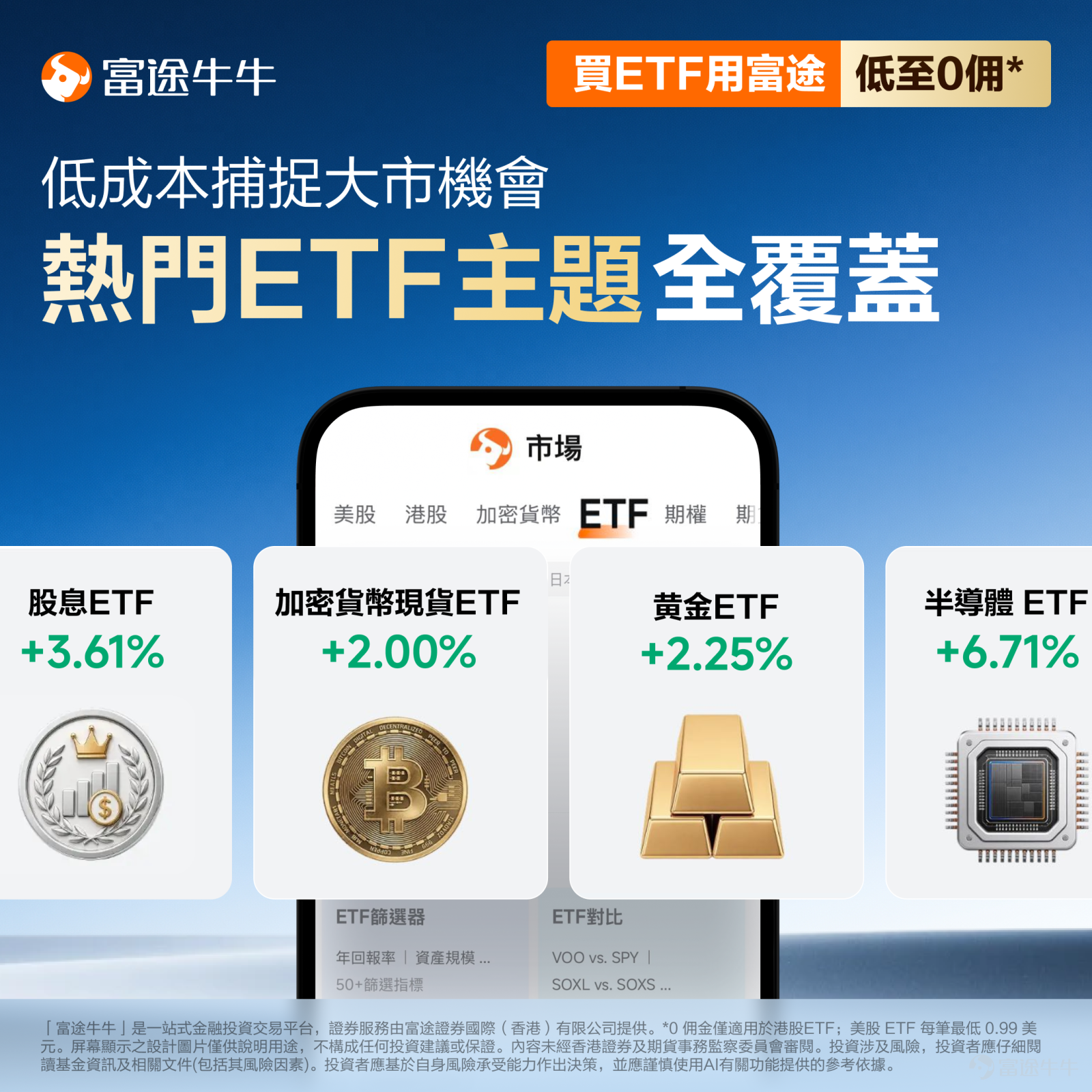
August ETF Trading Challenge! Share your trading stories and win great prizes 🎁
ETF Investment Guide | When multiple ETFs cover the same theme, how should you choose?
If you want to invest in AI, semiconductors, healthcare, or robotics, a quick search will often yield several relevant ETFs.
Here comes the question:The names look similar, so which one should you actually pick?
Many investors immediately compare "which one has risen the most" or simply choose the largest one by AUM. However, the most critical differences among thematic ETFs are often hidden behind their names—What exactly does it hold?
Even if they are both called AI ETFs, one might be heavily weighted in chip leaders, another might lean toward software and AI applications, while a third could include a large number of robotics and industrial automation companies. As market sentiment shifts across different sub-sectors, the performance of these ETFs can diverge significantly.
Therefore, when choosing a thematic ETF, the first step is not to compare returns, but to clearly consider:What do you truly want to invest in?
01 | The first step isn't picking an ETF, but clarifying what you want to buy
For example, you may be bullish on "AI," but AI itself is a very broad concept.
If you are most bullish on companies like NVIDIA, Broadcom, and AMD, what you really want to buy might beAI Chips and Semiconductors。
If you believe the biggest opportunities in the coming years will stem from the continuous expansion of AI data centers, you may be more interested inAI infrastructure sectors such as data centers, optical communications, and power equipment。
If you believe that hardware investments must ultimately translate into applications and revenue, then what you truly want to invest in might beAI software, cloud services, and SaaS companies。
And if you prefer not to judge which specific sub-sector is the strongest, but simply wish to cover the entire AI industry chain with a basket approach, then more comprehensive AI ETFs may better suit your needs.
So before searching for ETFs, it might be worth asking yourself:"If this theme really takes off, which part of the rally do I most hope to profit from?"
Defining your investment logic first and then finding ETFs is usually more effective than spotting a recently popular ETF and then trying to justify it afterward.
![If you're looking to invest in AI, semiconductors, healthcare, or robotics, a quick search will often yield several related ETFs. Here comes the question:With names that look so similar, which one should you actually pick? Many investors immediately compare "which one has risen the most" or simply choose the largest fund by AUM. However, the most critical differences among thematic ETFs are often hidden behind their names—What exactly are they holding? Even among funds all labeled as "AI ETFs," one might have heavy positions in chip leaders, another may lean towards software and AI applications, while a third could include a significant number of robotics and industrial automation companies. As market sentiment shifts across different sub-sectors, the performance of these ETFs can diverge significantly. Therefore, when selecting a thematic ETF, the first step isn't to compare returns, but to clarify:What do you truly want to invest in? 01 | The first step isn't picking an ETF, but rather clarifying what you actually want to buy. For example, you may be bullish on "AI," but AI itself is already a very broad concept. If you are most bullish on companies like NVIDIA, Broadcom, and AMD, what you really want to buy might beAI chips and semiconductors.。 If you believe the biggest opportunities in the coming years will come from the continuous expansion of AI data centers, you may be more interested inAI infrastructure sectors such as data centers, optical communications, and power equipment.。 If you believe that hardware investments must ultimately translate into applications and revenue, then what you truly want to invest in might beAI software, cloud services, and SaaS companies.。 [Share Link: Further Reading: ETF Battle | AI Stages a Strong Rebound! How to Choose ETFs for Memory, Optical Communications, Cloud, Software, and Cybersecurity] ...](https://nnqimage.futunn.com/sns_client_feed/999989/20260826/web-1787747226775-okjFWFLFJp.png/big?area=2&is_public=true&imageMogr2/ignore-error/1/format/webp)
02 | ETF names may be similar, but their holdings can differ significantly
Once you've determined your investment direction, the next step is to open the ETF's data page.
There's no need to dive into a plethora of complex indicators right away. For ordinary investors, focusing on just three key items is already highly effective.
First, check the top ten holdings.
This is the quickest way to understand an ETF.
For example, two ETFs might both be themed around AI, but one's top ten holdings are primarily hardware companies like NVIDIA, Broadcom, and Taiwan Semiconductor, while the other mainly holds Palantir, along with software and cloud companies.
Although both have "AI" in their names, the actual market exposure you buy could be completely different.
So don't just ask:"Is this an AI ETF?"
A better question to ask is:"Which companies does this ETF primarily rely on to generate returns?"
If the top ten holdings differ significantly from your intended investment direction, the ETF may not be suitable for you, regardless of how attractive its name sounds.
Second, examine the sector allocation.
Some ETFs have broad-sounding names, but their actual holdings may be heavily concentrated in a single sector.
For instance, you might think you are buying into the entire AI supply chain, only to find that the majority is invested in semiconductors. Alternatively, you may intend to invest in technology, yet the portfolio holds a significant proportion of industrial and automation companies.
This does not necessarily mean the ETF is poor; it simply indicates that the risk exposure it offers may differ from your expectations.
Before selecting an ETF, ensure that what you are actually buying aligns with what you intend to buy.
![If you're looking to invest in AI, semiconductors, healthcare, or robotics, a quick search will often yield several related ETFs. Here comes the question:With names that look so similar, which one should you actually pick? Many investors immediately compare "which one has risen the most" or simply choose the largest fund by AUM. However, the most critical differences among thematic ETFs are often hidden behind their names—What exactly are they holding? Even among funds all labeled as "AI ETFs," one might have heavy positions in chip leaders, another may lean towards software and AI applications, while a third could include a significant number of robotics and industrial automation companies. As market sentiment shifts across different sub-sectors, the performance of these ETFs can diverge significantly. Therefore, when selecting a thematic ETF, the first step isn't to compare returns, but to clarify:What do you truly want to invest in? 01 | The first step isn't picking an ETF, but rather clarifying what you actually want to buy. For example, you may be bullish on "AI," but AI itself is already a very broad concept. If you are most bullish on companies like NVIDIA, Broadcom, and AMD, what you really want to buy might beAI chips and semiconductors.。 If you believe the biggest opportunities in the coming years will come from the continuous expansion of AI data centers, you may be more interested inAI infrastructure sectors such as data centers, optical communications, and power equipment.。 If you believe that hardware investments must ultimately translate into applications and revenue, then what you truly want to invest in might beAI software, cloud services, and SaaS companies.。 [Share Link: Further Reading: ETF Battle | AI Stages a Strong Rebound! How to Choose ETFs for Memory, Optical Communications, Cloud, Software, and Cybersecurity] ...](https://nnqimage.futunn.com/sns_client_feed/999989/20260826/web-1787747220320-qJGxkAaYqF.png/big?area=2&is_public=true&imageMogr2/ignore-error/1/format/webp)
Third, look at individual stock concentration.
Another often overlooked issue is the extent to which an ETF relies on a few specific stocks.
Suppose one ETF has a high weighting in a leading AI stock, while another spreads its capital across dozens of companies.
When the leading stock surges, the former may offer greater upside potential; however, if the leader drops sharply, it will also suffer more pronounced drag.
For ETFs with more diversified holdings, the impact of any single company is usually lower. However, when market rallies are driven by a few leading stocks, their gains may not be the most prominent.
Therefore, there is no absolute right or wrong between concentrated and diversified strategies.
The key question remains:Do you want stronger thematic exposure or more diversified risk?
![If you're looking to invest in AI, semiconductors, healthcare, or robotics, a quick search will often yield several related ETFs. Here comes the question:With names that look so similar, which one should you actually pick? Many investors immediately compare "which one has risen the most" or simply choose the largest fund by AUM. However, the most critical differences among thematic ETFs are often hidden behind their names—What exactly are they holding? Even among funds all labeled as "AI ETFs," one might have heavy positions in chip leaders, another may lean towards software and AI applications, while a third could include a significant number of robotics and industrial automation companies. As market sentiment shifts across different sub-sectors, the performance of these ETFs can diverge significantly. Therefore, when selecting a thematic ETF, the first step isn't to compare returns, but to clarify:What do you truly want to invest in? 01 | The first step isn't picking an ETF, but rather clarifying what you actually want to buy. For example, you may be bullish on "AI," but AI itself is already a very broad concept. If you are most bullish on companies like NVIDIA, Broadcom, and AMD, what you really want to buy might beAI chips and semiconductors.。 If you believe the biggest opportunities in the coming years will come from the continuous expansion of AI data centers, you may be more interested inAI infrastructure sectors such as data centers, optical communications, and power equipment.。 If you believe that hardware investments must ultimately translate into applications and revenue, then what you truly want to invest in might beAI software, cloud services, and SaaS companies.。 [Share Link: Further Reading: ETF Battle | AI Stages a Strong Rebound! How to Choose ETFs for Memory, Optical Communications, Cloud, Software, and Cybersecurity] ...](https://nnqimage.futunn.com/sns_client_feed/999989/20260826/web-1787747223766-OT0aKQ06eJ.png/big?area=2&is_public=true&imageMogr2/ignore-error/1/format/webp)
03 | Finally, compare size, fees, and liquidity
Only after confirming that the ETF's investment strategy and holdings align with your views should you move on to evaluating "how practical the product itself is."
At this stage, you can look at three more practical indicators:Size, fees, and liquidity.
Size: Pay extra attention to smaller products
A larger ETF size usually indicates a longer track record and more market participants. If the product size is very small, you should further monitor its trading volume, bid-ask spreads, and the sustainability of its operations.
However, larger scale is not always better.
If two ETFs have completely different investment strategies, it is not necessarily reasonable to assume that the one with a larger AUM is automatically more suitable for you.
Compare the underlying holdings first, then compare the fund size.
![If you're looking to invest in AI, semiconductors, healthcare, or robotics, a quick search will often yield several related ETFs. Here comes the question:With names that look so similar, which one should you actually pick? Many investors immediately compare "which one has risen the most" or simply choose the largest fund by AUM. However, the most critical differences among thematic ETFs are often hidden behind their names—What exactly are they holding? Even among funds all labeled as "AI ETFs," one might have heavy positions in chip leaders, another may lean towards software and AI applications, while a third could include a significant number of robotics and industrial automation companies. As market sentiment shifts across different sub-sectors, the performance of these ETFs can diverge significantly. Therefore, when selecting a thematic ETF, the first step isn't to compare returns, but to clarify:What do you truly want to invest in? 01 | The first step isn't picking an ETF, but rather clarifying what you actually want to buy. For example, you may be bullish on "AI," but AI itself is already a very broad concept. If you are most bullish on companies like NVIDIA, Broadcom, and AMD, what you really want to buy might beAI chips and semiconductors.。 If you believe the biggest opportunities in the coming years will come from the continuous expansion of AI data centers, you may be more interested inAI infrastructure sectors such as data centers, optical communications, and power equipment.。 If you believe that hardware investments must ultimately translate into applications and revenue, then what you truly want to invest in might beAI software, cloud services, and SaaS companies.。 [Share Link: Further Reading: ETF Battle | AI Stages a Strong Rebound! How to Choose ETFs for Memory, Optical Communications, Cloud, Software, and Cybersecurity] ...](https://nnqimage.futunn.com/sns_client_feed/999989/20260826/web-1787747571473-vf5m3kdVPm.png/big?area=2&is_public=true&imageMogr2/ignore-error/1/format/webp)
For example, $Roundhill Photonics & Optics ETF (LYTE.US)$ As a newly listed ETF product, its current AUM has exceeded 300 million, making it a product with relatively rapid asset growth. In contrast, some other ETFs in the optical communication industry may have relatively smaller AUMs.
Fees: Pay closer attention if holding long-term
ETFs charge annual management fees and related operating expenses.
The longer the holding period, the more significant the cumulative impact of fee differences becomes.
However, for thematic ETFs, do not immediately choose the cheaper option just because there is a 0.x% difference in fees between two products.
If one primarily invests in semiconductors while the other focuses on software, the primary factor influencing investment outcomes is stillPositions and Market Conditions。
Fees are important, but only if the two ETFs are truly comparable.
Liquidity: Don't just look at "today's trading volume"
Like stocks, ETFs have both bid and ask prices when traded, with a spread between them.
Generally, products with higher trading activity and better liquidity tend to have narrower bid-ask spreads; for some niche thematic ETFs, the spread can be more significant.
If you're only holding long-term, you may not feel this difference daily; however, if you trade frequently, the bid-ask spread itself becomes part of your transaction costs.
Therefore, in addition to trading volume, it's helpful to check the actual bid-ask spread. Don't assume liquidity is sufficient just because an ETF has recorded trades.
04 | Bull Tips: 5 Steps to Choosing Thematic ETFs
If several ETFs suddenly emerge for the same theme and you're unsure how to compare them, you can filter them using the following order:
Step 1: Theme
Which segment of the market do I truly want to invest in?
AI chips, AI software, data centers, or the entire AI supply chain?
Step 2: Holdings
Who are the top ten holdings?
Are these the companies I actually want to buy?
Step 3: Concentration
Is the ETF heavily reliant on a few stocks?
If the largest holding plunges, can I tolerate the resulting volatility?
Step 4: Product
Is the fund size reasonable? Are the fees acceptable?
If you plan to hold for the long term, it is especially worthwhile to compare fee differences.
Step 5: Trading
Is trading activity robust? Are the bid-ask spreads reasonable?
This is particularly true for newer, niche, and smaller thematic ETFs, which warrant extra scrutiny.
Completing these five steps will usually filter out many ETFs that have catchy names but do not align with your actual investment intent.
![If you're looking to invest in AI, semiconductors, healthcare, or robotics, a quick search will often yield several related ETFs. Here comes the question:With names that look so similar, which one should you actually pick? Many investors immediately compare "which one has risen the most" or simply choose the largest fund by AUM. However, the most critical differences among thematic ETFs are often hidden behind their names—What exactly are they holding? Even among funds all labeled as "AI ETFs," one might have heavy positions in chip leaders, another may lean towards software and AI applications, while a third could include a significant number of robotics and industrial automation companies. As market sentiment shifts across different sub-sectors, the performance of these ETFs can diverge significantly. Therefore, when selecting a thematic ETF, the first step isn't to compare returns, but to clarify:What do you truly want to invest in? 01 | The first step isn't picking an ETF, but rather clarifying what you actually want to buy. For example, you may be bullish on "AI," but AI itself is already a very broad concept. If you are most bullish on companies like NVIDIA, Broadcom, and AMD, what you really want to buy might beAI chips and semiconductors.。 If you believe the biggest opportunities in the coming years will come from the continuous expansion of AI data centers, you may be more interested inAI infrastructure sectors such as data centers, optical communications, and power equipment.。 If you believe that hardware investments must ultimately translate into applications and revenue, then what you truly want to invest in might beAI software, cloud services, and SaaS companies.。 [Share Link: Further Reading: ETF Battle | AI Stages a Strong Rebound! How to Choose ETFs for Memory, Optical Communications, Cloud, Software, and Cybersecurity] ...](https://nnqimage.futunn.com/sns_client_feed/999989/20260826/web-1787747222800-riuxZEF5Ct.png/big?area=2&is_public=true&imageMogr2/ignore-error/1/format/webp)
Finally, remember:There is no single correct answer when selecting an ETF, and the one with the highest recent gains is not necessarily the best.
What you truly need to find is an ETFwhose holdings align with your investment thesis, with acceptable concentration and risk levels, and reasonable trading costs.
Clarify what you want to buy before comparing ETFs. This step is often more important than trying to predict the next top-performing ETF.
🎁 The August ETF Challenge is in full swing!Whether you're a novice investor just starting out or a seasoned pro with battle-tested experience, join the ETF Trading Challenge now! Share your ETF trading stories and stand a chance to win points, vouchers, Bullboxer merchandise, and other exciting prizes!Click to join now >>
![If you're looking to invest in AI, semiconductors, healthcare, or robotics, a quick search will often yield several related ETFs. Here comes the question:With names that look so similar, which one should you actually pick? Many investors immediately compare "which one has risen the most" or simply choose the largest fund by AUM. However, the most critical differences among thematic ETFs are often hidden behind their names—What exactly are they holding? Even among funds all labeled as "AI ETFs," one might have heavy positions in chip leaders, another may lean towards software and AI applications, while a third could include a significant number of robotics and industrial automation companies. As market sentiment shifts across different sub-sectors, the performance of these ETFs can diverge significantly. Therefore, when selecting a thematic ETF, the first step isn't to compare returns, but to clarify:What do you truly want to invest in? 01 | The first step isn't picking an ETF, but rather clarifying what you actually want to buy. For example, you may be bullish on "AI," but AI itself is already a very broad concept. If you are most bullish on companies like NVIDIA, Broadcom, and AMD, what you really want to buy might beAI chips and semiconductors.。 If you believe the biggest opportunities in the coming years will come from the continuous expansion of AI data centers, you may be more interested inAI infrastructure sectors such as data centers, optical communications, and power equipment.。 If you believe that hardware investments must ultimately translate into applications and revenue, then what you truly want to invest in might beAI software, cloud services, and SaaS companies.。 [Share Link: Further Reading: ETF Battle | AI Stages a Strong Rebound! How to Choose ETFs for Memory, Optical Communications, Cloud, Software, and Cybersecurity] ...](https://nnqimage.futunn.com/sns_client_feed/999989/20260826/web-1787747303712-C5dIjgtDNV.png/big?area=2&is_public=true&imageMogr2/ignore-error/1/format/webp)
Risk Disclaimer: The above content only represents the author's view. It does not represent any position or investment advice of Futu. Futu makes no representation or warranty.Read more

Comments (2)
to post a comment
35
39