Hong Kong and US pharmaceutical stocks remain active; have you positioned your portfolio?

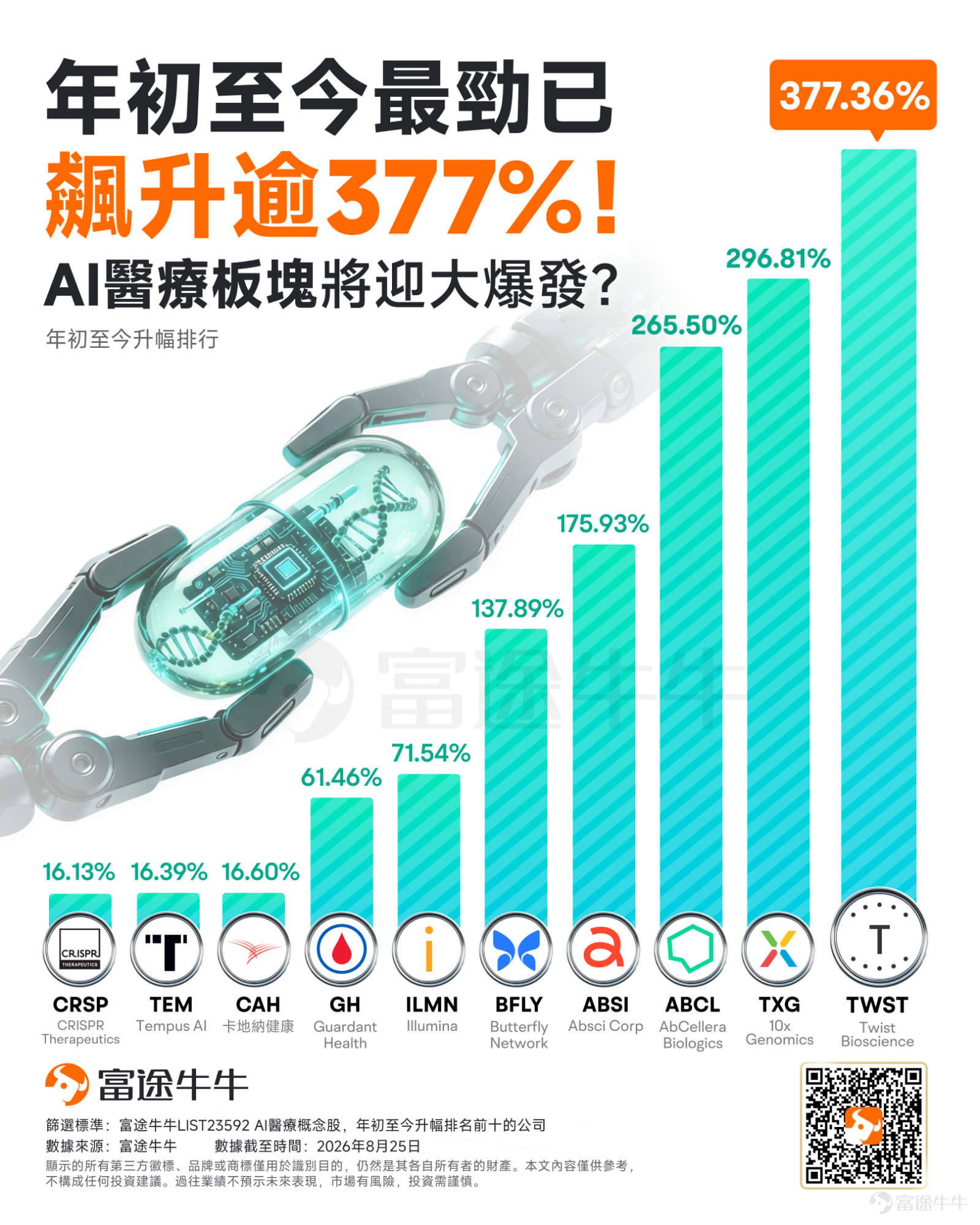
Year-to-date surge of over 377%! AI healthcare faces value reassessment—which companies are worth watching?
Since the beginning of this year, a previously relatively low-profile AI niche has been rapidly heating up—AI + Healthcare。
Several AI healthcare-related stocks have performed impressively this year, including:
The leader in synthetic biology and high-throughput DNA construction $Twist Bioscience (TWST.US)$ with a YTD gain as high as377.36%leading the pack;
The pioneer in single-cell sequencing and spatial biology $10x Genomics (TXG.US)$ follows closely behind, with a YTD gain reaching296.81%;
Focused on AI-powered antibody discovery platforms $AbCellera Biologics (ABCL.US)$ also recorded265.50%gains;
Overall, the healthcare sector is showing a broad-based warming trend, spanning from underlying data infrastructure and core algorithm platforms to end-user clinical applications.

--
--
--
Why has AI + Healthcare attracted significant attention recently?
The current focus of AI development is shifting from a competition in computing power for general large models to the realization of industrial commercial value.
Due to long R&D cycles, high costs, and extremely high failure rates in trial and error, biopharmaceuticals are becoming the core testing ground with the most disruptive potential for AI technology.
Technical Validation Breakthrough:Recently, $Moderna (MRNA.US)$ and $Merck & Co (MRK.US)$ the personalized mRNA cancer vaccine co-developed by [Company] has achieved a milestone clinical breakthrough. By leveraging AI algorithms to precisely match the neoantigen mutation characteristics of individual patient tumors, it has significantly reduced the risk of recurrence or death in melanoma patients.
This breakthrough demonstrates to the global market that AI is no longer confined to peripheral assistance but can deeply penetrate the core segments of life sciences, restructuring the paradigm of new drug development, thereby unlocking a new precision medicine market with a potential scale of trillions of dollars.
Institutions Continue to Increase Positions:Meanwhile, forward-looking institutional capital, represented by ARK Invest founded by "Cathie Wood," is accelerating its entry. Its actively managed ETF focused on biotechnology and genetic innovation ( $ARK Genomic Revolution ETF (ARKG.US)$ ) continues to hold significant positions in core assets such as $10x Genomics (TXG.US)$ 、 $Twist Bioscience (TWST.US)$ 、 $Tempus AI (TEM.US)$ and $Absci Corp (ABSI.US)$ . As of now, $10x Genomics (TXG.US)$ has become its largest holding.
Which companies will benefit? The six core sectors of AI healthcare
AI in healthcare is not merely a single technological breakthrough; rather, it encompasses the entire lifecycle, from underlying data and drug discovery to terminal diagnosis and treatment. Previously, Niu Niu Jun also outlined relevant concept stocks in the article "Moderna Surges 177%! A Paradigm Revolution in Cancer Treatment: Which of the Six Major AI Healthcare Sectors Stands to Benefit Most?" for fellow investors' reference:

--
--
--
Specifically:
1. Early Screening and Precision Diagnosis & Treatment.
The core logic in this field is to integrate genomic sequencing with clinical medical records via AI, significantly improving the accuracy of early screening for cancer and rare diseases.
$Tempus AI (TEM.US)$:As a newly listed giant in clinical multimodal data, it has established a database connecting thousands of hospitals across the US, leveraging AI to provide real-time clinical decision support for oncologists;
$Guardant Health (GH.US)$:By combining trace amounts of ctDNA in blood with machine learning models, it achieves ultra-early screening and dynamic monitoring for multiple cancer types, including colorectal cancer.
$Natera (NTRA.US)$: A pioneer in non-invasive prenatal screening and tumor liquid biopsy, its AI algorithms can precisely isolate fetal DNA from maternal blood or detect early signs of cancer recurrence.
2. AI Drug Discovery and Computational Biology.
This is a key link in breaking through traditional pharmaceutical bottlenecks, leveraging generative AI to predict protein structures and design molecules from scratch.
$Absci Corp (ABSI.US)$:By combining generative AI with high-throughput wet labs, it is possible to generate high-affinity antibody candidate sequences within weeks.
$Recursion Pharmaceuticals (RXRX.US)$ : This AI-driven drug discovery unicorn, previously backed by NVIDIA, holds one of the world's largest high-throughput cell imaging databases and leverages AI to identify new indications for existing drugs.
Regarding the Hong Kong market, $XTALPI (02228.HK)$ and $INSILICO (03696.HK)$ These companies are also accelerating commercial collaborations with global large-cap pharmaceutical firms through R&D platforms that combine AI computational predictions with automated experimental validation.
3. Multi-omics and clinical data platform.
High-quality biological data is the 'fuel' for training AI healthcare models; companies providing this underlying infrastructure have relatively higher certainty in performance realization.
$Twist Bioscience (TWST.US)$: Leveraging a unique silicon-based high-throughput DNA synthesis platform to significantly reduce gene construction costs and provide massive synthetic data for AI models.
$10x Genomics (TXG.US)$& $Illumina (ILMN.US)$ : Established deep data entry barriers in the fields of single-cell spatial resolution and high-throughput genomic sequencing, respectively.
$IQVIA Holdings (IQV.US)$: IQVIA is one of the largest clinical research organizations globally, possessing vast amounts of real-world data, and is currently using AI to significantly optimize patient recruitment and data analysis for clinical trials.
4、AI medical imaging and assisted diagnosis.
Image recognition is the most mature area for the commercial implementation of AI.
$GE HealthCare Technologies (GEHC.US)$: Traditional industry giants are comprehensively embedding AI algorithms into large-scale imaging equipment such as MRI and CT scanners.
$Butterfly Network (BFLY.US)$: By combining handheld ultrasound chips with AI-assisted image diagnosis, medical devices are becoming more portable and accessible at the primary care level.
$RadNet (RDNT.US)$: The largest operator of outpatient imaging centers in the US is actively acquiring AI algorithm companies to scale the application of AI-based breast and lung cancer screening technologies in its clinics.
5. Surgical robots, instruments, and monitoring.
AI technology is gradually taking over preoperative planning, intraoperative navigation, and postoperative continuous monitoring.
$Intuitive Surgical (ISRG.US)$: The parent company of the da Vinci Surgical Robot continues to integrate machine vision and AI analysis into its vast surgical database, strengthening its competitive moat.
$Medtronic (MDT.US)$: A global medical device giant, its Hugo surgical robot and AI endoscopy systems are accelerating the layout of an intelligent surgical ecosystem.
$DexCom (DXCM.US)$: The leader in Continuous Glucose Monitoring (CGM) combines wearable devices with AI algorithms to accurately predict patients' blood glucose fluctuation trends.
6. Digital healthcare and service platforms.
$Cardinal Health (CAH.US)$: A pharmaceutical distribution giant leveraging AI to intelligentize its supply chain and upgrade digital health services.
$Hims & Hers Health (HIMS.US)$: A digital personal health platform that uses AI and big data analytics to provide patients with personalized online consultations and prescription subscription services for conditions such as hair loss and weight management.
$Doximity (DOCS.US)$: A digital network platform built specifically for doctors, featuring an AI assistant that automatically generates medical records and documentation, significantly reducing administrative burdens.
Regarding the Hong Kong market, $JD HEALTH (06618.HK)$ and $ALI HEALTH (00241.HK)$ Leveraging massive internet traffic, it is deploying AI triage, smart prescriptions, and chronic disease management, effectively reducing the overall transaction costs of the healthcare system.
Will AI in healthcare become the next major investment theme in AI?
Compared to infrastructure sectors like AI chips, servers, and data centers, AI healthcare is still in its early stages of development, but the market is reassessing its long-term growth potential.
The core logic lies in:AI provides computing power, life sciences provide data entry points, and healthcare scenarios deliver commercial value.
As AI model capabilities improve, biological data accumulates, and medical applications mature, AI is poised to evolve from an auxiliary tool into critical infrastructure for the life sciences industry.
However, investors should also note that some AI healthcare companies are still in the exploration stage of commercialization, with uncertainties surrounding their profit models, technology implementation, and valuation levels. Rather than chasing a single concept, it is more worthwhile to focus on core companies within the industry chain that truly possesstechnical barriers and data resources,andcommercialization capabilities,as their core strengths.
Risk Disclaimer: The above content only represents the author's view. It does not represent any position or investment advice of Futu. Futu makes no representation or warranty.Read more


Comments (6)
to post a comment
98
259