HK Stock Market Barometer | HK stocks continue to fluctuate and pull back! How much room for recover

Decoding Star Stock Earnings | Don't Just Look at Food Delivery: How to Break Down Meituan's Results in Three Steps
However, if you look at Meituan's financial reports and focus solely on food delivery orders, it is actually difficult to accurately assess the company's performance.
Beyond the well-known restaurant food delivery, Meituan's business also includes Meituan Instashopping, in-store dining services, hotel and travel bookings, Xiaoxiang Supermarket, and Keeta, which has been actively expanding into overseas markets in recent years. Some of these businesses drive high-frequency traffic, others generate profits, while some are still in the investment phase.
Meituan willafter the Hong Kong stock market closes on August 28announce its results for the second quarter of 2026 and hold an earnings conference call at 7:00 PM that evening.
Before reviewing this quarter's results, it may be helpful to first clarify one thing:How exactly does Meituan make money?
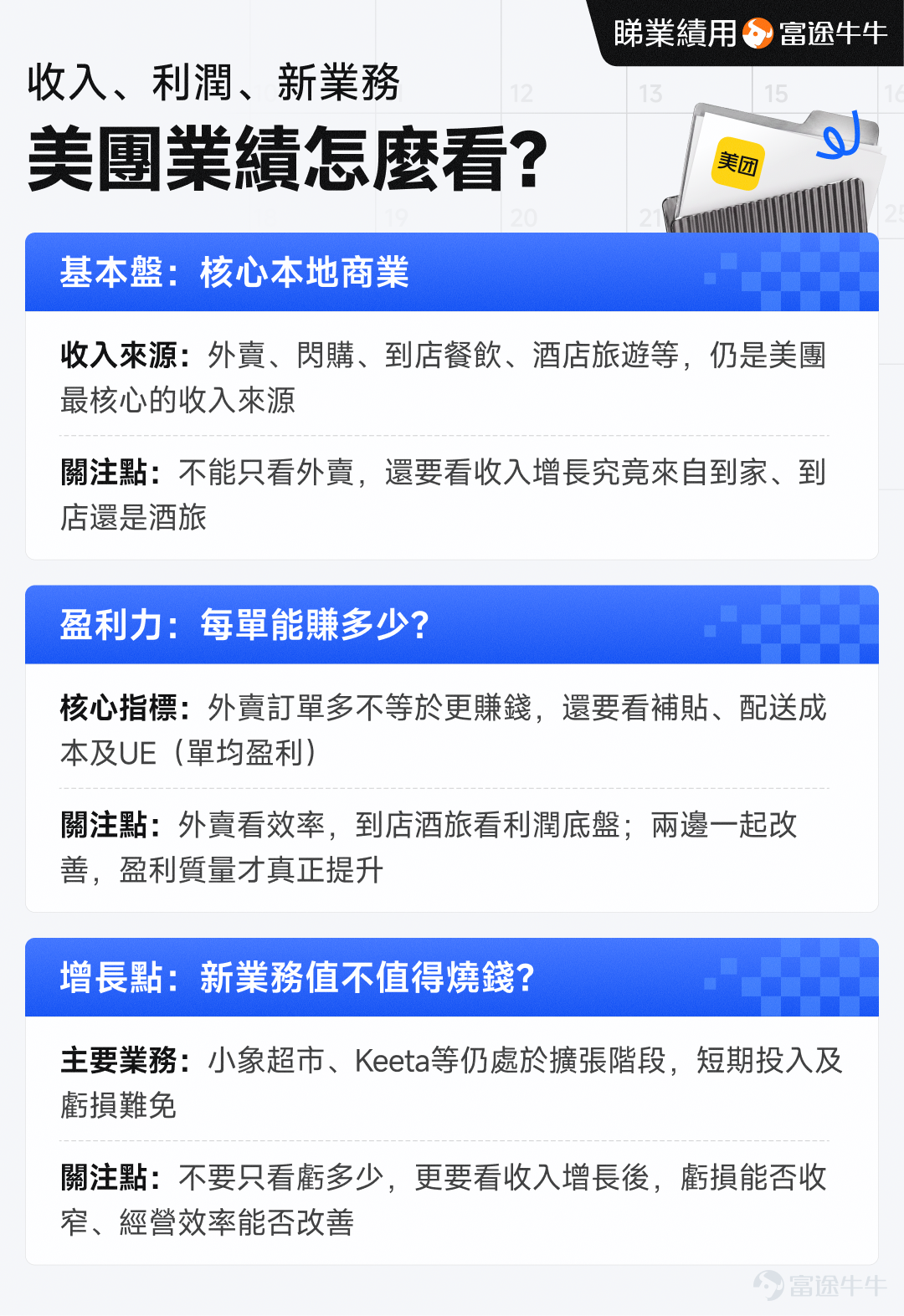
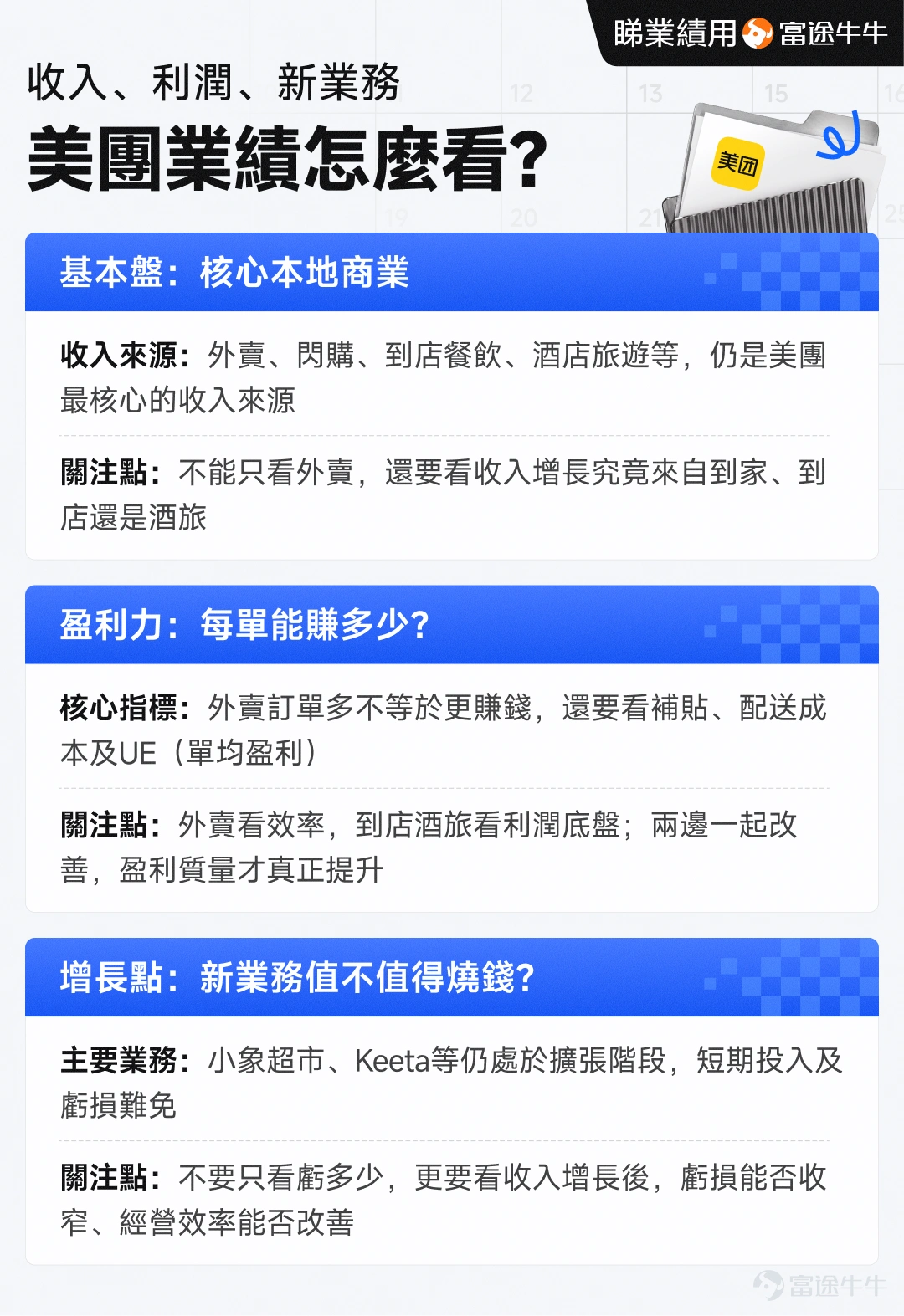
It can actually be broken down into three steps:First, look at where the revenue comes from; second, examine how profits are generated; and finally, assess whether the spending on new businesses is worthwhile.
How to analyze Meituan's performance? Master these three steps first.
Step 1: Look at revenue—Meituan is no longer just a food delivery company.
In its current financial reports, Meituan primarily divides its business into two major segments:Core Local CommerceandNew Initiatives。
Core Local Commerce is currently the largest foundation, including the most familiar services such as food delivery, Meituan Instashopping, as well as in-store dining, hotel and travel, and other local lifestyle services.
To understand it more simply, it can be divided into "to-home" and "in-store" services.
arrived homeIt essentially involves delivering goods directly to consumers, such as food delivery and Meituan Instashopping. The defining characteristic of this business is high frequency—every meal, beverage, medication, or daily necessity purchase can generate an order.
However, each order requires delivery by riders, and the platform may also need to provide consumer vouchers, merchant subsidies, and various promotions. Therefore, while the revenue scale is large, costs are equally significant.
In-store ServicesThis segment includes dining group buys, hotels, travel, and other local services. Users typically consume these services on-site, so Meituan does not need to arrange rider delivery for every order. Consequently, fulfillment costs are relatively lower, making this a key long-term profit driver for Meituan.
As for the second major segment, 'New Initiatives,' it includes businesses still in expansion phase, such as Xiaoxiang Supermarket and Keeta.
Therefore, when analyzing Meituan's revenue, one should not only ask:How much has food delivery grown?
But also:Which segments are driving growth among food delivery, Instashopping, in-store/hotel/travel, and new initiatives?
Because the 'quality' of earnings varies across different revenue streams.
A hundred yuan in revenue that requires substantial subsidies and high delivery costs to generate has a completely different impact on final profitability compared to a hundred yuan in higher-margin in-store revenue.
This is the first lesson when reading Meituan's financial reports:Don't just look at how much revenue grows; also examine where that revenue growth is coming from.
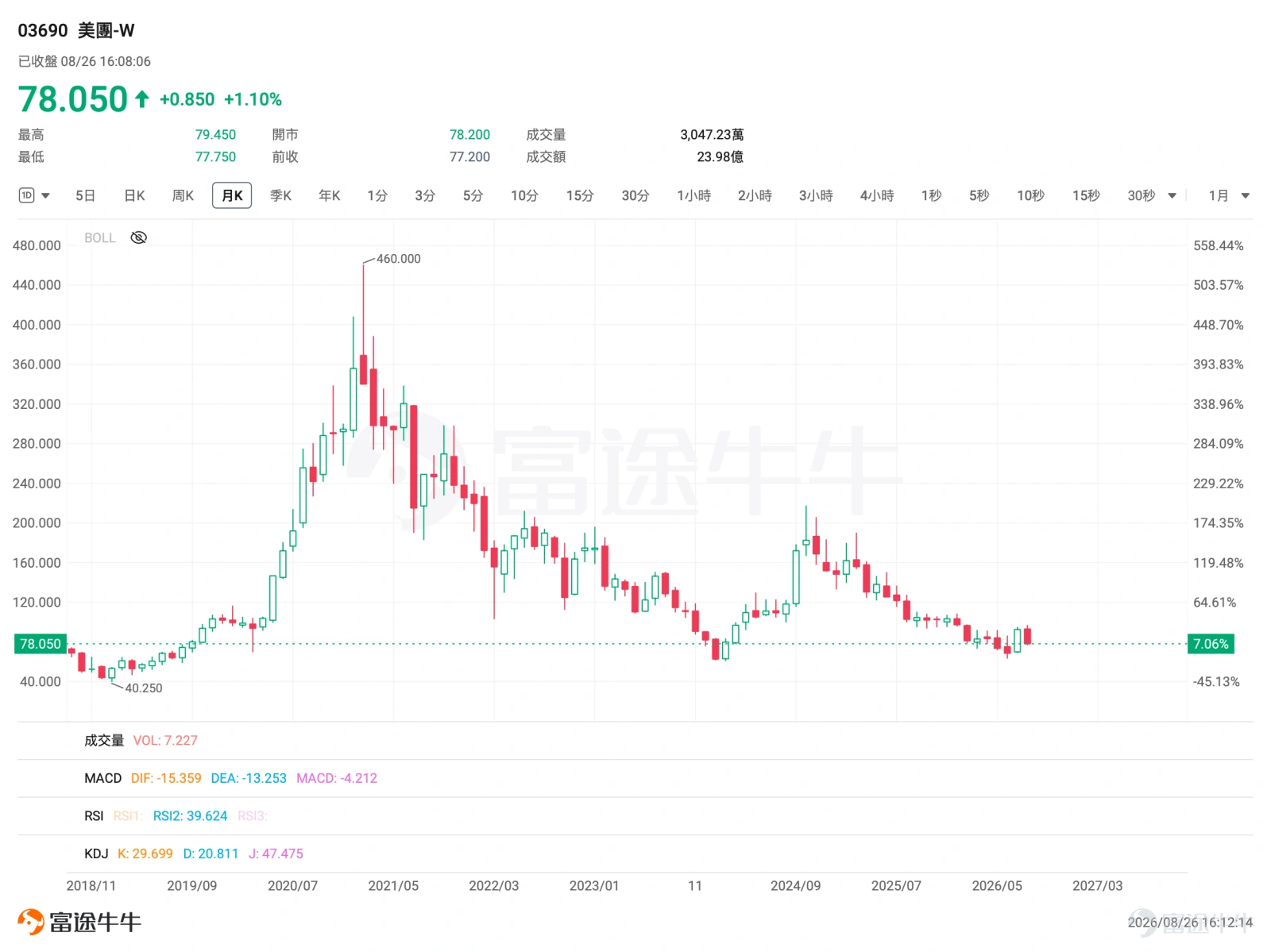
Last year, fierce competition in the food delivery business led to continuous adjustments in Meituan's stock price.
Step two: Look at profits—more orders do not necessarily mean higher earnings.
This is arguably the most critical point for understanding Meituan.
When people look at food delivery platforms, the most intuitive metric is "how many orders are placed per day."
But for investors, order volume is only half the story.
Suppose Meituan's food delivery orders grow by 20% this year, which looks impressive on paper. However, if the company significantly increases consumer vouchers, merchant subsidies, and rider incentives to capture these orders, the actual profit per order may decrease. In this case, more orders do not necessarily translate to higher profits.
Conversely, if orders grow by only 10%, but subsidies are reduced and delivery efficiency improves, allowing more profit to be retained per order, overall profitability could actually improve at a faster pace.
This is frequently mentioned in earnings reports and conference calls: Unit Economics, abbreviated as UE。
It can be simply understood as:How much profit Meituan actually retains on average after completing a single order.
Therefore, for Meituan's food delivery business, what truly matters is not just the "volume," but ratherWhether order volume and profit per order can improve simultaneously。
Over the past year, this point has been particularly critical.
Competition in mainland China's food delivery and instant retail sectors has intensified, with platforms vying for consumers through substantial discounts and subsidies. Although Meituan still maintains massive order volumes and revenue, its profitability is under significant pressure.
Another easily overlooked point is that while food delivery is high-frequency, Meituan's profitability does not rely solely on this segment.
In-store dining, hotel, and travel services do not require rider fulfillment for every transaction and typically offer better profitability. Therefore, when assessing the health of Meituan's Core Local Commerce segment, one must examine both sides:Has the unit economics (UE) of food delivery improved?
And:Has the core profit base of in-store, hotel, and travel services been maintained?
Meituan does not currently disclose the complete operating profits for food delivery, in-store, and hotel & travel segments separately in every quarterly earnings report. Therefore, investors often need to combine management commentary, segment data, and broker estimates to make judgments.
But keep the big picture in mind:For food delivery, focus on profit per order; for in-store, hotel, and travel, watch whether the core profit base remains stable.
Step 3: Finally, look at new businesses—losses are not necessarily a bad thing
When seeing losses in a specific business line of a company, novice investors tend to immediately interpret it as "this business is poor."
However, for new businesses that are still expanding, looking at losses alone is insufficient.
Meituan's current new businesses include Xiaoxiang Supermarket and Keeta, among others. Keeta is expanding from markets like Hong Kong and Saudi Arabia to more overseas regions. Launching in new markets, building delivery networks, and attracting users all require upfront investment.
What truly matters are three things:
Has revenue grown?
Have losses narrowed?
As scale increases, has operational efficiency improved?
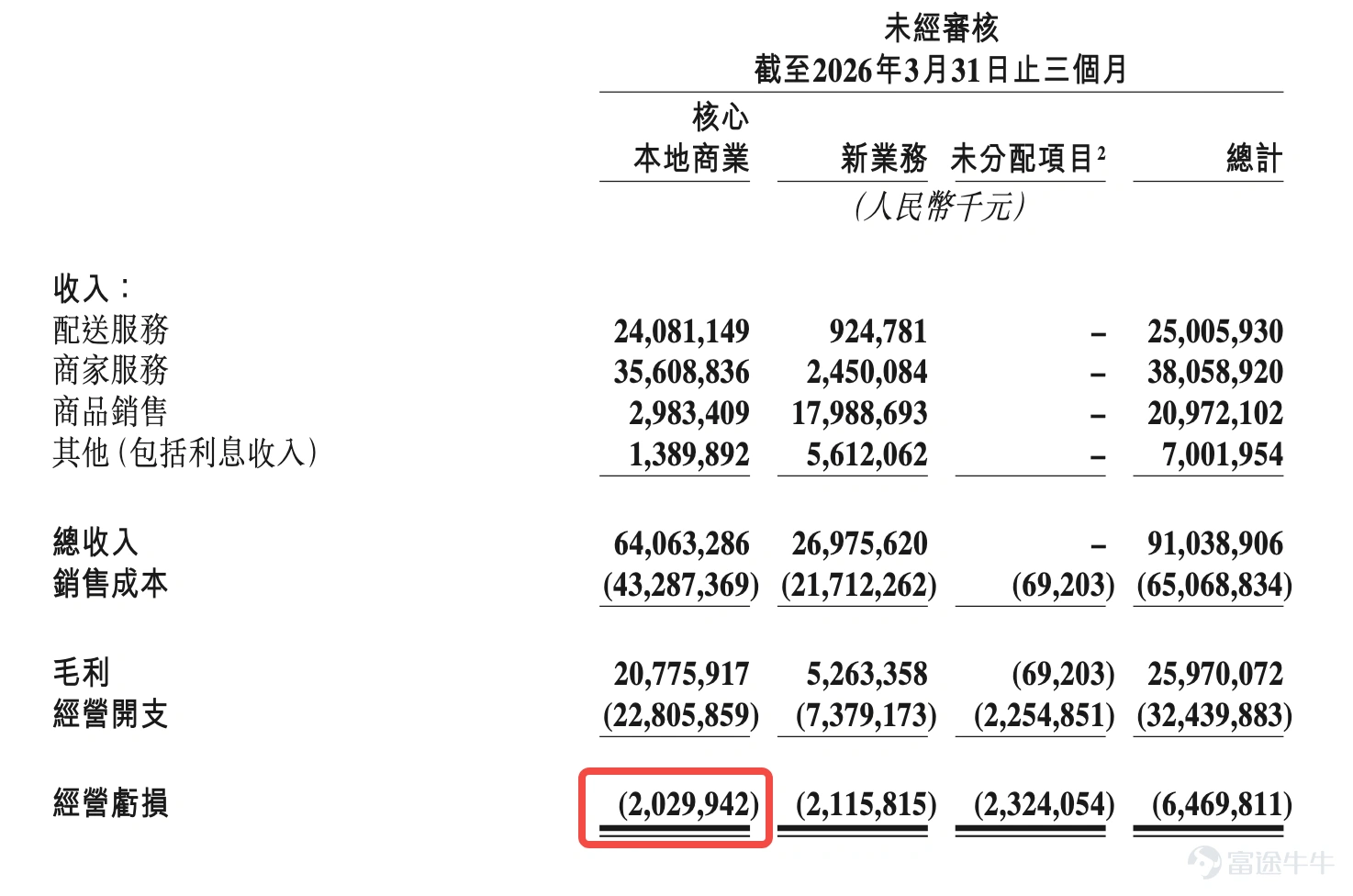
In Q1 2026, Meituan's new businesses revenue was approximatelyRMB 27 billion, representing a 21% year-on-year increase; operating loss was approximatelyRMB 2.1 billion. The company also stated that Xiaoxiang Supermarket now covers 55 cities, and Keeta's operational efficiency in the Hong Kong and Saudi Arabian markets has also improved.
Therefore, if a new business continues to see revenue growth while losses gradually decrease, it typically indicates that economies of scale are beginning to take effect.
Conversely, if revenue grows by 10% but requires double the losses to achieve, the quality of such growth is questionable.
Once you grasp these three steps, Meituan's seemingly complex financial report becomes much simpler:Assess revenue by business structure, core business by profitability efficiency, and new businesses by ROI and growth.
Applying these three steps to this Q2: Where lies Meituan's most significant change?
With the above framework, reviewing Q2 2026 means you won't be led astray by dozens of financial figures.
The most important change this time can be summarized in one sentence:The market is less concerned about Meituan's core foundation and has started to refocus on how much profit these businesses can generate.
Looking at revenue: Can growth be sustained? More importantly, what is the quality of that growth?
Current market consensus expects Meituan's Q2 revenue to be approximatelyRMB 100.7 billion, representing a year-on-year increase of about 10% from RMB 91.8 billion in the same period last year.
Judging by revenue alone, Meituan remains a major local services platform with quarterly revenue exceeding RMB 100 billion.
But what the market really wants to confirm this time is:Can order volume and revenue be sustained after subsidies are reduced?
If food delivery discounts are cut back, yet consumers continue to use Meituan without a significant drop in orders or revenue, this would actually be a relatively positive signal.
This implies that user retention is driven not just by "saving a few bucks," but also by merchant supply, delivery efficiency, and usage habits.
Meituan Instashopping also deserves attention.
Instant retail has expanded beyond traditional "food delivery" to cover more scenarios such as beverages, pharmaceuticals, consumer electronics, home appliances, beauty products, and daily necessities. This is a key direction for Meituan to boost user purchase frequency in the future, though competition is far more intense than it was a few years ago.
Therefore, meeting revenue targets is just the first hurdle.
If revenue growth can be maintained while reducing subsidies, the quality of earnings will be significantly higher.
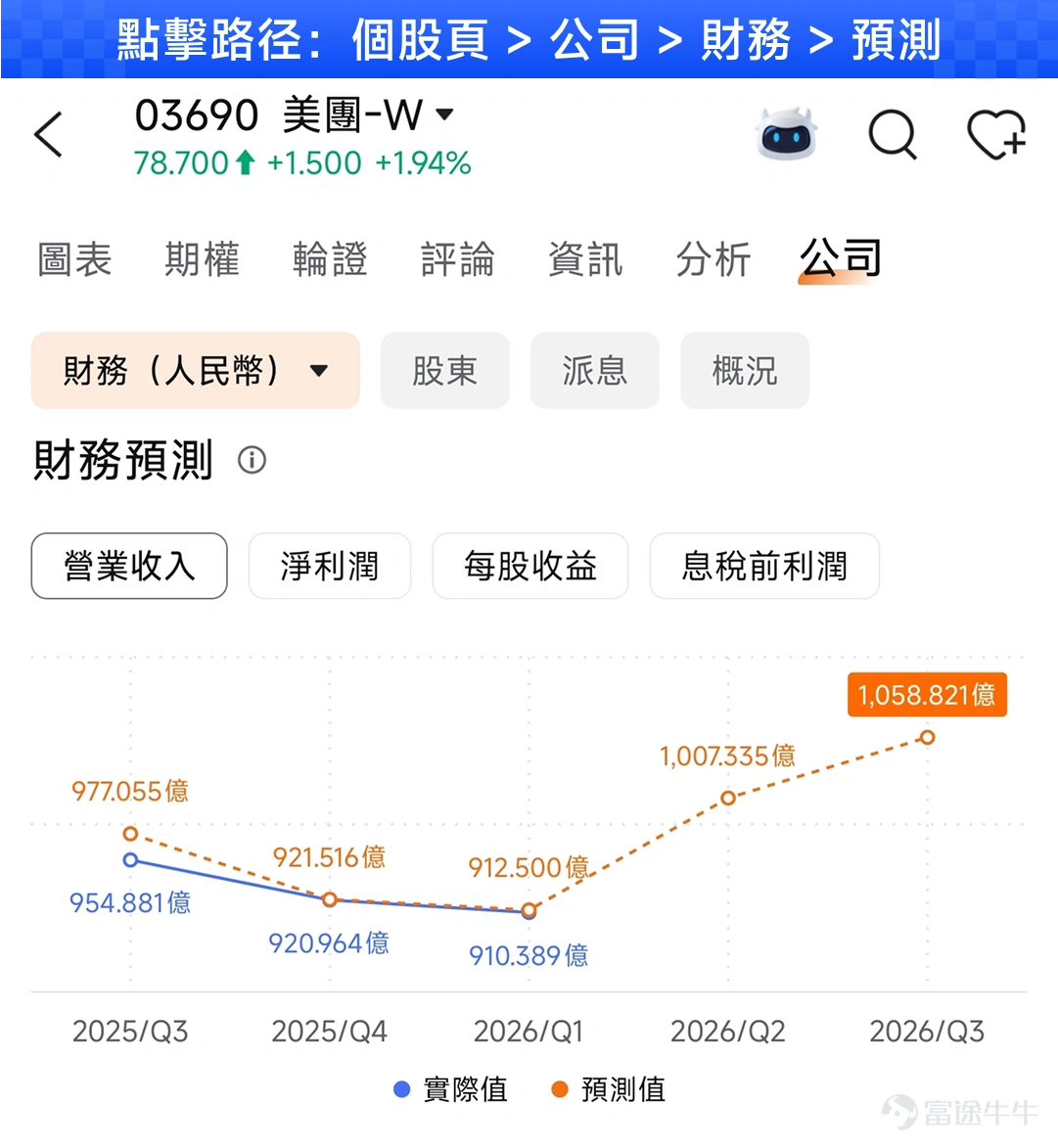
Looking at profitability: Q1 saw a loss of RMB 2 billion; how much recovery can be expected in Q2?
This may well be the most important figure in Meituan's latest earnings report.
In Q1, Meituan's Core Local Commerce segment still recorded an operating loss of approximately RMB 2 billion. However, this represents a significant narrowing compared to the roughly RMB 10 billion loss in the previous quarter.
Heading into Q2, the market generally expects further improvement in profitability.
Here is a crucial investment concept:The market anticipating improvement is one thing; improvement exceeding market expectations is another.
Even if Meituan returns to profitability after the earnings release, it does not necessarily mean the stock price will surge.
Investors are already betting on an earnings recovery. The real expectation gap lies in:How fast is the recovery?
For instance, is the profit per food delivery order recovering faster than market estimates? Can the operating profit of Core Local Commerce significantly beat expectations? And what is management's outlook on subsidies and margins for the second half of the year?
These figures are more likely to influence the market's re-evaluation of Meituan's earnings potential over the next one to two years.
So, looking at Q2 results, the second question to ask is:"Are earnings growing as fast as the market expects?"
On competition: A cooling price war does not mean the end of competition.
Another significant recent change for Meituan is the shifting dynamics of competition in the food delivery market.
In June, mainland China's market regulators released a draft of rules regarding subsidies on food delivery platforms, strengthening regulations on practices such as selling below cost and forcing merchants to bear subsidy costs. Meituan, Alibaba, and JD.com subsequently expressed their support.
For the platforms, this at least reduces the risk of falling back into an endless subsidy war.
However, this does not mean that Alibaba and JD.com are exiting the instant retail sector.
Alibaba's instant retail revenue still grew year-over-year in the latest quarter,45%and the company stated that its unit economics continue to improve, with losses narrowing at an accelerated pace.
This actually highlights a trend worth paying closer attention to:Competition may be shifting from "who distributes the most coupons" to "who has more merchants, a more comprehensive product range, faster delivery, and a more complete user ecosystem."
For Meituan, this is not necessarily a bad thing. Its rider network, local merchant supply, and user habits accumulated over many years are precisely the key advantages in this type of competition.
Regarding Keeta and Xiaoxiang Supermarket, look beyond just the "cash burn."
On the other hand, new businesses remain part of Meituan's long-term story.
Currently, the market's expectations for Keeta are fundamentally different from those for a mature food delivery business.
In the short term, overseas expansion will inevitably incur costs related to city launches, marketing, riders, and merchant acquisition.
If Keeta continues to improve efficiency in more mature markets like Hong Kong and Saudi Arabia, and expansion into new markets does not cause overall losses to spiral out of control, the market is generally more willing to accept these investments.
The same logic applies to Xiaoxiang Supermarket.
What Meituan needs to prove is not that it spends "no money at all," but rather:As scale increases, every dollar invested generates more revenue.
Three key things to watch after the earnings release
After Meituan releases its results on August 28, if you don't want to wade through dozens of pages of reports, you can follow this sequence.
First, look at revenue.
The market currently expects around RMB 100.7 billion. If revenue is significantly higher or lower than this level, determine whether the variance stems from Core Local Commerce or New Initiatives.
Second, and more importantly, look at the profitability of Core Local Commerce.
This is the biggest source of expectation gap this time. After a RMB 2 billion loss in Q1, the extent of recovery in Q2 largely reflects the impact of food delivery subsidies and the pace of unit economics (UE) improvement.
Third, be sure to listen to management's commentary on the second half of the year.
Pay particular attention to food delivery subsidies, competition in instant retail, in-store hotel and travel services, investment in new initiatives, and profit trends.
Because an earnings report reflects the 'past three months,' but stock prices often trade on expectations for the 'next few quarters.'
Even if Q2 figures are strong, if management signals a need to increase subsidies again in the second half, the market may still downgrade future earnings expectations.
Conversely, if revenue merely meets expectations but food delivery unit economics (UE), core local commerce profits, and the second-half outlook all exceed market expectations, this could serve as an even more significant positive signal.
First, clarify the sources of revenue, how it is generated, and where the funds are allocated. Then, compare actual results with market expectations to gain a clearer view of whether the financial report is truly strong. By grasping these key indicators, breaking down Meituan's seemingly complex performance becomes much more manageable.
Risk Disclaimer: The above content only represents the author's view. It does not represent any position or investment advice of Futu. Futu makes no representation or warranty.Read more

Comments (5)
to post a comment
24
12