US Stock Market Talk | The Fed Resumes Rate Hikes After a Three-Year Pause! Is a New Shift Ahead for

Wall Street Brief (August 26): US stocks staged a mild rebound on Tuesday, easing concerns over short-term volatility; NVIDIA's recovery boosted confidence in AI hardware. Easing US-Iran diplomatic tensions and weaker economic data drove long-end yields lower.
Summary: US stocks rose modestly on Tuesday, with the S&P 500 up 0.32%, Nasdaq up 0.66%, Dow Jones up 0.30%, and Russell 2000 up 0.50%. The VIX fell to 15.45, down 2.52% on the day. While the market is not extremely optimistic, fears of short-term volatility have eased. Diplomatic thaw between the US and Iran, coupled with weak US consumer and housing data, led to a decline in long-end interest rates. In terms of sector performance, NVIDIA's rebound bolstered confidence in AI hardware, while energy and consumer staples lagged significantly. Chinese concept stocks and cryptocurrency-related stocks showed overall strength. From a medium-term perspective, market concentration has decreased, with the equal-weight S&P (RSP) clearly outperforming SPY. Regarding major asset classes: the 10-year US Treasury yield stood at 4.639%, down 1.38%; gold was at $4,658.705, up 0.13%; crude oil was at $81.11, down 4.55%; Bitcoin was at $78,889.51, up 0.19%; and the US Dollar Index was at 98.9125, down 0.08%.
I. Major Events
1. Easing US-Iran diplomatic tensions reduces oil risk premiumRussian media, citing sources, reported that the US and Iran have reached a consensus on the terms of a ceasefire agreement, which includes free navigation through the Strait of Hormuz. Iran and Oman also issued a joint statement on restoring navigation in the Strait of Hormuz, thereby cooling the risk of supply disruptions in the Middle East. The news directly reduced the oil risk premium, alleviated pressure on inflation and long-end interest rates, and provided a better environment for the valuation repair of US stocks.
2. Weakening US consumer and housing data; long-end interest rates decline
The Consumer Confidence Index released by The Conference Board came in below expectations, and July's new home sales data also indicated that housing demand remains suppressed by high interest rates. Both datasets point to a cooling in growth, but have not yet directly pushed the market into a recession trade. The weak data initially impacted interest rates. As long-end US Treasury yields fell, valuation pressure on growth stocks and small-cap stocks eased. The stock market is more inclined to interpret this as an increase in room for rate cuts rather than an immediate shift toward earnings downgrades.
II. Major Trends
All four major US stock indices rose on Tuesday, with the Nasdaq and Russell 2000 showing slightly stronger performance, while the Dow Jones Industrial Average and S&P 500 maintained a moderate recovery. The market was not solely supported by traditional heavyweight stocks; the decline in interest rates began to provide more direct support to growth stocks and small-cap stocks.
Over a two-week horizon, leading technology and growth styles remain in a recovery phase. MAGS declined by 1.21%, and the growth style $Spdr Series Trust Spdr Portfolio S&P 500 Growth Etf (SPYG.US)$ declined by 1.51%, while the value style $Spdr Series Trust Spdr Portfolio S&P 500 Value Etf (SPYV.US)$ rose by 0.46%. Over a three-month horizon, the Dow Jones Industrial Average ETF (DIA) rose by 6.16%, the Russell 2000 ETF (IWM) rose by 5.20%, the S&P 500 ETF (SPY) rose by 2.98%, and the Nasdaq-100 ETF (QQQ) fell by 0.84%. The medium-term advantage remains with traditional heavyweight stocks and small-caps.
Market concentration has decreased over the past two weeks. MAGS remained negative over the two-week period, indicating that large-cap technology stocks have not yet become the sole pillar of support again. The S&P 500 Equal Weight ETF (RSP) rose by 7.77% over three months, outperforming SPY's 2.98% gain, showing that the medium-term rally has broadened to cover more constituents. In terms of style, SPYV rose by 4.57% over three months, outperforming SPYG's 1.71% gain, indicating that value stocks continue to show better medium-term resilience than growth stocks.
III. Market Sentiment
The VIX dropped to 15.45, down 2.52% for the day, as demand for risk hedging continued to subside. While this level does not indicate extreme optimism, market concerns about short-term volatility have eased. The CNN Fear & Greed Index rose from 56 to 59, keeping sentiment in the 'greedy' range. Combined with the broad-based rise in indices, capital has not significantly shifted toward defensive assets; instead, investors are increasing risk exposure following the decline in interest rates.
Regarding CBOE put/call ratios, the total put/call ratio stands at 0.75, the index put/call ratio at 1.02, and the equity put/call ratio at 0.63. There remains a certain demand for hedging on the index side, while sentiment toward individual stocks is more aggressive, indicating that investors are willing to participate in the rebound but have not yet fully removed their defenses against broader market volatility.
4. Market Scan
1. Index ETFs
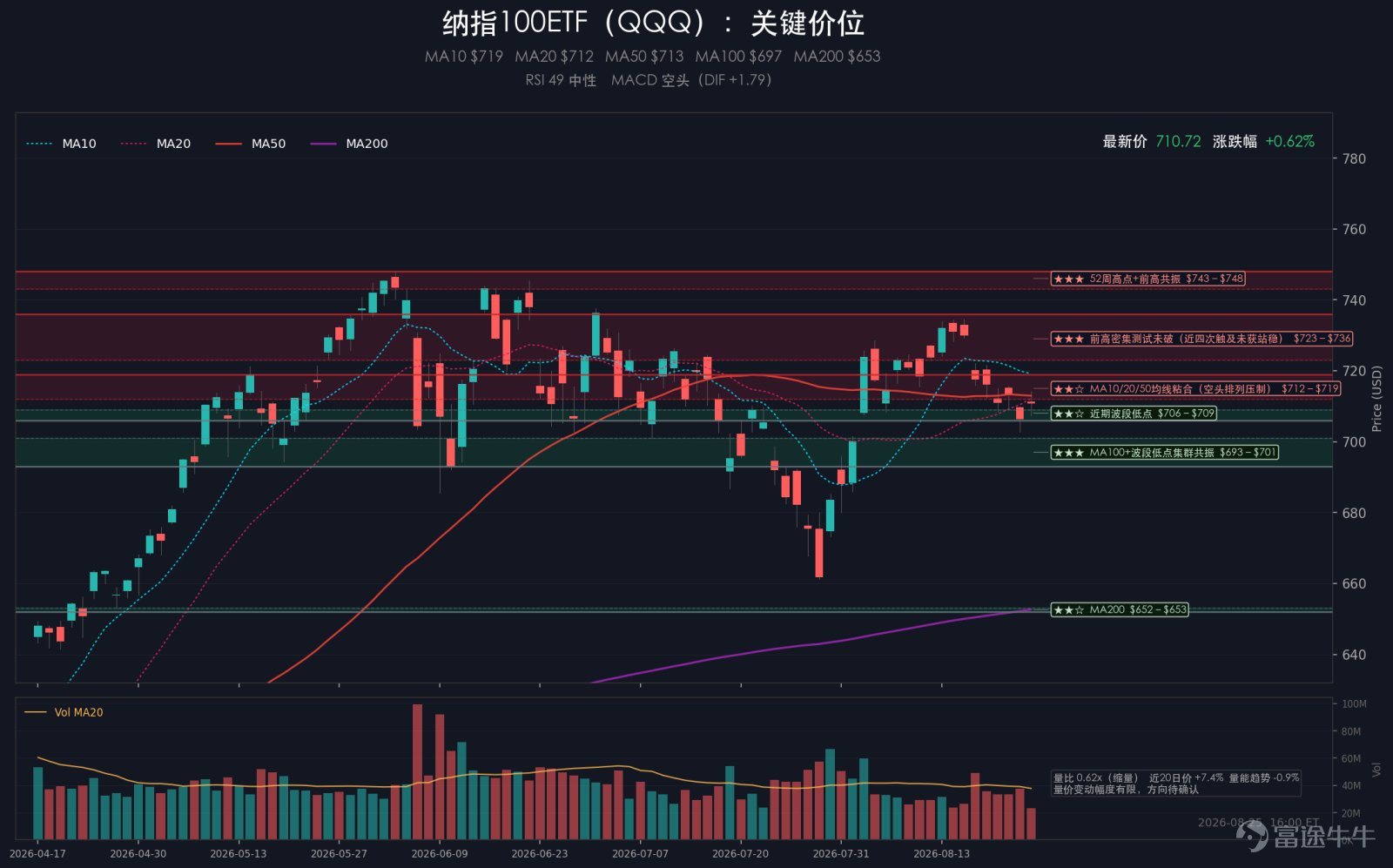
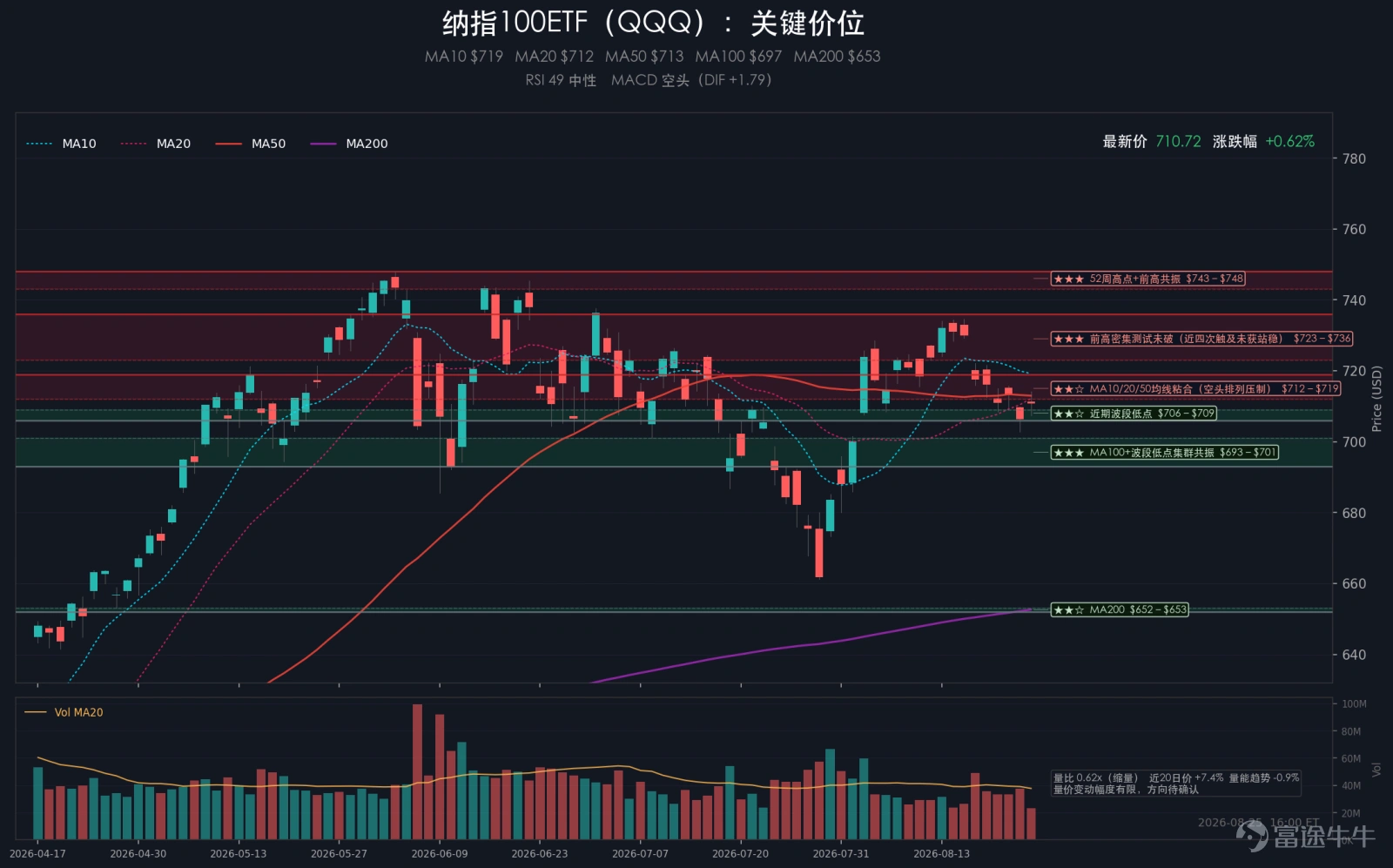
The Dow Jones Industrial Average ETF (DIA) rose 0.30%, the S&P 500 ETF (SPY) rose 0.32%, the Nasdaq-100 ETF (QQQ) rose 0.62%, and the Russell 2000 ETF (IWM) rose 0.42%. All four major index ETFs strengthened, with QQQ showing the highest elasticity and IWM outperforming both SPY and DIA. This suggests that following the decline in interest rates, the recovery momentum in growth and small-cap segments is more pronounced.
$iShares MSCI South Korea ETF (EWY.US)$ rose 3.75%, $iShares MSCI Brazil ETF (EWZ.US)$ rose 2.02%, $Ishares Msci Australia Index Fund (EWA.US)$ rose 1.23%. These overseas ETFs performed relatively strongly, indicating that risk appetite extends beyond US equities; however, the main theme in the US market on Tuesday remained the synchronous recovery of the four major indices.
2. Sector Performance
Among the 11 GICS sectors, $The Technology Select Sector SPDR® Fund (XLK.US)$ rose 0.94%, $The Communication Services Select Sector SPDR® Fund (XLC.US)$ rose 0.77%, $The Health Care Select Sector SPDR® Fund (XLV.US)$ rose 0.34%, ranking among the top performers; $Energy Select Sector SPDR Fund (XLE.US)$ down 1.66%, $Consumer Staples Select Sector SPDR Fund (XLP.US)$ down 1.06%, becoming the main drag. The sharp drop in oil prices directly weighed on the energy sector, while weakness in consumer staples also indicates that capital has not significantly rotated into defensive assets.
From the perspective of industry and thematic ETFs, $Global X Uranium ETF (URA.US)$ up 5.36%, posting the most notable gain; $Roundhill Memory ETF (DRAM.US)$ up 3.61%, $VanEck Semiconductor ETF (SMH.US)$ up 1.65%. The AI optical communication basket rose by an average of 4.62%, with memory and optical communication/optical modules continuing to outperform the software sector. $SPDR S&P Biotech ETF (XBI.US)$ rose 3.00%, $VanEck Gold Miners Equity ETF (GDX.US)$ up 1.91%, $Global X Copper Miners ETF (COPX.US)$ up 1.89%; robotics $Global X Robotics & Artificial Intelligence Thematic ETF (BOTZ.US)$ up 1.70%; $SPDR S&P Oil & Gas Exploration & Production ETF (XOP.US)$ down 1.88%, under pressure in sync with the energy sector.
3. The Magnificent Seven Tech Stocks
The seven major tech ETFs (MAGS) rose 0.61%, showing overall recovery but continued divergence. Netflix (NFLX) gained 2.77%, NVIDIA (NVDA) rose 2.19%, Meta increased 1.97%, Microsoft climbed 0.90%, and Tesla edged up 0.37%; Apple (AAPL) dipped 0.14%, while Google (GOOG) fell 0.36%.
From a structural perspective, NVIDIA's rebound boosted confidence in AI hardware, with Meta and Microsoft also following suit in their recovery. However, Apple and Google did not strengthen in sync, indicating that the rally among mega-cap tech stocks is not yet uniformly strong across the board.
4. Chinese ADRs
$KraneShares CSI China Internet ETF (KWEB.US)$ Rose 0.61%, with Chinese concept stocks generally moving higher moderately. $Futu Holdings Ltd (FUTU.US)$ Surged 8.48%, $NetEase (NTES.US)$ Gained 4.74%, $Baidu (BIDU.US)$ Rose 1.36%, significantly outperforming most peer assets. $JD.com (JD.US)$ Increased 0.55%, $PDD Holdings (PDD.US)$ Climbed 0.78%, $Tencent Music (TME.US)$ Advanced 0.92%, $Bilibili (BILI.US)$ Edged up 0.42%, with relatively limited gains. Within the Chinese concept stock universe, individual stock elasticity remains stronger than the overall trend, and internet platform stocks have not formed a broad-based unilateral rally.
5. Cryptocurrencies
Bitcoin rose 0.19%, with the trend remaining relatively mild but continuing its rebound. Cryptocurrency-related stocks showed stronger elasticity, $Riot Platforms (RIOT.US)$rising 6.50%, $MARA Holdings (MARA.US)$ rising 5.81%, $Circle (CRCL.US)$ rising 4.90%, $Coinbase (COIN.US)$ rising 4.28%, $Strategy (MSTR.US)$ rising 3.42%. Capital shows a higher risk appetite for cryptocurrency-related stocks than for Bitcoin itself. As long as Bitcoin does not weaken again, miners, trading platforms, and stablecoin-related targets may maintain high elasticity.
$S&P 500 Index (.SPX.US)$ $SPDR S&P 500 ETF (SPY.US)$ $Invesco Exchange Traded Fd Tr S&P 500 Equal Weight Etf (RSP.US)$ $NASDAQ 100 Index (.NDX.US)$ $Invesco QQQ Trust (QQQ.US)$ $Dow Jones Industrial Average (.DJI.US)$ $State Street® SPDR® Dow Jones Industrial Average® ETF Trust (DIA.US)$ $Russell 2000 Index (.RUT.US)$ $iShares Russell 2000 ETF (IWM.US)$ $Roundhill Magnificent Seven ETF (MAGS.US)$ $USD (USDindex.FX)$ $U.S. 10-Year Treasury Notes Yield (US10Y.BD)$ $iShares 20+ Year Treasury Bond ETF (TLT.US)$ $XAU/USD (XAUUSD.CFD)$ $SPDR Gold ETF (GLD.US)$ $CBOE Volatility S&P 500 Index (.VIX.US)$ $CME-Bitcoin RR Futures (SEP6) (BTCmain.US)$ $iShares Ethereum Trust ETF (ETHA.US)$ $NVIDIA (NVDA.US)$ $Tesla (TSLA.US)$ $Meta Platforms (META.US)$ $Amazon (AMZN.US)$ $Alphabet-C (GOOG.US)$ $Microsoft (MSFT.US)$ $Apple (AAPL.US)$
Risk Disclaimer: The above content only represents the author's view. It does not represent any position or investment advice of Futu. Futu makes no representation or warranty.Read more


Comments
to post a comment
9