
NVIDIA's revenue doubles, beating expectations; is the AI trade narrative making a comeback?

Decoding Star Stock Earnings | The Universe's Top Leader, Seven Consecutive Drops Before Earnings? How to Analyze NVIDIA's Results
After the U.S. stock market close on August 26 (early morning on August 27, Beijing time), the global leader in AI computing power, $NVIDIA (NVDA.US)$ will announce its financial results for the second quarter of fiscal year 2027 (corresponding to May–July 2026).
The earnings report hasn't even been released yet, but the stock price has already fallen for seven consecutive days—from August 14 to August 24, NVIDIA closed lower for seven straight trading sessions, with the share price sliding from $225.3 to $208.5, representing a cumulative decline of approximately 7.5% and a market cap erosion of over $400 billion.
Why did the "Universal Market Leader" drop before the earnings release? How should we interpret this earnings report? This article uses NVIDIA as a case study to clearly explain these points for beginner investors.

The Universal Market Leader: More Than Just the Largest Market Cap
Let's first discuss where the market's nickname for NVIDIA as the "Universal Market Leader" comes from.The first layer is market capitalization: As of the close on August 24, NVIDIA's total market cap was approximately $5 trillion, consistently ranking among the top globally.But having a large market cap alone isn't enough to earn the title of "Universal Market Leader." What truly elevated it to legendary status is...It holds a pivotal position in the AI industry chain.
NVIDIA is the "arms dealer" in the global AI arms race. In the AI era, the most core factor of production is computing power, and the most critical hardware for computing power is the GPU. NVIDIA commands approximately 90% of the data center GPU market, with nearly all training and inference for large models running on its chips. Even more formidable is its ecosystem—the CUDA software platform has conditioned global developers to write AI programs using NVIDIA's "language," creating a software moat that is deeper than its hardware barriers.
Moreover, it is no longer just "selling chips": today, NVIDIA sells an entire computing power system—delivering GPUs, networking, racks, and software as an integrated solution, and even deeply participating in the financing and construction of AI data centers.
More critically, every move NVIDIA makes sends tremors through the entire AI industry.。
When it releases a new technology, the industry-wide computing power benchmarks are reset;When it chooses or abandons a technical route, upstream and downstream suppliers, competitors, and even the entire secondary market must reprice;When it adjusts its supply rhythm, cloud providers must revise their data center construction plans accordingly.
From Blackwell to the next-generation Rubin, each architectural iteration is not just NVIDIA's own affair but sets the "baseline" for the entire AI industry—other chipmakers chase its performance, cloud providers wait for its shipments, and ventures write code on its ecosystem.This level of industry influence deserves the title of "Universal Leader" far more than its market capitalization figures do.
In the previous quarter (Q1 of fiscal year 2027), NVIDIA's revenue was $81.6 billion, of whichData center revenue reached $75.2 billion, accounting for over 90% of the total,representing a 92% year-over-year increase. The company also provided "visibility" into combined revenues of $1 trillion from its Blackwell and next-generation Rubin platforms between 2025 and 2027.
What’s behind the seven-day losing streak: Here are the market's key concerns
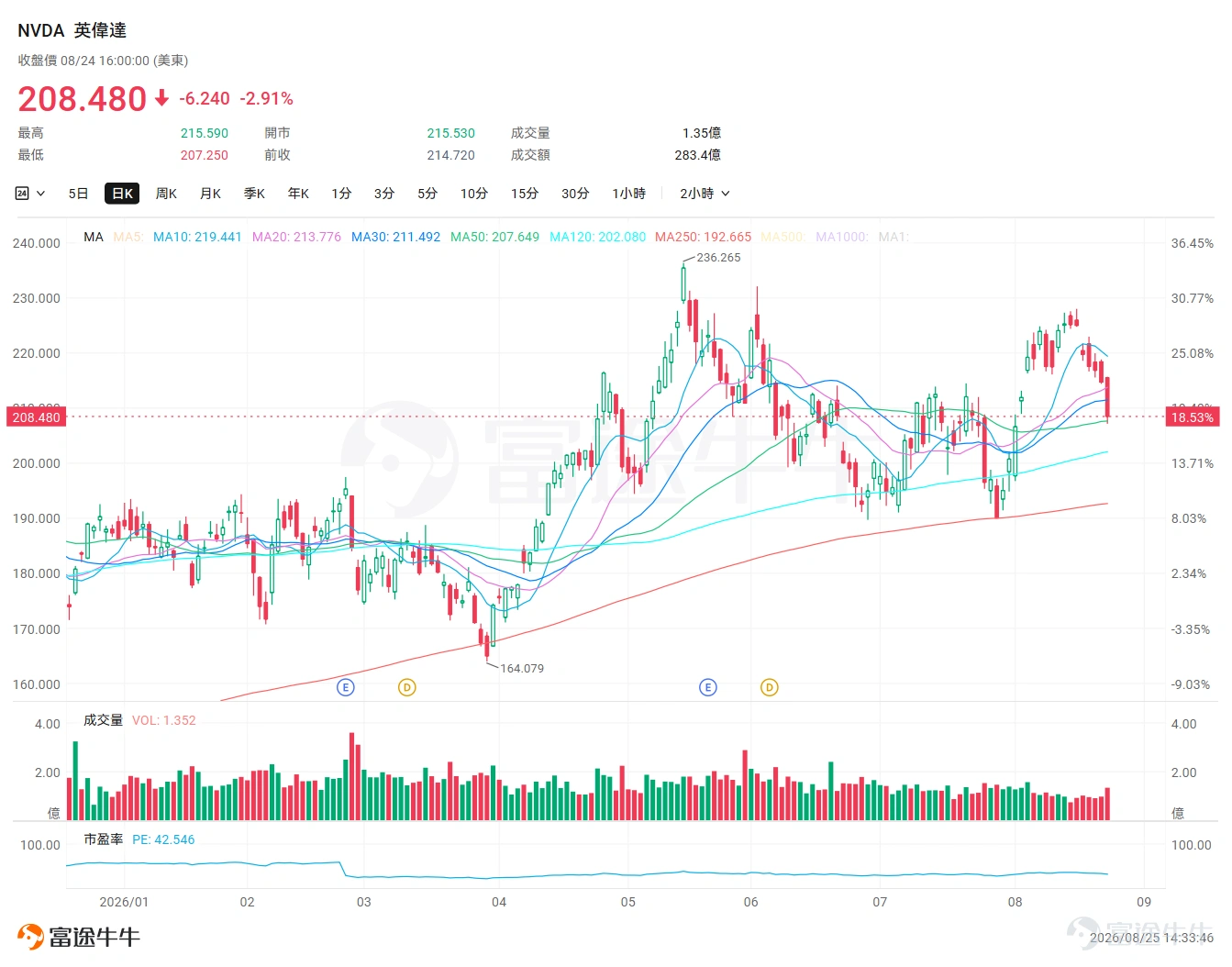
The stock fell for seven consecutive days ahead of the earnings release, wiping out $400 billion in market cap. What is the market really worried about? A closer look reveals that concerns are primarily focused on two aspects of NVIDIA: its "role" and market "expectations."
What has made the market most uneasy is the impact brought by NVIDIA's shifting role:circular financingrisk.
On August 10, NVIDIA officially announced a partnership with six major institutions—Apollo, BlackRock, Blackstone, Brookfield, Goldman Sachs, and KKR—to establish an AI computing power financing platform capable of leveraging over $500 billion in third-party capital. On the same day, the stock price dropped more than 3% during intraday trading.
Why is the market not buying it? Because NVIDIA's role has changed:It used to be the "shovel seller," but now it has become the "backstop provider."The platform provides loans to new AI cloud vendors to purchase NVIDIA chips, while NVIDIA guarantees these loans and the minimum rental income for the GPUs.
Critics question whether this amounts to NVIDIA guaranteeing its own revenue: lending money to buy its own chips, with the revenue flowing back into its financial statements, creating a "circular" effect. If AI demand falls short of expectations, these guarantees could turn into bad debts, posing significant hidden credit risks.
Beyond concerns about its role, there are equally realistic worries on the income statement—Gross margin peaking. NVIDIA's gross margin has climbed from 60% to 75%, with guidance for the current quarter at around 75% (±50 basis points). Can it maintain this level on such a high base? With the rising costs of HBM memory and advanced packaging, the market is concerned that gross margins have peaked and may decline.
Looking further ahead,the sustainability of AI capital expenditureis also called into question. Hyperscale cloud providers' capex expectations for 2027 have exceeded $1 trillion, but the phrase "slowing growth" is enough to make the market uneasy. Whether AI revenue can cover such massive investments and what the actual payback period will be are questions hanging over the entire sector.
Finally, there is an unavoidable hurdle—Expectations are too high. Given NVIDIA's sheer size, market expectations are already maxed out. After several consecutive quarters of significantly beating estimates, investors implicitly expect a perfect score every time. As a result, even when recent earnings figures were impressive, the stock price often dropped immediately after the announcement—not because the results were bad, but because "good" was no longer enough.This time, there was even a hint of front-running: the stock price fell for seven days before the earnings were even revealed.
Analyzing NVIDIA's Earnings with Futubull: A Three-Step Breakdown of the Financial Report
Getting back to the main topic, how should we actually interpret the earnings? Open Futubull, navigate to the NVIDIA page, and follow these three steps.
(1) Operational Data: Data Centers Are the Core
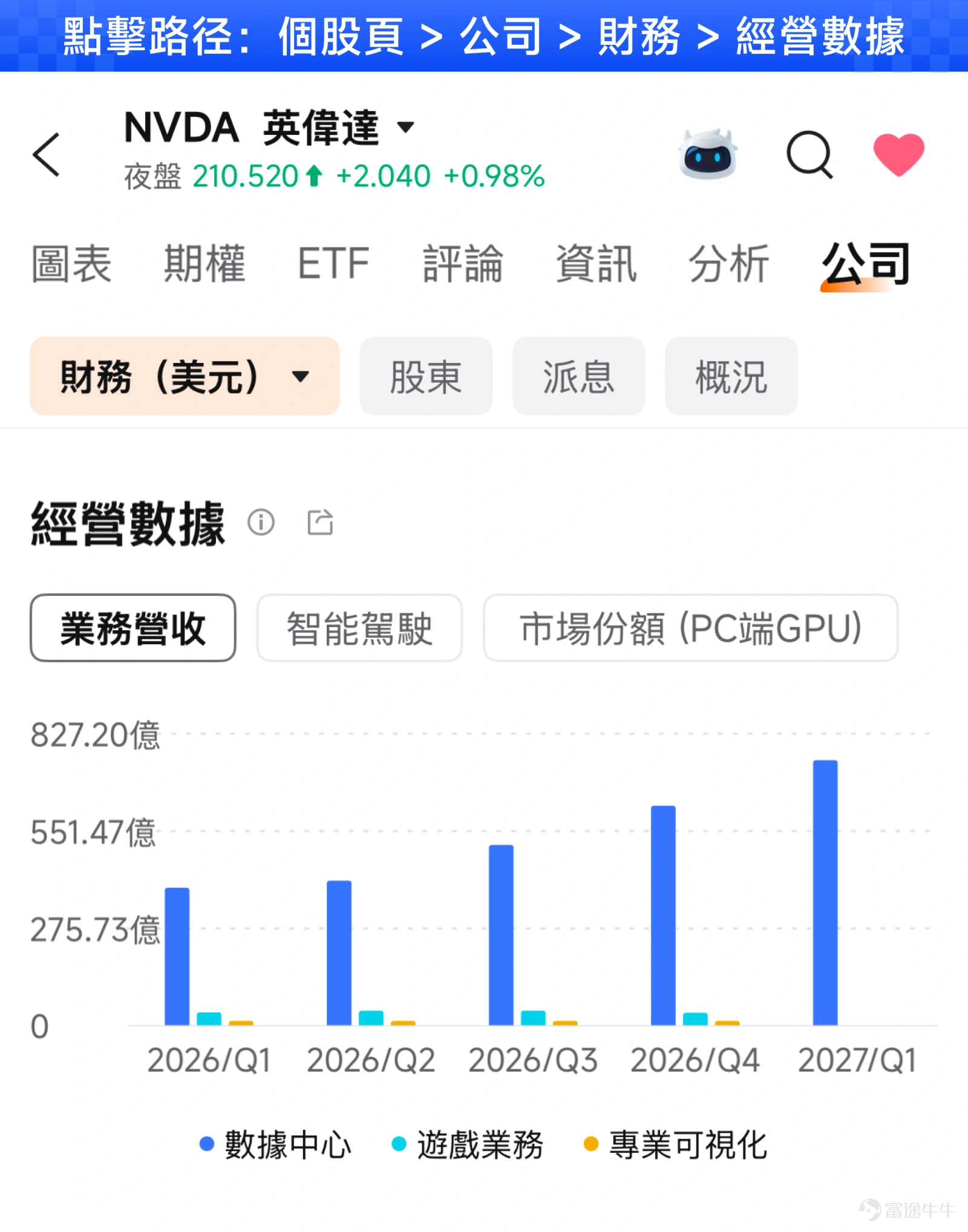
As clearly visible from the bar chart, data centers absolutely dominate NVIDIA's revenue structure.Over the past five quarters, data center revenue has grown steadily from approximately $35 billion to over $75 billion, while segments like Gaming and Professional Visualization have remained at the scale of only a few billion dollars. For this quarter, the market expects data center revenue to reach around $85.7 billion, doubling year-over-year. So remember the first lesson: NVIDIA is essentially a "data center company" now, with other businesses serving merely as supplements.
(2) Revenue Composition by Region: The "On/Off Switch" for China (including Hong Kong)
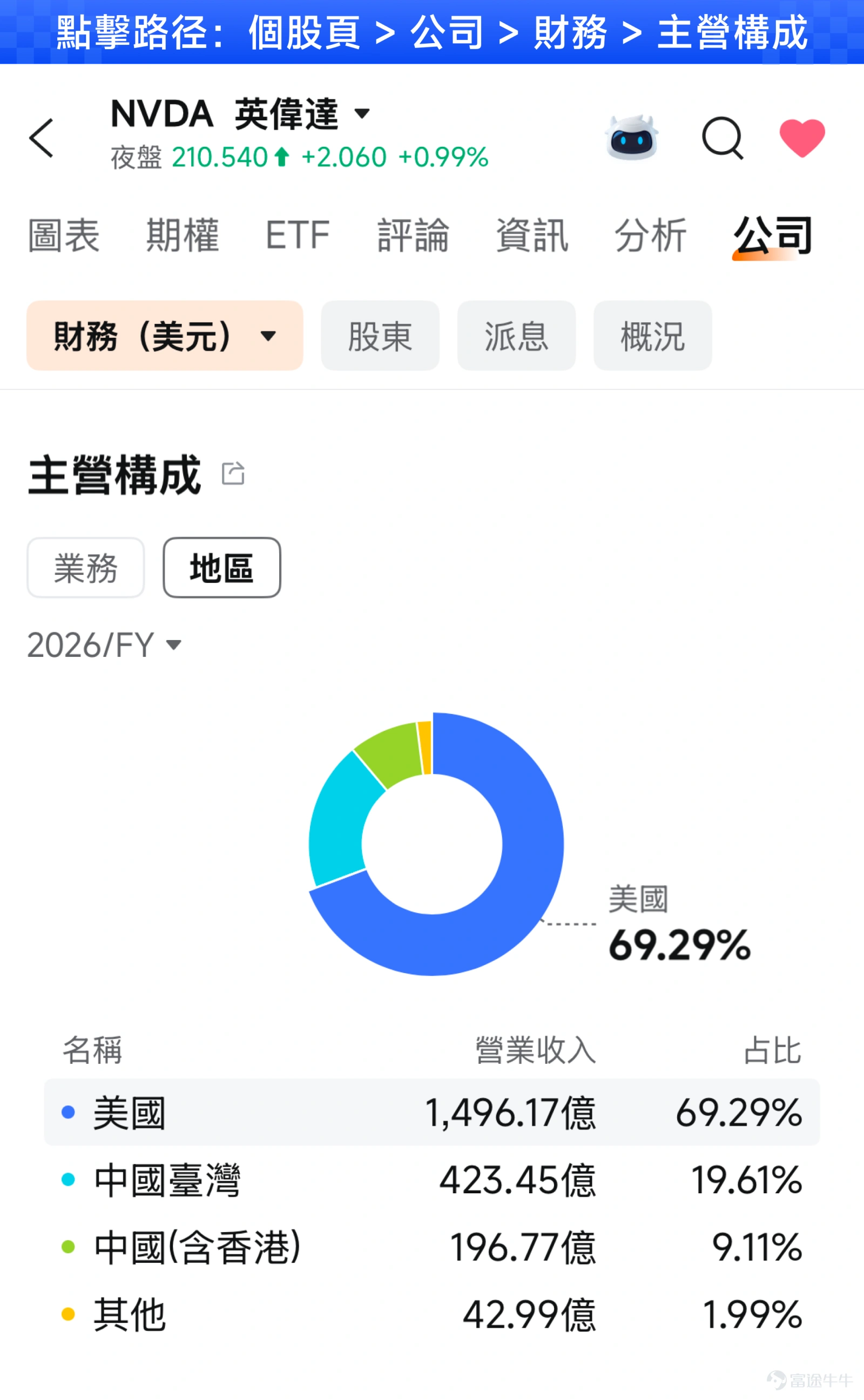
Taking FY2026 as an example: the US accounts for 69.29%, Taiwan (China) for 19.61%, China (including Hong Kong) for 9.11%, and other regions for 1.99%.This 9% from China (including Hong Kong) is critical—NVIDIA's guidance has already excluded data center revenue from China. When this figure starts to rebound, it will signal a loosening of export policies and provide additional upside potential for earnings.
(3) Gross Margin: A Indicator of Competitiveness
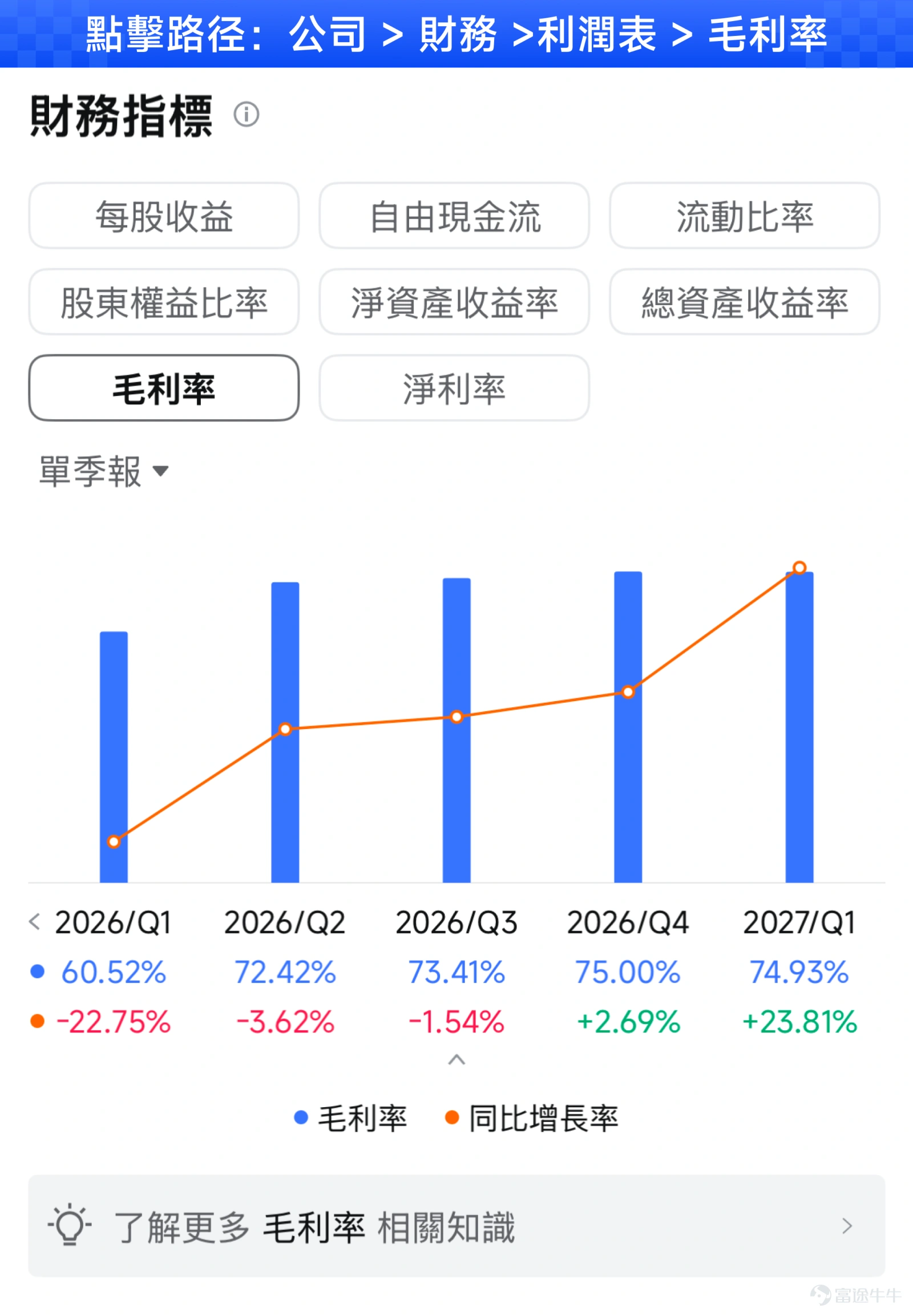
Starting in FY26, NVIDIA's quarterly gross margin has risen steadily from 60.52% to around 75%, with a trend line that is almost unilaterally upward—a rarity among hardware companies.
How should we interpret these figures? Let's compare them with memory chip stocks:SanDisk's gross margin hit a historic high of 84.6% in the latest fiscal quarter,which looks even more impressive than NVIDIA.
However, the gross margin in the memory sector is driven by a 'super cycle'—price hikes during super cycles can push margins from 30% to 80% within a year. The market is now concerned that if supply and demand reverse in the future, the decline could be equally alarming.
In contrast, NVIDIA's gross margin is supported by 'pricing power': it doesn't rely on price hikes to boost performance even amidst strong demand, but rather on the irreplaceability of its products, steadily climbing from 60% to 75% quarter by quarter.Whether margins are high depends on competitiveness; whether they are stable depends on the economic moat—this is the core lesson of gross margin analysis.
Returning to the initial question: the stock has fallen for seven consecutive sessions before the earnings release. Is this earnings report still worth watching? Keep these three points in mind.
Before the announcement, avoid betting heavily on earnings results.A streak of declines doesn't necessarily mean deteriorating fundamentals; it’s more likely a digestion of overly optimistic expectations. Heavy single-position bets are the most dangerous.
After the announcement, first look at the expectation gap, then listen to the guidance.Consensus estimates for this quarter's revenue are around $92 billion, with EPS expected at approximately $2.06. Whether the actual figures beat or miss these expectations, combined with management's guidance for the next quarter and the ability to maintain a gross margin of 75%, will be the key determinants of the stock's direction.
Psychologically, let the dust settle before making a move.Significant volatility following earnings releases is normal; wait for the market sentiment to digest the news before forming a judgment.
Risk Disclaimer: The above content only represents the author's view. It does not represent any position or investment advice of Futu. Futu makes no representation or warranty.Read more


Comment (1)
to post a comment
27
24