Hong Kong and US pharmaceutical stocks remain active; have you positioned your portfolio?

Options Income Strategy | Cancer vaccine milestone acts as a catalyst; MRNA surges then consolidates with volatility. How to capture the high volatility premium?
1. MRNA: Major Phase III success for mRNA cancer vaccine ignites market sentiment! Intensified bull-bear tug-of-war following extreme volatility
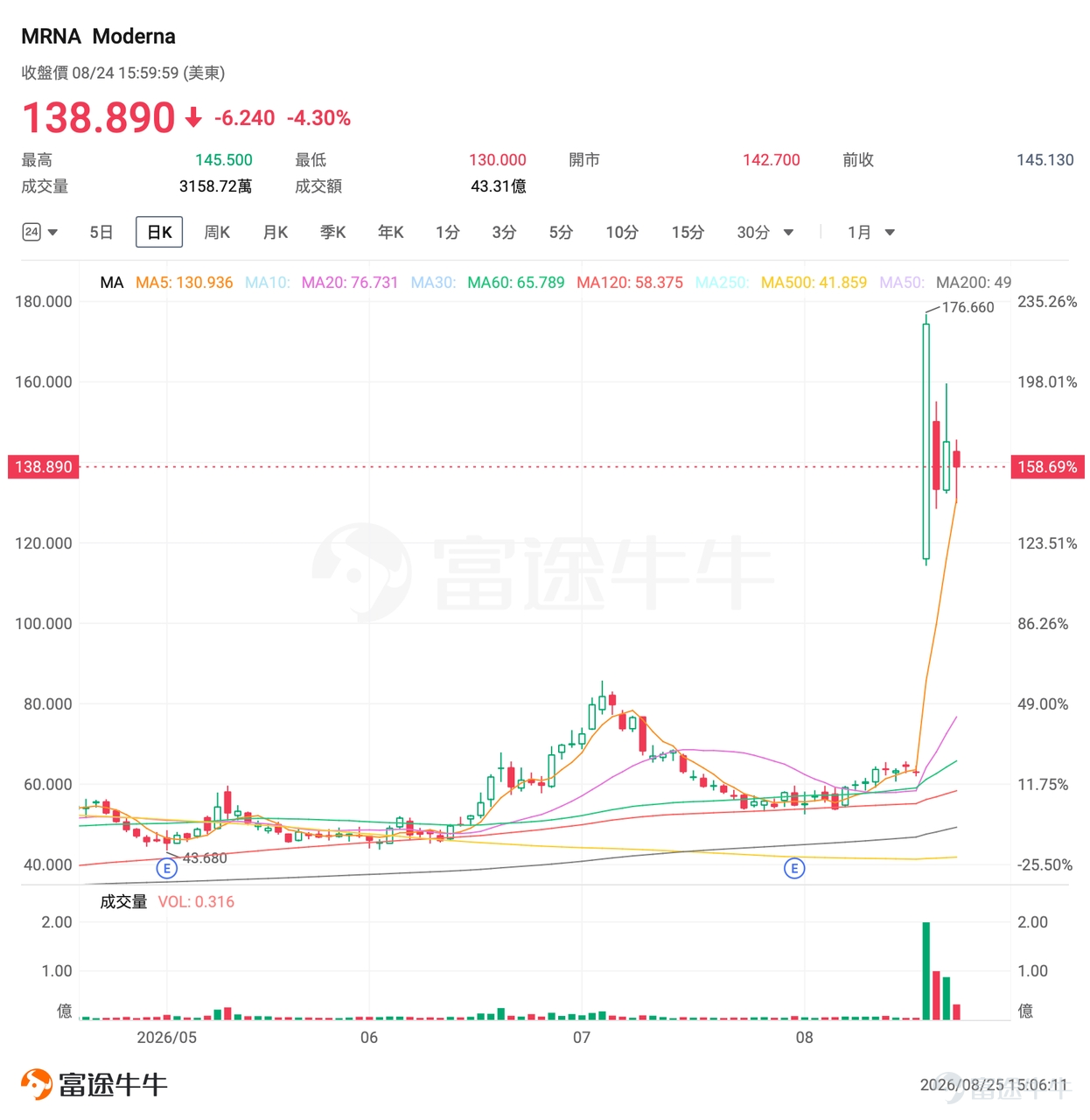
$Moderna (MRNA.US)$ Closed down 4.30% on Monday at $138.89, with an intraday high of $145.50 and a low of $130.00, resulting in a daily amplitude of 10.68%. Trading volume reached $4.331 billion, with a turnover rate of 8.485%.
Previously, on last Wednesday (August 19), $Moderna (MRNA.US)$ the stock surged 176.97% in a single day, skyrocketing from $62.96 to $174.38. It then experienced severe volatility over the next two trading sessions—dropping 23.55% on Thursday and rebounding 8.86% on Friday.

Technical Analysis:
$Moderna (MRNA.US)$ Prior to August 19, the stock had long been consolidating in the $53–$68 range. The massive surge on August 19 completely altered the technical pattern, as the price broke through all short- and medium-term moving average resistances in one go. However, it subsequently underwent intense wide-range fluctuations in the $130–$176 zone over the following three trading days,exhibiting a typical short-term pattern of 'sharp rise followed by high-level severe volatility.'For support levels, watch $130 (Monday's intraday low); for resistance levels above, focus on the $155–$176 range (the high-point areas from Thursday and Wednesday).
In terms of volume, single-day turnover hit $29.269 billion on August 19. Although it has gradually declined since then, it remains far above the previous daily average of $200–$400 million. While capital participation is extremely high, marginal interest is waning, indicating that momentum for chasing the rally is fading.
News Analysis:
$Moderna (MRNA.US)$The core catalyst for the stock's surge was the positive results from the Phase III clinical trial of the personalized mRNA cancer vaccine co-developed with MRK (Merck & Co.).This marks the first successful Phase III clinical trial in the field of mRNA oncology vaccines. Tailored to the specific cancer cell characteristics of individual patients with high-risk melanoma, it is planned for market launch within two years.
The significance of this event lies in its fundamental validation of the feasibility of the mRNA technology platform in oncology treatment, enabling $Moderna (MRNA.US)$ the narrative shift from a "vaccine company" to an "oncology immunotherapy platform company" to gain critical clinical evidence support. Multiple institutions pointed out that this breakthrough has become a catalyst for the entire biotech sector, driving widespread gains in biotech ETFs.
The core expectation differential currently priced into the market hinges on whether cancer vaccines can expand beyond melanoma to other tumor types, and whether the commercialization pace can be delivered as promised.Key variables to monitor going forward include: FDA approval progress, profit-sharing arrangements in the partnership with MRK, the clinical development pace for other tumor indications, and $Moderna (MRNA.US)$ whether cash flows from the existing respiratory vaccine business can sustain continued investment in the oncology pipeline.
Major Bank Views:
Among 11 analysts, 18.18% rate it a Buy, 72.73% Hold, and 9.09% Sell. The average target price is $96.38, with a low of $48 and a high of $170.
Notably, following the release of Phase III data, multiple institutions intensified their adjustments:BofA Securities upgraded from Sell to Neutral, sharply raising its target price from $40 to $170; Morgan Stanley maintained its Neutral rating but raised its target price from $39 to $89; RBC Capital raised its target price from $45 to $130; Goldman Sachs raised its target price from $67 to $120. The focal point of institutional divergence lies in whether the long-term commercialization value of the oncology pipeline can justify current valuations, as well as the risk of declining respiratory vaccine business.
2. Rent Collection Strategy
IV Analysis:
Currently, $Moderna (MRNA.US)$ Implied Volatility (IV) stands at a high 94.97%, at the 94.44th historical percentile, indicating extremely rich option premiums. The 10-day Historical Volatility (HV) has surged to 372.37% (100th percentile), and the 30-day HV reached 273.28% (100th percentile), reflecting extreme recent stock price volatility.

Cash Secured Put
Sell 1 contract of $Moderna (MRNA.US)$2026-09-18 $110 Put; reserve sufficient cash to potentially take delivery of shares.

Opportunity Rationale:The success of the mRNA cancer vaccine in Phase III trials has opened a new growth narrative for Moderna, but the stock faces significant short-term pullback pressure after surging over the past week. For investors bullish on the long-term thesis of oncology vaccines but unwilling to chase highs, selling puts allows you to collect premiums. If the stock continues to consolidate at high levels, the premium becomes your profit; if it pulls back to around $110, you can accumulate shares at a lower price.
Covered Call:

Opportunity Rationale:For investors who already hold 100 shares during the surge, $Moderna (MRNA.US)$ the stock price has fallen from a high of $176 to around $139, facing short-term selling pressure from profit-taking and technical resistance at high levels. Investors unwilling to sell their underlying shares can consider selling calls to collect substantial premiums in the current high implied volatility (IV) environment, effectively lowering their cost basis. If the stock continues to consolidate and adjust, the premium hedges against drawdowns; if it rebounds above $185 and gets assigned, it effectively locks in阶段性 (phase-based) gains near previous highs.
3. Risk Control Notes
Although short-option strategies generally have a high probability of profit, investors must still implement sound risk management:
- Position management is core.The biggest risk for option sellers lies in black swan events. It is recommended that margin usage for a single underlying asset does not exceed 20% of total capital. Do not sell options beyond your capacity to take delivery just to chase premiums.
- Pay attention to rolling positions for Covered Calls.When a Covered Call is deep in-the-money, if you remain bullish on the underlying stock, consider buying back the current option to close the position and simultaneously selling an option with a further expiration date and a higher strike price. This avoids having your shares forcibly sold at a low price.
- Be wary of left-tail risks when selling Cash-Secured Puts.If the stock price drops significantly due to deteriorating fundamentals, do not mechanically hold on. Instead, cut losses or roll down the position based on your risk tolerance.
Make good use of the Options Seller Hub to understand income strategies for selling options and earnOption premiums!

Options Risk Disclosure
An option is a contract that gives the holder the right—but not the obligation—to buy or sell an underlying asset at a predetermined price on or before a specified date. Option prices are influenced by multiple factors, including the current price of the underlying asset, the strike price, time to expiration, and implied volatility. Implied volatility reflects the market's expectation of future volatility over the life of the option and is derived by back-solving from the Black-Scholes option pricing model. It is commonly viewed as an indicator of market sentiment. When investors anticipate higher volatility, they may be willing to pay more for options to hedge their risk, leading to higher implied volatility. Traders and investors use implied volatility to assess the attractiveness of option prices, identify potential mispricings, and manage risk exposure.
Disclaimer
This content does not constitute an offer, solicitation, recommendation, advice, opinion, or any guarantee regarding any securities, financial products, or instruments. The risk of loss in trading options can be substantial. In certain circumstances, your losses may exceed the initial margin deposit. Even if you place contingent orders, such as 'stop-loss' or 'limit' orders, there is no guarantee they will prevent losses. Market conditions may render such orders unexecutable. You may be required to deposit additional margin on short notice. If you fail to meet the required margin within the specified timeframe, your open positions may be liquidated. Nevertheless, you remain fully responsible for any resulting deficit in your account. Therefore, prior to trading options, you should thoroughly study and understand options and carefully consider whether such trading aligns with your financial situation and investment objectives. If you trade options, you should become familiar with the procedures for exercising options and handling expiration, as well as your rights and obligations upon exercise or expiration. Options trading involves substantial risk and is not suitable for all investors. Investors should carefully read 'Characteristics and Risks of Standardized Options' before engaging in any options trading strategy.
Risk Disclaimer: The above content only represents the author's view. It does not represent any position or investment advice of Futu. Futu makes no representation or warranty.Read more


Comment (1)
to post a comment
32
26