US-Japan Intervene to Prop Up Yen — What's Next for US Stocks?

Nasdaq's Chief Economist joins Futu, bringing top-tier Wall Street insights directly to fellow investors
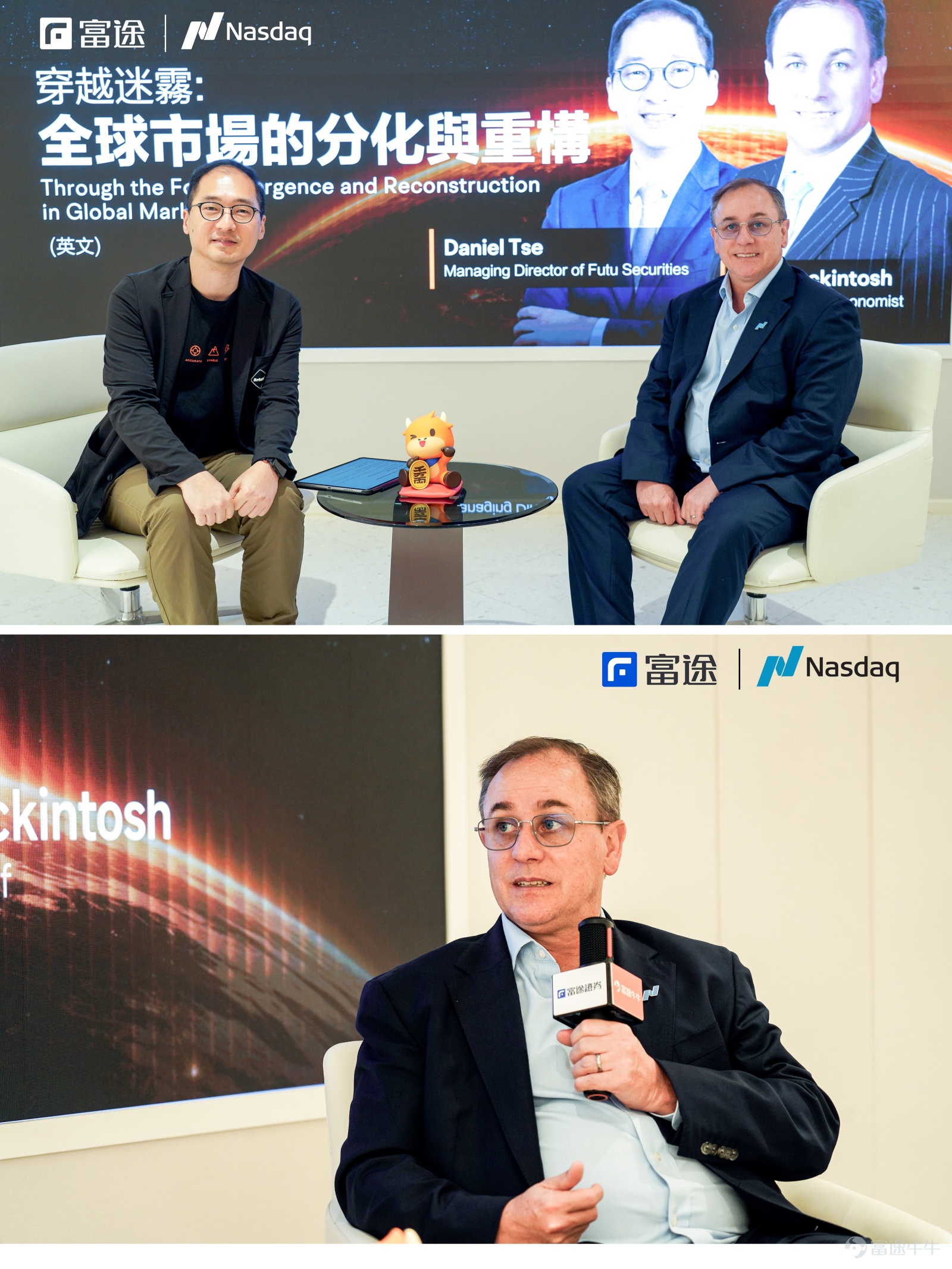
Last week, we had the honor of invitingPhil Mackintosh, Chief Economist and Senior Vice President at Nasdaqto visit Futu's Hong Kong headquarters in person, where he engaged in an in-depth dialogue with Daniel, Managing Director of Futu Securities.
With over 30 years of experience on Wall Street spanning trading, research, and market infrastructure, Phil is one of the most influential economists in global financial markets.
This time, he brought the "Wall Street perspective" to fellow investors. What are the key takeaways? Let's take a look ⬇️

1. High interest rates + recession fears: Why is the stock market still rising?
Tariffs, tensions in Iran, high oil prices... the news is full of bad headlines, yet US stocks keep hitting record highs. Is this contradictory?
Phil breaks down the underlying logic:
First, with interest rates declining, inflation cooling, and wage costs gradually coming under control, not only AI companies but also traditional enterprises are seeing increased profits.
Second, the real money brought by AI—US hyperscalers spent over $500 billion last year building data centers, buying chips, and training models, with an expected investment of $1 trillion next year. This spending translates into tangible revenue for the recipients. $NVIDIA (NVDA.US)$ 、 $Taiwan Semiconductor (TSM.US)$ Chip demand is in a state of explosive growth.
So,The market's new highs are not driven by sentiment but supported by solid earnings.

2. Is inflation structural?
Phil's view differs from the prevailing market narrative of 'structural high inflation'.He believes that current inflation is essentially "tactical."
Phil pointed out that US inflation was already slowly approaching the 2% target before the imposition of additional tariffs. The current factors driving up prices (tariffs, geopolitical conflicts, and tight supply and demand for AI chips) are largely driven by short-term events. Once these geopolitical tensions subside, inflationary pressures will likely dissipate as well.
Even more interesting is Phil's deduction from a demographic perspective: the global population is aging and shrinking. Japan experienced this in the 1990s, and Europe in the 2000s. At that time, even with interest rates cut to zero or even negative levels, the economy remained unresponsive to stimulus.
Therefore, Phil judges that the future central tendency of interest rates should be lower than historical levels, rather than higher.

3. How do tariffs flow through the economy?
Tariffs sound scary, but how significant is the actual impact?
Phil ran the numbers: imports account for about 10% of US GDP. Imposing a 10% tariff on this 10% would result in an overall price impact of only about 1%. Moreover, exporters and importers each absorb part of the cost, so consumers may actually bear only half to two-thirds of it. Theoretically, this is a one-time price jump; as long as no new tariffs are layered on, it will not generate additional inflationary pressure after 12 months.
What’s even more interesting is the situation in Asia:Exports to the US have risen instead of falling. The reason is simple—labor and factory construction costs in the US are simply too high. Even with tariffs, production in Asia remains more cost-effective. Coupled with strong demand for AI chips, trade data from Asia (especially Taiwan and South Korea) has become even more impressive, with exports from the ASEAN region also growing.The "blade" of tariffs, at least for now, has not cut as deeply as the market expected.。

4. Why is the market more resilient to oil price shocks?
Typically, any unrest in the Middle East would send oil prices soaring and trigger investor panic, but this time the market has remained unusually calm.
Phil explained several key changes:
First, supply chain resilience has significantly improved—there are increasingly more pipelines bypassing the Strait of Hormuz, with alternative routes available via the UAE, Saudi Arabia, and the Suez Canal direction. Even if shipping lanes are blocked, about one-third of oil supplies can still be exported through other channels.
Second, the economic structure has fundamentally shifted. We are now in a tech-driven and service-based economy, with far less reliance on oil than in the past.
Furthermore, about half of Europe's electricity now comes from renewable energy sources, so fluctuations in oil prices have a limited impact on them.
Finally, the US has released approximately 150 million barrels of crude oil from its Strategic Petroleum Reserve into the market, effectively filling the supply gap.
In short, the damaging impact of energy shocks on the market is systematically weakening, and the old playbook of "panic whenever oil prices spike" may need to be rewritten.
5. Is AI a genuine macro catalyst?
Phil particularly emphasized:AI is no longer just a stock theme driven by hype; it is now genuinely driving economic growth.
Approximately half of U.S. economic growth stems from AI-related capital expenditures. Data center construction has spurred significant physical job creation (for construction workers, electricians, and plumbers). Taiwan, South Korea, and even Australia are benefiting from the demand for AI data centers.
Moreover, this cycle is fundamentally different from the 2000 dot-com bubble. Phil stated bluntly: "Back then, tech companies relied on free products to attract attention and monetize through advertising; now, companies like Anthropic are charging directly for AI queries, with enterprises paying real money for AI." This represents genuine revenue, not empty promises.
Currently, AI has not replaced jobs on a large scale; instead, it is creating new positions in the short term as companies need AI experts to train their staff. Looking ahead five years, whether the depreciation of major players' AI capital expenditures can be covered by new revenue will be the next key milestone to watch.

6. Is market valuation driven by earnings or liquidity?
Phil believes that the current market highs are driven byactual profitsrather than liquidity.
Hyperscale tech companies possess real businesses and stable revenues, with profits being reinvested into AI infrastructure. Although spending may exceed profits in the coming years, companies like Anthropic are already generating real paid revenue from AI queries, which is starkly different from the dot-com bubble era model of offering free products and monetizing attention.
He believes this rally is supported by fundamental earnings and is not a bubble.。
7. How is the rise of retail investors changing the market?
Phil has observed a significant trend: Asian investors are buying US stocks in large volumes, a phenomenon that was almost non-existent in the past.。 Most of these trades occur during Asian daytime hours, which correspond to late night in the US. To better serve global investors, Nasdaq willimplement continuous trading for 23 hours a day, 5 days a week, starting December 6 this year,along with unified market data, allowing investors in Asian time zones to access real-time best bids and offers as well as trade records.
Phil stated that this will foster quote competition, reduce trading costs for Asian investors in US stocks, and imply better returns.。
Futu launched its 24-hour US stock trading feature as early as 2023, receiving positive feedback from fellow investors.Nasdaq's move signifies that the entire market infrastructure is advancing toward being "always open"—a tangible benefit for retail investors worldwide.
8. The future of 24-hour trading and tokenization
Regarding asset tokenization, Phil believes it is a genuine trend, but it is still in a very early stage.。
At present, although the stablecoin market has reached approximately $300 billion and serves practical transactional purposes (for instance, platforms like Robinhood and Kraken have begun trading tokenized shares of stocks such as Nvidia), the overall scale of tokenized assets is only around $30 million. This stands in stark contrast to the U.S. stock market's after-hours average daily trading volume of $7 billion and its total average daily trading volume of $700 billion.
Therefore, Phil candidly stated: "Whether tokenization supplements liquidity or fragments it, we do not yet have the answer."
In summary, this is a trend worth monitoring over the long term, but its current scale is too small to be a game-changer in the short term. It is best to treat this period as an observation phase.。
The above captures the core message from the dialogue between Phil Mackintosh and Daniel. To summarize in one sentence: Fundamentals are improving, and AI is creating real value, but the greatest opportunities still lie ahead. For investors, it requires both the patience to weather market cycles and an open mindset toward new developments.
Of course, in addition to Phil and Daniel's in-depth discussion, many fellow investors actively asked questions at the event. NiuNiu has curated five sets of Q&A for everyone, allowing fellow investors to learn practical insights in real time.
NiuNiu has curated five sets of Q&A for everyone, allowing fellow investors to learn practical insights in real time.
Q&A Highlights: What did fellow investors ask, and how did Phil respond?
Q: Do you consider U.S. Treasury debt a cause for concern?
Phil: U.S. national debt exceeds 100% of GDP, with annual interest payments accounting for about one-fifth of tax revenue, beginning to squeeze fiscal space for education, healthcare, infrastructure, and other areas. Politically, it is difficult to implement austerity measures; raising taxes or expanding the tax base is more likely. However, looking at it from another angle—if AI brings about a leap in productivity, the debt incurred today may not be as burdensome to repay in ten years as imagined. The internet once drove a 10-15% increase in productivity, equivalent to an additional $3-4 trillion in annual output. From a return-on-investment perspective, AI investment is entirely worthwhile.
Q: Could AI resemble 19th-century railway construction—where the infrastructure was built, but the construction companies themselves went bankrupt?
Phil: Railway construction accounted for 5-10% of GDP, and depreciation led to the bankruptcy of most railway companies, yet the railways continue to operate a century later. The difference today is that companies building AI infrastructure already have mature businesses and revenue streams, so cash flow is unlikely to dry up easily. Depreciation accounts for approximately 40% of profits. When crunching the numbers, trillion-dollar investments in AI are entirely justified from a productivity return perspective—it just remains to be seen 'who will capture the profits.'
Q: Could Nvidia's financing arrangements end up resembling AIG before the financial crisis?
Phil: Using Buffett as an analogy—Buffett holds a large amount of cash because he cannot find better returns, $NVIDIA (NVDA.US)$ it’s the same here; cash inflows can be used for buybacks, bank deposits, or investments. The risk lies in whether the capital is allocated correctly. However, the competitive landscape could change significantly within five years: $Alphabet-C (GOOG.US)$ With TPU development underway, quantum computing could reduce the demand for GPUs. $NVIDIA (NVDA.US)$ Perhaps it's also time to start paying attention to quantum computing.
Q: If the Fed reduces forward guidance, will market conditions worsen?
Phil: Counterintuitively, it might not get worse. During the pandemic, supply-side inflation surged, yet the Fed was slow to raise rates, insisting it was "transitory." As a result, the market saw the truth sooner than the Fed did. One chart our team’s economists love shows that the Fed’s forecast curves have historically been inaccurate. Perhaps the Fed should listen more closely to the bond market.
Q: Is it typically a bear market during midterm elections?
Phil: I’ve seen different statistics—the year following midterm elections usually delivers positive returns. So, just hold patiently and see what next year brings.
Q: The current rise in US stocks is largely driven by a few large-cap tech stocks, showing high concentration. Is this a good sign—indicating strong leaders—or does it mask underlying risks? Additionally, capital has recently been flowing out of US stocks into other markets. Is this because investors feel US stocks are too expensive, or is it just a short-term phenomenon?
Phil: Think about the tech bubble of the 90s. One interesting point is that many companies we called "tech stocks" back then were later reclassified. Tesla is no longer considered a tech stock, $Amazon (AMZN.US)$ it's a retail stock. So perhaps we also need to rethink industry classifications now. Because the economy has changed, every company uses computers and engages in technological activities; in a sense, every company is a "tech company." We shouldn't cram all these companies into a single "Technology" sector and claim it's "too concentrated." The issue isn't concentration, but rather that the classification method needs updating—just categorize them into the industries they truly belong to.
Moreover, from a valuation perspective, the situation isn’t as dire as it seems. Retail investors haven’t rushed in en masse recently; after the frenzy around the "Magnificent Seven," they’ve become more selective and cautious. But the key point is: profits are still growing, and at a faster pace than stock prices. Therefore, for those using P/E ratios to assess valuation, the P/E ratios of these large-cap stocks are actually declining. I wouldn’t say they’ve become "cheap," but they are certainly "less expensive," with earnings beginning to genuinely support their valuations. This is not a bad thing.

The above summarizes the core content of this session. Futu’s intention in hosting this talk was simple—to bring the world’s most cutting-edge macro insights directly to fellow investors.Over the next decade, structural trends have emerged: investment in AI infrastructure, a downward shift in the neutral interest rate, market institutional reforms, and the evolution of tokenization technology. Seizing opportunities within these trends requires not just information, but insight.And this is exactly what Futu MooMoo aims to continuously deliver to our fellow investors.
Risk Disclaimer: The above content only represents the author's view. It does not represent any position or investment advice of Futu. Futu makes no representation or warranty.Read more


Comment (1)
to post a comment
19
20