13F機構持倉大公開!「聰明錢」在買什麼?

Politician Holdings Tracker | The "Oracle of Capitol Hill" strikes again! Pelosi targets AI power and chips: Buys Intel and Bloom Energy
The "investment bellwether" most watched by the market in US politics has made a new move.
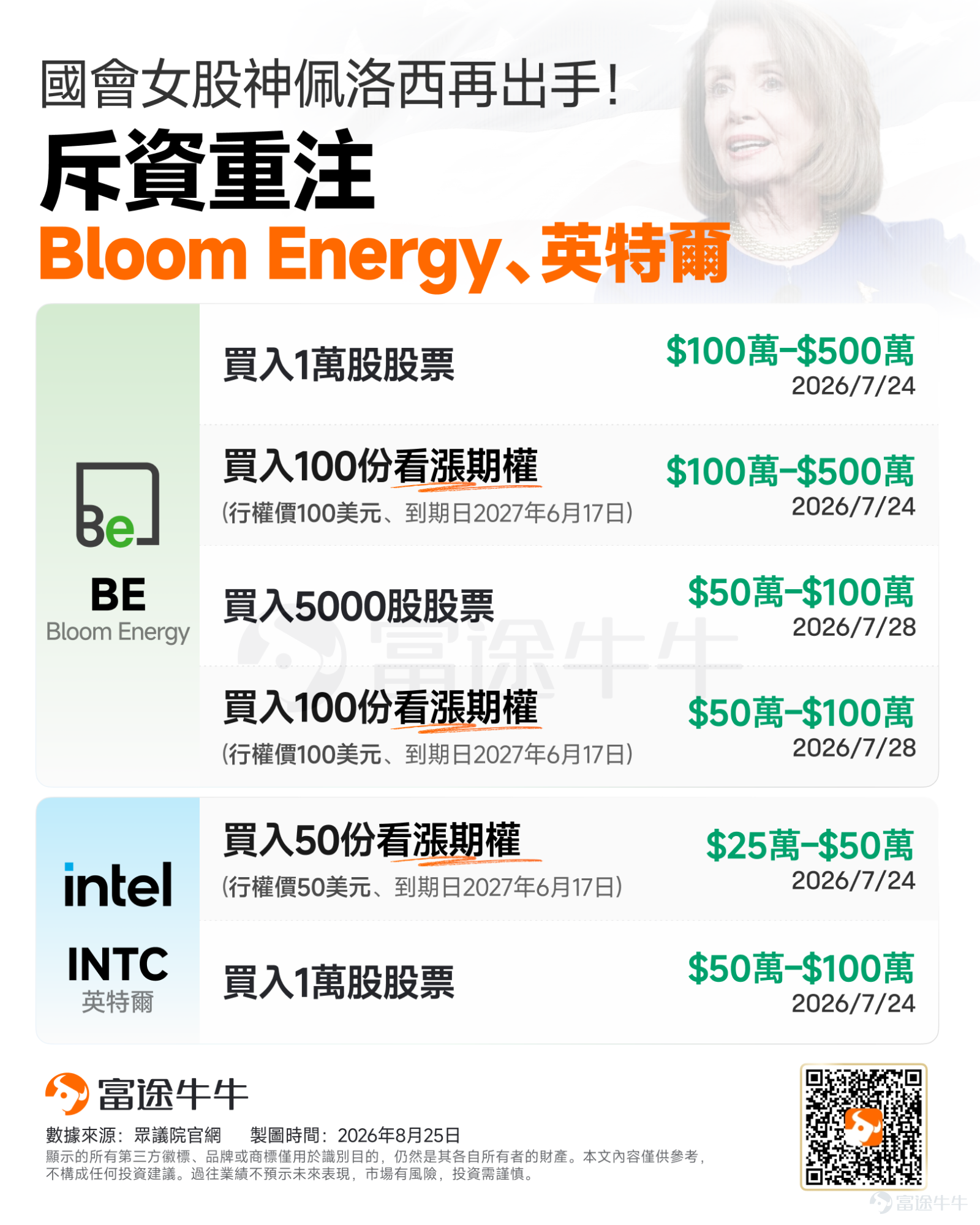
Recently disclosed documents from the US House of Representatives show that Pelosi has once again added a new AI concept stock to her portfolio—the fuel cell powerhouse $Bloom Energy (BE.US)$ , and she also reinvested in $Intel (INTC.US)$ of stock.

--
--
--
The highlight of this transaction is undoubtedly the significant purchase of Bloom Energy. The two transactions combined involved buying 15,000 shares of common stock and 200 call option contracts,This combination of "common stock + medium-to-long-term calls" is typically not just a bet on a short-term rebound in the stock price. The common stock captures the medium-term trend, while the call options amplify the upside potential when the stock price rises, reflecting a highly positive directional view on Bloom Energy in this trade.
Why Bloom Energy?
Pelosi is not betting on a traditional new energy company, but rather on the most critical bottleneck in the current AI industry—electricity.
As AI data centers accelerate their expansion, the industry bottleneck is gradually shifting from a "shortage of GPUs" to a "shortage of electricity and grid access." It may take several years for traditional data centers to go from applying for grid connection to actually receiving power, $Bloom Energy (BE.US)$ while its solid oxide fuel cells can be deployed directly on-site at data centers, reducing reliance on the public power grid.
The company's Q2 revenue reached $1.065 billion, surpassing the $1 billion mark for the first time, representing a 165.5% year-over-year increase; product revenue grew by 215.4%. The company also raised its 2026 revenue guidance to $3.9–$4.2 billion, which is nearly double the previous midpoint on a year-over-year basis.
More importantly, Bloom Energy and Brookfield expanded their financing cooperation framework for AI infrastructure power projects from $5 billion to $25 billion in late June, a fourfold increase, with plans to deploy fuel cell power projects globally.
Therefore, Pelosi's purchase of Bloom Energyis essentially a bet on a new AI narrative: as AI computing investment continues to expand and data center power shortages intensify, companies capable of rapidly deploying on-site power solutions will capture greater industry value.
Notably, the second BE transaction occurred on July 28, the same day the company announced its Q2 results. However, the filing did not disclose the specific execution time, so it is unclear whether the trade took place before or after the earnings release.
Adding to her Intel position again
Bloom Energy represents the power infrastructure for AI data centers, $Intel (INTC.US)$ while Intel corresponds to computing chips, advanced packaging, and wafer manufacturing.
Intel announced its Q2 results on July 23, and Pelosi bought 10,000 shares of Intel the following day, along with 50 call options with a strike price of $50 expiring on June 17, 2027. This looks more like a fundamental bet placed after the earnings report.As early as JunePolitician Holdings Tracker | The "Oracle of Capitol Hill" Strikes Again: Heavy Bets on Intel and Uber Options, What Is Pelosi's Grand Strategy?The article mentions that Pelosi made a significant purchase of 200 Intel call options with a strike price of $50 and an expiration date of March 19, 2027, involving an amount between $1 million and $5 million.
Intel's Q2 revenue reached $16.1 billion, a 25% year-over-year increase; among this, Data Center and AI business revenue grew 59% to $6.3 billion, while Foundry Services revenue rose 31% to $5.8 billion. The company provided Q3 revenue guidance of $15.8 billion to $16.8 billion.
This trade is betting on Intel regaining its valuation anchor in the AI era, including server CPUs, custom ASICs, advanced packaging, and foundry services. However, Intel's turnaround still carries high risks. The company subsequently announced an increase in its common stock offering size from $15 billion to $20 billion. While this can supplement funding for capital expenditures and capacity building, it also brings significant equity dilution pressure.
What is the real bet behind this round of trades?
On the surface, Bloom Energy and Intel belong to two different industries—energy and semiconductors—but both trades actually revolve around the same central theme: AI infrastructure.
Bloom Energy addresses the power supply issues for data centers; Intel is betting on the recovery of demand for computing power, servers, and advanced process technologies. The former is a high-growth target addressing the AI power bottleneck, while the latter is a target for valuation and fundamental repair.
This forms a fairly clear portfolio:
$Bloom Energy (BE.US)$: Focusing on the AI power shortage, pursuing high earnings growth; $Intel (INTC.US)$: Betting on the transformation and valuation repair of traditional chip giants;
Underlying stock: Riding the medium-term trend; Call options: Amplifying upside potential before 2027.
Of course, being a "Pelosi concept stock" does not guarantee profits. After a significant rally, Bloom Energy's valuation already prices in high growth expectations, requiring sustained delivery on orders, capacity, and earnings going forward. Intel, meanwhile, still faces risks related to process yield, foundry losses, capital expenditures, and competitors capturing market share.
However, from a trading structure perspective, the Pelosis are not simply chasing a single hot AI stock this time; instead, they are betting on two key links in the AI investment cycle:One end is increasingly scarce electricity, and the other is chip manufacturing capacity awaiting a turnaround.
Compared to asking "who is the next AI chip stock," the signal released by this filing may be more direct: as GPUs are no longer the sole bottleneck, AI capital expenditure is continuing to expand outward along the power, data center, and semiconductor manufacturing chains.
Risk Disclaimer: The above content only represents the author's view. It does not represent any position or investment advice of Futu. Futu makes no representation or warranty.Read more


Comments (8)
to post a comment
46
232