Tempus AI surges 36% in five days: Is AI healthcare entering the monetization phase?

Sector Breakdown | mRNA Cancer Vaccine Achieves First Phase III Breakthrough; Timely Opportunity for Supply Chain Positioning
💡 Key Insight
🔸August 19, $Moderna (MRNA.US)$ and $Merck & Co (MRK.US)$The personalized mRNA cancer vaccine, co-developed by,INTerpath-001has succeeded in Phase III clinical trials, becomingthe first personalized cancer vaccine to demonstrate efficacy in a Phase III trial,marking the formal clinical validation of the mRNA oncology vaccine technology pathway.The market's pricing logic for mRNA companies has undergone a fundamental shift:they are no longer viewed merely as transient beneficiaries of the COVID-19 pandemic, but as platform companies with genuine clinical value in oncology capable of sustaining long-term cash flows.。
🔸This breakthrough not only provides$Merck & Co (MRK.US)$a key strategic asset to address the 2028 patent cliff for Keytruda, and also drives$Moderna (MRNA.US)$ 、 $BioNTech (BNTX.US)$ Awaiting the revaluation of mRNA platform companies. More importantly, the heavy reliance of personalized vaccines on the extended turnaround cycle of "sequencing-design-production" means thatthe positioning of AI4S (AI for Science) has evolved from being merely a tool for R&D efficiencyto becoming infrastructure for the pharmaceutical industry,with upstream "wet lab enablers" (such as gene synthesis and protein expression within the CDMO sector) poised to realize performance gains first. Leading suppliers like Twist Bioscience and GenScript Biotech have significant room for valuation reshaping.
▎I. Event Recap
1.1 Moderna mRNA Cancer Vaccine Phase III Data Readout
August 19, the personalized mRNA cancer vaccine jointly developed by Moderna and Merck & Co. has succeeded in a large-scale Phase III clinical trial, becoming the first personalized cancer vaccine to demonstrate efficacy in a Phase III trial. This is regarded by the industry as a milestone breakthrough in the field of oncology immunotherapy. The trial is namedINTerpath-001, results show that the vaccine mRNA-4157 (V940) in combination with Merck & Co's immunotherapy drug Keytruda can significantlyreducereduce the risk of post-operative recurrence in high-risk melanoma patients, andinhibittumor metastasis to distant organs, outperforming the previously standard-of-care Keytruda monotherapy. Moderna CEO Stéphane Bancel hailed the results as an "extraordinary milestone for mRNA science," stating that the two companies will engage with regulators regarding marketing authorization applications, with the productpotentially approved for market launch as early as 2027. Detailed data will be presented at an upcoming international medical conference.The market's pricing logic for mRNA companies has undergone a fundamental shift:they are no longer viewed merely as transient beneficiaries of the COVID-19 pandemic, but as platform companies with genuine clinical value in oncology capable of sustaining long-term cash flows.。
The two companies disclosed earlier this year thatKEYNOTE-942/mRNA-4157-P201Five-year follow-up data from the Phase II study showed that, among melanoma patients treated with the mRNA vaccine in combination with Keytruda, compared to Keytruda monotherapy, within five years:the risk of death or cancer recurrence was reduced by 49%,the risk of distant metastasis or death was reduced by 59%. The success of this Phase III melanoma trial is a core milestone in the broader clinical development plans of both companies. The INTerpath program currently includesnine Phase II and Phase III clinical trials, covering multiple tumor types including melanoma, non-small cell lung cancer, bladder cancer, and renal cell carcinoma. Among these, the melanoma study is the most advanced, leading the market to view its Phase III results as a key checkpoint for validating the feasibility of this technological approach. Curative cancer vaccines have long been considered an elusive goal in oncology. The potential advantage of such therapies lies in their promise to extend patient survival without significantly increasing additional side effects, offering patients the hope of achieving a cancer-free state.
INTerpath-001 is a randomized, double-blind, placebo-controlled and active-comparator-controlled global Phase III clinical trial, which enrolled1,137high-risk melanoma patients (Stage IIB to IV) following complete surgical resection. Participants were stratified by2:1Patients were randomized into groups; the treatment arm received the mRNA vaccine in combination with Keytruda for approximately56 weeks, while the control arm received Keytruda monotherapy for approximately one year. The trial met its primary endpoint of recurrence-free survival (RFS) and key secondary endpoint of distant metastasis-free survival (DMFS), with both endpoints demonstrating statistical significance and clinical relevance. The two companies stated that the safety profile of the combination therapy was consistent with previous studies, with no new safety signals identified.
Currently, the two companies have not disclosed the specific magnitude of improvement in recurrence-free survival. The trial will continue to evaluate other key secondary endpoints, such as overall survival (OS). This trial is expected to establish a new treatment paradigm in the adjuvant melanoma setting, helping patients remain cancer-free for longer periods. Moderna currently has two pipelines for mRNA vaccines: one isthe personalized custom route (TSA), and the other isthe universal off-the-shelf route (TAA). The INTerpath-001 trial is part of the personalized pipeline, where personalized vaccines are highly dependent on the turnaround speed of "sequencing-design-production." Currently, Moderna's delivery cycle is approximately6 weeks (42 days), and AI4S is expected to shorten this cycle, thereforeIf personalized mRNA tumor vaccines are the first to achieve commercialization, production capacity bottlenecks will be concentrated in the upstream CDMO sector.。
1.2 Personalized mRNA Cancer Vaccine Treatment Pathway
The personalized approach effectively addresses the challenge of tumor heterogeneity, and domestic comparable companies are accelerating their follow-up efforts. Unlike traditional universal vaccines, personalized mRNA vaccines sequence patient tumors to customize up to34 typesof exclusive neoantigens, achieving precise "targeted ignition" of the immune system. The core premises supporting current optimistic expectations are production turnover speed and the expandability of indications. Therefore, during future large-scale commercial expansion, companies need to address the ultra-long cycle of "sequencing-design-production" (currently leading companies require approximately30-42 days). Personalized cancer vaccines require customizing exclusive mRNA sequences for each patient's tumor mutations, placing extremely high demands on the synthesis speed and length of upstream DNA templates. Traditional synthesis methods struggle to balance high throughput with long sequences, whereas AI4S companies are accelerating commercialization through higher efficiency and lower costs.
Currently, the cost per dose of personalized vaccines is around one million yuan, with the industry aiming to reduce it to below 100,000 yuan to enhance downstream commercial penetration. AI4S is currently the most certain pathway for shortening the cycle. The success of this vaccine not only directly validates the feasibility of the mRNA tumor vaccine technology pathway but alsotransforms the positioning of AI4S into infrastructure for the pharmaceutical industry. Past pharmacology has followed an industrialized route: standardization, mass production, and scaling. However, the success of the personalized vaccine pathway in randomized Phase III trials implies thatPersonalized drug manufacturing and release can be completed within real-world clinical timelines, which meansAI-driven pharmaceuticals have finally encountered a "must-have" use case, whereas AI previously served primarily as an accelerator to enhance efficiency, narrow screening scopes, and reduce the number of experiments, the success of personalized vaccines now implies thatAI for Science (AI4S) is no longer merely a scientific accelerator but has become fundamental infrastructure for the pharmaceutical industry. While the former type of AI generated R&D efficiency, the latter has the potential to become a production factor paid for with every dose administered. Consequently, the scale of AI4S adoption is expected to grow exponentially.
1.3 Impact on Merck & Co
Merck & Co's Keytruda has long faced the challenge of a patent cliff. The successful Phase III clinical trial of its mRNA cancer vaccine, Intismeran (V940), representsthe most critical strategic asset for Merck & Co to address the 2028 Keytruda patent cliff. It not only directly contributes billions of dollars in incremental profit but also deeply binds and extends Keytruda's lifecycle through a "combination therapy" model, effectively alleviating market concerns about Merck & Co's future earnings cliff. Currently, Merck & Co faces an extreme crisis of single-product dependency.2025The company's total revenue is$65.011 billion, of which Keytruda contributed$31.68 billion, accounting for nearly half. As Keytruda's core patents are set to2028expire sequentially, the company is urgently seeking a successor.August 2026Intismeran in combination with Keytruda successfully met the dual endpoints of recurrence-free survival (RFS) and distant metastasis-free survival (DMFS) in Phase III clinical trials for melanoma. Previous five-year follow-up data showed that the combination therapy significantlyreduced the risk of recurrence or death by 49%(HR=0.51).This demonstrates that mRNA vaccines can upgrade Keytruda's efficacy from merely "lifting immune suppression" to "targeted augmentation of immune response," establishing a cornerstone for next-generation oncology treatments and building a formidable moat for Keytruda.Additionally, the therapy is expected to advance into first-line treatment regimens, further expanding the patient population, while prolonged patient survival is anticipated to extend the drug's usage cycle.
Regarding earnings expectations and valuation restructuring, Merck & Co and Moderna will share costs and profits according to a50:50prescribed ratio. In terms of incremental revenue, just the two indications of melanoma and non-small cell lung cancer (NSCLC) are projected to generate2035sales of$6.7 billion,by [target year]. On the valuation front, Merck & Co's P/E ratio has long been constrained by expectations of a patent cliff (approximately11x P/E, below the industry average).The success of Intismeran not only offers Merck & Co approximately 7% upside potential in its stock price but also serves as the core driver supporting its strategic goal of returning its oncology business to $25 billion by the mid-2030s.Going forward, the key determinant for the slope of Merck & Co's valuation repair will be the data validation of Intismeran in other major indications. Key focus periods includelate 2026 to early 2027Phase II clinical data readouts for renal cell carcinoma (RCC) and muscle-invasive bladder cancer (MIBC), as well as2027Phase III clinical progress in adjuvant therapy for non-small cell lung cancer (NSCLC).
1.4 Other mRNA-related US stock targets
In addition to driving up Moderna (MRNA) shares, other peers in the same sector have also benefited indirectly. $BioNTech (BNTX.US)$ The company has long been plagued by corporate governance issues. Recently, it appointed a new CEO, Guido Oelkers, who spent the past nine years at the Swedish pharmaceutical company Sobi. Under his leadership, Sobi transformed from a niche European pharma firm into a global biopharmaceutical company with significant commercial success in the US. Consequently, short-term headwinds weighing on the stock price have been removed.
As the second major player in mRNA vaccines, BioNTech directly benefits from this data readout. The company also maintains pipelines for both personalized and universal cancer vaccines. Its personalized vaccine Autogene cevumeran, developed in collaboration with Roche, focuses on adjuvant therapy. Phase I pancreatic cancer6 yearsfollow-up data shows that patients who generated an immune response survived for up to6 years, while the median OS for non-responders was only3.4 years, demonstrating strong long-tail survival benefits. The company’s heavily invested PD-(L)1/VEGF bispecific antibody, Pumitamig (BNT327), has reached an agreement with BMS50:50global collaboration (including$1.5 billionupfront payments). The pipeline is scheduled toby the end of 2026launch Phase III clinical trials globally8 items, serving as the company's most critical near-term commercialization driver. In the future, it aims to emulate Merck & Co by launching combination therapies involving bispecific antibodies and vaccines.
▎II. Investment Logic for Upstream Supply Chain Beneficiaries
2.1 AI4S & AIDD
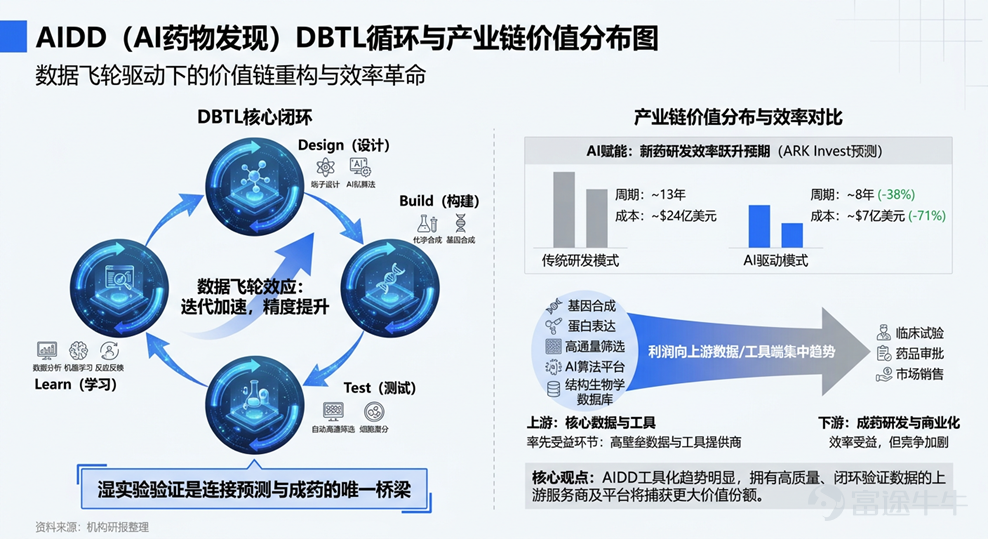
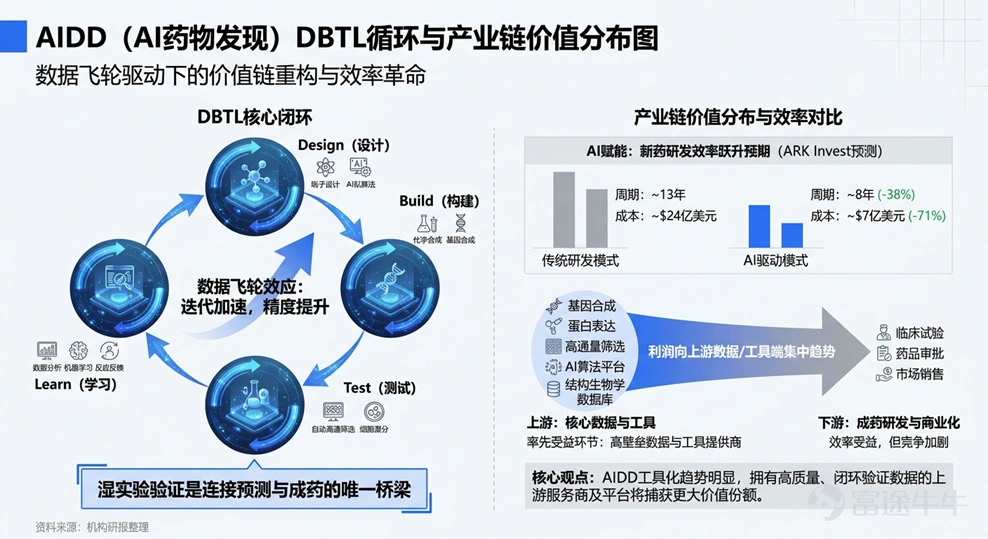
AI4S (AI for Science) is reshaping the entire scientific discovery process, while AIDD (AI-driven Drug Discovery) represents its earliest and most significant application scenario in the pharmaceutical sector. The industry is currently evolving from "pure algorithmic prediction" to a "closed-loop integration of dry and wet lab experiments."Investment themes should focus on the "upstream wet-lab enablers," where demand is being systematically amplified by AI.. Traditional innovative drug development faces the "Three Tens" dilemma: cycles lasting up to9-15 years, with investment exceeding$1 billion(total R&D costs approximately$2.4 billion), and clinical success rates below10%. AIDD significantly boosts efficiency in early-stage processes such as target discovery, molecular design, and virtual screening through deep learning and generative AI. AIDD currently follows theDBTLmodel, i.e., Design (D) - Build (B) - Test (T) - Learn (L), where AI platforms primarily handle the "dry lab" phase, while upstream tool providers manage "wet lab" validation, including gene synthesis, protein expression, and model animal supply.The explosion in the number of AI-designed molecules has directly driven demand for gene synthesis and protein expression, making current "wet lab" suppliers a bottleneck in production capacity.High order visibility, early realization of financial performance, and certainty in earnings growth.From a valuation perspective, the market has not yet fully priced in its long-term value as 'AI infrastructure,' leaving significant room for valuation re-rating. The recent vaccine data readout extends AIDD's commercial application from early-stage drug discovery to scaled manufacturing, directly driving an exponential rise in earnings expectations.
Figure 1: Summary of AIDD Business Model
Source: Public information
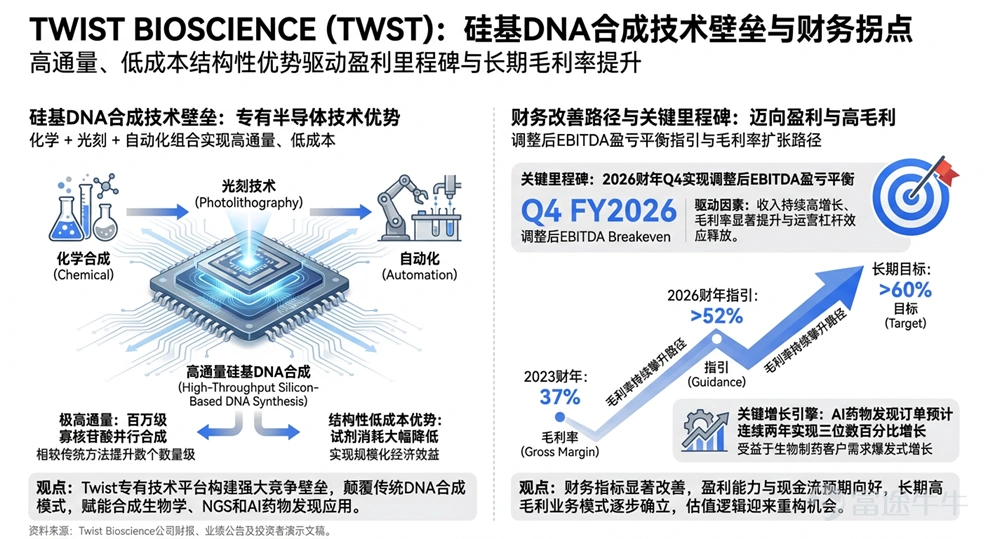
Company Overview:Twist Bioscience (Twist Bio) specializes in silicon-based DNA synthesis technology. Its core business involves the high-throughput, low-cost synthesis of oligonucleotides and gene fragments, serving the synthetic biology, nucleic acid therapeutics (siRNA, mRNA, DNA vaccines), and CRO/CDMO sectors. Leveraging its chip-based DNA synthesis platform, the company mass-produces high-precision gene fragments, providing raw material support for target screening, lead compound optimization, and preclinical molecular construction.
In terms of development, the company initially focused on research services. With the boom in small nucleic acid and mRNA drugs, it gradually entered the pharmaceutical supply chain, expanding its business from research reagents to CDMO-supporting services such as customized gene synthesis and library construction for pharmaceutical companies, thereby deeply integrating into the entire new drug R&D process.As nucleic acid drug pipelines advance, orders continue to grow, steadily establishing the company as a leading global supplier in the DNA synthesis sector.
Business SegmentAt the business level, the logic behind AI-driven drug discovery is as follows: Customers use AI computing to generate tens of millions of potential DNA sequences and iteratively screen for the optimal candidate therapeutic molecules for specific diseases. The company leverages its end-to-end capabilities in high-throughput DNA synthesis, protein expression, and downstream protein performance testing to rapidly convert digital designs into physical biological materials. This supports the rapid Design-Build-Test-Learn cycle in the early stages of drug discovery.Currently, this business has evolved from an emerging opportunity into a sustainable growth engine covering short-, medium-, and long-term horizons.
Growth drivers include continued repurchases and iterative R&D by existing clients, ongoing expansion into new customers—covering large pharmaceutical companies, dry-lab biotech firms, traditional biotech enterprises, and leading tech companies—and a continuously expanding opportunity funnel. Regarding growth expectations, AI-related orders are projected to achieve triple-digit year-over-year growth in fiscal year 2026. As we are currently in the third quarter of FY2026, the company expresses strong confidence in meeting or even exceeding its targets.fiscal 2027Orders for AI-driven drug discovery are expected to maintain triple-digit year-over-year growth. Regarding long-term targets,2030the company's addressable market size is approximatelyUSD 13 billion, and the subsequent innovation engine will introduce new capabilities to further expand market potential, with revenue expected2031to double through organic growth;Fiscal Year 2026Gross margin is projected to exceed52%, with a long-term gross margin target of over % as the business matures;60%Adjusted EBITDA is expectedin Q4 of fiscal year 2026to reach break-even,fiscal 2027and this profitability level will be maintained.
In terms of industry barriers, speed is Twist Bioscience Corporation's key differentiator. Twist Bioscience Corporation delivered its sequences within 17 days,while the next fastest competitor took41 days,and the slowest competitor took57 days.Through high levels of automation, AI has shortened in vivo workflows fromsix weeks to two weeks.. Therefore,Twist Bioscience Corporation stands to reap disproportionate benefits from the fixed costs invested in its "Future Factory," asfew competitors currently possess similar facilities.。
Regarding orders, large pharmaceutical companies and well-funded AI drug discovery firms are currently more important customer segments than tech companies. Specifically, startups that have raised hundreds of millions of dollars but have no intention of building in-house wet lab capabilities are willing to treat data procurement as a variable cost. The company is pursuing all top 20Major pharmaceutical companies (currently boasting robust product pipelines) and all seven tech giants (Mag 7) have become its clients. Notably, these orders can be broadly categorized into two types: selling data to AI teams and selling proteins to traditional life sciences companies.
Chart 2: Summary of TWIST's Business Model
Source: Public information
Company Overview:GenScript Biotech is a global leader in life science R&D services, having established a CRO/CDMO platform covering the entire chain from drug discovery to commercialization. Its core operations are divided into two main segments: Life Science Research Services, which focuses on basic research reagents and services such as gene synthesis, peptide synthesis, and protein expression for universities and research institutions worldwide; and Biopharmaceutical CDMO/CRO Business, which focuses on nucleic acid drugs, antibody drugs, and cell and gene therapy (CGT), providing integrated services including target screening, lead compound optimization, preclinical studies, process development, and commercial production.
The company started with gene synthesis technology and leveraged its upstream advantages in nucleic acid synthesis to deeply integrate into the new drug R&D industry chain. By securing global pharmaceutical clients and riding the rapid expansion of the small nucleic acid and CGT sectors, its business has continuously extended into mid-to-late clinical stages and commercial production. It is now a leading biotechnology enterprise in China with capabilities in both early-stage CRO and large-scale CDMO.
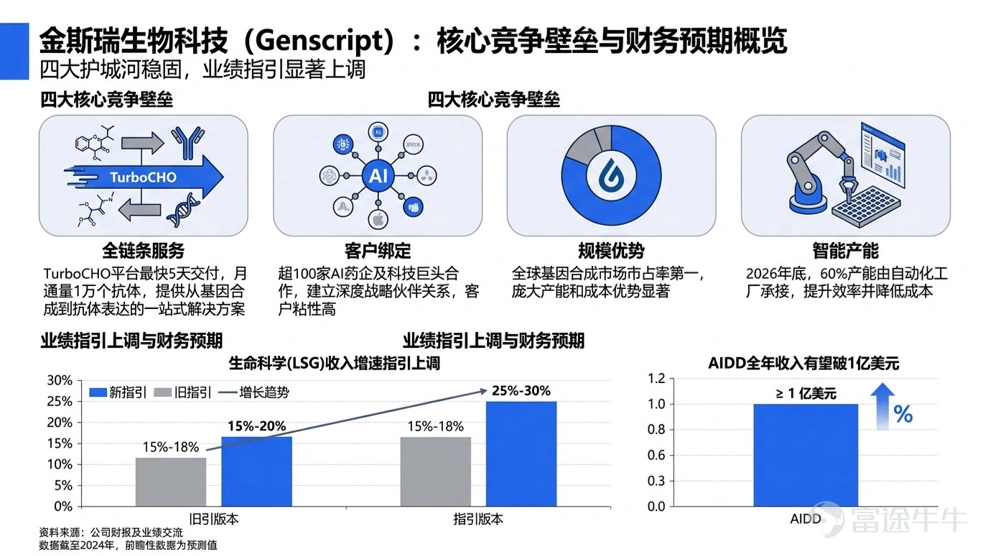
Business Segment: Accelerating release of AIDD demand has driven faster revenue growth and continuous margin improvement. The Life Sciences segment reported revenue of USD 320 million in the first half of the year, year-on-yearincrease of 28.8%, adjusted gross margin55.4%, significantlyincreased by 4.4 percentage points, adjusted operating margin27.1%, significantlyIncreased by 8.4 percentage pointsContinuously enhancing global scaled delivery capabilities to improve production and operational efficiency.AI automated workstations have been deployed in 60% of global laboratories. Breakthrough Gene-to-Protein technology enables experimental data generation for adaptive models in as fast as 4 days, from sequence to data package. The company has significantly raised its revenue guidance for the life sciences segment. The company updated its full-year revenue growth guidance to 25%-30%., adjusted gross margin55%+, adjusted operating margin25%+, Phoenix Biologics FFS revenuegrew by 25%-30%, and is expected to2027achieved positive EBITDA.
Overseas capacity: The company has R&D and production bases in multiple locations globally (US, Europe, China, Singapore), capable of meeting customers' local production needs and effectively mitigating geopolitical risks. The company continues to invest in automated and intelligent manufacturing, planning that by the end of 2026,**60%** of global capacity will be handled by its proprietary AI smart manufacturing centers.These upfront investments are gradually translating into the release of operating leverage, positioning the company to gain a first-mover advantage.。
Chart 3: GenScript Biotech's Business Model
Source: Public information
[Investment Advisory Information]
Sun Bihan, Licensed Representative, Central Entity Reference Number: BWS708
Disclaimer
This report is prepared by Futu Securities International (Hong Kong) Limited ("Futu Securities"). Without Futu Securities’ prior written consent, this report and the information contained herein may not be (i) reproduced, copied, or stored in any form, or (ii) distributed or transmitted directly or indirectly to any other person for any purpose. The information in this report is derived from sources that Futu Securities believes to be accurate and reliable as of the date of publication; however, this report is not intended to contain all information required by investors and may be subject to delays, obstructions, or interception in transmission. Futu Securities makes no express or implied representation or warranty regarding the adequacy, accuracy, completeness, reliability, or fairness of such information or opinions. Accordingly, Futu Securities and its affiliates (collectively, the "Futu Group") shall not be liable for any losses (including, without limitation, direct, indirect, or consequential damages) arising from any actions taken by third parties relying on the content of this report. The views, recommendations, suggestions, and opinions expressed in this report do not necessarily reflect those of Futu Securities or its affiliates and may be changed at any time without notice. Futu Securities undertakes no obligation to update any such information or opinions. This report is provided for general informational purposes only and is intended solely for the general reference of Futu Securities’ clients, without regard to the specific investment objectives, financial situation, or particular needs of any individual recipient. Nothing in this report constitutes or should be construed as an offer, recommendation, or solicitation by any member of the Futu Group to buy or sell any securities, investments, or other financial instruments. It should not be interpreted as an offer or invitation to purchase or sell securities. Any decision to purchase securities mentioned in this report should be based on publicly available information, including relevant prospectuses. The products referenced in this report may not be suitable for all investors, and readers should carefully consider all relevant factors and seek professional advice before making any investment decisions. This report is provided to recipients on the assumption that they are capable of independently evaluating investment risks and exercising independent judgment in making investment decisions. In certain jurisdictions or countries, the distribution, issuance, or use of this report may violate applicable laws, regulations, rules, or other registration or licensing requirements. This report is not intended for distribution to, or use by, any person or entity in such jurisdictions or countries. Hong Kong-based investors with questions regarding Futu Securities research reports should contact Futu Securities directly. The SFC Central Entity Reference Number of the report’s author is disclosed next to the author’s name on the report’s cover page. The analyst primarily responsible for preparing this report confirms that: (i) the views expressed in this report accurately reflect his/her personal views regarding the subject listed companies; and (ii) none of the compensation he/she has received, currently receives, or will receive—directly or indirectly—is linked to the specific recommendations or views expressed in this report. The analyst confirms that neither he/she nor any related party has traded in the securities of the subject listed companies or their related securities within 30 days prior to the publication of this report or within three business days following its publication. Neither the analyst nor any related party serves as a senior officer of the subject listed companies or holds any financial interest in them. In this report, Futu Securities does not hold a financial interest equal to or greater than 1% of the listed company’s market capitalization and has had no investment banking relationship with the company in the past 12 months. None of the company’s employees are employed by the listed company.
Risk Disclaimer: The above content only represents the author's view. It does not represent any position or investment advice of Futu. Futu makes no representation or warranty.Read more

Comments
to post a comment
1
2