NVIDIA's revenue doubles, beating expectations; is the AI trade narrative making a comeback?

Earnings Options Strategy | NVIDIA is about to release its results! Can it break the curse of "selling off on earnings" this time?
The AI wave is sweeping across the globe, $NVIDIA (NVDA.US)$ and it is undoubtedly the most dazzling pearl standing at the crest of the wave.Each of its earnings reports sends ripples through global tech stocks and even the broader market.
In just two days, specifically onAugust 26, 2026 (U.S. Eastern Time), after market close, NVIDIA will release its results for the second quarter of fiscal year 2027 (covering the calendar period of May–July 2026).In light of this significant event, what are the current market expectations, and how should one position using options?
Revenue and profits are expected to maintain high growth rates.
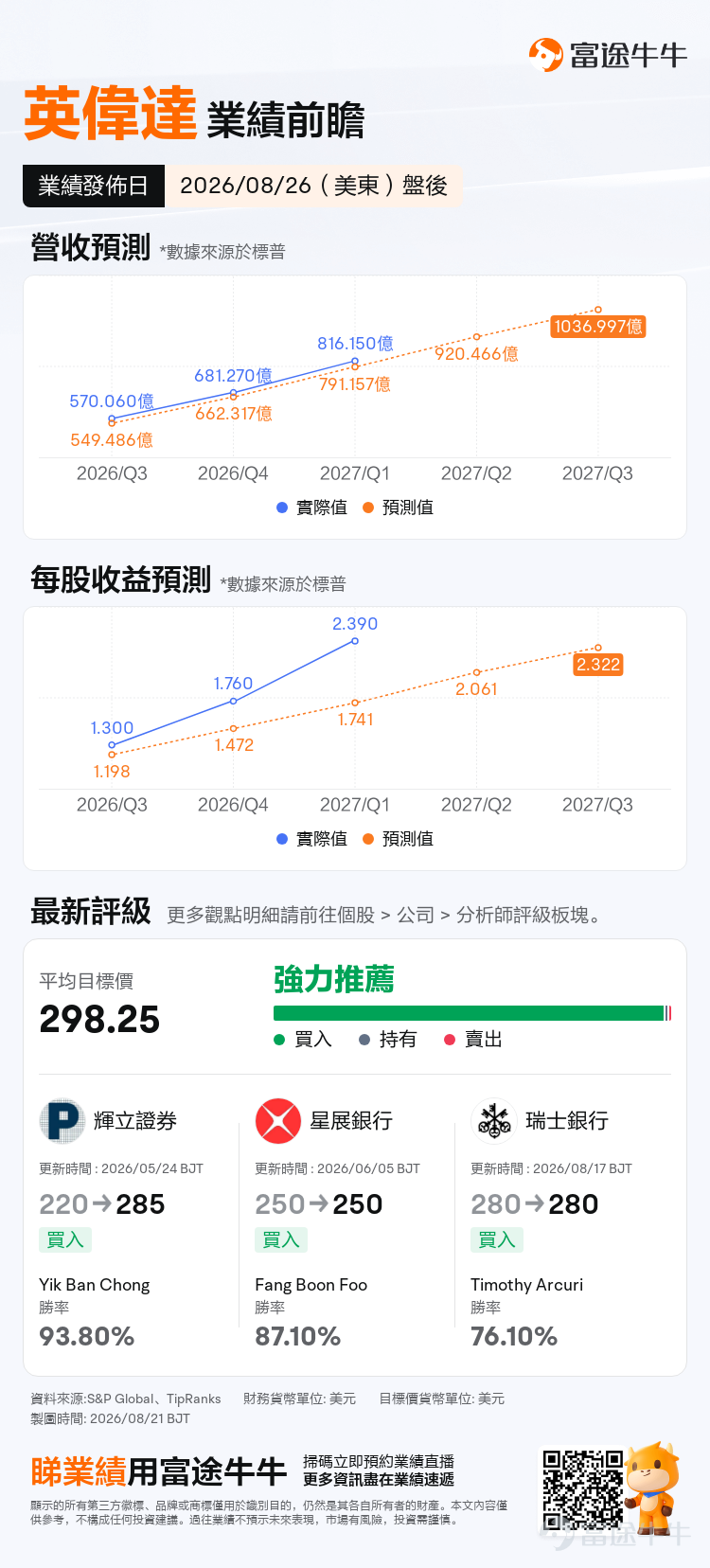
Institutions expect revenue to reach $92.047 billion in Q2 2027, a year-over-year increase of 96.92%; EPS is projected at $2.061, up 90.81% year-over-year, maintaining rapid growth. Looking back at the past few quarters, NVIDIA's revenue and profits have consistently shown remarkable growth momentum, with both metrics displaying a steep upward trajectory.

Regarding institutional ratings, major investment banks currently have nearly uniform "Buy" or "Strong Buy" ratings for NVIDIA. UBS Group recently (on August 17) maintained its price target of $280, while the average analyst price target is close to $300, significantly higher than the current stock price, indicating that institutions remain bullish on NVIDIA in the long term.
Key Earnings Highlight: Circular Financing Concerns Await Clarification from Management
Performance figures are merely the outcome; more critical are the drivers behind these numbers and management's outlook for future business. In this earnings report, investors should focus on the following key points:
(1) Concerns over AI Circular Financing and the New Cloud Business Model
This has been a topic of significant market discussion recently.On August 10, NVIDIA announced the signing of memoranda of understanding with six major Wall Street financial institutions—Apollo, BlackRock, Blackstone, Brookfield, Goldman Sachs, and KKR—to jointly establish an independent computing power financing platform. The aim is to leverage over $500 billion in third-party capital for AI infrastructure construction.
CEO Jensen Huang emphasized that the $500 billion comes entirely from third-party capital, not NVIDIA's own funds. NVIDIA may provide guarantees of up to approximately 25% for individual loans depending on circumstances, rather than full recourse, to limit its own risk exposure.
However, the market did not interpret this as positive news. Prominent investor Michael Burry (the inspiration for the film "The Big Short") warned that such transactions have characteristics of "circular financing"—where companies in which NVIDIA invests, provides financing to, or holds equity in, ultimately turn around and purchase NVIDIA's chips.The core concern in the market is that such arrangements could distort true demand and lead corporations to make erroneous investment decisions.
Citi believes these risks are not as significant as they appear. This is because NVIDIA's commitments are limited to the initial phase, with the remainder structured as optional contracts. Furthermore, by partnering with major asset managers such as Apollo and Blackstone, NVIDIA is only required to guarantee a portion of the loans.Compared to its substantial cash flow (approximately $50 billion in free cash flow per quarter) and cash reserves (around $80 billion), these guarantee risks are manageable.
This earnings report will be a critical moment for management to directly address market concerns.If management can provide convincing responses, it is expected to alleviate market worries about systemic risk; conversely, if their statements are vague, the narrative around circular financing could further suppress valuations.
(2) Rubin mass production progress and Q3 shipment visibility
Vera Rubin is the next-generation AI data center platform following Blackwell. Each Rubin GPU is equipped with 288GB of HBM4, reducing inference token costs by up to 10 times compared to Blackwell and cutting the number of GPUs required for training MoE models to one-fourth. Vera Rubin has currently entered the customer sampling phase, with dozens of top-tier clients having received test racks.
NVIDIA previously stated that Vera Rubin has entered production and is expected to be supplied to partners in the second half of 2026. Investors will closely monitor for any delays in production, cloud deployment, or supporting infrastructure.
(3) Disruptions in the China market
The China market (including Hong Kong)
contributed approximately $4.55 billion last quarter, accounting for only about 5.6% of total revenue. While the scale is not large, market sensitivity to it remains extremely high—Because the "on-off" nature of Chinese demand carries strong policy variables.
The current situation is that limited H200 shipments have begun delivering to Chinese customers, which means Q3 guidance will likely include some catch-up revenue from China.
Stock drops on earnings day for four consecutive quarters?
This is probably the most confusing aspect for investors.Looking at past earnings performance, NVIDIA's stock price fell without exception on the first trading day following its earnings announcements over the past four quarters.This seems to have formed a curse of "positive earnings, yet falling stock price."

The underlying reason aligns with the classic Wall Street adage: "Buy the rumor, sell the news." The reason NVIDIA keeps falling into this trap is precisely because it has become "mature and entrenched."
Using this term here is not meant to disparage NVIDIA, but to vividly depict its current situation:NVIDIA has evolved from a high-growth "dark horse" company a few years ago into a mature giant with a massive scale, whose earnings growth is fully priced in by the market.。
Morgan Stanley's analysis accurately pinpointed this shift: the market's pricing logic for NVIDIA is changing. As the earnings base continues to rise,"Beat & Raise" (beating earnings expectations + raising future guidance) is evolving from a stock price catalyst into a basic market requirement.
Any slight flaw—such as a product line slightly missing expectations, lowered gross margin guidance, or vague Rubin shipment timelines—will be magnified and interpreted as a trigger for a stock price pullback.
What the market is truly waiting for iswhether market share can be maintained, margins can remain stable, and whether Rubin can prove NVIDIA's leading edge in the next round of AI infrastructure competition.。In other words, a quarterly earnings report—no matter how impressive—is increasingly unable to answer these medium- to long-term questions on its own.
This explains why the stock price continues to fall even with consistent "Beat & Raise" results:The market is not just paying for "how much more was earned this quarter," but rather "can you continue to earn at this pace over the next two years."
Options Market Signals and Strategy Deployment
Now, let's look at the tool that best reflects short-term market sentiment and expected price volatility—the options market.

Currently, the implied volatility priced in for NVIDIA's earnings day is approximately ±5.58%. The market views the expected volatility for this earnings release as relatively moderate compared to the previous four instances.

NVIDIA's implied volatility (IV) level before the earnings report was not particularly high,It remained at a neutral-to-low level, which theoretically favors option buyers. However, investors should still be wary of an IV crush following the earnings announcement.
Strategy 1: Single-leg options to bet on direction (Long Call / Long Put)
Target Audience: Investors who have a clear view on the earnings outcome and wish to amplify leverage at a lower cost in a low-IV environment.
Execution: Directly purchase at-the-money (ATM) or slightly out-of-the-money (OTM) calls or puts before the earnings release. In a low-IV environment, single-leg option buyers do not need massive price swings to achieve profitability. If the actual post-earnings stock price movement exceeds the implied volatility, buyers will enjoy a double benefit from both directional gains and IV expansion.
Note that low IV does not mean risk-free. Investors should strictly set stop-loss orders and control position sizing.

(The illustrative graphics shown on screen are for demonstration purposes only and do not constitute investment advice or guarantees; market conditions change frequently, and the displayed option prices do not reflect real-time data.)
Strategy 2: Long Strangle
Target Audience: Investors who expect significant volatility from the earnings report but are uncertain about the direction, seeking to bet on a major move in either direction with limited cost.
Execution: Simultaneously buy one OTM call and one OTM put with the same expiration date.
Logic: A Long Strangle is a classic long-volatility strategy. Establishing a Strangle in a low-IV environment results in relatively low premium costs, providing buyers with greater room for error. If the stock experiences unexpected, sharp volatility in either direction after earnings, the profit from one leg will far outweigh the loss from the other, resulting in an overall profit.

(The illustrative graphics shown on screen are for demonstration purposes only and do not constitute investment advice or guarantees; market conditions change frequently, and the displayed option prices do not reflect real-time data.)
A strangle strategy requires sufficient realized volatility to cover the total premium cost of both legs. If the stock price fluctuates only slightly after the earnings report, investors face the risk of both options expiring worthless. Therefore, it is advisable to establish positions before implied volatility (IV) spikes significantly ahead of earnings and to close positions immediately after the earnings announcement to avoid subsequent IV crush.
Strategy 3: Short Put (Selling Put Options)
Target Audience: Investors who are bullish on NVIDIA's fundamentals in the medium to long term, believe the stock price will not plummet after earnings, are willing to collect premiums in a low IV environment, or wish to acquire the underlying stock at a discount.
Execution: Sell one out-of-the-money (OTM) put option, with the strike price set near support levels approximately 10%-15% below the current price, and choose an expiration date one or two weeks after the earnings release. Simultaneously, lock up sufficient cash in the account as collateral for assignment (i.e., Cash-Secured Put).
Scenario A (Stock price does not fall below the strike price): If the stock remains strong or experiences only a minor pullback after earnings, the option will expire worthless, and the investor keeps the full premium. Although premium income is lower in a low IV environment compared to high IV periods, the win rate is higher, and capital efficiency remains attractive.
Scenario B (Stock price falls below the strike price): The investor is assigned and must buy 100 shares of NVIDIA stock at the predetermined strike price. Since the strike price is set significantly below the current market price, this effectively allows building a position at a discount, with the collected premium further reducing the actual cost basis. For investors bullish on NVIDIA in the long term, this is akin to "passively buying the dip."
The core premise of this strategy is that the investor is willing to take delivery of the stock if it declines and possesses both the willingness and financial capacity to hold it long-term.If NVIDIA faces unexpected negative catalysts (e.g., lowered capital expenditure guidance, technological breakthroughs by competitors), the stock price may fall below the strike price and continue to decline, resulting in unrealized losses. Therefore, the selection of the strike price should combine technical support levels with fundamental margin of safety.

(The illustrative graphics shown on screen are for demonstration purposes only and do not constitute investment advice or guarantees; market conditions change frequently, and the displayed option prices do not reflect real-time data.)
Finally, we’ve got a little perk for our fellow investors—feel free to claim it!Options Starter Pack
*This promotion is exclusively available to invited Hong Kong users. Click to learn more.Detailed terms and conditions of the promotion >>
Market conditions are complex and ever-changing,Options strategiesToo many choices and unsure how to proceed? Let Futubull help you build a strategy in three simple stepsOptions strategies, making investing simple and efficient!

Risk Disclaimer: The above content only represents the author's view. It does not represent any position or investment advice of Futu. Futu makes no representation or warranty.Read more


Comments (20)
to post a comment
37
169