Gold prices break above USD 4,400—can the precious metals rally accelerate?

Options Sir Breaks Down Hot Topics | Call Options Fuel the Rally as Gold Hits a Three-Month High; Can Precious Metals Become the Next Main Market Theme?
Since August, gold has once again become one of the best-performing assets.
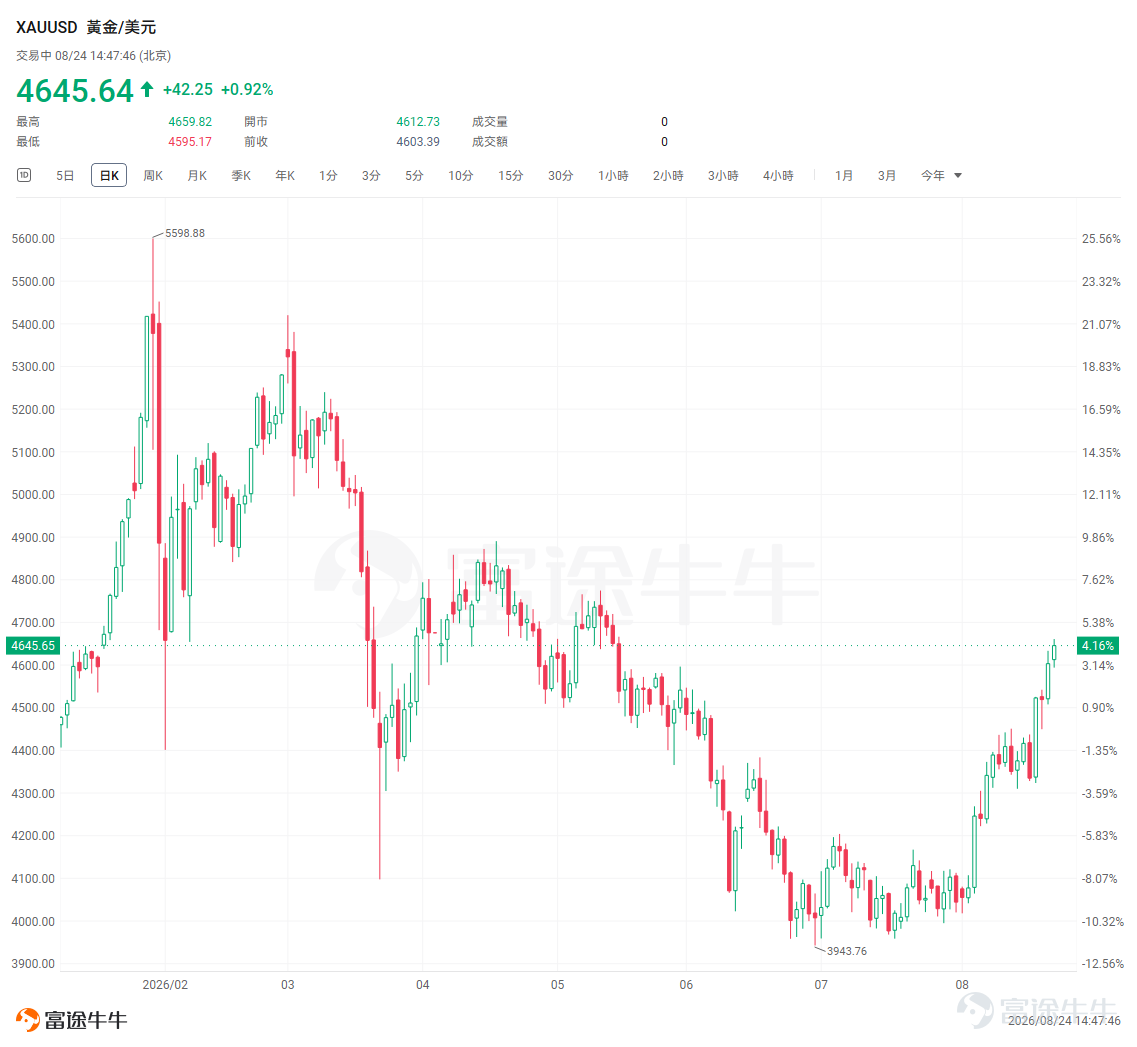
On August 3, spot gold $XAU/USD (XAUUSD.CFD)$ was still hovering around $4,030 per ounce. By August 24, the price had surged past $4,640, marking a gain of over 14% in three weeks and reclaiming a three-month high. In the past week alone, gold prices rose by more than 5%.
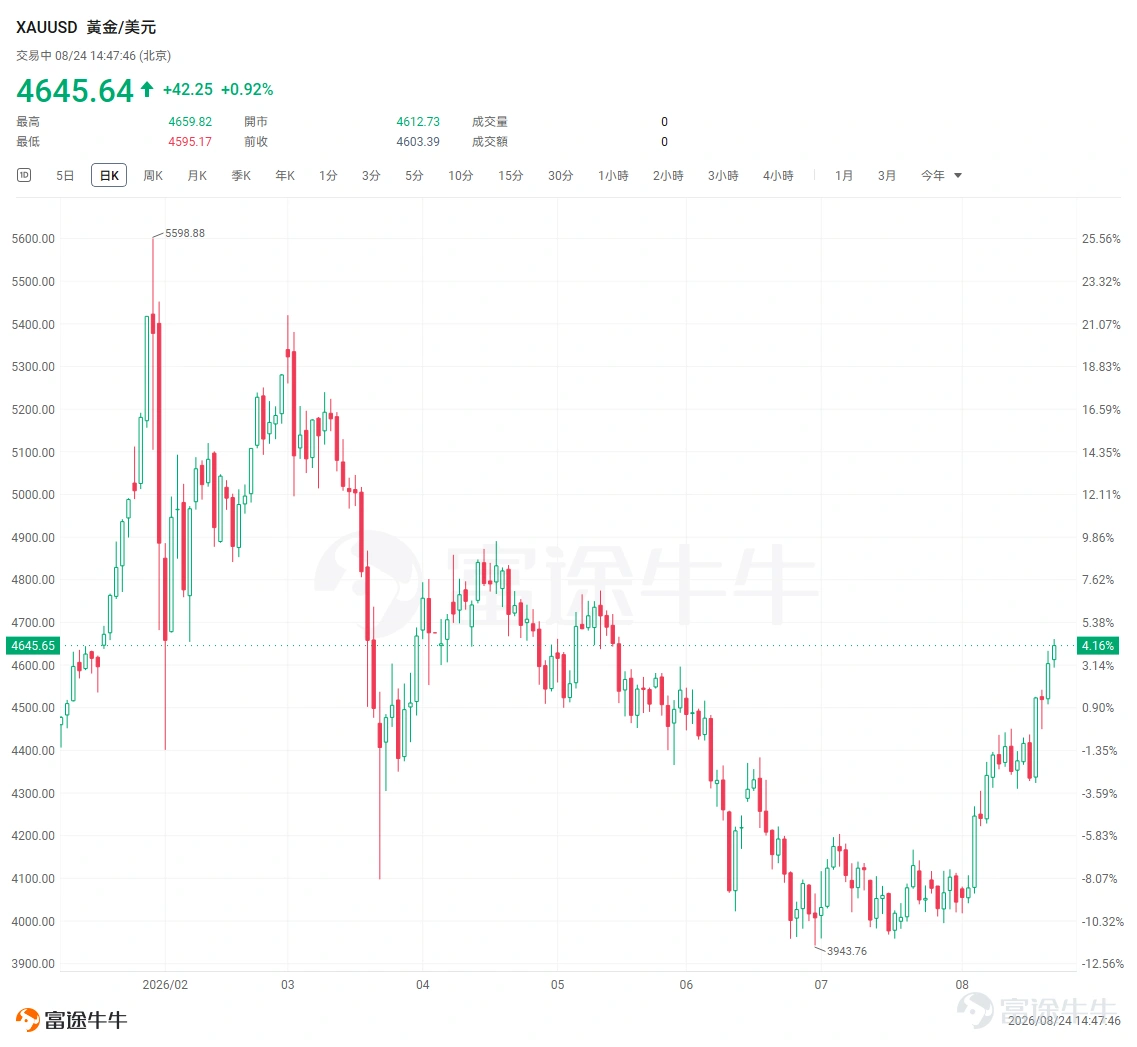
Such a steep rally is difficult to attribute to a single factor. Over the past few weeks, interest rate expectations, the US dollar, fiscal credibility, central bank gold purchases, and ETF fund flows have all shifted in favor of gold. After gold prices broke through key levels, the options market further amplified the speed of the rise.
With these forces converging, gold quickly bid farewell to the consolidation around the $4,000 mark.
Where did the rally begin?
1. The shift in interest rate expectations is seen as the starting point of this rally.
From March to July this year, the market continuously pushed back the timing of rate cuts and even briefly reopened discussions on rate hikes. Since gold yields no interest, the opportunity cost of holding gold increased as both U.S. real interest rates and the U.S. dollar rose. During this period, interest rate expectations kept gold prices suppressed.
In August, the situation began to ease.
U.S. non-farm payrolls unexpectedly dropped by 23,000 in July, contrary to the market's expectation of an 80,000 increase. Following the data release, traders significantly scaled back their bets on a September rate hike. Recent inflation and retail sales data have also been relatively mild,reducing the necessity for the Federal Reserve to continue raising rates, which allowed gold to quickly break out of its previous trading range.
2. A weaker U.S. dollar added fuel to the fire for gold prices.
On August 19, the U.S. Treasury announced an expansion of its long-term Treasury bond buyback program. Yields on long-term U.S. Treasuries fell sharply, the U.S. Dollar Index dropped by about 0.8% that day, and gold surged more than 3%. Since then, the dollar has been trading near its multi-month lows.The weakening dollar reduced the cost for non-U.S. investors to purchase gold, while the decline in real interest rates lowered the opportunity cost of holding gold.
The dynamics of capital flows in this cycle go beyond the typical inverse correlation with the U.S. dollar. With the U.S. fiscal deficit widening, debt levels continuing to rise, and the government attempting to suppress long-term financing costs, the market has refocused on the "debasement trade" (currency devaluation trade).
Some investors are concerned that the persistent expansion of the U.S. fiscal deficit and rapid debt growth will ultimately require lower real interest rates, a more accommodative monetary environment, or even inflation to absorb the debt. This would increase the risk to the real purchasing power of holding long-term USD assets. Since the supply of gold cannot expand like fiat currency, capital is increasing its allocation to gold as a hedge against declining currency purchasing power and fiscal credit risk.
The recent simultaneous rise in gold and Bitcoin indicates that some capital is seeking store-of-value instruments beyond the US dollar and long-term sovereign bonds.At this point, the logic has evolved from the simple "buy gold when the dollar falls" toreducing exposure to USD-denominated assets and increasing allocations to real assets.。
3. The回流 (return) of investment capital is also crucial.
There are currently two main types of buyers in the gold market. Central banks handle long-term allocation, while ETFs and macro funds determine short-term price elasticity. The former makes it harder for gold prices to fall deeply, while the latter accelerates upward momentum.
Data from the World Gold Council shows thatafter two consecutive months of net outflows, global gold ETFs saw net inflows of approximately $3 billion in July,with holdings increasing by 23 tonnes to reach 4,068 tonnes. Since August, Chinese gold ETFs have seen capital inflows on almost every trading day.
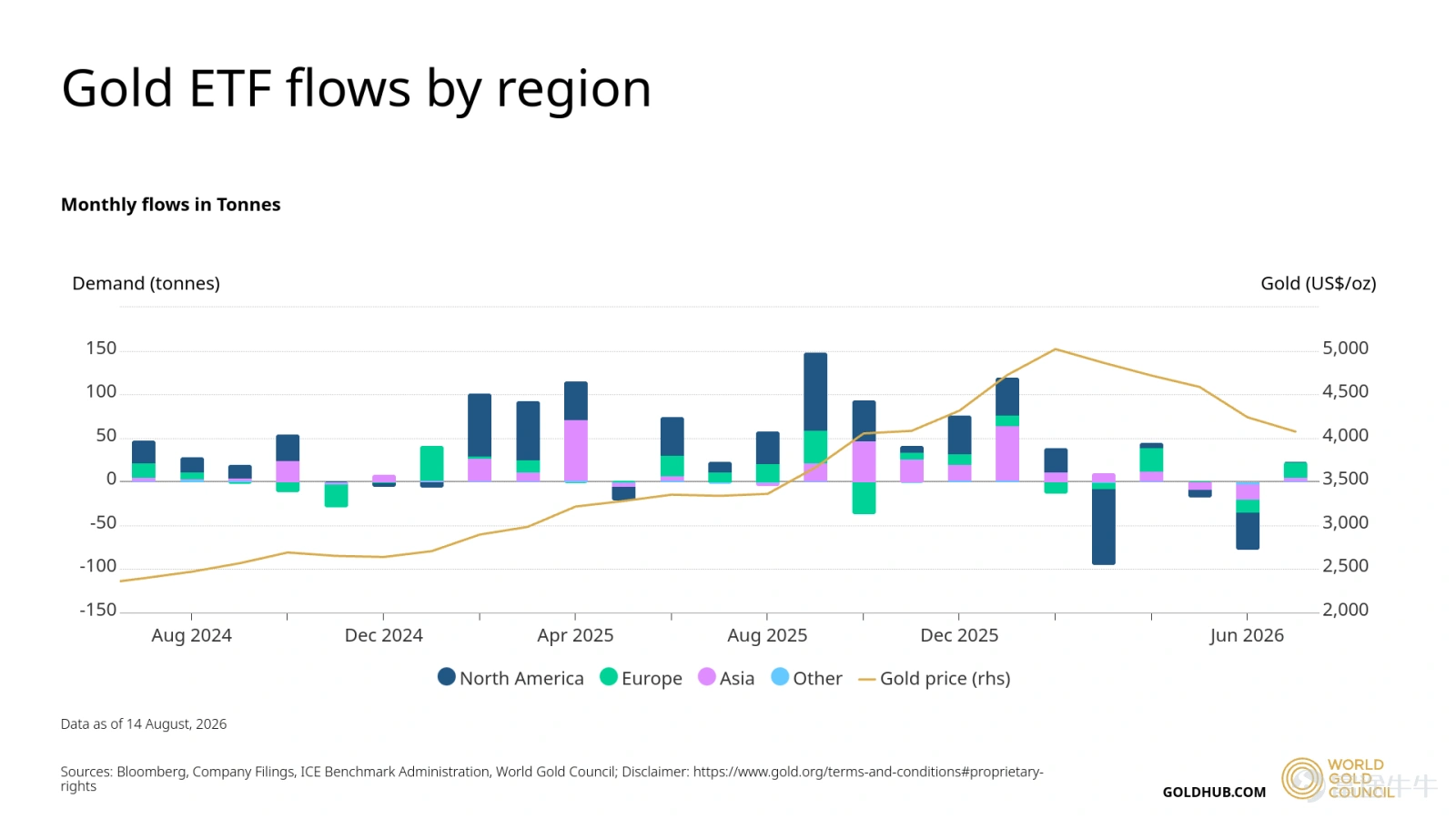
This portion of capital was absent in the previous phase.As ETF demand recovers, gold is seeing an influx of price-sensitive buying.
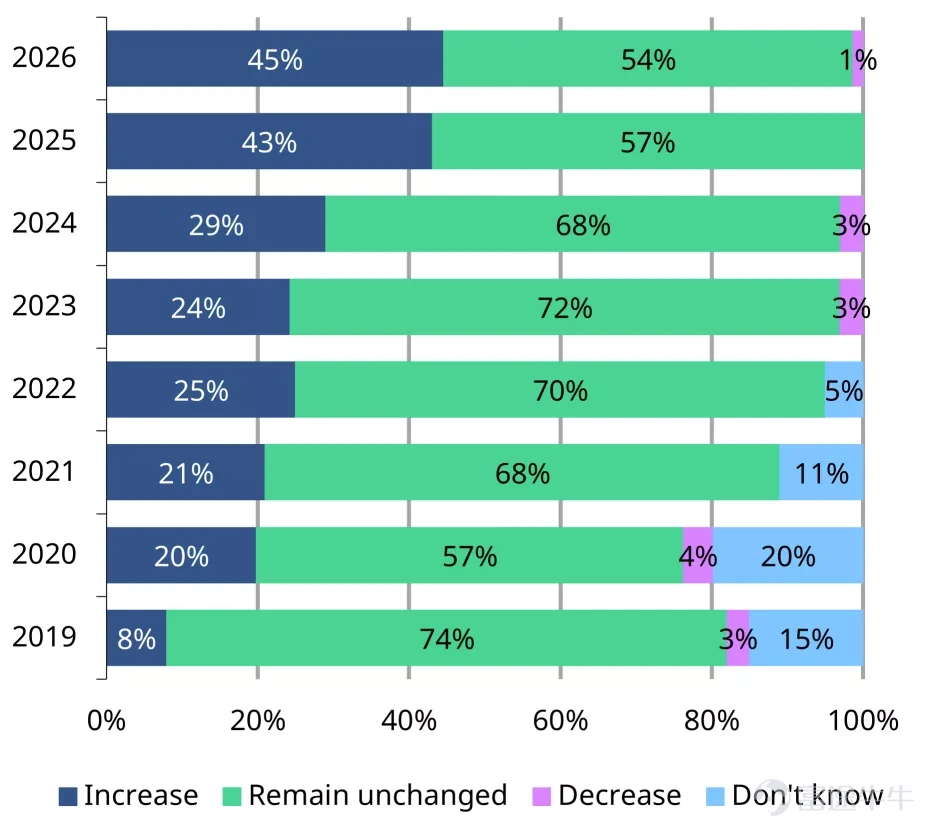
Central banks continue to provide stable long-term demand. Data from the World Gold Council shows that global central banks net purchased approximately 289 tonnes of gold in Q2, a 62% year-on-year increase. In the latest survey, 89% of central bank reserve managers expect global central banks to continue increasing their gold reserves over the next year. Additionally, 45% of respondents anticipate that their own central banks will continue to add to their holdings, marking a record high since the survey began.
The options market is accelerating the upward momentum.
According to a report released by Goldman Sachs,Gold options are becoming a mechanical amplifier of market trends.
Demand for gold call options surged sharply in August., $SPDR Gold ETF (GLD.US)$ The net open interest of call options minus put options has recently risen rapidly to approximately 2.5 million contracts. This figure is significantly higher than the average level from 2021 to 2024 and is approaching the extreme levels seen earlier this year.
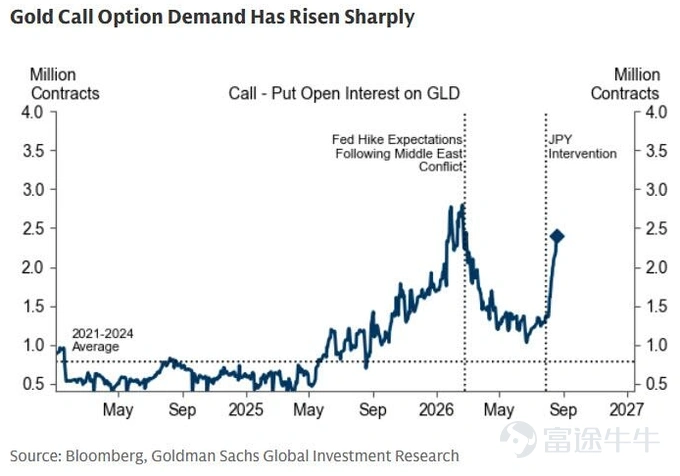
This triggers typical dealer gamma hedging.After investors heavily purchase call options, market makers often become net sellers of these calls. As gold prices approach key strike prices, market makers need to buy GLD or gold futures to maintain delta neutrality in their positions.
If gold prices continue to rise, market makers will need to increase their hedging purchases.These buy orders will, in turn, push gold prices higher, creating a mechanical positive feedback loop.
The put/call skew has also fallen to a six-month low, indicating that traders are not only buying call options but also paying a premium for upside tail risk. When these two factors coincide, it suggeststhat the market is strongly betting on an imminent breakout in gold.However, caution is warranted as current positioning has become heavily one-sided.
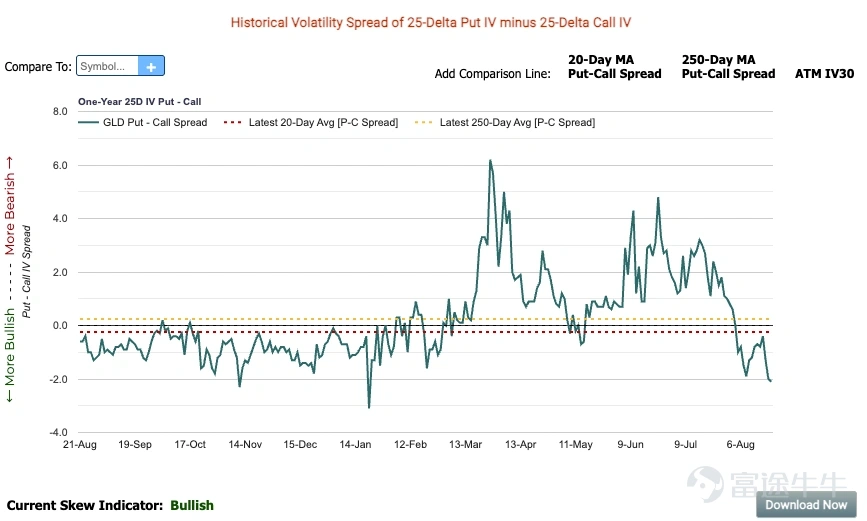
While options do not alter gold's fundamentals, they can compress price movements that would normally take much longer into just a few days.Over the past two weeks, gold has frequently seen single-day volatility of 2% or even more than 3%, with options hedging likely being a contributing factor.
However, this mechanism also works in reverse during downturns.
Once gold prices retreat, market makers need to sell off the hedging positions they previously bought. This selling pressure could further depress gold prices, forcing more position adjustments. Consequently, Goldman Sachs believes that gold currently faces greater risks of upside overshooting, with two-way volatility expected to be higher than in the past.
This round of market action has largely unfolded in the following sequence: as expectations for rate hikes declined, the US dollar weakened, ETF funds began flowing back in, and central bank gold purchases continued to support long-term demand. As gold prices broke through key levels, investors chased call options, and market makers' hedging trades further accelerated the pace of the rally.
These final steps explain why the market movement in August was particularly sharp.
How much upside potential remains for gold?
Major banks remain bullish on the medium-term outlook for gold.The current positioning has shifted from a "contrarian allocation with favorable odds" to a phase characterized by "a continuing upward trend with significantly amplified short-term volatility."
Goldman Sachs currently forecasts a fair value of $4,900/oz for gold by the end of 2026, noting that risks are skewed to the upside.This forecast does not yet account for the current robust global demand for macro-hedging call options. If gold ETFs continue to see inflows and option positions remain elevated, dealer hedging could push gold prices above $4,900.
Other institutions are also raising their forecasts. UBS expects gold to reach $5,000 in the first half of 2027. The World Gold Council believes that demand growth in the second half of this year will still be driven primarily by investment demand, while central banks are expected to maintain significant gold purchases.
Looking ahead, there are two potential paths to consider.
If the PCE index remains moderate,the Fed maintains a cautious stance at Jackson Hole, the market further reduces the probability of rate hikes, and the US dollar does not rebound significantly, then the $4,900–$5,000 range will become the key observation zone for the next leg of the rally. Option gamma could drive prices even higher in the short term.
The primary risks stem from oil prices and inflation.If oil prices surge significantly again, reigniting inflation, the Fed may strengthen its hawkish stance on rate hikes. In that scenario, both the US dollar and real interest rates could rebound. The currently crowded long call option positions would also force market makers to sell their hedging positions, potentially accelerating the correction. On August 18, global long-end yields rose rapidly, and gold dropped more than 1% in a single day, highlighting its sensitivity to interest rate changes.
How should investors respond?
Gold/USD is currently in a rally driven by both macroeconomic fundamentals (shaking confidence in the US dollar, central bank gold purchases) and geopolitical risks. From a technical perspective,the trend is strongly bullish,with prices surging significantly in the short term, causing them to deviate far from moving average support levels and leading to an accumulation of profit-taking positions,significantly increasing the pressure for a technical pullback.The area around $4,500 has gradually shifted from a previous resistance zone to a key support level to watch.
– Upside ResistanceFirst resistance: $4,650 - $4,680 (the zone where today's high coincides with the upper Bollinger Band); Psychological resistance: $4,700 (a round-number threshold and the next target for bulls)
– Downside SupportFirst support: $4,583 - $4,595; Key support: $4,509 - $4,520 (the bull-bear dividing line and near the 5-day moving average); Strong support: $4,420 - $4,430 (the upper boundary of the previous consolidation range; if prices pull back to this level, the bullish structure remains intact).
Gold ETFs have relatively direct exposure to gold prices. Gold mining stocks are also influenced by factors such as mining costs, management quality, and regional policies. These two asset classes should not be conflated.High levels of bullish demand often imply that option premiums and implied volatility are also relatively expensive.
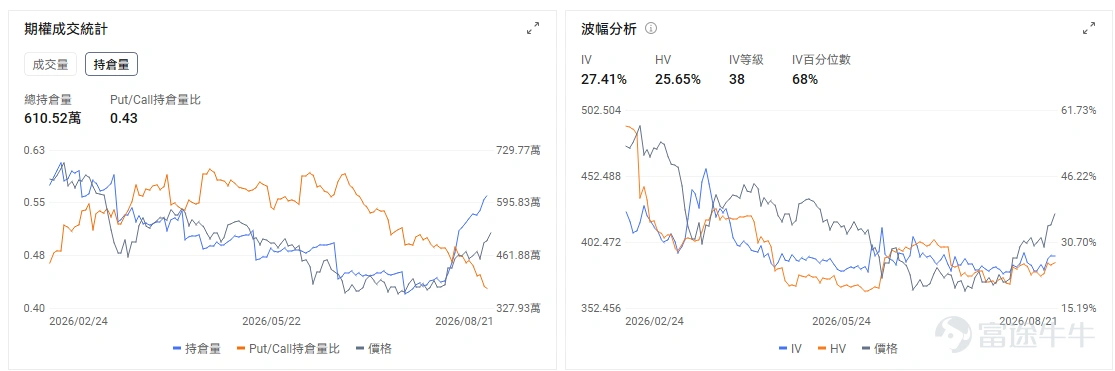
Taking $SPDR Gold ETF (GLD.US)$ For example, over the past 5 trading days, the Put/Call ratio has remained withinan extremely low range of 0.23 to 0.36.This indicates that call option volume is more than four times that of put options, with bullish sentiment reaching a阶段性 peak. IV has risen moderately, reflecting heightened volatility expectations, with implied volatility climbing steadily from 23.98% on August 18 to 27.41% on August 21. This suggests that as gold prices continue to hit new highs, the options market is pricing in a "high volatility" environment, with buyers willing to pay higher premiums for option protection or leveraged returns.
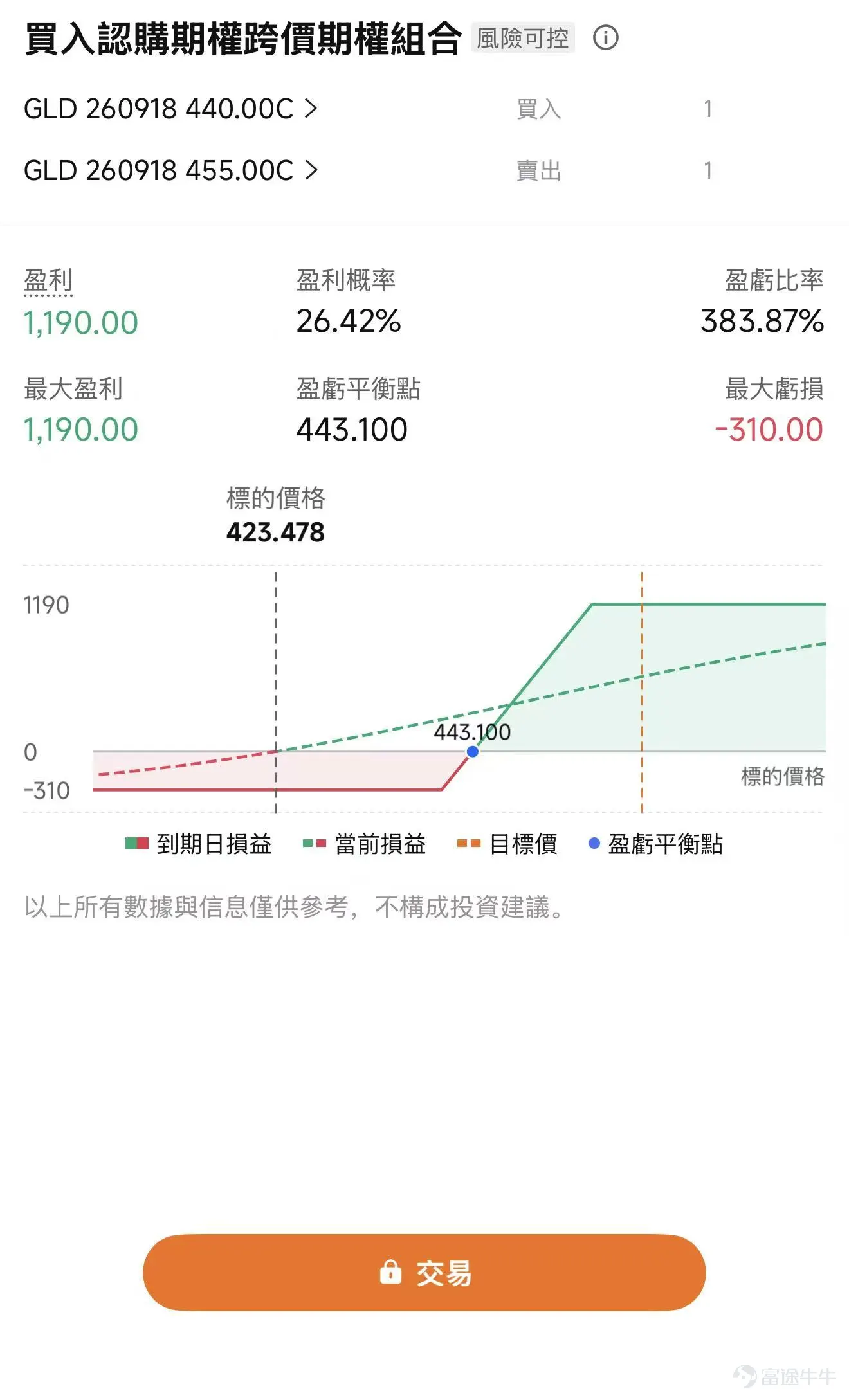
1. Bull Call Spread: The trend remains bullish, but this strategy reduces the cost of chasing highs.
Suitable for: Investors who believe the medium-term bullish logic for gold remains unchanged and see further upside potential, but are concerned about the high cost of buying calls directly after a rapid monthly surge and the risk of short-term volatility or pullbacks.
A Bull Call Spread involves buying an at-the-money or slightly out-of-the-money GLD call while simultaneously selling a call with a higher strike price, using the premium received from the sold call to lower the overall cost. Currently, a weaker US dollar, easing pressure on real interest rates, ETF inflows, and central bank gold purchases continue to support gold. However, following the rapid price increase, short-term volatility and call demand have risen significantly. Therefore, compared to buying naked calls,a Bull Call Spread is better suited to capture a scenario where gold's uptrend continues but the pace of gains normalizes, while also capping maximum losses within the net premium paid.。
(The design images shown on screen are for illustrative purposes only and do not constitute any investment advice or guarantee; market conditions change rapidly, and displayed prices may not reflect actual market values.)
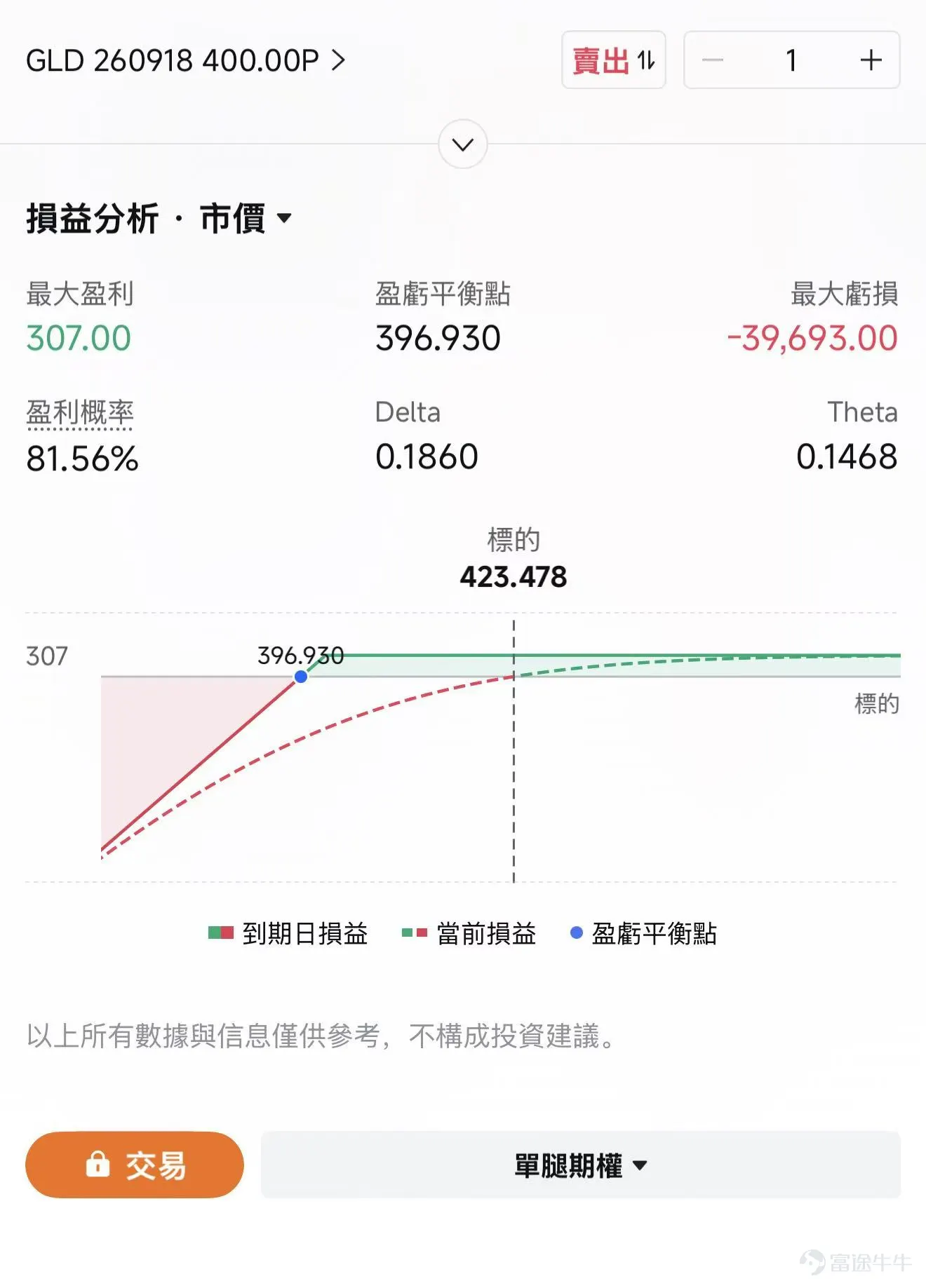
2. Cash-Secured Put: Wait for a pullback and use high volatility to lower entry costs.
Suitable for: Investors who remain bullish on gold in the medium to long term but believe chasing the current rally offers poor value, preferring to wait for GLD to pull back before establishing a position.
With a Cash-Secured Put, you can sell puts at strike prices near the level where you are willing to buy GLD, while reserving sufficient cash to fulfill the obligation of taking delivery if assigned. If GLD remains strong and does not fall below the strike price at expiration, you keep the premium; if it pulls back and breaks below the strike price, it is equivalent to buying GLD at an effective cost ofthe strike price minus the premium received.
Recently, demand for gold options and implied volatility have risen significantly, making premium income more attractive for sellers. This strategy is better suited for a view of "long-term bullishness without chasing short-term highs," but requires accepting the possibility of significant unrealized losses if gold undergoes a deep correction.
(The design images shown on screen are for illustrative purposes only and do not constitute any investment advice or guarantee; market conditions change rapidly, and displayed prices may not reflect actual market values.)
Finally, Options Sir has a small giveaway for fellow investors—feel free to claim it!Options Starter Pack
*This promotion is exclusively available to invited Hong Kong users. Click to learn more.Detailed terms and conditions of the promotion >>
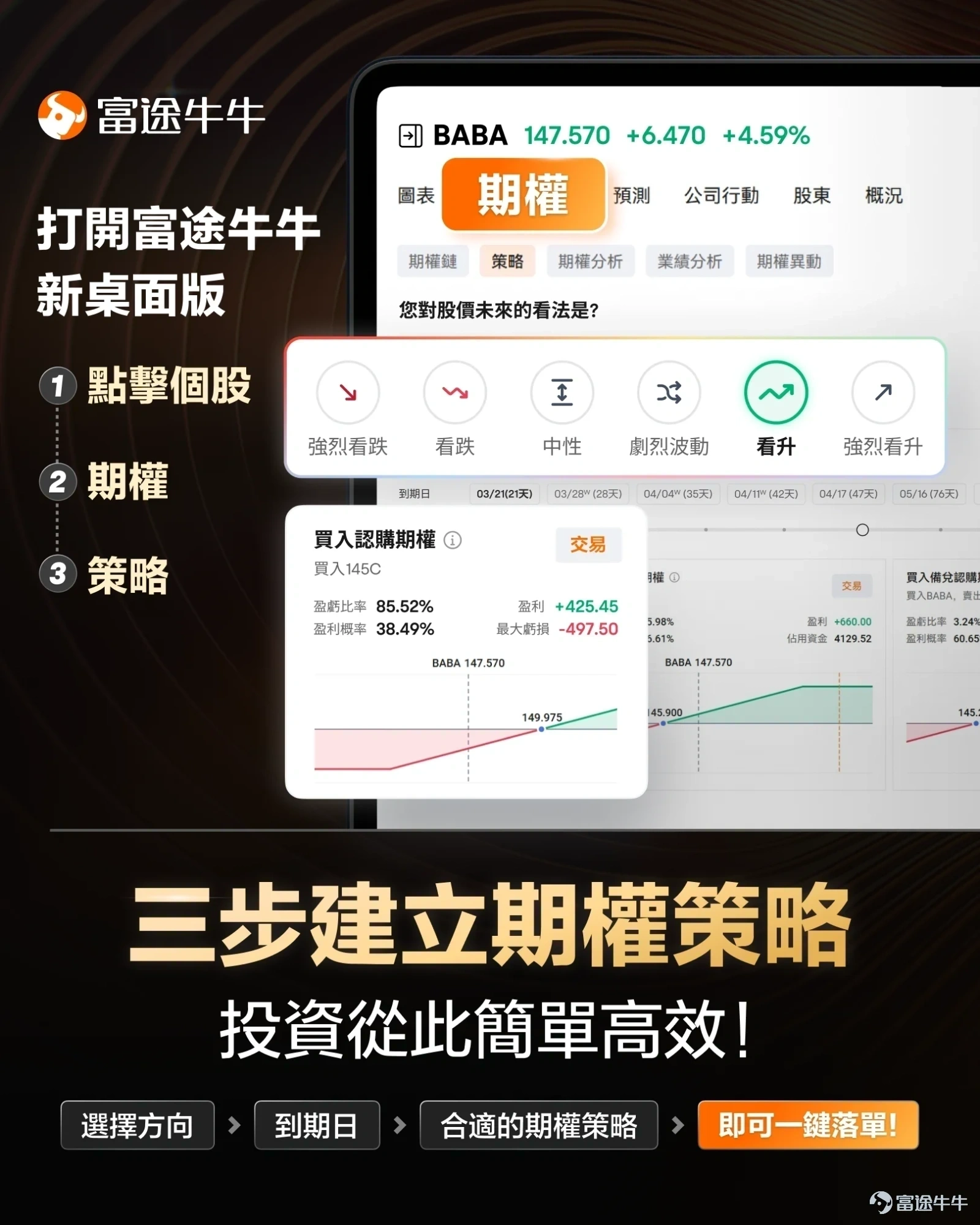
Market conditions are complex and ever-changing,Options strategiesToo many choices and unsure how to proceed? Let Futubull help you build a strategy in three simple stepsOptions strategies, making investing simple and efficient!
Disclaimer
This content does not constitute an offer, solicitation, recommendation, opinion, or any form of guarantee regarding any securities, financial products, or instruments. The risk of loss in trading options can be substantial. In certain circumstances, your losses may exceed the initial margin deposit. Even if you place contingent orders such as 'stop-loss' or 'limit' orders, there is no assurance that losses will be avoided, as market conditions may prevent execution of these orders. You may be required to deposit additional margin on short notice. If you fail to meet such margin calls within the stipulated time, your open positions may be liquidated. You remain fully liable for any resulting deficit in your account. Therefore, prior to trading options, you should thoroughly research and understand how options work and carefully consider whether such trading aligns with your financial situation and investment objectives. If you trade options, you should become familiar with the procedures for exercising options and handling expiration, as well as your rights and obligations upon exercise or expiration. Options trading involves significant risk and is not suitable for all investors. Investors should carefully read"Characteristics and Risks of Standardized Options"。
Risk Disclaimer: The above content only represents the author's view. It does not represent any position or investment advice of Futu. Futu makes no representation or warranty.Read more


Comments (3)
to post a comment
25
28