NVIDIA's revenue doubles, beating expectations; is the AI trade narrative making a comeback?

NVIDIA Q2 Earnings Preview: After a Year-Long Rally, Momentum Cools Ahead of the "Major Test"
After market close this Wednesday (August 26), NVIDIA will release its FY2027 Q2 earnings report, expected around 5:00 AM Beijing Time on Thursday. As one of the world's most valuable companies and an "AI bellwether" accounting for approximately 4.3% of the S&P 500's weight, this report has the entire AI trading sector on edge.
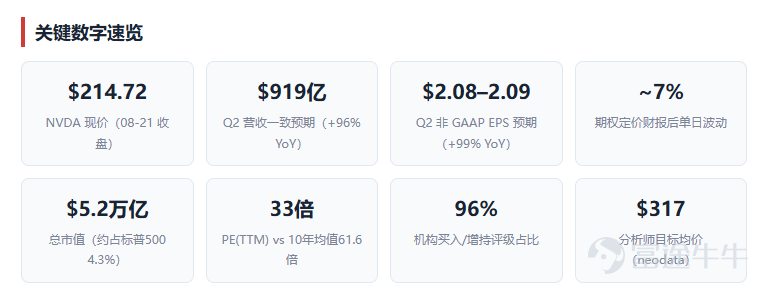
Let's first look at recent performance. NVIDIA (NVDA) is up approximately 15.3% year-to-date, remaining one of the top performers among the "Magnificent Seven." However, it has dropped 4.6% over the past five days and 4.1% over the past ten days, marking its worst weekly performance in over a month last week. In the first half of August, NVDA surged more than 12% in two weeks, followed by profit-taking and cooling expectations. Technically, the current price of $214.7 has fallen below the 5-day moving average, with the $208–$213 range (corresponding to the 20- and 60-day moving averages) forming a support band. The trailing P/E ratio is approximately 33x, which, while higher than the S&P 500, is significantly lower than its own ten-year average of 61.6x. The forward P/E of roughly 18–24x is considered a "discount" by several investment banks.
What should investors watch out for in the two days leading up to the earnings release?
In the first half of August, NVDA rose more than 12% in two weeks. Goldman Sachs explicitly warned that "the gains of the past two weeks imply that positive news has already been priced in, and significant new catalysts will be required to drive a post-earnings surge." The options market is pricing in a single-day volatility of approximately 6.8%–7% following the earnings report, indicating that both bulls and bears are"betting on direction"", rather than"betting on high or low"waiting for clarity." Over the past four quarters, NVIDIA has beaten expectations every time, yet its stock closed lower the day after each earnings release (ranging from -0.8% to -5.5%), as "beating estimates" has become taken for granted. Key observations for these two days include: whether the stock stabilizes within the $208–$213 support band on Monday; if it breaks below $208 on heavy volume, pre-earnings sentiment could deteriorate further. Additionally, watch for any major incremental news, such as new financing partnerships, government orders, or progress on China export licenses.
Earnings forecast
Scenario 1: Beat expectations + Strong guidance
Revenue > $93 billion; Q3 guidance ≥ $108 billion (consensus range from Goldman Sachs, UBS Group, Bank of America, and Jefferies); gross margin holds at 75%. Achieving this would likely end the "four-day post-earnings decline streak," driving a high-volume rally toward the $225–$230 range. However, the probability of this outcome is low, as market consensus is already near the upper end of company guidance, and Goldman Sachs has warned that positives are partially priced in.
Scenario 2: Meets expectations but lacks excitement
Revenue falls within $91–$93 billion; Q3 guidance between $103–$106 billion (close to consensus); gross margin at 74.5%–75.5%. If this scenario plays out, historical patterns suggest narrow fluctuations or a slight decline the day after earnings, with short-term consolidation in the $208–$220 range. This is the most probable outcome, as the magnitude of beats over the past 13 quarters has narrowed from 22.8% to 4.6%, compressing the room for "surprise" upside.
Scenario 3: Missed expectations or guidance collapse
Revenue < RMB 91 billion (rare); Q3 guidance < RMB 103 billion; or gross margin falls below 74%; or signs of delays in Rubin emerge. If these conditions are met, the stock price could retrace to around 200 or even 190. While the probability of this outcome is low, it cannot be ignored.HBM price hikes impacting gross margins, concerns over cyclical financing, and skepticism regarding AI ROIare three amplifiers of "meeting surface-level targets but deteriorating sentiment."
Future price action
96% of institutional ratings are Buy/Outperform, with an average target price of approximately USD 305–317, implying roughly 40% upside potential.
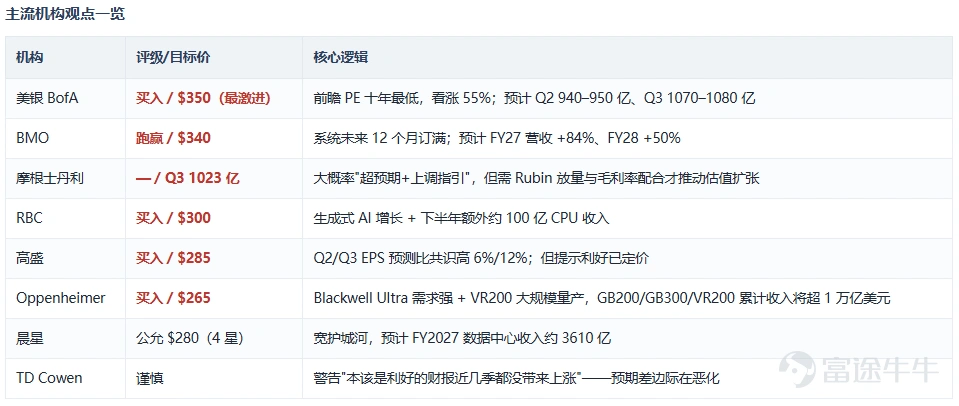
Buying NVIDIA is essentially buying "the volume and price increase in the AI computing power capital expenditure cycle", as long as cloud providers' capital expenditures do not retract and Rubin ramps up production as planned (UBS Group estimates monthly GPU shipments of approximately 500,000 units in Q4), the consensus path of ~84% revenue growth in FY27 has a solid foundation for realization. Two major mid-term disruptors: diversion due to cloud providers' in-house chip development, and slowed spending triggered by skepticism over AI investment returns. Historical patterns suggest that the 1–5 trading days following earnings reports are likely to see range-bound oscillation rather than one-sided trends, unless Q3 guidance significantly exceeds expectations; meanwhile, pullbacks below the 60-day moving average often present valuation repair opportunities rather than trend reversals.
Summary: The earnings report itself is likely to pass muster. What the market is truly pricing in is "how high is the Q3 guidance, how fast is Rubin ramping up, and can gross margins be maintained"—the marginal changes in expectation gaps are more important than single-quarter figures.
Disclaimer:The above content is based on public data and quantitative analysis and is for reference only; it does not constitute investment advice. The market involves risks, so invest with caution. Any investment decision should be made independently based on personal risk tolerance, financial status, and investment objectives, consulting licensed professional institutions when necessary. Past performance does not indicate future returns.
Content Disclosure: Personal opinion
Risk Disclaimer: The above content only represents the author's view. It does not represent any position or investment advice of Futu. Futu makes no representation or warranty.Read more
Comments
to post a comment
1