Trump rings the opening bell at the White House! Predicts 'US stocks will soar to the moon'

Politician Holdings Tracker | Trump Rebalanced Portfolio Over 1,000 Times in June! Which Companies Were Added to Positions? Which Were Reduced?
A substantial 34-page filing, covering over a thousand transactions, has revealed the portfolio adjustment trends of U.S. President Trump's investment account in June.
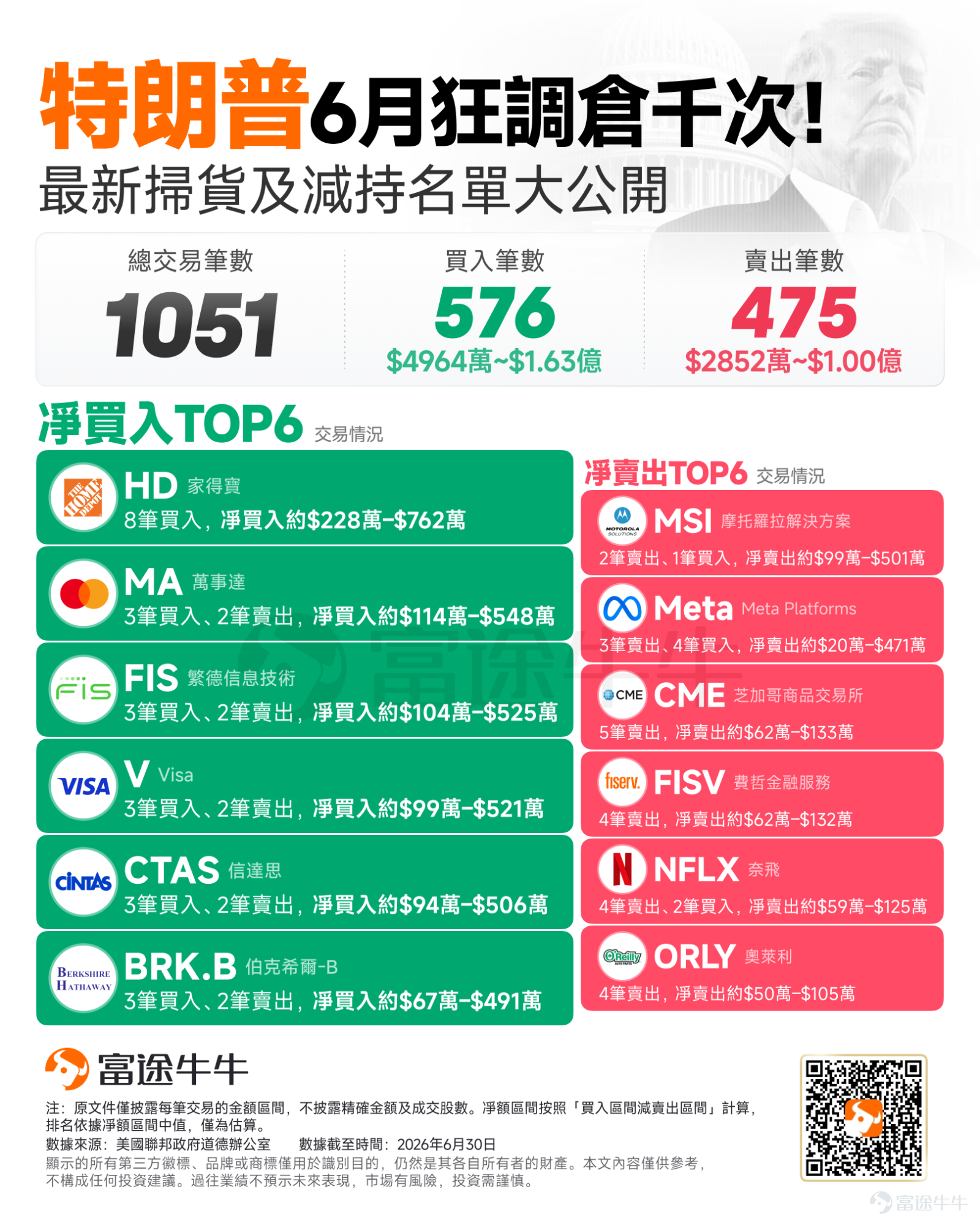
Data shows that the account was extremely active in June, with a cumulative total of 1,051 transactions (576 buys and 475 sells). Based on the median of the reported amount ranges, the net buying volume for June was approximately $41.97 million (total buy amounts ranged from ~$49.64 million to $163 million, while total sell amounts ranged from ~$28.52 million to $100 million).
Rather than chasing the net buy amount, which is difficult to measure precisely, the core value of this document lies in providing an observational perspective:To clearly see which targets Trump's investment account is 'heavily positioning' in, and which stocks are being 'concentratedly reduced'.
Which companies were added to positions? Which were reduced?
In June, the buying and selling directions of Trump's investment account showed significant divergence, as detailed below:

--
--
--
On the buy side, $Home Depot (HD.US)$was the clearest direction for positioning,In June, there were 8 buy transactions and no sell transactions, with estimated net purchases of approximately$2.28 million to $7.62 million。
Payment and financial services companies frequently appeared on the net buy list, $MasterCard (MA.US)$ recording 3 buys and 2 sells, with estimated net purchases of approximately$1.14 million to $5.48 million; $Fidelity National Information Services (FIS.US)$ also recording 3 buys and 2 sells, with estimated net purchases of approximately$1.04 million to $5.25 million; $Visa (V.US)$ The estimated net buying is approximately$990,000 to $5.21 million。
$Cintas (CTAS.US)$ Estimated net buying of approximately$940,000 to $5.06 million; $Berkshire Hathaway-B (BRK.B.US)$ Estimated net buying of approximately$670,000 to $4.91 million, ranking fifth and sixth respectively.
Additionally,He purchased shares worth between $15,000 and $50,000 on June 23 $SpaceX (SPCX.US)$ of stock.This investment was one of several stock trades made by Trump in June.
On the sell side, $Motorola Solutions (MSI.US)$and $Meta Platforms (META.US)$it has become the primary direction for reducing holdings.
$Motorola Solutions (MSI.US)$ Recorded 2 sell transactions and 1 small buy transaction, with estimated net sales of approximately$990,000 to $5.01 million。 $Meta Platforms (META.US)$ Although there were 4 buy transactions and only 3 sell transactions, the declared amount for sell trades was significantly higher, with estimated net sales of approximately$200,000 to $4.71 million。
Other securities with net sales include $CME Group (CME.US)$ 、 $Fiserv (FISV.US)$ 、 $Netflix (NFLX.US)$ and $O'Reilly Automotive (ORLY.US)$ . Among them, CME recorded 5 sell transactions and no buy transactions, with estimated net sales of approximately$620,000 to $1.33 million; Fiserv recorded 4 sell transactions and no buy transactions, with estimated net sales of approximately$620,000 to $1.32 million; Netflix estimated net sales of approximately$590,000 to $1.25 million; O'Reilly Automotive estimated net sales of approximately$500,000 to $1.05 million。
Overall, $Home Depot (HD.US)$ was the most prominent one-sided buy target in June, while payment networks and financial infrastructure companies became one of the most heavily allocated sectors. However, financial stocks did not see across-the-board increases in holdings: $MasterCard (MA.US)$ 、 $Visa (V.US)$ and$Fidelity National Information Services (FIS.US)$ were favored, $CME Group (CME.US)$and $Fiserv (FISV.US)$while others faced concentrated reductions.
Therefore, a more accurate conclusion is:Trump's investment account did not simply bet on a single industry in June, but rather executed a clear structural rotation among the financial, technology, consumer, and enterprise services sectors.
The largest single transaction was not in an individual stock, but in an ETF.
In addition to rebalancing individual stock positions, the filing disclosed significant trading activity in ETFs, mutual funds, bonds, and notes. On June 22,the account sold $Vanguard Dividend Appreciation ETF (VIG.US)$, with a single reported transaction value ranging from $5 million to $25 million, making it the largest single trade in June.

--
--
--
During the same period, the account also bought and sold ETFs related to the S&P 500, technology, industrials, commodities, and U.S. Treasuries. This reflects that trading activity throughout June was not merely about rotating individual stocks, but rather a large-scale asset rebalancing across equities, ETFs, and bonds.
From this perspective, the 576 buy orders and 475 sell orders should not be simply interpreted as the account placing a broad bet on a rise in U.S. stocks. It is more likely that the portfolio was being reallocated across different sectors, styles, and asset classes while maintaining broad market exposure.
Was this investment judgment made by Trump himself?
In response to external concerns regarding frequent trading and potential conflicts of interest, the White House stated that neither President Trump nor any of his family members had the ability to direct, influence, or provide advice on portfolio allocation or the timing of trades. All investment decisions were made entirely by independent managers.
White House spokesperson Davis Ingle further explained that the President’s equity and bond portfolio is independently managed by a third-party financial institution. All holdings are placed in discretionary accounts and invested through computer-model-based portfolios that automatically replicate recognized indices, such as the Charles Schwab 1000 Index.
Judging by the trading characteristics presented in the filing documents, where many companies saw simultaneous buy and sell orders on different dates, covering hundreds of stocks, ETFs, and bonds, the activity indeed resembles quantitative rebalancing and portfolio realignment rather than active bets on a few specific stocks.
Therefore, what this filing reveals is thatTrump’s investment accounts underwent a massive and broad-based asset reallocation in June, but specific trades should not be directly interpreted as Trump’s personal investment views.
However, what truly warrants attention is the structural rotation evident behind these thousands of transactions:
On one hand, $Home Depot (HD.US)$ emerged as the clearest unilateral buy target, $MasterCard (MA.US)$ 、 $Visa (V.US)$ and$Fidelity National Information Services (FIS.US)$payment fintech companies such as Fiserv also saw significant net buying; on the other hand, $Motorola Solutions (MSI.US)$ 、 $Meta Platforms (META.US)$ 、 $CME Group (CME.US)$ 、 $Fiserv (FISV.US)$ and $Netflix (NFLX.US)$ appeared on the primary list of reductions.
This was not a simple 'broad-based buy,' but rather a comprehensive portfolio rebalancing across individual stocks, ETFs, and bonds.
Risk Disclaimer: The above content only represents the author's view. It does not represent any position or investment advice of Futu. Futu makes no representation or warranty.Read more


Comments (6)
to post a comment
48
57