NVIDIA's revenue doubles, beating expectations; is the AI trade narrative making a comeback?

[Comment to Win Points] NVIDIA's Earnings Bombshell Drops! Can the AI Computing Power Sector Still Spin a New Narrative?
If the first half of the AI race was about "who can train a large model first," the second half has already begun to compete on "who can turn computing power into sustained productivity." Behind this shift, NVIDIA remains the most critical supplier of computing power.
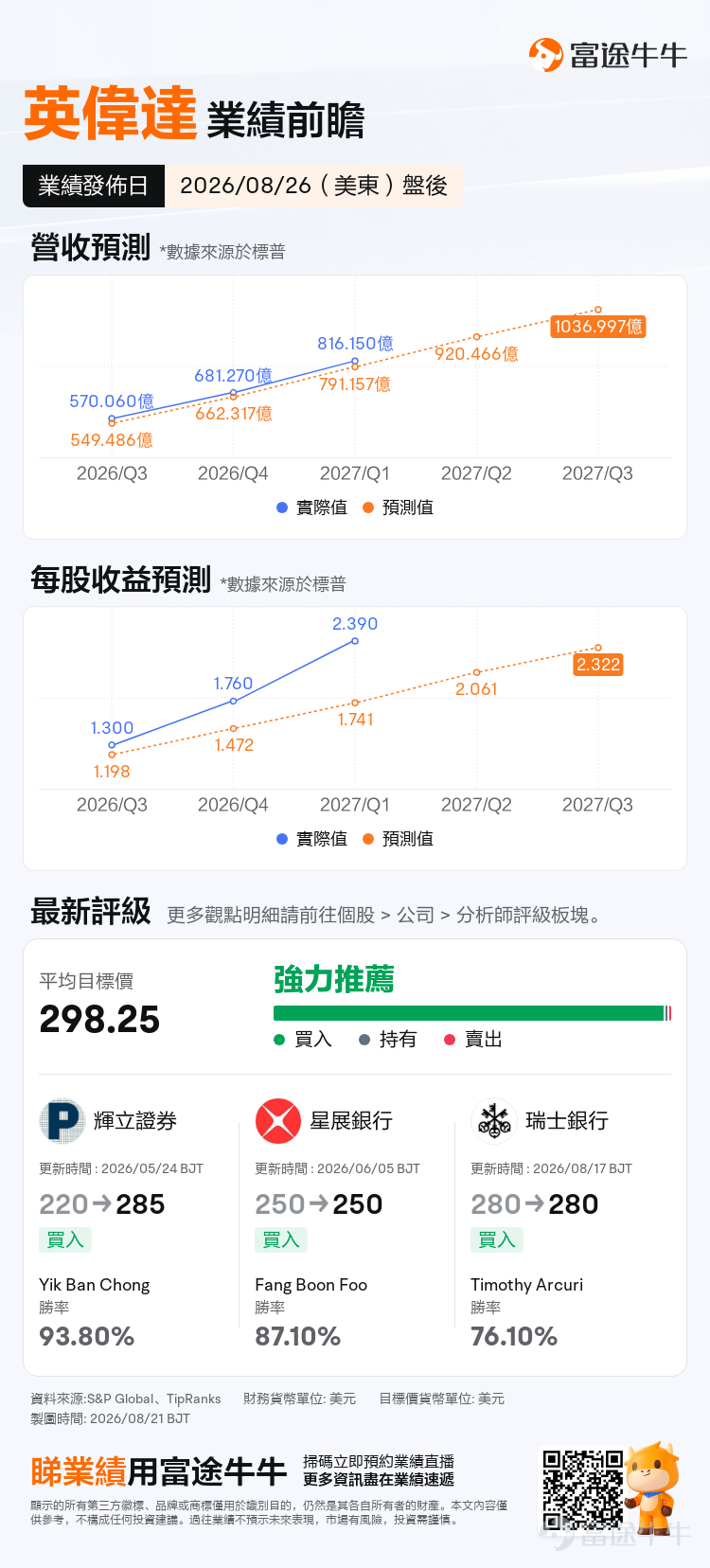
In the early hours of August 27 (Beijing Time),$NVIDIA (NVDA.US)$ it will release its financial results for Q2 of fiscal year 2027.Analysts expect NVIDIA to achieve revenue of $92.047 billion in Q2 FY2027, a year-over-year increase of 96.92%; expected earnings per share (EPS) is $2.061, a year-over-year increase of 90.81%.
![If the first half of the AI race was about "who can train large models first," the second half has already shifted to competing on "who can turn computing power into sustained productive capacity." Behind this transition, NVIDIA remains the most critical supplier of computing power.[Onlooker] In the early hours of August 27 (Beijing Time),$NVIDIA (NVDA.US)$ it will release its Q2 FY2027 earnings report.Analysts expect NVIDIA to achieve revenue of $92.047 billion in Q2 FY2027, a year-over-year increase of 96.92%; expected earnings per share (EPS) is $2.061, a year-over-year increase of 90.81%. The market used to view it merely as a "GPU supplier," but its narrative has long expanded beyond chips to become a complete platform centered on accelerated computing. This includes GPUs, networking interconnects, software ecosystems, developer tools, plus the emerging fields of robotics and physical AI. Rather than just a chip company, it is better described as the general contractor for "AI factory" infrastructure.[Chuckle] The AI industry is currently at a delicate stage: leading cloud providers are aggressively expanding computing capacity, but the market is increasingly concerned about when these massive capital expenditures will translate into sustainable cash flow returns. As the upstream "shovel seller" in the supply chain, NVIDIA not only benefits from this expansion but also bears the brunt of significant cyclical fluctuations and expectation shifts. 🔎 There are three key focal points for watching NVIDIA this time: First, the Data Center business: Has the peak of training passed, while the ramp-up of inference is just beginning? Although training large models is capital-intensive,...](https://nnqimage.futunn.com/sns_client_feed/999982/20260824/web-1787553213995-P57hEEvaAb.png/big?area=2&is_public=true&imageMogr2/ignore-error/1/format/webp)
The market used to view it merely as a "GPU supplier," but its narrative has long evolved beyond just chips to a complete platform centered on accelerated computing. This includes GPUs, networking interconnects, software ecosystems, developer tools, plus the emerging fields of robotics and physical AI. Rather than calling it a chip company, it is more accurate to describe it as the general contractor for "AI factory" infrastructure.
The AI industry is currently at a delicate stage: leading cloud providers are aggressively expanding computing capacity, but the market is also starting to question when these massive capital expenditures will translate into sustainable cash flow returns. As the upstream "shovel seller" in the supply chain, NVIDIA not only benefits from this expansion but also bears the brunt of significant cyclical fluctuations and expectation swings.
🔎 Our current focus on NVIDIA highlights three key points:
First, the data center business: Has the peak of training passed, while the slope of inference is just beginning?
Although training large models burns cash, it ultimately has a阶段性 (phased) ceiling; whereas inference demand scales with user volume, call frequency, and business scenarios, theoretically having no ceiling. As AI applications expand from chatbots to coding, video, search, and recommendation systems, the consumption curve for inference computing power may be steeper than that for training. While NVIDIA holds a solid position in high-end training chips, what truly determines its long-term growth potential may well be its market share and efficiency advantages in the inference market.
Second, Software and Networking: The "Invisible Moat" Beyond Chips
Looking solely at chip performance, competitors are closing the gap; however, when factoring in the CUDA ecosystem, NVLink/InfiniBand networking, and inference deployment toolchains, customer switching costs become significantly higher. This combination of "hardware + networking + software" elevates data center competition from a comparison of single-node computing power to a contest of overall cluster throughput efficiency. In the coming quarters, NVIDIA's progress in network interconnects and software subscriptions may be more noteworthy than simply how many cards it sells.
Third, From Cloud to Physical World: The Second Growth Curve in Automotive, Robotics, and Digital Twins
Training large models is only part of AI. Autonomous driving requires environmental perception and real-time decision-making; robotics needs simulation training in the physical world; and industrial manufacturing relies on digital twins to optimize production lines. Demand for accelerated computing in these scenarios is spilling over from the cloud to the edge and end devices. NVIDIA has long established its presence in these fields. Whether we see substantial breakthroughs in non-data center businesses next will determine the ceiling of the "AI Factory" narrative.
This time, the market may be focusing not just on NVIDIA's revenue and gross margin for the quarter, but on whether NVIDIA can continue to firmly hold the main artery of this wave as the AI industry chain shifts from a "training arms race" to "inference scaling."
✅ Is the proportion of inference-related revenue within data center income rising rapidly?
✅ Can network interconnects and the software ecosystem drive higher recurring revenue?
✅ When will emerging businesses such as automotive and robotics start contributing significant revenue?
✅ Can the supply chain meet the continuously increasing computing power demands of global cloud providers?
✅ Will changes in export policies and global regulations affect its global delivery pace?
Now, it's up to the judgment of our fellow investors! Join this prize-winning interaction quickly, share your views on the leading AI computing power platform, and win point rewards! 👇👇🏆 Activity 1: Bull Circle Opinion Leader ✨
NVIDIA's earnings report is making a major splash. Can AI accelerated computing expand from training to inference, and from the cloud to the physical world? How much further can the story of computing power platforms go? Will the results boost confidence in the global AI sector?
Share your thoughts in the comments below:
✅ Minimum 30 words ✅ Original viewpoint ✅ Complies with community guidelines
Meet the requirements to join the draw for 10,000 points!
🏆 Activity 2: Options Strategy Exchange ✨
Stock volatility tends to intensify around earnings announcements—creating a strategic window for options positioning.How do you plan to trade? Share your options strategy in the comments below!Write at least 30 characters with sound reasoning to earn 66 points(Points stack on top of those from Activity 1)
🏆 Event 3: Speak Freely | Win Futubull Merchandise ✨
We’re not just looking for directional calls—we want to hear your reasoning.
How to participate: Reply in the comment section of this post with at least 30 characters and your own unique insights
Sir Performance will review all comments,The top 3 comments with the most likes will each receive an additional Futubull Bull Oil hanging scroll!
![If the first half of the AI race was about "who can train large models first," the second half has already shifted to competing on "who can turn computing power into sustained productive capacity." Behind this transition, NVIDIA remains the most critical supplier of computing power.[Onlooker] In the early hours of August 27 (Beijing Time),$NVIDIA (NVDA.US)$ it will release its Q2 FY2027 earnings report.Analysts expect NVIDIA to achieve revenue of $92.047 billion in Q2 FY2027, a year-over-year increase of 96.92%; expected earnings per share (EPS) is $2.061, a year-over-year increase of 90.81%. The market used to view it merely as a "GPU supplier," but its narrative has long expanded beyond chips to become a complete platform centered on accelerated computing. This includes GPUs, networking interconnects, software ecosystems, developer tools, plus the emerging fields of robotics and physical AI. Rather than just a chip company, it is better described as the general contractor for "AI factory" infrastructure.[Chuckle] The AI industry is currently at a delicate stage: leading cloud providers are aggressively expanding computing capacity, but the market is increasingly concerned about when these massive capital expenditures will translate into sustainable cash flow returns. As the upstream "shovel seller" in the supply chain, NVIDIA not only benefits from this expansion but also bears the brunt of significant cyclical fluctuations and expectation shifts. 🔎 There are three key focal points for watching NVIDIA this time: First, the Data Center business: Has the peak of training passed, while the ramp-up of inference is just beginning? Although training large models is capital-intensive,...](https://nnqimage.futunn.com/sns_client_feed/999982/20260821/web-1787280379346-G1bCz6QUl4.jpeg/big?area=2&is_public=true&imageMogr2/ignore-error/1/format/webp)
Note: All above events will end at 4:00 AM Beijing Time on August 27; rewards will be distributed uniformly after the conclusion of this earnings period.
Click to reserve:‘Earnings Express’ has been fully upgraded—with three key features to help you get ahead during earnings season!![If the first half of the AI race was about "who can train large models first," the second half has already shifted to competing on "who can turn computing power into sustained productive capacity." Behind this transition, NVIDIA remains the most critical supplier of computing power.[Onlooker] In the early hours of August 27 (Beijing Time),$NVIDIA (NVDA.US)$ it will release its Q2 FY2027 earnings report.Analysts expect NVIDIA to achieve revenue of $92.047 billion in Q2 FY2027, a year-over-year increase of 96.92%; expected earnings per share (EPS) is $2.061, a year-over-year increase of 90.81%. The market used to view it merely as a "GPU supplier," but its narrative has long expanded beyond chips to become a complete platform centered on accelerated computing. This includes GPUs, networking interconnects, software ecosystems, developer tools, plus the emerging fields of robotics and physical AI. Rather than just a chip company, it is better described as the general contractor for "AI factory" infrastructure.[Chuckle] The AI industry is currently at a delicate stage: leading cloud providers are aggressively expanding computing capacity, but the market is increasingly concerned about when these massive capital expenditures will translate into sustainable cash flow returns. As the upstream "shovel seller" in the supply chain, NVIDIA not only benefits from this expansion but also bears the brunt of significant cyclical fluctuations and expectation shifts. 🔎 There are three key focal points for watching NVIDIA this time: First, the Data Center business: Has the peak of training passed, while the ramp-up of inference is just beginning? Although training large models is capital-intensive,...](https://nnqimage.futunn.com/sns_client_feed/999982/20260820/web-1787214616263-I2aLcjVZoi.webp/big?area=2&is_public=true&imageMogr2/ignore-error/1/format/webp) Futubull AI Get instant answers to your questions, use intelligent stock selection to target promising upward momentum, and analyze your holdings to seize opportunities and avoid risks!
Futubull AI Get instant answers to your questions, use intelligent stock selection to target promising upward momentum, and analyze your holdings to seize opportunities and avoid risks!![If the first half of the AI race was about "who can train large models first," the second half has already shifted to competing on "who can turn computing power into sustained productive capacity." Behind this transition, NVIDIA remains the most critical supplier of computing power.[Onlooker] In the early hours of August 27 (Beijing Time),$NVIDIA (NVDA.US)$ it will release its Q2 FY2027 earnings report.Analysts expect NVIDIA to achieve revenue of $92.047 billion in Q2 FY2027, a year-over-year increase of 96.92%; expected earnings per share (EPS) is $2.061, a year-over-year increase of 90.81%. The market used to view it merely as a "GPU supplier," but its narrative has long expanded beyond chips to become a complete platform centered on accelerated computing. This includes GPUs, networking interconnects, software ecosystems, developer tools, plus the emerging fields of robotics and physical AI. Rather than just a chip company, it is better described as the general contractor for "AI factory" infrastructure.[Chuckle] The AI industry is currently at a delicate stage: leading cloud providers are aggressively expanding computing capacity, but the market is increasingly concerned about when these massive capital expenditures will translate into sustainable cash flow returns. As the upstream "shovel seller" in the supply chain, NVIDIA not only benefits from this expansion but also bears the brunt of significant cyclical fluctuations and expectation shifts. 🔎 There are three key focal points for watching NVIDIA this time: First, the Data Center business: Has the peak of training passed, while the ramp-up of inference is just beginning? Although training large models is capital-intensive,...](https://nnqimage.futunn.com/sns_client_feed/999982/20260824/web-1787553914606-vqtLzlBnk8.webp/big?area=2&is_public=true&imageMogr2/ignore-error/1/format/webp)
Risk Disclaimer: The above content only represents the author's view. It does not represent any position or investment advice of Futu. Futu makes no representation or warranty.Read more


Comments (79)
to post a comment
36
5