Optical communication stocks lead the rebound; will the AI optical cycle continue?

Sector Breakdown | Shifting Landscape in Optical Modules, Dual CPO Paths Accelerating Simultaneously
💡 Key Insight
🔸Global concentration in the optical transceiver industry continues to rise, with top manufacturers leveraging advantages in sample delivery timing, production ramp-up, and certification capabilities to secure a widening gap between market share, profitability, and customer base.Price competition is expected to intensify further in the second half of 2026; the key differentiator for individual stocks will be who can offset price declines through in-house chip supply and vertical integration.CPO technology follows two paths: SK Hynix is pursuing chip-level architectural innovation (2D → 2.5D → 3D, with final implementation targeted for post-2030), while NVIDIA focuses on integration at the network switch level (faster deployment, already in full-scale mass production).
🔸At the individual stock level, $Suzhou TFC Optical Communication (300394.SZ)$ Performance validation confirms the industry's profit center is shifting from "generic modules" to "high-margin active components/CPO supporting devices"; $ZJ INNOLIGHT (03308.HK)$ Offers mid-to-long-term allocation value following valuation pullback, with fundamentals remaining robust; $CIG (06166.HK)$ High elasticity but lower certainty compared to market leaders; $Lumentum (LITE.US)$ Both CW laser and OCS businesses exceeded expectations, with OCS emerging as a new growth driver; $Coherent (COHR.US)$ Order visibility extends to 2028, while OCS/CPO opens up new growth opportunities.
🔸For US stocks, focus on companies occupying high-end positions in the upstream supply chain $Lumentum (LITE.US)$ ; leading tier-1 Chinese companies offer stronger long-term certainty than tier-2 manufacturers.
1. Global competitive landscape for optical modules: Tier-1 players have developed a significant divergence in "market share–profitability–customer base"
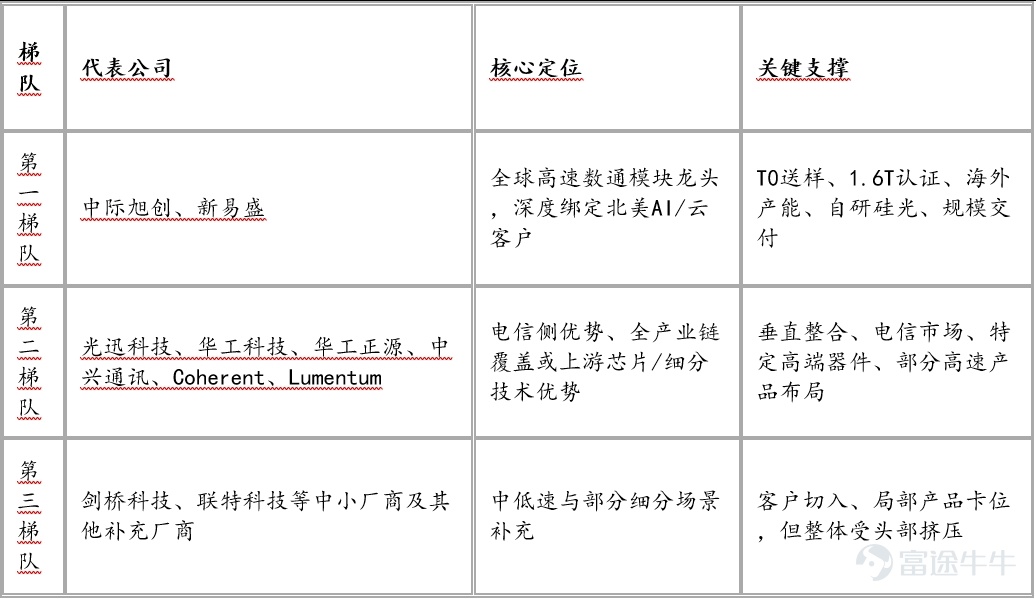
The core characteristics of the global optical module industry are high concentration, long certification cycles, and customer lock-in among top players.In 2025, the top five global companies held 61.4% of the market share, with the top five Chinese companies accounting for 52.6% of the global market share.. More importantly,The formation of this leading landscape is not driven by low-cost competition, but ratherdetermined by sample delivery timing, production ramp-up, and certification capabilities: The certification cycle for leading North American customers lasts as long as2–3 yearsManufacturers that fail to achieve T0-level status for early sample delivery will be systematically excluded from the high-end market. Therefore, in the new generation represented by 1.6T,"Securing qualification first" essentially means locking in the profit pool for the next two to three years.。
Chart 1: Tiering and Competitive Positioning of Core Global Optical Module Manufacturers

Source: Futu Securities
This landscape dictates that investment decisions cannot simply extrapolate performance across all companies based on general "industry prosperity."Because in this cycle, industry demand growth and profit growth are not evenly distributed. Tier-1 players, leveraging their priority in 1.6T mass production and access to high-end clients, capture the most lucrative profit pools; even if Tier-2 players see revenue growth, their product mix, client structure, and yield rates may lag behind industry leaders,resulting in significantly weaker earnings elasticity.。
In the second half of 2026, the industry will also face intensifying competition and downward price pressure, a risk that cannot be ignored. According to LightCounting, as capacity gradually catches up with demand, intensified industry competition and pricing pressure will become more apparent. Therefore, in stock selection,investors should focus on which companies can hedge against price declines through in-house chip supply, vertical integration, optimized client structures, and product upgrades.。
Chart 2: Optical Module Price Trends

Source: LightCounting, Futu Securities
2. CPO: Two Technical Routes from SK Hynix and NVIDIA
SK Hynix recently published a paper proposing a three-stage roadmap for CPO technology.Stage 1: 2D Planar Integration (Short-term Solution)The core approach involves co-packaging optical transceivers and AI chips side-by-side on the same substrate, replacing the traditional pluggable optical module architecture;While signal loss in traditional pluggable optical interfaces typically ranges from 3-5 dB, this 2D integrated CPO solution can keep signal loss below 1 dB,while also effectively reducing device power consumption and enhancing overall hardware operational stability and reliability.
Stage 2: 2.5D Interposer Integration (Mid-term Upgrade)Building on the 2D side-by-side packaging, this stage introduces a silicon photonics interposer and utilizes Through-Silicon Via (TSV) technology to enable ultra-close interconnection between optical devices and AI electronic chips. Compared to Stage 1, which merely "packages them together," this stage significantly shortens the optoelectronic conversion path,compressing transmission distance from the centimeter scale to the millimeter scale, and directly reducing transmission latency to under 10 nanoseconds.。Phase three involves 3D vertical integration (the long-term ultimate goal), which will achieve vertically stacked integration of the optical layer, computing core layer, and storage layer, creating a new system architecture centered on optical interconnects. Unlike the first two phases, where optical interconnects served as peripheral hardware accessories,the most critical innovation in this phase isbreaking the traditional bonded packaging model of HBM and GPUs, transforming HBM into a globally shared memory pool, allowing various computing units to flexibly access storage resources based on their computational needs。
There is a core difference between SK Hynix’s and NVIDIA’s CPO technology roadmaps: NVIDIA’s CPO technology focuses on the network switch level, directly integrating traditional external pluggable optical modules into Spectrum-X switches. By simplifying the optical path structure to reduce signal loss and transmission power consumption, it constitutes an optimization of the peripheral network layer without requiring changes to the GPU core architecture,making it easier to implement and faster to commercialize; whereas SK Hynix’s CPO technology represents a fundamental architectural innovation at the chip level, comprehensively replacing traditional electrical interconnects within chips with high-speed optical interconnects. The ultimate goal is to achieve complete decoupling of computing and storage units, enabling independent deployment and global sharing of HBM memory. Industry consensus predicts thatthis complete optical-centric architecture prototype systemis unlikely to be implemented before 2030, as it is currently only in the theoretical R&D and technical exploration stage, with a long cycle remaining before large-scale commercial adoption.
3. Key Investment Targets
Tfc Communication released its earnings this week, serving as one of the best "barometers" for gauging the current boom in AI optical interconnects from the component side. Compared to OEM module manufacturers, the company is positioned closer to the mid-to-upstream segments, such as high-speed optical engines, FAUs, ELS, precision micro-optics, and active/passive components. Consequently, its performance is more sensitive to changes in industry supply-demand dynamics and technological pathways. The earnings report highlights two industry trends: First, the phased disruptions in Q1 caused by seasonality, foreign exchange fluctuations, and material shortages have been significantly repaired in Q2.The industry is not experiencing weakening demand, but ratherprofits are being rapidly realized following an improvement in the pace of supply release,Currently, the core issue in the AI optical chain is not whether the sector is booming, but who can first break through constraints on key materials like EML/CW lasers and deliver capacity. Second, the industry's profit center is shifting from "general-purpose modules" to "high-margin active components/optical engines/CPO support solutions."High-end products such as 1.6T still maintain healthy margins, but general-purpose 800G modules are already feeling price pressure,and orders for CPO/NPO-related components are beginning to ramp up.
Changes in valuation reflect a dramatic repricing of market expectations: After a significant compression in the forward FY1 P/E ratio,valuation now depends more on earnings realization rather than mere sentiment expansion, currently falling back to approximately 35x.。This shift indicates thatThe current valuation base is far more solid than the previous phase driven by expectations. Future stock price elasticity will be driven to a greater extent by the ramp-up of 1.6T volumes, improved visibility for NPO, and the easing of supply constraints.。
Figure 3: Zhongji Innolight (300308) Forward FY1 P/E Ratio

Source: Wind
From a fundamental perspective,we maintain a bullish outlook.1.6T shipments are materializing, and high growth is highly likely to continue in Q2/H1. The probability of upward revisions to full-year 2026 earnings remains. From a valuation standpoint, the pullback has created medium-to-long-term reallocation value. If subsequent semi-annual reports, Q3 shipment data, and 1.6T ramp-up continue to validate expectations, valuations may shift toward 2028 multiples. From a trading perspective, volatility is expected to remain significant—factors such as export bans, capacity expansion, crowded positioning, and debates over technical roadmaps could further amplify fluctuations. Therefore,it is suitable for dynamic allocation between earnings confirmation and event-driven shocks, or as a core long-term holding in the optical transceiver sector.。
Cambridge Industries Group is a second- or third-tier optical transceiver manufacturer in China. Its earnings preview shows net profit attributable to shareholders for the first halfof RMB 310 million to RMB 360 million,including foreign exchange losses of RMB 200 million. After adjusting for this factor,actual profits exceeded RMB 500 million,with overall operational performance meeting market expectations. In terms of H1 shipment structure, the company's deliveries were dominated by 800G optical transceivers, with volumes ranging from slightly under 500,000 to 500,000 units. Previously, it was expected that the company's 800G shipments would exceed 2 million units and 1.6T shipments would exceed 500,000 units in 2026. Based on the semi-annual results,There is some order pressure in the second half of the year.Previously, market rumors suggested that the company might secure orders from Meta, but Meta has not yet made its supplier selection, which remains the core source of order uncertainty.Cambridge Industries Group has lower medium-to-long-term visibility compared to Zhongji Innolight, making it a high-beta, high-risk investment target.。
Revenue for this periodsurpassed USD 1 billion for the first time,and even more surprisingly, the non-GAAP gross marginexceeded 50% for the first time,significantly beating market expectations; the company guided next quarter's non-GAAP operating margin to be around 40%,a profitability plateau that the market originally expected to see only in later quarters, but Lumentum has approached it one to two quarters ahead of schedule.Demand for EMLs has not slowed down, and demand for CW lasers has strengthened in tandem: EML shipments hit a record high this quarter,Revenue from 200G EML products now accounts for over 25% of total EML revenue.It is expected to become the primary shipment driver by mid-2027 and remains a "hard bottleneck asset" in the upstream AI optical interconnect supply chain.
A few days ago, NVIDIA announced that its Spectrum-X Ethernet optical switches have officially entered full-scale mass production.LITE is the primary supplier of NVIDIA's ultra-high-power CW lasers.The company's CW laser shipments are expected to reach an inflection point in Q4 this year, with shipment volumes set to grow significantly further by 2027. Additionally, regarding the recently high-profile OCS (Optical Circuit Switch) business, SemiAnalysis noted that Google's TPU v9t has been further upgraded to a 6D topology architecture, significantly boosting OCS adoption. OCS establishes optical connections between communication nodes, keeping data transmission entirely in the optical domain without requiring optoelectronic conversion, thereby creating end-to-end all-optical paths directly between fiber ports. It is primarily used for Scale-Across/Scale-Out in AI computing clusters and is currently focused mainly on long-distance transmission.LITE's OCS business revenue is projected to exceed $100 million next quarter, with current backlog orders surpassing $400 million.The company is currently accelerating its delivery phase.OCS will be a significant long-term growth driver and will also enhance the company's overall gross margin.。
The quality of this earnings report itself was solid; continued demand for AI-related optical modules/components drove growth, and improved gross margins validated execution capabilities. However, the market had already priced in a high degree of "beat expectations" magnitude and valuation, leading to a muted or even declining stock price reaction following the earnings release. COHR's main revenue source remains optical modules, and the strongest incremental information from this earnings report isthat orders cover the entire 2027 calendar year and extend into 2028, with Long-Term Agreements (LTAs) extending to 2030, showing no signs of demand attenuation.。
COHR's OCS business achieved quarter-over-quarter revenue growth in Q2 (calendar year), and is continuously ramping up capacity. It is expected to become an increasingly significant contributor to revenue and gross profit in the second half of the year. The company is not only shipping core OCS components (such as MEMS arrays and WSS), but its full systems/subsystems have also completed sampling and mass deployment with seven major customers. Management emphasized that, with the evolution of AI cluster architectures,OCS application scenarios are rapidly expanding from traditional Scale-Out to Scale-Across (cross-pod interconnects) and Scale-Up,The TAM for OCS is projected to double, exceeding $4 billion.。
Summary
The ECOC (European Conference on Optical Communication) in September is expected to provide positive catalysts for the sector. Additionally, while specific details of the US FCC's restrictions on optical modules remain pending, based on policy trends,the long-term bullish outlook for US-listed optical communication stocks remains intact.Two US-listed targets are worth watching, particularly LITE, which occupies a high-end position in the upstream supply chain. For Chinese optical module manufacturers,the worst-case scenario regarding US policy restrictions is unlikely to occur,as China's substantial share of optical module supply determines the pace of AI infrastructure build-out by US cloud providers, and given the intertwined supply chains between China and the US,China accounts for over 70% of bare indium phosphide substrates, and 20%-30% of manufacturing for some US companies still takes place in China.。The long-term certainty for leading tier-one Chinese companies remains very strong, outperforming tier-two manufacturers.。
⚠️ Risk Warning
– Order fulfillment pace fell short of expectations
– AI capital expenditure missed expectations
[Investment Advisory Information]
Yang Yi, Licensed Representative, CE No.: BUR210
Disclaimer
This report is prepared by Futu Securities International (Hong Kong) Limited ("Futu Securities"). Without Futu Securities’ prior written consent, this report and the information contained herein may not be (i) reproduced, copied, or stored in any form, or (ii) distributed or transmitted directly or indirectly to any other person for any purpose. The information in this report is derived from sources that Futu Securities believes to be accurate and reliable as of the date of publication; however, this report is not intended to contain all information required by investors and may be subject to delays, obstructions, or interception in transmission. Futu Securities makes no express or implied representation or warranty regarding the adequacy, accuracy, completeness, reliability, or fairness of such information or opinions. Accordingly, Futu Securities and its affiliates (collectively, the "Futu Group") shall not be liable for any losses (including, without limitation, direct, indirect, or consequential damages) arising from any actions taken by third parties relying on the content of this report. The views, recommendations, suggestions, and opinions expressed in this report do not necessarily reflect those of Futu Securities or its affiliates and may be changed at any time without notice. Futu Securities undertakes no obligation to update any such information or opinions. This report is provided for general informational purposes only and is intended solely for the general reference of Futu Securities’ clients, without regard to the specific investment objectives, financial situation, or particular needs of any individual recipient. Nothing in this report constitutes or should be construed as an offer, recommendation, or solicitation by any member of the Futu Group to buy or sell any securities, investments, or other financial instruments. It should not be interpreted as an offer or invitation to purchase or sell securities. Any decision to purchase securities mentioned in this report should be based on publicly available information, including relevant prospectuses. The products referenced in this report may not be suitable for all investors, and readers should carefully consider all relevant factors and seek professional advice before making any investment decisions. This report is provided to recipients on the assumption that they are capable of independently evaluating investment risks and exercising independent judgment in making investment decisions. In certain jurisdictions or countries, the distribution, issuance, or use of this report may violate applicable laws, regulations, rules, or other registration or licensing requirements. This report is not intended for distribution to, or use by, any person or entity in such jurisdictions or countries. Hong Kong-based investors with questions regarding Futu Securities research reports should contact Futu Securities directly. The SFC Central Entity Reference Number of the report’s author is disclosed next to the author’s name on the report’s cover page. The analyst primarily responsible for preparing this report confirms that: (i) the views expressed in this report accurately reflect his/her personal views regarding the subject listed companies; and (ii) none of the compensation he/she has received, currently receives, or will receive—directly or indirectly—is linked to the specific recommendations or views expressed in this report. The analyst confirms that neither he/she nor any related party has traded in the securities of the subject listed companies or their related securities within 30 days prior to the publication of this report or within three business days following its publication. Neither the analyst nor any related party serves as a senior officer of the subject listed companies or holds any financial interest in them. In this report, Futu Securities does not hold a financial interest equal to or greater than 1% of the listed company’s market capitalization and has had no investment banking relationship with the company in the past 12 months. None of the company’s employees are employed by the listed company.
Risk Disclaimer: The above content only represents the author's view. It does not represent any position or investment advice of Futu. Futu makes no representation or warranty.Read more


Comments
to post a comment
3
1