
Bai Dao Options Mini-Class 06 | Selling Calls (Short Call): "Collecting Rent" or "Unlimited Losses"? The Difference Lies in This One Move
Every Wednesday, the "Hundred Dollar Mini-Class" starts on schedule.We start from the basics, focusing on just one key concept per session. Fellow investors can learn step by step, and you'll find that options are not actually that difficult.
In addition to the Wednesday mini-class, we also have 'Opportunity Pool' on Mondays to discuss potential trade ideas, and 'Weekly Recap' on Fridays to break down cases from the week—each of these three segments has its own focus, and they work even better when consumed together.Follow NiuNiu’s official account 'BaiDao Plays Options' so you never miss an update~

In the previous two sessions, we discussed the "buyer" side—spending tens or hundreds of dollars to buy a Call to bet on a surge, or a Put to bet on a plunge, where losses are limited but profit potential is vast. Today, let's switch roles and act as the "landlord collecting rent."
Have you ever thought about this:Since someone is willing to pay for options, who is the person receiving this money?The answer is the "seller."
What we're covering todayShort Call, which is the most classic "rent-collecting" strategy. Everyone loves the sweet taste of collecting premiums, but hidden behind it is a nerve-wracking concept:theoretically unlimited risk. This tension between "collecting rent" and "unlimited risk" is exactly what we will thoroughly explain today.
What is a Short Call? You are the "landlord collecting rent"
Let's start with an analogy. Suppose you own a house (the underlying stock), and someone worried about rising prices wants to agree that "I have the right to buy it from you at a specified price in one month." To secure this "right," they pay you a deposit upfront. This deposit can be likened toOption premium; by accepting the money, you incur theobligation to sell the stock to the counterparty at the agreed-upon strike price upon expiration。
The essence of a Short Call is collecting a premium while betting that "the stock price won't rise above a certain level."
Let's look at an example (the following is a hypothetical scenario; figures are for educational purposes only): Suppose a tech stock is currently trading at $170, and you believe it won't exceed $190 next month. So, you sell one Call option with a strike price of $190, priced at $2 per share, pocketing $200 in option premium.
If the stock price doesn't surge past $190 by expiration: the counterparty won't exercise the option, and that $200 is pure profit—your "rent."
If it breaks through $190: you must sell the shares to the counterparty at $190.
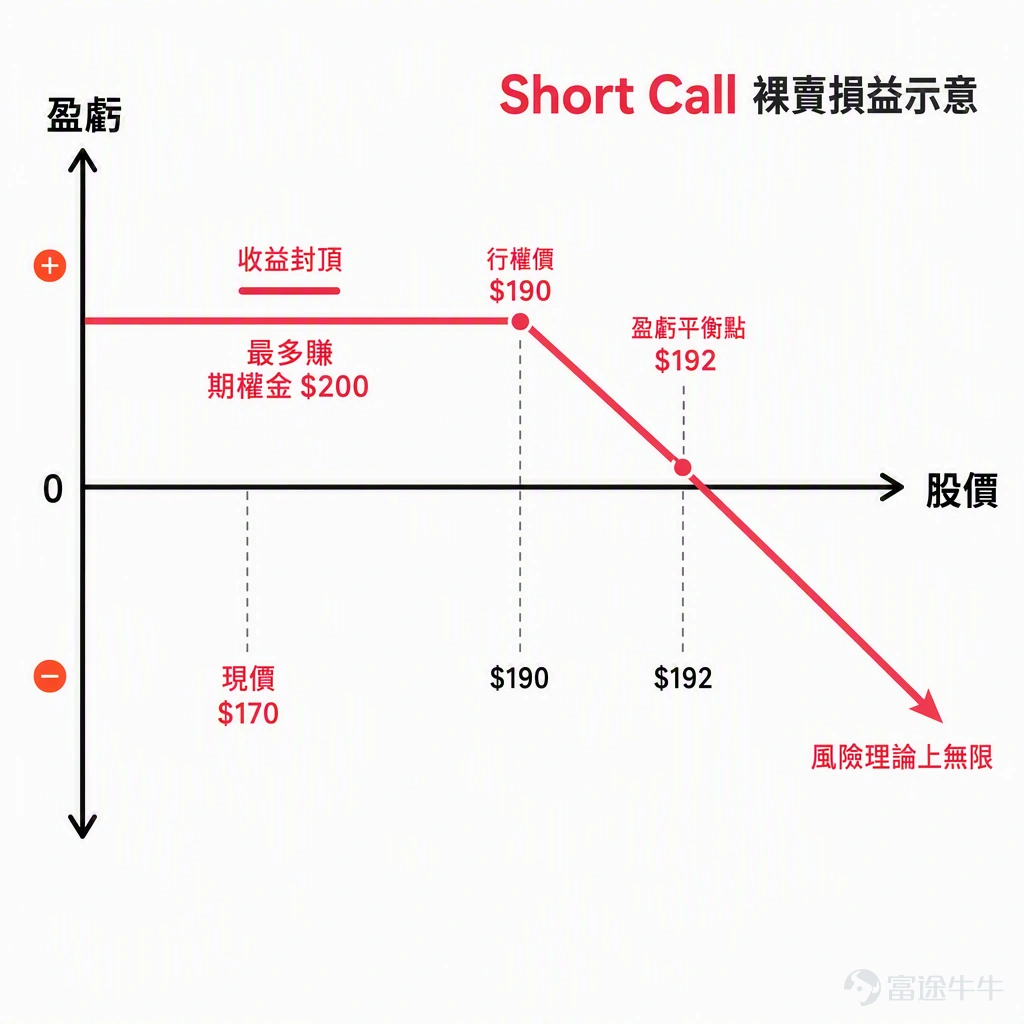
Looking at the P&L diagram, you'll see the seller's profit is "capped"—you can earn at most that $200 in rent; as long as the stock price stays below $190, you collect rent steadily.
Why is it said that the "risk is unlimited"?
Now that we've covered the upside, let's look at that scary term. Suppose youdon't actually hold the 100 underlying shares,,but simply collected $200 upfront while promising to "sell shares at $190 at expiration." This is called a "Naked Call."
As long as you don't hold the shares, the loss from selling a call option is theoretically uncapped—the sharper the stock price rise, the greater your loss.
Let's continue with the example above: You sold that $190 Call and collected $200. Then the stock suddenly releases positive news, and the price skyrockets to $250. The counterparty will certainly exercise the option, requiring you to sell 100 shares to them at $190—but since you don't have the shares, you must first buy 100 shares from the market at $250, then sell them at a loss at $190:
Loss on this trade = ($250 - $190) × 100 = $6,000,After deducting the $200 premium received earlier, the net loss is $5,800.
What’s even more terrifying is: what if it surges to $300 or $400? Since there’s no ceiling on a stock’s upside, there’s no ceiling on your losses either. Collecting $200 in premium while risking thousands or even tens of thousands in losses—this is the danger of "limited profit potential, unlimited loss risk."
So you’ll find that selling calls and buying calls are exact "mirrors" of each other:The buyer has limited loss and unlimited profit potential; the naked seller has limited profit potential and unlimited loss. Collecting that premium comes at a price.
Want to collect premium safely? Hold enough underlying shares first.
Does this mean selling calls is off-limits? Not necessarily. What experienced traders commonly use is a relatively稳健 (robust) version—Covered Call。
Hold 100 shares of the underlying stock first, then sell the corresponding call option. This is called "covered"; having the shares as collateral prevents the unlimited losses associated with naked selling.
Using the same example above: this time, youalready hold 100 shares of the stock currently priced at $170, and then sell one $190 call option, collecting $200 in premium.If the stock price rises above $190 and the counterparty exercises the option, you can simply sell your 100 shares at $190. There is no need to rush into the market to buy shares at a high price. The result: you profit from the price difference as the stock rises from $170 to $190, plus you collect an additional $200 in premium. The only cost is forfeiting any gains above $190.
The ideal market condition for covered calls is whenyou believe the stock in your portfolio will not surge significantly—instead, it will trade sideways or fluctuate moderately.This strategy earns "time value": options continuously lose value as they approach expiration (known as time decay). As the seller, you benefit from this phenomenon; time is on your side.The cost of collecting this premium is giving up the potential upside if the stock were to skyrocket.
Key takeaway
Selling a call option = collecting option premium, betting that the stock price will not exceed the strike price; returns are capped, with maximum profit limited to the premium collected.
Naked selling without holding the underlying asset = theoretically unlimited risk: if the stock price surges, you must buy back at a high price and sell at a loss, meaning losses increase with every dollar the price rises. Novices should avoid this strategy.
Holding sufficient underlying shares before selling calls = Covered CallRelatively stable, suitable for sideways or mildly volatile markets, profiting fromtime decay.
It is the mirror image of "buying calls": the buyer has limited loss and theoretically unlimited profit; the naked seller has limited profit and theoretically unlimited loss.
If you want to experience the feeling of "being a landlord collecting rent," the safest first step is "covered calls": check if you hold at least 100 shares of a specific stock in your account. If so, open Futubull → Stock → Options → Option Chain, find a slightly "out-of-the-money" Call (strike price higher than the current price), and see how much "rent" you can collect and what portion of the upside you are giving up.
Remember: the "unlimited risk" of naked selling without holding the underlying asset is not a bluff; beginners must avoid it.Understand the risks and ensure you have the underlying assets before considering small live trades.
Finally, we’ve got a little perk for our fellow investors—feel free to claim it!Options Starter Pack~
*This promotion is exclusively available to invited Hong Kong users. Click to learn more.Detailed terms and conditions of the promotion >>

Disclaimer
This content does not constitute an offer, solicitation, recommendation, advice, opinion, or any form of guarantee regarding any securities, financial products, or instruments. Trading options carries substantial risk of loss. In certain scenarios, your losses may exceed the initial margin deposit. Even if you set contingency instructions such as 'stop-loss' or 'limit orders,' these may not necessarily prevent losses, as market conditions could render such instructions unexecutable. You may be required to deposit additional margin on short notice. If you fail to meet the margin call within the specified timeframe, your open positions may be liquidated. Nevertheless, you remain fully liable for any resulting deficit in your account. Therefore, prior to trading options, you should thoroughly study and understand options trading and carefully consider whether such trading aligns with your financial situation and investment objectives. If you do trade options, you must become familiar with the procedures, rights, and obligations associated with exercising options and their expiration.
Risk Disclaimer: The above content only represents the author's view. It does not represent any position or investment advice of Futu. Futu makes no representation or warranty.Read more


Comments
to post a comment
13
34