HK Stock Market Barometer | HK stocks continue to fluctuate and pull back! How much room for recover

Decoding Star Stock Earnings | Is Alibaba Still Just an E-commerce Play? One Financial Report Reveals How AI is Reshaping Valuation
When you mention $BABA-W (09988.HK)$ / $Alibaba (BABA.US)$ Many investors still think of Taobao and Tmall first.
But if you've been watching Alibaba's stock price recently, you'll notice that the key terms dominating market discussions have gradually shifted toAI, Qwen, and Alibaba Cloud。
Alibaba is expected toreport its Q1 FY2027 earnings before the U.S. market opens on August 20, corresponding to Q2 2026 in the calendar year.As of August 17, Alibaba's ADR was trading at approximately $124.7, rebounding more than 30% over the past two months from a recent low of around $95 at the end of June.
The stock price has already priced in some gains, so this earnings report naturally faces higher market expectations.
So here's the question:When reviewing Alibaba's earnings, should we focus on e-commerce or AI?
The answer is actually: both, but their roles have diverged.
Core e-commerce still determines how much profit Alibaba generates now, while AI and Cloud Computing increasingly influence the valuation multiple the market is willing to assign to Alibaba.

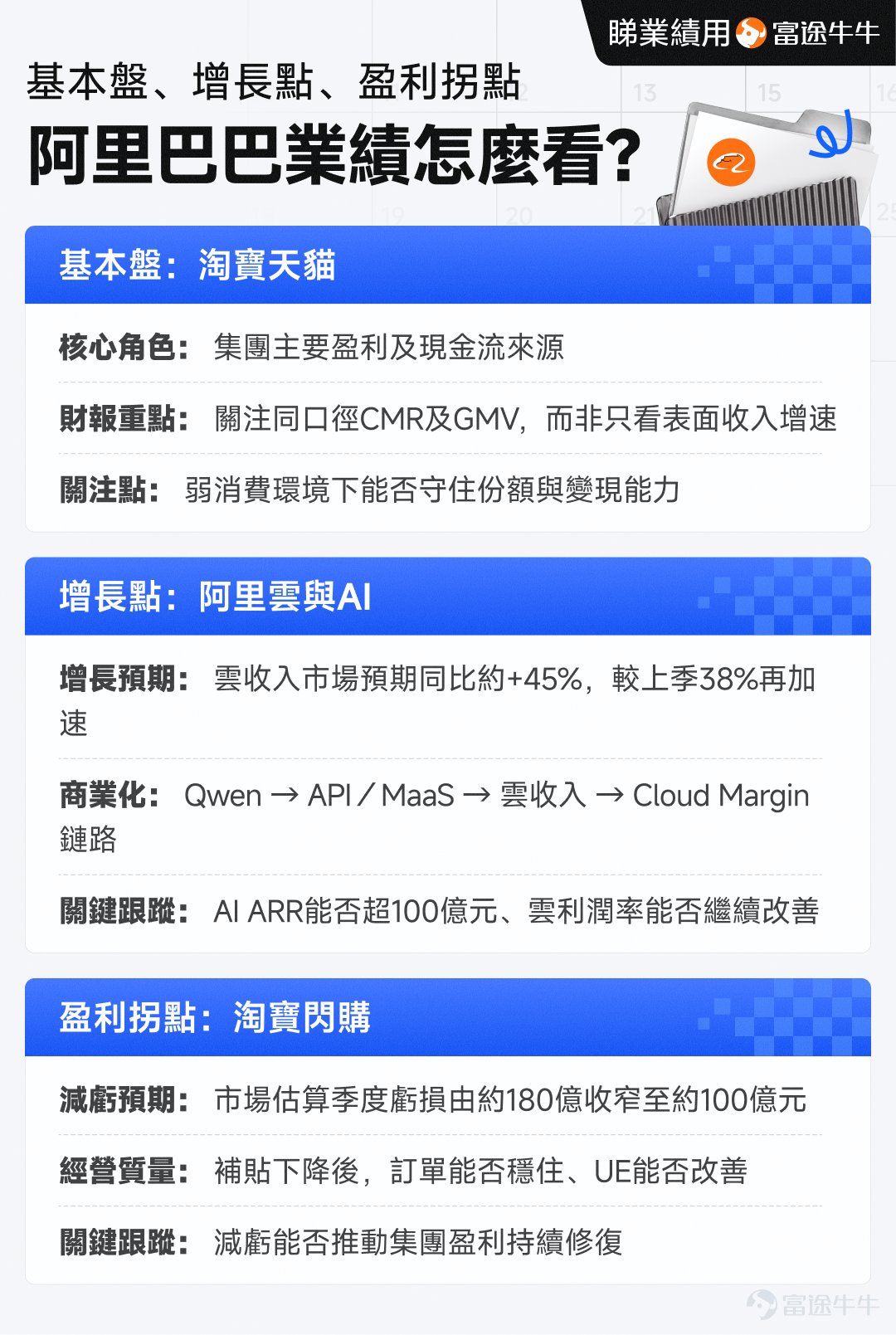
To analyze Alibaba, first distinguish between 'who drives profits' and 'who drives growth.'
For investors new to reading financial statements, a diversified company like Alibaba can quickly become overwhelming.
In fact, you can start by simply dividing it into three segments.
Core e-commerce platforms like Taobao and Tmall are Alibaba's cash cows. Even with weak consumer growth in China, their massive base of merchants and users remains the group's most important source of profit.
Alibaba Cloud and AI are currently the most important new growth engines. Although this segment still contributes far less to the group's revenue than e-commerce, its growth rate is significantly faster, which is also the main reason for the market's recent re-rating of Alibaba.
On the other hand, new businesses such as Taobao Flash Sales and Qwen consumer applications still require investment, which will weigh on the group's profitability in the short term. The market is not focused on whether these businesses are "losing money," but rather on whether the investment translates into user growth and revenue, and when losses will begin to narrow.
Current market consensus expects Alibaba's revenue for this quarter to be approximatelyRMB 269 billion, with adjusted EBITA of approximatelyRMB 26 billion. The latter represents a significant quarter-on-quarter recovery from about RMB 5.1 billion in the previous quarter, but may still decline by around 30% year-on-year.
Therefore, if you see a "significant quarter-on-quarter increase in profits" after the earnings report, do not rush to conclude that Alibaba's profitability has suddenly strengthened substantially.
The real question to ask is:Why is profitability recovering? Can this improvement be sustained?
Tip: A company's largest business segment is not necessarily the one that has the greatest impact on its stock price.
Mature businesses typically provide cash flow, while a smaller but rapidly growing new business may actually determine the valuation the market is willing to assign to the company.
Alibaba Cloud is a classic example of this.
With Alibaba Cloud growing at 45%, why does the market care so much?
In the previous quarter, Alibaba Cloud's revenue reachedRMB 41.63 billion, representing a 38% year-over-year increase, with external commercial revenue growing even faster at 40%. Revenue from AI-related products reached RMB 8.97 billion, marking the 11th consecutive quarter of triple-digit year-over-year growth.
For the current quarter, consensus market expectations suggest that Alibaba Cloud's revenue could further increase to approximatelyRMB 48.4 billion, a year-over-year growth of about 45%。
Is 45% considered fast or slow?
It’s worth looking at AWS, one of the world’s largest cloud providers. In Amazon’s latest Q2 earnings report, AWS revenue grew year-over-year37%, marking its fastest growth rate in 18 quarters.
Of course, business structures and disclosure methodologies vary across companies, so we can’t simply rank them by growth rates. But if Alibaba Cloud truly achieved around 45% growth this quarter, it at least demonstrates that,against the backdrop of re-accelerating growth among major global cloud providers, Alibaba Cloud’s own growth trajectory remains quite prominent.
The market’s focus is now shifting from "Can Alibaba Cloud return to growth?" to:"How long can growth above 40% be sustained?"
This is why ~45% growth may now be closer to the market’s "passing grade" rather than a surprising upside.

Alibaba’s true advantage may lie not just in "having a cloud subsidiary."
If enterprises simply need more AI computing power and thus rent GPUs, multiple cloud providers—not just Alibaba—stand to benefit.
One reason the market has higher expectations for Alibaba is its attempt to integrateModels, chips, and cloudintegrated into a single system.
Alibaba currently possesses the Qwen foundation models, Alibaba Cloud, self-developed AI chips, as well as the software capabilities to manage different chip clusters and model inference. The company refers to this suite of capabilities as its full-stack AI capability.
For investors, the key validation point is actually a clear business logic chain:
Increased Qwen usage → Increased API/MaaS calls → Revenue growth for Alibaba Cloud → Improved cloud margins.
If we see both accelerating cloud revenue and expanding profit margins in the future, it would signify more than just "strong AI demand"; it would indicate that Alibaba is truly converting its AI technology into revenue and profits.
This perspective also suggests that when evaluating a high-growth business, one should not only ask:How much is revenue growing?
but also ask:Has profitability improved following revenue growth?
If revenue grows but costs rise even faster, valuations may not continue to increase. Conversely, if profit margins improve alongside revenue growth, it usually indicates that economies of scale are taking shape.
Flash sales are still losing money, so why is the market expecting an improvement in profitability?
Beyond AI, another key highlight in Alibaba's latest earnings report that cannot be overlooked is Taobao Flash Sales.
Over the past year, Alibaba has heavily invested in instant retail, driving growth in orders and users, but also clearly dragging down the group's profitability.
The market currently estimates that the quarterly loss from instant retail may narrow from approximately RMB 18 billion in the previous quarter toaround RMB 10 billion. It is important to note that these figures are market estimates and not the official segment loss data disclosed by Alibaba.
Therefore, the market is no longer just looking at 'whether flash sales orders are high.'
What truly warrants observation is:After subsidies are reduced, will users stay? Can order volumes be maintained? Is the loss per order decreasing?
This is what is often referred to in earnings reports asUnit Economics。
If a company loses significant money on every new order, scaling up could actually lead to greater losses. However, if each order gradually approaches profitability as subsidies decrease and delivery efficiency improves, the business's value proposition changes entirely.
This is also the most compelling aspect of Flash Sale this time around.
Taobao and Tmall haven't disappeared; the market's expectations for them have simply changed.
While AI is a hot topic, we shouldn't overlook Alibaba's core business foundation because of it.
In the first half of 2026, China's total retail sales of consumer goods grew by only1.3%year-on-year, with June's growth rate at just 1.0%, indicating that the overall consumption environment remains weak. In contrast, online retail sales of goods and services increased by 5.2% year-on-year in the first half of the year.
Against this backdrop, the market's expectation for Taobao and Tmall may not be a return to very high growth rates, but ratherto defend market share, maintain merchant monetization capabilities, and continue providing cash flow for new businesses.
Another metric this quarter that is easily misunderstood by novices is CMR (Customer Management Revenue), which can be simply understood as revenue generated from merchants advertising on Taobao and Tmall to acquire traffic.
Due to changes in the accounting treatment for certain merchant subsidies, reported CMR this quarter may appear to decline year-on-year, but this should not be directly interpreted as a sudden deterioration in Taobao's business performance.
In the previous quarter, the company disclosed that its comparable CMR actually grew by approximately 8% year-over-year.

Therefore, after the earnings report is released, rather than jumping to conclusions based solely on a percentage decline in revenue, it is more important to check whether the company has disclosedtrends in comparable CMR and GMV.。
Some figures in the financial statements can be affected by factors such as accounting standards and business restructuring.
When you see a metric suddenly surge or plummet, first check if the company has provided "comparable" data before judging the true business trend.
For this earnings report, beginners really only need to look at three key things first.
Alibaba's earnings report is lengthy with many business segments, but if you want to quickly assess core changes, you can focus on three main threads.
The first thread is Alibaba Cloud. The market currently expects growth of around 45%. If growth continues to accelerate while profit margins improve, it indicates that the second growth curve driven by AI cloud services is still strengthening.
The second thread is AI commercialization. Key focuses include whether the ARR for AI models and application services has met or even exceeded the phased target of RMB 10 billion, and whether services like Model Studio and MaaS continue to generate actual revenue.
The third thread is loss reduction in instant commerce. If orders remain stable while losses decrease rapidly, it suggests that Alibaba's current strategic investments are gradually moving past the most cash-intensive phase.
As for the group's total revenue and net profit, they are certainly still important, but they cannot solely determine whether this financial report is 'good' or 'bad'.

For a company with complex operations, it is often the direction of a few key business segments that truly drives stock price changes. Alibaba's stock price has rebounded about 40% from its June low of HK$88 to HK$125. Whether this rebound can continue will depend critically on the impact of these earnings.
In the past, the market primarily viewed Alibaba as a large e-commerce platform; currently, core e-commerce remains the most important profit foundation, butAI Cloud is gradually becoming a new variable influencing valuation.While investors focus on growth opportunities in new businesses, they should also pay attention to risks such as AI capital expenditures, industry competition, consumer demand, and investments in new businesses.
Risk Disclaimer: The above content only represents the author's view. It does not represent any position or investment advice of Futu. Futu makes no representation or warranty.Read more


Comment (1)
to post a comment
12
18