Dividend Investor's Guide: Golden September Dividend Season! Yields Up to 34%

China AMC Asia High Dividend Equity ETF (3145.HK): Envious of the 21% high dividend yield? During the dividend season, we break down allocation strategies for high-dividend stocks and high-dividend ETFs.
As Hong Kong stocks enter the dividend season in August, a batch of high-yield companies are going ex-dividend one after another, significantly heating up market attention. In the dividend list recently compiled by Futu, Topsports' TTM dividend yield is around 21.17%, Midea Real Estate's is about 14.05%, and China Gas Holdings' is approximately 8.08%. Dividend yields of over 10% or even above 20%[1] are indeed hard to resist for investors focused on cash flow.
However, there is an easily overlooked issue during dividend season: a high payout does not necessarily guarantee a high overall investment return.
1. Behind High Yields, First Ask: "Is It Sustainable?"
Dividend yield is influenced by both the dividend amount and changes in stock price. If a company's stock price drops significantly, the nominal dividend yield may rise passively, even if the dividend amount remains unchanged.
Therefore, when you see a stock with a dividend yield of 10%, 15%, or even 20%, rather than just focusing on how high the number is, it is more important to determine whether this high yield stems from the company's sustained earnings and cash flow, or is primarily driven up by a falling stock price.
For medium- to long-term income investing, factors such as corporate earnings, free cash flow, and the sustainability of dividend policies must be considered. If a company faces future earnings pressure or adjusts its dividend policy, the currently observed high dividend yield may also change.
For investors who do not have much time to study financial reports, industry cycles, and dividend policies for each company individually, instead of concentrating their income sources in one or two companies, they might consider another approach: diversifying through a basket of high-yield stocks to reduce reliance on the dividend performance of any single stock.
2. Basket of High-Yield Strategy: Shifting from Single Stocks to Diversified Allocation
The principle of diversified investment is not complicated, but over-concentration in specific industries or individual stocks is common in high-yield investing. For example, if a portfolio is concentrated in banking, real estate, or a few high-yield stocks, once the relevant industries enter a downturn or companies adjust their dividend policies, the portfolio's cash flow and net asset value performance may be adversely affected.
The approach offered by high-yield ETF baskets is to achieve portfolio allocation across different markets, industries, and multiple companies, rather than trying to predict which single stock can maintain a high dividend yield of over 10% or even 20% in the long term.
![As Hong Kong stocks enter the dividend season in August, a batch of high-yield companies are going ex-dividend one after another, significantly heating up market attention. In the dividend list recently compiled by Futu, Topsports' TTM dividend yield is around 21.17%, Midea Real Estate's is about 14.05%, and China Gas Holdings' is approximately 8.08%. Dividend yields of over 10% or even above 20%[1] are indeed hard to resist for investors focused on cash flow. However, there is an easily overlooked issue during the dividend season: a high payout does not necessarily equate to high overall investment returns. 1. Behind the High Yield, First Ask: "Is It Sustainable?" The dividend yield is influenced by both the dividend amount and changes in the stock price. If a company's stock price drops significantly, the book dividend yield may rise passively, even if the dividend amount has not increased. Therefore, when you see a stock with a dividend yield of 10%, 15%, or even 20%, rather than just focusing on whether the number is high, it is more worthwhile to consider: Does this high yield stem from the company's sustained earnings and cash flow, or is it primarily driven up by a decline in the stock price? For medium-to-long-term income investing, factors such as corporate earnings, free cash flow, and the sustainability of dividend policies must be taken into account. If the company faces pressure on future earnings or adjusts its dividend policy, the currently observed high dividend yield may also change. For investors who do not have much time to study financial reports, industry cycles, and dividend policies for each company individually, instead of concentrating their income sources in just one or two companies, they might consider another approach: through...](https://nnqimage.futunn.com/sns_client_feed/12917760/20260819/web-1787124439664-1BweLy55ER.jpeg/big?area=2&is_public=true&imageMogr2/ignore-error/1/format/webp)
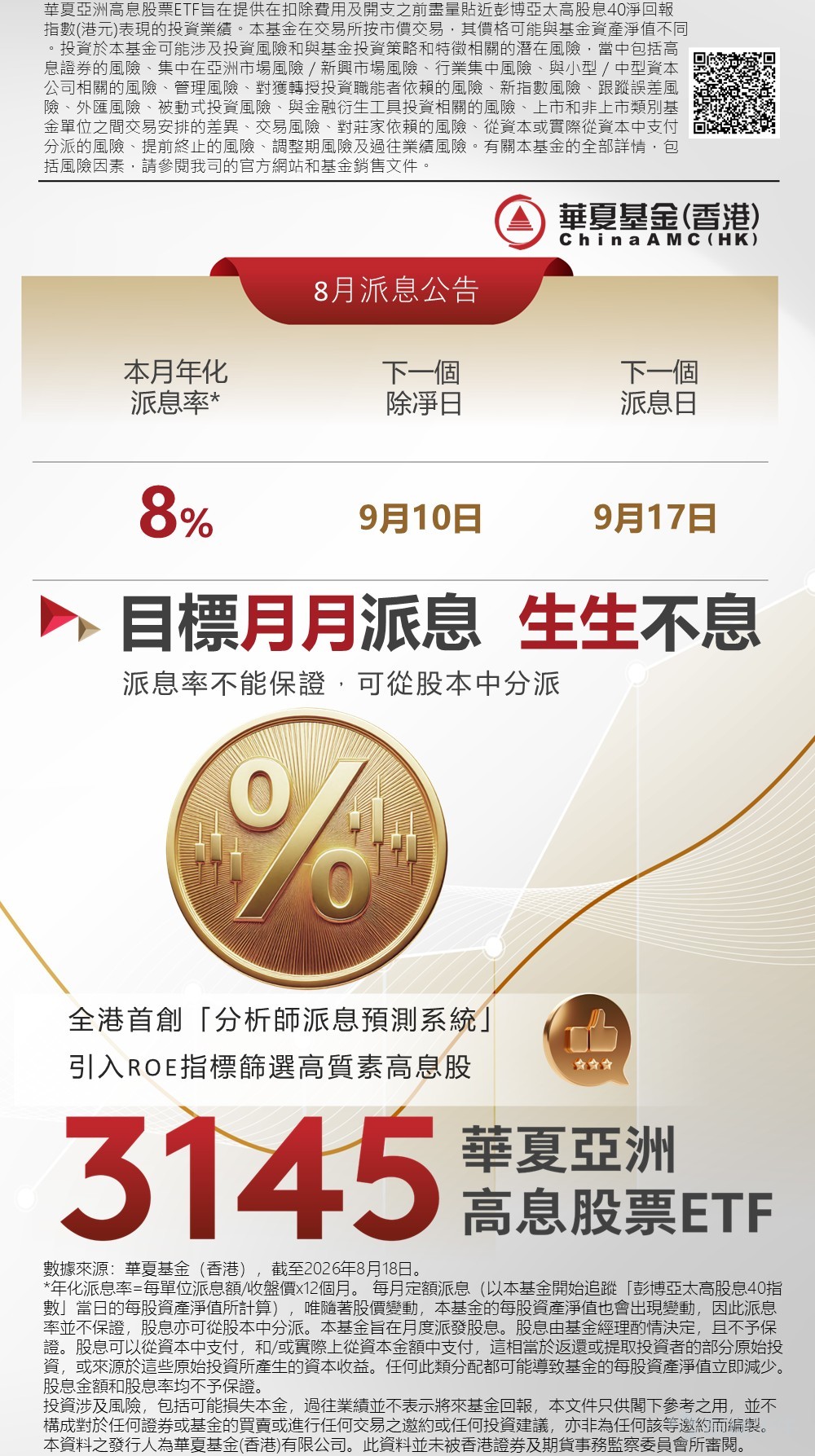
Taking $ChinaAMC Asia High Dividend ETF (03145.HK)$ Taking [Product Name] as an example, its annualized dividend distribution rate in August was 8%*. Its holdings focus on high-quality, high-yield stocks in the Asia-Pacific region, with monthly dividends historically derived mainly from the operating earnings of constituent companies, aiming for monthly payouts. The product seeks to enhance portfolio resilience during market volatility through dividend income sources, while preserving growth potential via diversified exposure across the Asia-Pacific region.
Monthly Distribution Records Since 2026
![As Hong Kong stocks enter the dividend season in August, a batch of high-yield companies are going ex-dividend one after another, significantly heating up market attention. In the dividend list recently compiled by Futu, Topsports' TTM dividend yield is around 21.17%, Midea Real Estate's is about 14.05%, and China Gas Holdings' is approximately 8.08%. Dividend yields of over 10% or even above 20%[1] are indeed hard to resist for investors focused on cash flow. However, there is an easily overlooked issue during the dividend season: a high payout does not necessarily equate to high overall investment returns. 1. Behind the High Yield, First Ask: "Is It Sustainable?" The dividend yield is influenced by both the dividend amount and changes in the stock price. If a company's stock price drops significantly, the book dividend yield may rise passively, even if the dividend amount has not increased. Therefore, when you see a stock with a dividend yield of 10%, 15%, or even 20%, rather than just focusing on whether the number is high, it is more worthwhile to consider: Does this high yield stem from the company's sustained earnings and cash flow, or is it primarily driven up by a decline in the stock price? For medium-to-long-term income investing, factors such as corporate earnings, free cash flow, and the sustainability of dividend policies must be taken into account. If the company faces pressure on future earnings or adjusts its dividend policy, the currently observed high dividend yield may also change. For investors who do not have much time to study financial reports, industry cycles, and dividend policies for each company individually, instead of concentrating their income sources in just one or two companies, they might consider another approach: through...](https://nnqimage.futunn.com/sns_client_feed/12917760/20260819/web-1787124566226-1mayaF8xcp.png/big?area=2&is_public=true&imageMogr2/ignore-error/1/format/webp)
Source: China AMC (HK), as of August 14, 2026
3. Is now a good time to focus on high-yield assets?
Looking back at August, are high-yield assets still worth watching?
From the perspective of the Asia-Pacific market, the return sources of high-yield strategies are not limited to dividends. As of August 17, 2026, the Asia-Pacific ex-Japan Financials, Materials, Energy, and Utilities indices have risen by approximately 10.0%, 16.0%, 3.2%, and 2.5% year-to-date, respectively. The dividend yields of these sectors are also higher than the overall regional market average. Among them, the Financials, Materials, and Energy sectors simultaneously show varying degrees of expected earnings growth, indicating that some high-yield assets may also possess earnings-driven and capital appreciation attributes, rather than having only defensive characteristics. [2]
However, there are significant differences in interest rates, exchange rates, economic cycles, and industry structures across different Asia-Pacific markets. If a portfolio is concentrated solely in one market or one high-yield sector, it may be more susceptible to changes in the local economy and industry cycles. Therefore, compared to simply seeking "which market has the highest dividends," cross-market and cross-sector allocation can serve as a way to diversify risks associated with single markets and sectors.
For high-yield investments, the focus now may need to shift from merely asking "is the dividend yield high enough" to considering dividend levels, earnings quality, valuation, and diversification together.
4. During the August dividend season, don't just fixate on the "highest yield"
High dividend yields are certainly eye-catching, but for genuine medium-to-long-term income investing, beyond "how much is paid out," two questions need to be clearly addressed: Is this dividend sustainable? Is the portfolio overly concentrated in a single company or sector?
If you are willing to spend time researching a company's earnings, cash flow, and dividend policy, you can further screen for high-yield stocks that align with your investment goals during the dividend season; if you are more focused on diversified allocation, cash flow management, and operational convenience, a basket of high-yield ETFs can also be a worthwhile tool to explore.
Taking $ChinaAMC Asia High Dividend ETF (03145.HK)$ For example, it constructs a portfolio of 40 high-dividend Asia-Pacific stocks, aiming for monthly dividend distributions. This allows investors to avoid concentrating their income sources on a single company and leverages index rules for periodic screening and rebalancing.
After all, dividend investing is not just about the immediate payout amount; it is more important to focus on the earnings support behind the dividends and the long-term resilience of the entire portfolio.
If it were you, during the August dividend season, would you focus more on individual high-yield stocks with yields of over 10% or even 20%, or would you prefer a diversified allocation through a basket of high-dividend stocks? Feel free to share your dividend investment strategy in the comments section.
5. $ChinaAMC Asia High Dividend ETF (03145.HK)$Provides an option for investors seeking high-yield opportunities in the Asia-Pacific region, looking to diversify away from the single-market risk of Hong Kong stocks, and focusing on dividend opportunities.
The fund tracks the Bloomberg Asia Pacific High Dividend 40 Net Total Return Index (HKD)
• Forward-looking stock selection helps mitigate 'high dividend traps'
• Aims to distribute dividends monthly, balancing stability and cash flow, with a target annualized dividend yield of 8%*
• Broad exposure across the Asia-Pacific region, designed to reduce single-market risk
Report Date: August 14, 2026
Sources:
[1] Source: Futu, as of July 30, 2026. https://q.futunn.com/discussion/1861746704
Unless otherwise specified, data sources are China AMC (HK) and Bloomberg, as of August 14, 2026.
[2] Source: J.P. Morgan Asset Management "Guide to the Markets—Asia", with underlying data from FactSet and MSCI, as of August 17, 2026. https://am.jpmorgan.com/content/dam/jpm-am-aem/asiapacific/regional/en/insights/market-insights/daily-guide-updated.pdf
*Annualized Distribution Yield = (Distribution per Unit / Closing Price) × 12 months. The fund pays fixed monthly distributions (calculated based on the net asset value per share on the day the fund began tracking the 'Bloomberg Asia Pacific High Dividend 40 Index'). However, as share prices fluctuate, the fund’s net asset value per share will also change; therefore, the distribution yield is not guaranteed, and distributions may be paid out of capital.
Investments involve risks, including the possible loss of principal. Any forecasts, outlooks, or opinions contained herein are provided for your reference only and are not guaranteed to materialize. The information herein reflects market conditions and our views as of the date of publication and is subject to change without notice. This document is issued by China AMC (HK) Limited. It has not been reviewed by the Securities and Futures Commission of Hong Kong. For full details and risk factors regarding the funds mentioned, please refer to our official website and the fund offering documents.
Past performance is not indicative of future results. Investors may not recover their full principal investment. Fund performance is calculated on a daily net asset value (NAV)-to-NAV basis, with dividend reinvestment included (except for distributing share classes, where dividend reinvestment is excluded). If all units or shares of a fund, sub-fund, or share class have been fully redeemed, the daily NAV will be shown as zero. If historical performance data is not displayed, it indicates insufficient data over the relevant period to calculate and present a fair performance figure. Performance is calculated from the inception date of each share class.
This fund aims to distribute dividends on a monthly basis. Dividends are determined at the discretion of the Fund Manager and are not guaranteed. Dividends may be paid out of capital and/or effectively out of the capital amount, which amounts to a return or withdrawal of part of the investors' original investment, or may be sourced from capital gains generated by such original investments. Any such distribution may result in an immediate reduction in the fund's net asset value per share. Neither the dividend amount nor the dividend yield is guaranteed.
$360 DigiTech (810444.HK)$$SITC (01308.HK)$ $SCB X PCL UNSPON ADS EACH REP 4 ORD (SCBXY.US)$$C&D INTL GROUP (01908.HK)$ $BOSIDENG (03998.HK)$$NVIDIA (NVDA.US)$$Amazon (AMZN.US)$$Alphabet-C (GOOG.US)$$Meta Platforms (META.US)$$Tesla (TSLA.US)$$HSTECH (LIST91332.HK)$$Hang Seng Index (800000.HK)$$SSE 50 Index (000016.SH)$$CSI 300 Index (000300.SH)$$CSI 1000 Index (000852.SH)$$SSE Science and Technology Innovation Board 50 Index (000688.SH)$ $Micron Technology (MU.US)$ $SanDisk (SNDK.US)$ $ChinaAMC Asia High Dividend ETF (03145.HK)$ $SK hynix (SKHY.US)$
Risk Disclaimer: The above content only represents the author's view. It does not represent any position or investment advice of Futu. Futu makes no representation or warranty.Read more

Comments
to post a comment
2
2