Optical communication stocks lead the rebound; will the AI optical cycle continue?

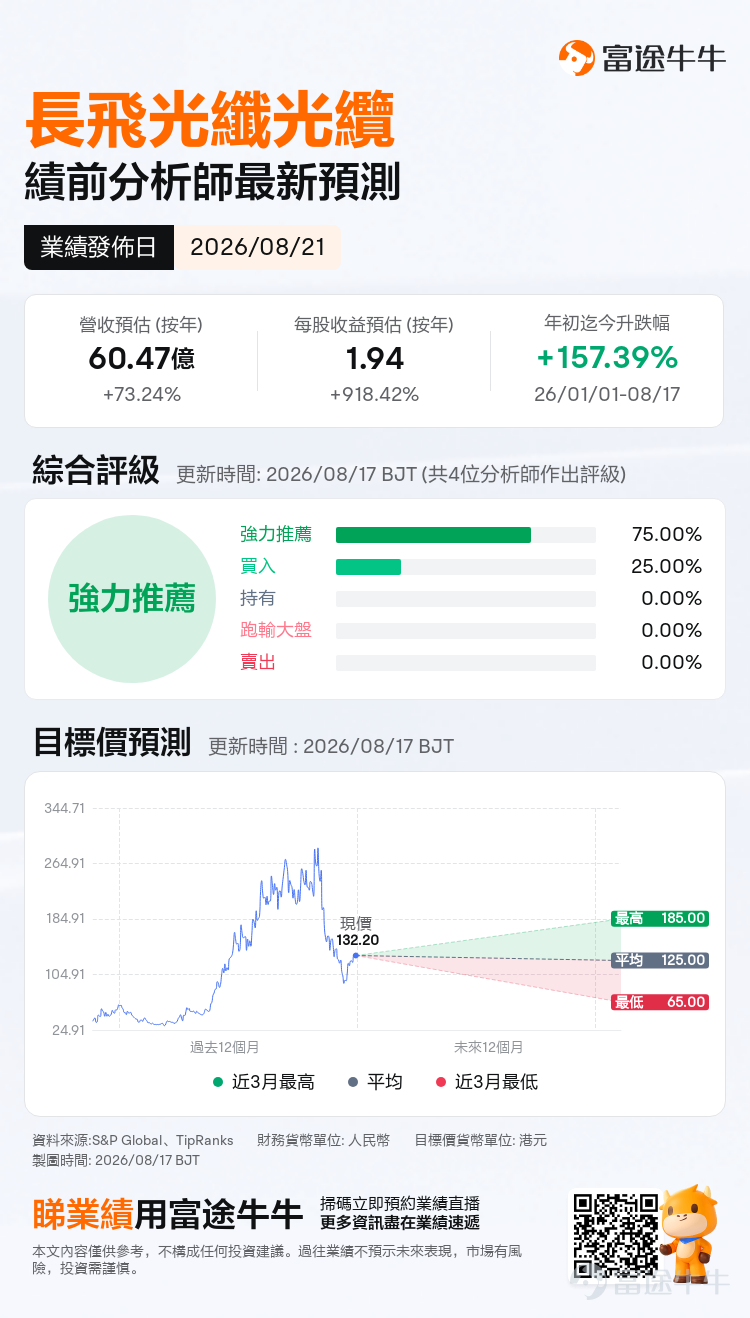
Infographic Preview | YOFC's interim results to be unveiled on Friday! Profit alert: Net profit expected to surge by up to 9 times. Can rising fiber optic prices and AI demand create a "double boost"?
$YOFC (06869.HK)$The earnings report is scheduled for release on Friday, August 21 (Beijing Time). Institutional consensus forecasts Q2 2026 revenue at RMB 6.047 billion, a year-on-year increase of 73.24%; and EPS at RMB 1.94, a year-on-year surge of 918.42%.
The company had previously issued a profit warning upgrade, forecasting net profit attributable to shareholders for the first half to be approximatelyRMB 2.4 billion to RMB 3.0 billion, representing a year-on-year growth of 711% to 914%; while net profit attributable to shareholders excluding non-recurring items is expected to range from RMB 2.0 billion to RMB 2.6 billion, up 1,349% to 1,784% year-on-year.
The company stated that the substantial performance growth was primarily driven by the accelerated construction of computing power data centers, which boosted demand for new types of optical fibers and cables both domestically and internationally. Additionally, improved supply-demand dynamics in the industry, expansion of core customers, and optimization of the product mix collectively enhanced profitability.
Key points to watch in this interim report include:Behind this earnings explosion, how much contribution came from the cyclical recovery of traditional optical fiber and cable businesses, and how much from the new demand for optical fibers and optical interconnects driven by AI data centers?

1. Traditional Optical Fiber Sees Cyclical Reversal: Can Price Hikes Translate into Profit Elasticity?
Over the past two years, YOFC first experienced a typical downturn cycle in the optical fiber industry.
In the first half of 2025, the company's optical transmission product revenue was approximately RMB 3.85 billion, up 8.7% year-on-year, but the gross margin stood at only 29.6%, down 4.5 percentage points year-on-year. At that time, demand for standard single-mode fiber remained under pressure. China Mobile's centralized procurement volume for standard optical cables in 2025/2026 decreased by nearly 10% year-on-year, with the average winning bid price dropping about 26% year-on-year. Consequently, YOFC's share of winning bids fell from approximately 20% previously to around 14%.
However, after entering 2026, the industry's supply and demand environment reversed significantly.
Data from CRU, a commodity research firm, shows thatthe price of standard G.652.D single-mode bare fiber in China rose by more than 80% in just two months from November 2025 to January 2026.Beyond the recovery in demand, this was driven by tighter supply of optical fiber preforms and manufacturers shifting more drawing capacity to higher-margin data center-related products such as G.657.A2, further squeezing the supply of standard optical fiber.
This means that the profit logic for Yangtze Optical Fibre and Cable's (YOFC) traditional business is shifting from the previous"volume increase with price decline" model to one characterized by "improved supply-demand dynamics + price repair."
Therefore, the first key metric to watch in this interim report isthe extent of improvement in revenue and gross margin for optical transmission products.If price increases for standard optical fiber can be successfully passed through to orders, while preform and fiber production capacities maintain high utilization rates, price repair could bring significant profit elasticity even if traditional telecom demand does not see explosive growth. In other words, the biggest highlight for traditional business in Q2 ishow much profit YOFC has regained from rising fiber prices.
2. Can the high-end optical fiber and optical interconnect businesses driven by AI sustain their high growth?
Compared to the cyclical recovery of standard optical fibers, the market's higher expectations for YOFC stem fromstructural demand growth driven by AI data centers。
CRU points out that AI and hyperscale data centers have become the strongest source of incremental demand in the global optical fiber and cable market. As GPU cluster scales continue to expand, the required fiber density within data centers, between campuses, and for data center interconnections is rising rapidly. Demand for low-bend-loss fibers such as G.657.A1/A2, high-fiber-count cables, and other high-specification products is growing significantly faster than in the traditional telecommunications market.
YOFC has already begun to reflect this shift.
In the first half of 2025, the company'soptical interconnect component business generated revenue of approximately RMB 1.44 billion, a year-on-year increase of 54.6%, with a gross margin of 40.7%, up 18 percentage points year-on-year; full-year revenue from optical interconnect components further reached RMB 3.144 billion, a year-on-year increase of 48.6%. This business segment includes optical devices, optical modules, Active Optical Cables (AOC), MPO patch cords, and high-speed copper cables, directly benefiting from AI data center construction.
Entering 2026, the high growth trend continues. YOFC's subsidiary $EverProX Technologies (300548.SZ)$ is expected to achieve net profit attributable to shareholders in the first halfRMB 280 million to RMB 345 million, representing a year-on-year increase of 66.5% to 105.1%The company explicitly stated that the primary drivers were the sustained expansion of global computing power demand and robust demand for data communication products.
Meanwhile, AI-driven demand is beginning to extend from optical modules upstream to optical fiber materials.
The company is currently expanding its product portfolio to include G.654.E, G.657 series, mid-to-high-end multimode fibers, polarization-maintaining fibers, and hollow-core fibers. Among these, G.654.E has already entered scenarios involving carrier networks and interconnections for computing data centers, while polarization-maintaining fibers are benefiting from advancements in silicon photonics and CPO (Co-Packaged Optics) technologies.
However, hollow-core fiber remains in the early stages of commercialization and should currently be viewed as a source of future incremental growth.It is inappropriate to attribute the surge in first-half profits primarily to hollow-core fiber.
Therefore, the second most noteworthy data point in this earnings report is:Whether the revenue share of AI-related new optical fibers and optical interconnect products has continued to rise significantly.If the company's Q2 profit explosion stems not only from price hikes in standard optical fibers but also accompanies rapid growth in high-margin optical interconnect components and new optical fiber revenues, then the quality of this earnings improvement will be substantially higher than that of a traditional cyclical rebound.
Summary: A significant Q2 profit increase is virtually certain; the key is to assess the 'quality' of this growth.
Two key logics behind YOFC's high growth:
The first is the cyclical logic: Can the tightening supply and demand, along with rising prices for standard optical fibers and preforms, drive a significant recovery in the gross margin of the optical transmission business?
The second is the growth logic: Can new types of optical fibers (such as G.657 and G.654.E) driven by AI data centers, as well as optical interconnect products like optical components, optical modules, and AOCs, continue to maintain rapid growth and further increase their contribution to revenue and profits?
If both materialize simultaneously, YOFC's current performance improvement will not merely be a traditional 'fiber optic price hike cycle,' but will form:A 'dual drive' of an upcycle in traditional fiber optics plus structural upgrades in AI optical communications.
Therefore, three key figures should be closely monitored in the interim report:The gross margin of optical transmission products, the revenue growth rate of optical interconnect components, and management's outlook on the supply, demand, and pricing of new optical fibers for the second half of the year.These three indicators may be more decisive in determining whether this round of high growth can extend into the second half of the year.
 AI breaks down earnings highlights in seconds—set up in three stepsOptions strategies! Open Futubull > Stock page > Tap [Company] >Earnings Flash
Editor/Rocky
Risk Disclaimer: The above content only represents the author's view. It does not represent any position or investment advice of Futu. Futu makes no representation or warranty.Read more

Comments
to post a comment
4
2