Is the food delivery war coming to an end? Meituan's Q2 profits exceed expectations

Earnings Options Strategy | Key Highlights of Alibaba's Earnings! Is 45% Cloud Growth Just a Passing Grade? Loss Reduction in Flash Sales Becomes Another Decisive Factor
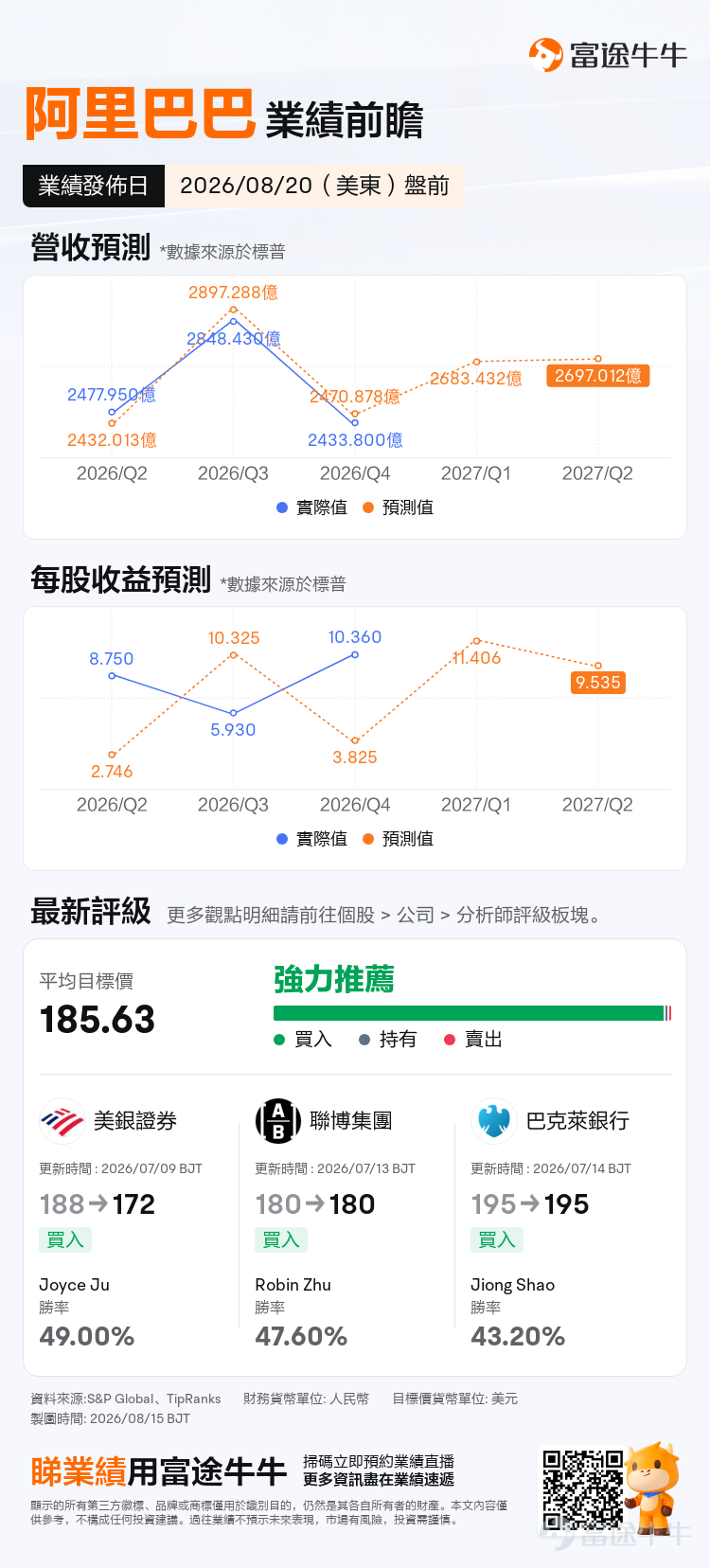
$BABA-W (09988.HK)$ Scheduled forBefore the US stock market open and after the HK stock market close on August 20Announcing Q1 FY2027 earnings, corresponding to Q2 calendar year 2026.
The key drivers for this earnings report are quite clear:On the surface, the market is watching whether profitability can recover from last quarter's trough. However, what truly determines the stock price is whether the AI cloud business can continue to accelerate and whether Taobao Flash Sales can rapidly reduce losses.
As of August 17, Alibaba's US shares closed at approximately $124.7, rebounding more than 30% from the recent low of around $95 in late June. In other words, the market has already priced in positive factors such as cloud business acceleration and loss reduction in flash sales. "Decent results" may not be enough to push the stock price higher; this time, we need to see a new expectation gap.
Profitability is expected to recover significantly, but the market is more concerned about the quality of the recovery.
Current market consensus expects Alibaba's revenue for this quarter to be approximatelyRMB 268.3 billion,representing a year-on-year increase of about 9%; EPS is expected to be 11.406.
Compared to the adjusted EBITA of only about RMB 5.1 billion in the previous quarter, the market expects adjusted EBITA for this quarter to be approximatelyRMB 26 billion,Profits are expected to recover significantly quarter-over-quarter, but may still decline by approximately 30% year-over-year. This is not due to a sudden weakening of core business, but rather because strategic investments in AI infrastructure, Qwen, and instant retail remain at high levels.
Therefore, this earnings report should not be viewed solely through the lens of "significant quarter-over-quarter profit growth." The market is more concerned with:Whether the high growth in cloud business has begun to generate operating leverage, and whether loss reduction in flash sales can enable the group's profitability to truly surpass the peak investment phase.

Alibaba Cloud's 45% growth is quite impressive even in the context of the global cloud market.
Last quarter, Alibaba Cloud's revenue reached RMB 41.63 billion, a 38% year-over-year increase, with external customer revenue growing by 40%. AI-related products already account for approximately 30% of external cloud revenue. Market sentiment is relatively optimistic this quarter, with Alibaba Cloud's revenue expected to be around RMB 48.4 billion,representing a year-over-year growth of approximately 45%.。
This figure is worth examining in the context of the entire cloud computing industry.
Amazon's recently announced results for Q2 2026 show that AWS revenue grew year-over-year37%, marking the fastest growth rate in 18 quarters. Management also clearly stated that AI and traditional cloud demand are mutually reinforcing.
The revenue structures and disclosure methodologies of the two companies differ, so simple horizontal comparisons are not appropriate. However, if Alibaba Cloud indeed achieves approximately 45% growth, it means its growth rate has not only accelerated further from the previous quarter's 38%,The surface growth rate is even higher than that of AWS, which is currently experiencing rapid growth.。
This is also the aspect of this earnings report most worthy of maintaining positive expectations.
The market no longer doubts whether AI can drive Alibaba Cloud to re-accelerate; the bigger question has become:Is 45% the new growth platform? Can it continue to maintain over 40% in the next quarter, or even approach 50%?
Therefore, around 45% seems to be the current market benchmark. If the final figure is only around 40%, the market may be disappointed even if the group's revenue meets expectations; conversely, if the growth rate approaches 47% to 50% while the Cloud EBITA margin breaks through 12%, the implication for valuation could be far more significant than a slight beat in group revenue.
Only when 'revenue acceleration + margin expansion' occur simultaneously does it truly prove that AI workloads are not just about trading price for volume, but are beginning to achieve economies of scale.

Alibaba FY26 Q4 Earnings Presentation Materials
AI is transitioning from 'model capabilities' into the 'commercialization validation phase'.
Besides Cloud revenue, there is another quite important metric this time:ARR for AI models and application services.
Alibaba clearly stated last quarter that the Annualized Run Rate (ARR) for its AI models and application services, including Model Studio, is expected to reach in the June quarterover RMB 10 billion, and reach by the end of 2026RMB 30 billion. Therefore, we have now reached the point where we can directly verify whether this target has been met.
If the ARR just exceeds RMB 10 billion, it would broadly constitute meeting the original target; if it is significantly higher than RMB 10 billion, or even leads to an upward revision of the year-end target to RMB 30 billion, that would represent a stronger positive expectation gap.
More importantly, Alibaba continued to rapidly advance its model capabilities within this fiscal quarter.
Qwen3.7-Max, launched in May, further enhanced Agent, Coding, and long-text capabilities; the June update added multimodal understanding, with a context window of up to 1 million tokens. Qwen3.7-Plus also went live in June, focusing on lower-cost multimodal Agent capabilities, aiming to further drive model adoption in practical enterprise applications.
After the fiscal quarter ended, Alibaba launched Qwen3.8-Max in early August. This is one of Alibaba's largest models to date, adopting a Mixture of Experts (MoE) architecture to enhance capabilities while controlling inference costs; the model's release also significantly boosted market expectations for Alibaba's AI capabilities at the time.
The significance of these developments goes beyond just 'Qwen releasing another new model.'
For the capital markets, what truly needs to be verified is:Enhanced model capabilities → Increase in developers and enterprise clients → Rise in Token/API usage → Growth in AI Annual Recurring Revenue (ARR) → Improvement in Cloud revenue and profit margins.
Only if this value chain continues to function effectively can Alibaba's AI investments truly translate into valuation. Meanwhile, Alibaba possesses the Qwen foundation model, its self-developed T-Head AI chips, inference platforms, and the scale effects of Alibaba Cloud. By jointly optimizing models, chips, and cloud infrastructure, it can continuously reduce inference costs and improve efficiency. This is also a key reason why the market has higher expectations for Alibaba Cloud's growth and margin improvement.
Competition in open-source models is intensifying; Alibaba's advantage cannot rely solely on "model leaderboards."
On the other hand, we must also recognize that competition among domestic large language models is rapidly escalating.
Players such as DeepSeek, Moonshot's Kimi, Zhipu's GLM, and ByteDance are iterating rapidly. Chinese open-source models are quickly expanding their global influence by leveraging lower costs and higher customizability; models like Kimi and GLM are already rapidly approaching top-tier closed-source models in capabilities such as coding and agents.
The ATOM Report, released this year and analyzing Hugging Face download volumes, derived models, and inference usage, also points out that since 2025, Chinese open-source models have surpassed their U.S. counterparts in several open-source ecosystem metrics, with Qwen and DeepSeek being core driving forces.
This presents both opportunities and pressures for Alibaba.
The opportunity lies in the fact that Qwen has already established a substantial global developer ecosystem, and the open-source model facilitates rapid penetration; however, the pressure stems fromthe rapid commoditization of the models themselves.As DeepSeek, Kimi, and GLM continue to enhance performance and lower prices, relying solely on leading model benchmarks makes it difficult to establish a long-term moat.

Therefore, Alibaba's true differentiation lies in its comprehensive underlying commercial infrastructure:
Qwen models + Model Studio + Alibaba Cloud computing power + enterprise clients + application scenarios such as Taobao and DingTalk.
A recent analysis of Alibaba's AI strategy by the Financial Times also pointed out that the company is shifting its focus more clearly from merely expanding open-source influence to Model-as-a-Service (MaaS) and monetizable AI products.
This is why, in this earnings report,the importance of AI ARR actually outweighs announcing another new model benchmark.
Whether Qwen can win every model ranking may not be the most important factor; what the market cares about most is whether it can convert its massive open-source user base and enterprise demand into Cloud revenue.
Can Taobao Flash Sales truly "stop the bleeding"?
Another variable directly affecting the group's profitability is instant retail.
The market currently expects instant retail revenue for this quarter to be around RMB 20.5 billion, maintaining relatively fast year-on-year growth; more importantly, the market estimates that the single-quarter loss may narrow rapidly from approximately RMB 18 billion in the previous quarter toaround RMB 10 billionThe aforementioned loss figures are market estimates, not officially disclosed by the company.
The market is now less concerned about whether orders can hit new highs, and more focused on:Whether orders and market share can be maintained after subsidy reductions, while per-order losses continue to improve.
Management previously expressed confidence that the unit economics model for instant retail would turn positive by the end of FY2027.
The external competitive environment has also improved compared to last year. Regulators have introduced stricter rules against excessive subsidies and price wars among food delivery platforms, reducing the tail risk of platforms falling back into endless subsidy battles.
Therefore, for Alibaba, the ideal outcome is not simply "burning less cash," but rather proving:Subsidies decrease, orders remain stable, and UE (Unit Economics) continues to improve.
If this is achieved, the market's perception of Taobao Flash Sales may shift from a "profit black hole" back to viewing it as a tool that enhances Taobao's user engagement frequency and value as a consumption entry point.
Core e-commerce still faces pressure; don't be alarmed by the superficial decline in CMR.
China's consumption environment remains weak. In the first half of 2026, total retail sales of consumer goods grew by only 1.3% year-on-year, with June growth at 1.0%; the growth rate further dropped to 0.6% in July.
Therefore, whether Taobao and Tmall can maintain their market share this quarter is more important than simply pursuing high growth.
Meanwhile, this quarter's CMR is also affected by accounting treatments. Since some merchant subsidies have been changed to directly offset revenue, the reported CMR may show a significant year-over-year decline, but this should not be directly interpreted as a simultaneous deterioration in Taobao's monetization capability.
In the previous quarter, the company disclosed that CMR on a comparable basis actually grew by approximately 8% year-over-year.
Therefore, after the earnings report is released, what deserves more attention isthe growth of CMR (Customer Management Revenue) on a comparable basis and GMV trends. If positive growth can still be maintained in the current weak consumption environment, it would instead demonstrate that the core e-commerce business retains resilience in terms of market share and monetization capability.
How much volatility has already been priced in by the options market?
Prior to the earnings release, short-term option volatility for Alibaba has risen significantly.
Based on market data after the close on August 17, the total premium for the $125 Call and Put options expiring on August 21, which are near at-the-money, is approximately$8.5Corresponding to an underlying stock price of approximately $124.7, this reflects that the market is pricing inan earnings report volatility of approximately ±6.5%.The implied volatility for the same set of near-at-the-money options is currently above 80%.

This implies that while earnings options are not cheap, they do not anticipate a massive swing exceeding 10%. Even if your directional view is correct, buyers may still suffer losses if the actual stock price movement is smaller than the magnitude already priced in by the options market, due toIV crush and rapid time decay.Impact.
Two approaches to playing the earnings move:
If you have a bullish outlook on Alibaba's earnings but are concerned about the high IV of short-term options, consider using aBull Call Spread: Buy a near-at-the-money Call and simultaneously sell a higher-strike Call.
Compared to buying a Call outright, this strategy reduces premium costs and mitigates some IV risk, though it caps maximum profit. Given that the market has already priced in some positive news, the risk-reward profile of a spread strategy may be easier to manage than chasing high-IV single-leg Calls.

Another strategy is suitable for investors who are already willing to hold Alibaba for the medium term:Covered CallFor investors who already hold Alibaba, they can sell a proportionate amount of higher-strike Calls against their holdings to collect premiums by leveraging the elevated implied volatility (IV) ahead of the earnings report.
However, if earnings significantly exceed expectations and the stock price surges above the strike price, the shares may be called away, capping the upside potential. Conversely, if the stock plunges, the premiums received will only provide limited downside protection.

This time,$Alibaba (BABA.US)$ the most critical aspect of the earnings report isn't whether group revenue beats estimates by a few percentage points, but rather whether the following three conditions can be met simultaneously:Alibaba Cloud maintains growth of around 45% or even faster, while simultaneously improving profit margins; ARR from AI models and applications meets or even exceeds original targets; and Taobao Flash Sales rapidly reduces losses while maintaining its business scale.
Currently, Alibaba Cloud remains the primary source of positive expectations. If its growth rate approaches 45%, it would still stand out significantly in the global cloud market context, where AWS has re-accelerated to 37%. Furthermore, if AI ARR and Cloud Margins also exceed expectations, the market may further raise the valuation of Alibaba's AI assets.
Disclaimer
Short-term options carry higher risk. As expiration approaches, time decay accelerates and price sensitivity increases,and positions may quickly move against you. SOXL and TQQQ are 3x leveraged products,which further amplify volatility. Combining leverage with short-term options can magnify both gains and losses. Please carefully manage your position size and clearly define your risks before entering a trade.
This content does not constitute an offer, solicitation, recommendation, opinion, or any form of guarantee regarding any securities, financial products, or instruments. The risk of loss in trading options can be substantial. In certain circumstances, your losses may exceed the initial margin deposit. Even if you place contingent orders such as 'stop-loss' or 'limit' orders, there is no assurance that losses will be avoided, as market conditions may prevent execution of these orders. You may be required to deposit additional margin on short notice. If you fail to meet such margin calls within the stipulated time, your open positions may be liquidated. You remain fully liable for any resulting deficit in your account. Therefore, prior to trading options, you should thoroughly research and understand how options work and carefully consider whether such trading aligns with your financial situation and investment objectives. If you trade options, you should become familiar with the procedures for exercising options and handling expiration, as well as your rights and obligations upon exercise or expiration. Options trading involves significant risk and is not suitable for all investors. Investors should carefully read"Characteristics and Risks of Standardized Options"。
Finally, Options Sir has a small giveaway for fellow investors—feel free to claim it!Options Starter Pack
*This promotion is exclusively available to invited Hong Kong users. Click to learn more.Detailed terms and conditions of the promotion >>
Market conditions are complex and ever-changing,Options strategiesToo many choices and unsure how to proceed? Let Futubull help you build a strategy in three simple stepsOptions strategies, making investing simple and efficient!

Risk Disclaimer: The above content only represents the author's view. It does not represent any position or investment advice of Futu. Futu makes no representation or warranty.Read more


Comments (3)
to post a comment
54
106