HK Stock Market Barometer | HK stocks continue to fluctuate and pull back! How much room for recover

Earnings Preview | Pop Mart to Report Results on Thursday! Can the Interim Report Alleviate Market Growth Concerns Amid a Deliberate Slowdown in the "Post-Blockbuster Era"?
$POP MART (09992.HK)$ The interim results for 2026 will be announced on August 20 (this Thursday).According to Bloomberg consensus estimates, revenue for the first half of 2026 is expected to reach RMB 19.9754 billion, compared to RMB 13.8763 billion in the same period last year; adjusted net profit is projected at RMB 5.9806 billion, up from RMB 4.7096 billion a year earlier.
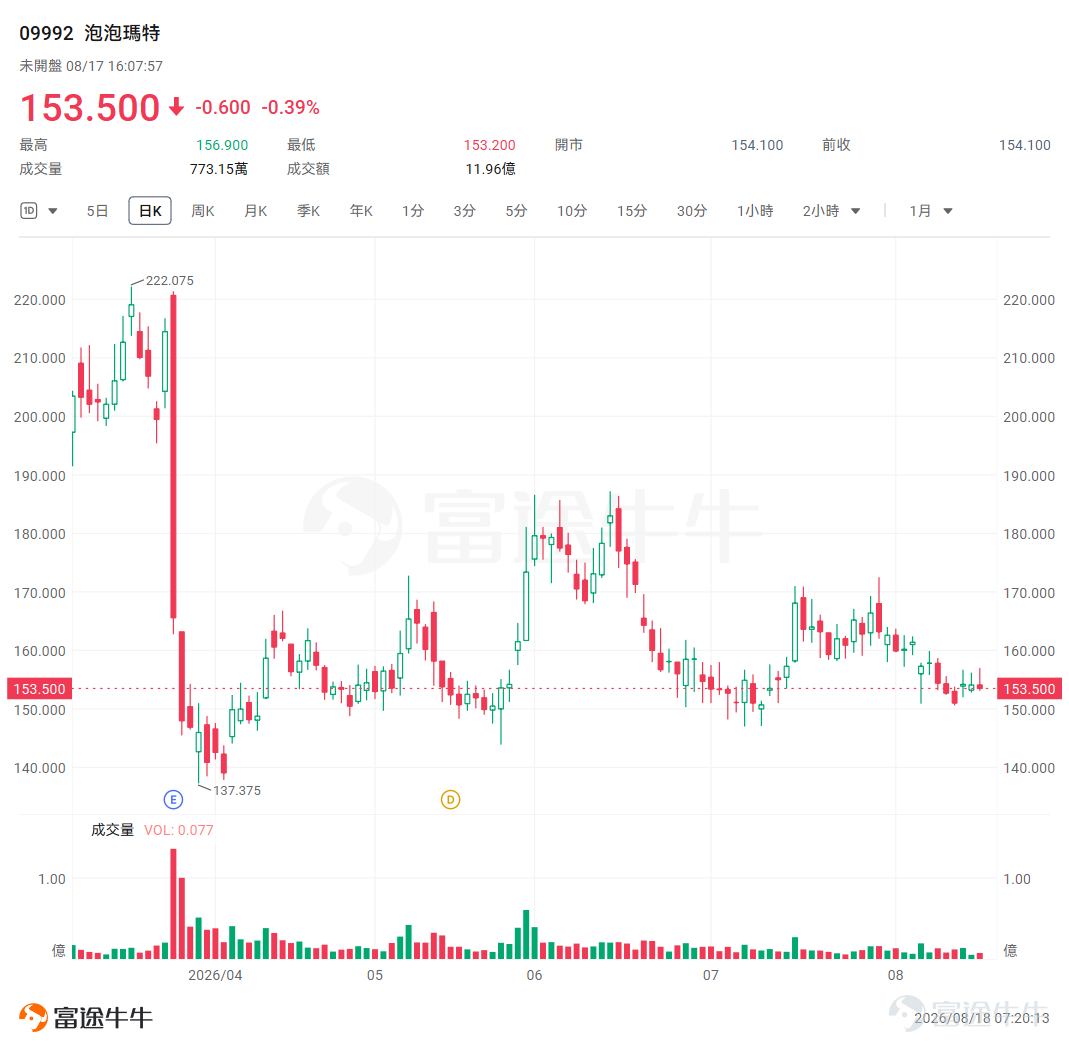
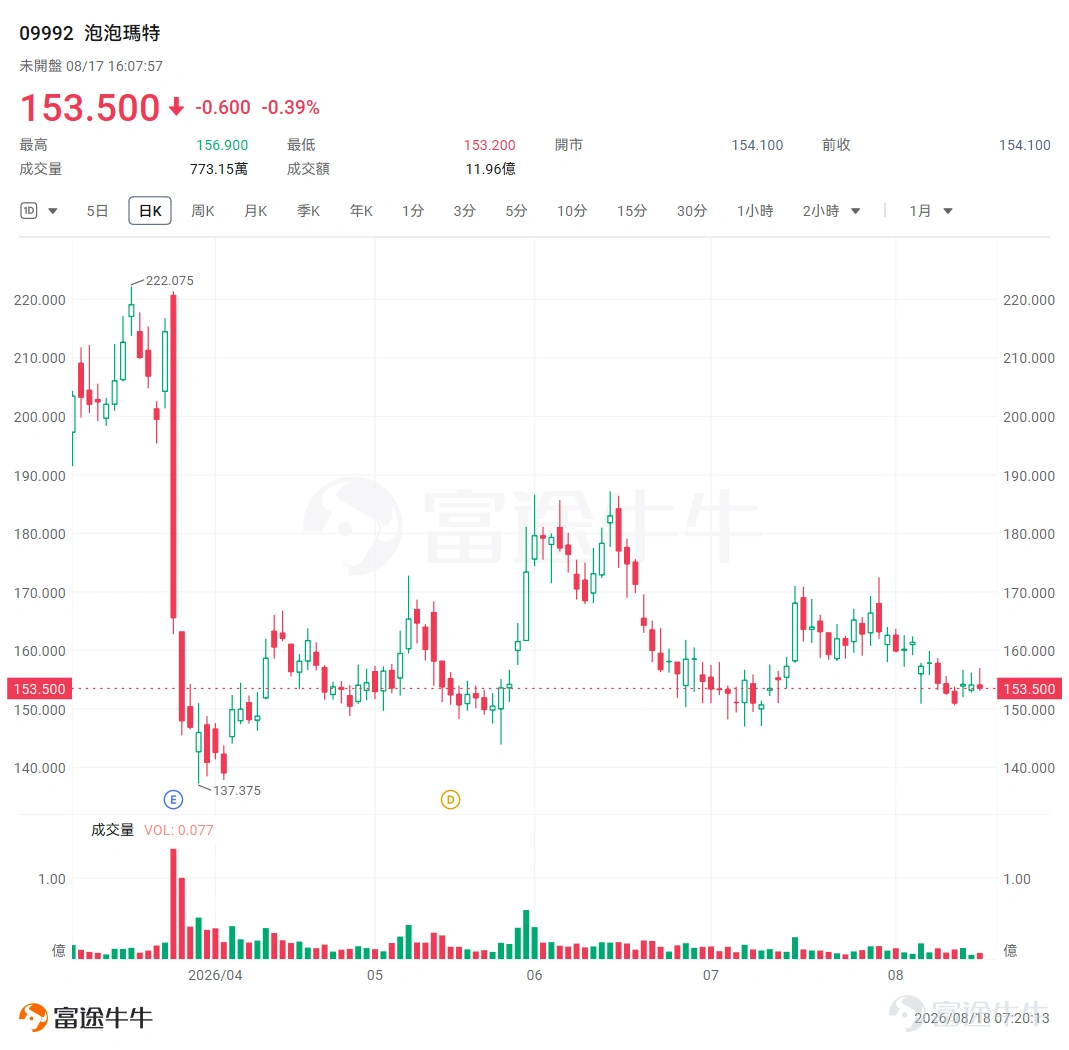
As one of the most discussed consumer stocks in the Hong Kong market, Pop Mart has seen a noticeable decline in traffic and sales pullback following the global viral success of LABUBU last year. In March, Pop Mart released its full-year 2025 results, which missed the market's high expectations, causing a sharp drop in its share price, which fell more than 30% cumulatively over the two days following the earnings release. Subsequently, several institutions, including UBS Group and Morgan Stanley, downgraded their future growth expectations for Pop Mart, while Duan Yongping increased his holdings multiple times, leading to a volatile trading pattern for Pop Mart's stock.
For this earnings report, the core focus lies on the growth rate correction in the 'post-blockbuster era' and the quality of global operations.As the phenomenal hype around Labubu and other IPs stabilizes, the market is evaluating the company's稳健 performance after it actively 'hit the brakes' to slow down growth.
Pop Mart Actively Slows Growth
In 2025, driven by the explosive popularity of phenomenon-level IPs like Labubu, Pop Mart's performance grew exponentially. After experiencing ultra-high-speed growth in 2025, Pop Mart proactively slowed its pace. At the 2025 annual results press conference,Wang Ning defined 2026 as a 'consolidation year,' significantly lowering the company's revenue growth target for 2026 from last year's 184.7% to 'no less than 20%'.
Wang Ning likened 2026 to an F1 race car's 'pit stop for refueling and tire changes,' aiming to build momentum for long-term globalization and IP lifecycle management rather than merely pursuing short-term speed. The proactive downward revision of expectations previously triggered stock price volatility, with some investors concerned about the slowing narrative of high growth.
Unaudited data for the first quarter released by Pop Mart in May this year showed that,Overall revenue continued to maintain high year-on-year growth of 75%–80%, indicating that actual momentum is stronger than conservative guidance.
Specifically, revenue in the China market grew 100%–105% year-on-year, with online channels in China surging 150%–155%, reflecting performance that "exceeded expectations." In contrast to the doubling or even multi-fold growth seen last year, overseas growth slowed significantly in the first quarter. The Americas, Europe, and other regions achieved growth of over 55%, while the Asia-Pacific region excluding China grew by only 25%–30%.
Challenges Following the Growth Slowdown
– Is the Labubu IP Lifecycle Peaking? Can Over-Reliance on a Single Asset Be Resolved?
Deutsche Bank warns that the lifecycle of Labubu, Pop Mart's phenomenal IP, may have peaked, suggesting that Pop Mart's era of high growth could be reaching an inflection point. With the launch of new products (such as the Labubu 4.0 series) and a significant increase in production capacity, market premiums for certain products have narrowed, leading to a decline in secondary market prices.
In the Chinese market, Pop Mart recently introduced tiered discounts and launched "lucky bags" containing multiple products through its official flagship stores on Taobao/Tmall during the 618 shopping festival. Deutsche Bank noted that the Labubu World Cup series was included in every four lucky bags, implying that actual sales conversion for this series was weaker than previously expected.
In 2025, revenue from The Monsters family, centered around Labubu, surged significantly, exceeding RMB 10 billion, making it the company's most critical pillar IP. In contrast, Molly, the veteran flagship IP, underperformed relative to market expectations. This highly concentrated IP structure means that once enthusiasm for Labubu wanes, the risk of overall operational volatility cannot be ignored.According to Bloomberg consensus estimates, revenue from The Monsters family will reach RMB 14.5097 billion in 2026, with its share declining from 38.1% in 2025 to 33.3%.
Pop Mart leverages the uncertainty premium generated by its blind box mechanism and the amplification effect of social propagation to achieve rapid product volume scaling and inventory turnover within short cycles. While this model is highly efficient in the consumer sector, its inherent flaws are also evident: once the lifecycle of a hit product enters a decline phase, growth faces immediate pressure.
For Pop Mart to truly eliminate its "Labubu dependency," relying on the growth of a single category is insufficient. The key lies in whether it can cultivate another flagship IP of comparable scale, or strengthen the competitive foundation of its overall IP matrix through strategies such as IP collaborations, content development, and theme park initiatives.
– Can overseas expansion transition from "explosive growth" to "deepened operations"?
The overseas market has been Pop Mart's biggest highlight in recent years. In 2025, the proportion of overseas revenue increased significantly, with total company revenue growing by 185% and overseas sales surging by 291.9%, raising its share of total revenue to 43.8%. Among these, the Americas market saw particularly rapid growth, with year-on-year revenue increasing by 748.4%. According to Pop Mart's official data, by the end of Q1 2026, there were 208 overseas stores, including 26 newly opened stores. Currently, the US market has 67 stores, with 12 new openings, making it the market with the largest number of overseas stores.
In Q1 of this year, Pop Mart's overseas market growth slowed significantly compared to the doubling or even multi-fold growth rates seen last year. However, the Americas, Europe, and other regions still achieved growth of over 55%.According to Bloomberg consensus estimates, Pop Mart's revenue for the first half of 2026 is projected to be RMB 12.0467 billion in the Chinese market, RMB 3.4957 billion in the Asia-Pacific region, RMB 2.7259 billion in the Americas, and RMB 792.1 million in Europe and other regions. For the same period last year, revenues in these regions were RMB 8.2828 billion, RMB 2.8509 billion, RMB 2.2649 billion, and RMB 477.7 million, respectively.
Pop Mart's Chief Operating Officer previously stated that while the overseas business expanded rapidly over the past two years, driven by a surge in new users, both customers and overseas employees have limited understanding of designer toy culture and IP. Consequently, as traffic subsided, sales retreated significantly, which has become the core challenge for the current overseas business.
Pop Mart is at a critical turning point, transitioning from "explosive growth" to "deepened operations" overseas. Success largely depends on its capabilities in refined operations, diversified business models abroad, and localized compliance management. The market's focus is on whether Pop Mart can establish more mature local operational capabilities overseas following its period of rapid expansion.
Other businesses such as desserts and theme parks
POP BAKERY is an independent dessert brand under Pop Mart, integrating popular IPs like Molly, Labubu, Dimoo, Skullpanda, and Star People into light dining offerings. It focuses on creating a composite experience that combines trendy IPs with food. This marks Pop Mart's business model upgrade from single-product designer toy sales to "IP experiential consumption," although it is not currently expected to contribute significantly to revenue.
Since POP BAKERY launched its first offline pop-up store at Beijing Capital International Airport late last year, nearly 40 pop-up dessert carts have been deployed in major domestic cities such as Beijing, Shanghai, Shenzhen, and Chengdu within just over six months. In June this year, the first permanent POP BAKERY store opened in Aranya; by late July, the first Southeast Asian store opened in Sentosa, Singapore.
POP LAND is Pop Mart's urban theme park project. In 2026, Phase 1.5 of POP LAND will be completed, adding several attractions including "Flying Labubu." In 2027, POP LAND will enter the mythical expansion phase of Phase 2, introducing themed scenes featuring SKULLPANDA and Star People.
From a short-term financial return perspective, the theme park business incurs high capital expenditures and operating costs, meaning its profitability may not outperform the retail segment. However, structurally, IP-embedded theme parks possess unique competitive advantages that deepen IP value and empower long-term growth.
Risk Disclaimer: The above content only represents the author's view. It does not represent any position or investment advice of Futu. Futu makes no representation or warranty.Read more


Comments
to post a comment
3
1