Is the food delivery war coming to an end? Meituan's Q2 profits exceed expectations

Chart Preview | Kuaishou's Q2 earnings to be released on Wednesday! Share price under pressure hits year-to-date low; can Kling AI help reverse the downturn?
Key variables determining Kuaishou's stock price trajectory will include the revenue growth rate of Kling AI in Q2, progress in overseas users and enterprise clients, and the extent to which computing power capital expenditures erode profit margins.
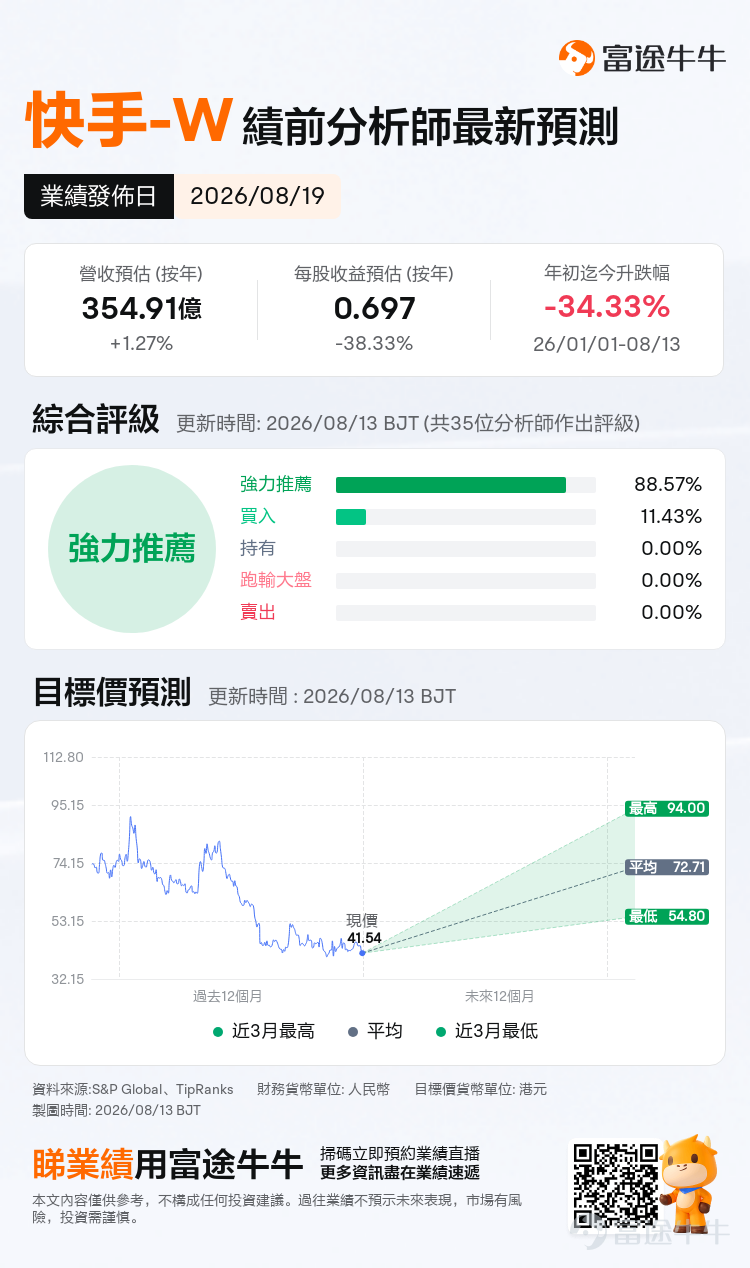
$KUAISHOU-W (01024.HK)$ Q2 earnings are scheduled to be released on Wednesday (Beijing time, August 19), with institutional expectations...$KUAISHOU-W (01024.HK)$Revenue reached RMB 35.491 billion in Q2 2026, a year-on-year increase of 1.27%; earnings per share were RMB 0.697, a year-on-year decrease of 38.33%.

Year-to-date, Kuaishou's stock price has experienced a deep correction.In Q1, investor sentiment shifted from chasing the valuation re-rating narrative driven by Kling AI to worrying about the erosion of short-term profitability by computing power capital expenditures. This, combined with the continuous decline in live streaming business and transparency concerns triggered by the cessation of e-commerce GMV disclosures, suppressed Kuaishou's valuation to historically low levels. Entering Q2, news in early July of Tencent reducing its stake by billions further impacted market sentiment,with the stock price briefly dipping to around HKD 40, hitting a new yearly low,as market divergence reached a阶段性 high point.

Online Marketing: AI empowers the core business, with growth showing a mild recovery.
Online marketing services constitute the fundamental base of Kuaishou's current revenue and are the core variable warranting the most attention in Q2.In Q1, revenue from this segment reached RMB 19.64 billion, a year-on-year increase of 9.3%, with its share of total revenue rising to 58.3%. The primary driver was the penetration of AI technology across the entire marketing chain, while marketing revenue per daily active user (DAU) increased by 7.9% year-on-year.
Looking at Q2, the advertising business is expected to continue its mild recovery trend:
On one hand, AI-driven recommendation models continue to optimize delivery efficiency. The number of merchants using paid traffic for sales grew by 38% year-on-year in Q1, and brand merchants' marketing spend increased by 42% year-on-year. The expansion of the merchant ecosystem provides support for advertising revenue;
On the other hand, e-commerce marketing services have benefited from the whole-domain traffic synergy strategy, with further deepening integration between organic and commercial traffic pools.
However, caution is warranted as a weak macro consumption environment and shrinking advertising budgets on e-commerce platforms (due to factors such as the food delivery price war) may suppress advertisers' willingness to spend. Market expectations......suggest that Q2 marketing revenue growth will likely remain in the single-digit to low double-digit range, making it difficult to replicate the previous high-growth momentum.
Live Streaming Business: Painful period of proactive adjustment; decline expected to narrow
The live streaming business is currently in a painful period of proactive adjustment. Q1 revenue was RMB 8.49 billion, down 13.5% year-on-year, with its share of total revenue falling to 25.2%, marking the fifth consecutive quarter of decline. Kuaishou's management attributed this to strategic choices aimed at proactively optimizing the content ecosystem, tightening compliance risk controls, and supporting premium content, sacrificing short-term GMV for long-term health.
Looking at Q2,The downward trend in live streaming revenue is likely to continue, but the decline is expected to narrow gradually.:
On one hand, stricter platform regulation on entertainment tipping and the cleanup of high-risk content will continue to suppress the gross merchandise value (GMV) of traditional show-style live streaming;
On the other hand, the expansion into new scenarios such as live commerce and paid knowledge services may provide a partial hedge. Overall, the live streaming business has transitioned from a past growth engine to a stable cash flow generator, with market expectations already well-priced in.
Key focus areas for Q2 include whether the decline narrows and whether the benefits of content structure optimization begin to materialize.
Other Services: E-commerce structure optimization, with Kling AI emerging as the biggest highlight
The 'Other Services' segment represents Kuaishou's most promising growth curve currently, driven by the dual engines of e-commerce and Kling AI, with the weighting of the AI narrative rising rapidly.
E-commerce: Structural upgrades behind the halt in GMV reporting
In terms of e-commerce, although the company stopped disclosing GMV data starting in Q1, structural indicators still show highlights: annual GMV growth for general shelf-based e-commerce reached 32%, brand merchants' omnichannel GMV grew over 25% year-over-year, and new and returning buyers on the mall page increased by approximately 36% in March, indicating strengthened user intent to shop proactively.
The e-commerce business is expected to continue its structural optimization trend in Q2. AI tools are empowering merchants to improve listing efficiency, driving structural growth in platform service fee revenue. However, slowing industry-wide growth and strengthened tax compliance regulations remain constraining factors.
Kling AI: User base surpasses 100 million, commercialization accelerates, and valuation reassessment is underway
Kling AI is the biggest highlight of Q2 earnings and the core variable driving Kuaishou's valuation restructuring.
In Q1, Kling AI's quarterly revenue exceeded RMB 650 million, a year-over-year surge of over 300%. Its annualized ARR approached USD 500 million in March, with commercialization validation exceeding expectations.
Entering Q2, Kling AI continues to maintain its rapid expansion momentum:As of June, global users surpassed 100 million, an increase of approximately 67% from 60 million at the end of 2025, covering 224 countries and regions. Corporate clients reached nearly 50,000, also up about 67% from year-end. Overseas markets contributed approximately 70% of revenue, with B-side API accounting for about 60%. Growth has been robust in overseas markets such as India, the US, and South Korea. The Kling 3.0 model achieved native 4K output first, placing its technical capabilities in the global top tier.
In early July, Kling AI completed external financing with a valuation exceeding RMB 100 billion. The market generally expects it to pursue an independent IPO in Hong Kong by 2027. Q2 revenue for Kling AI is projected to reach RMB 700-900 million, representing a quarter-on-quarter growth of 20%-30%, continuing its high-growth trajectory.
However, it is important to note that the high growth of the AI business comes with substantial computing power investments. The gross margin in Q1 dropped to 51.2% from 54.6% in the same period last year. The squeeze on profits from AI capital expenditures is the market's primary concern, and this pressure is likely to persist in Q2.
Intense bull-bear debate! Divergent views among major Wall Street banks
Major Wall Street institutions show significant divergence in their assessment of Kuaishou,with the core disagreement lying in the payback period for AI investments versus the pace of decline in traditional businesses.
Bank of America Securities maintains a 'Buy' rating with a target price of HKD 63, believing that Kling AI's completion of external financing brings spin-off expectations, which can alleviate Kuaishou's internal pressure from computing capital expenditures. It remains bullish on the value revaluation driven by AI assets.
Citi maintains a "Buy" rating with a target price of HK$72, acknowledging Keling AI's annualized ARR of nearly $500 million and strong commercialization momentum; however, it has lowered earnings forecasts, reflecting pressure on advertising and e-commerce businesses from the macro environment.
CICC assigns an "Outperform" rating with a target price of HK$72.8, believing that Kuaishou's core business foundation is solid and Keling AI has asset appreciation potential; earnings forecasts were lowered mainly due to increased investment in AI.
SPDB International maintains a "Buy" rating with a target price of HK$68, viewing Keling AI as the group's most explosive business segment. It raised revenue expectations for Q2 while warning of growth pressures on traditional core businesses.
Morgan Stanley holds a "Neutral" rating with a target price of HK$55, noting that the decline in gross margin exceeded previous model assumptions. It adopts a Sum-of-the-Parts (SOTP) valuation, applies a holding company discount to Keling AI's value, and lowers growth assumptions for core businesses.
HSBC Securities gives a "Neutral" rating with a target price of HK$65, taking a cautious view. It believes there is uncertainty regarding the ROI period for Keling AI, compounded by the continued contraction of the live streaming business, leaving little short-term earnings elasticity to support higher valuations.
Overall, Kuaishou's Q2revenue growth rate of Keling AI, progress in overseas users and enterprise clients, and the extent to which computing power capex erodes margins, will be the core variables determining the stock price trend.
 AI-powered earnings snapshot—key insights in three stepsOptions strategies! Open Futubull > Stock Page > Tap [Company] >Earnings Flash
Editor/lambor
Risk Disclaimer: The above content only represents the author's view. It does not represent any position or investment advice of Futu. Futu makes no representation or warranty.Read more
Comments
to post a comment
2