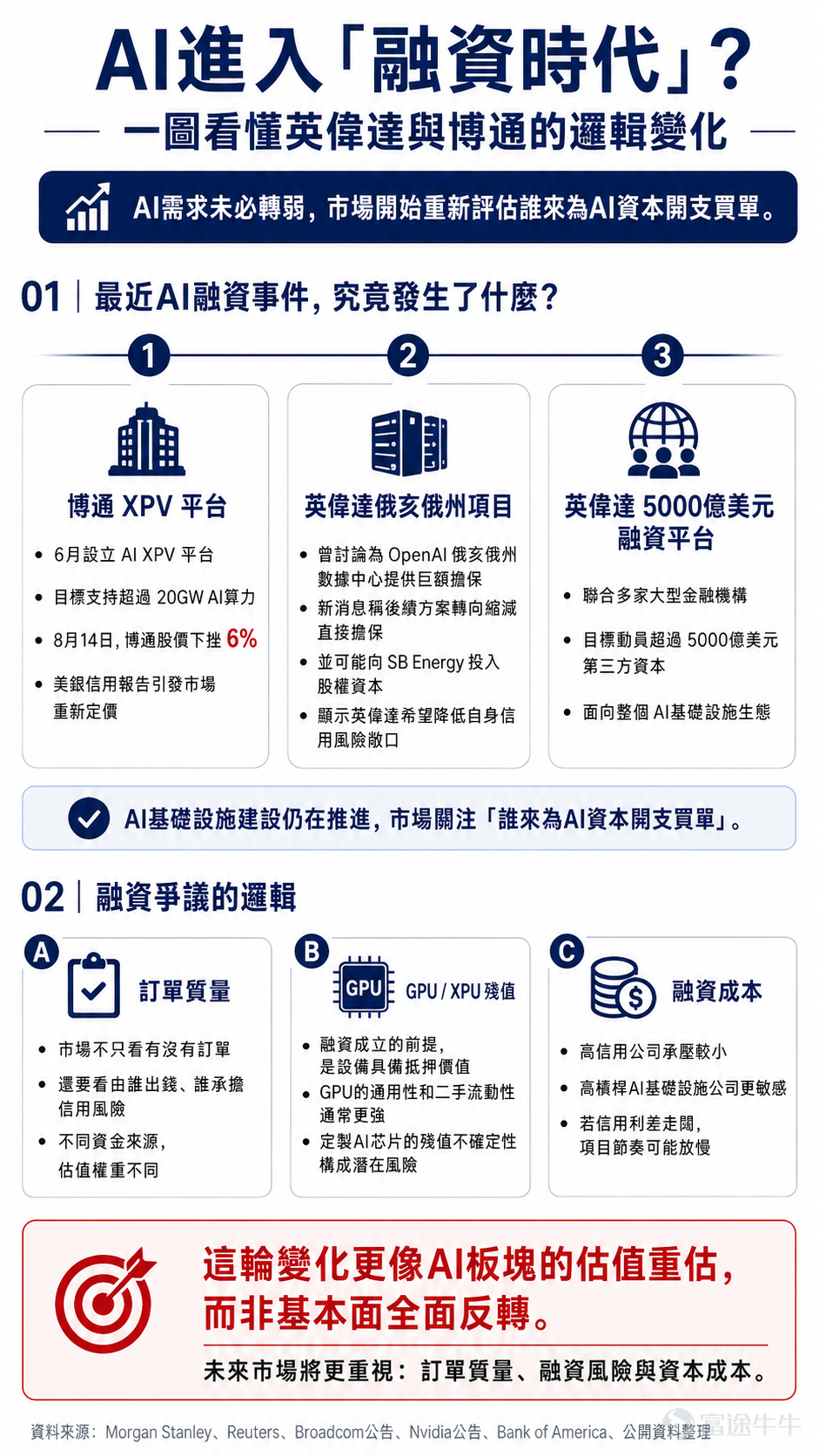
NVIDIA's revenue doubles, beating expectations; is the AI trade narrative making a comeback?

From NVIDIA to Broadcom, how will financing concerns impact valuations?
Last Friday, $Broadcom (AVGO.US)$ the stock price fell nearly 6% in a single day.The direct trigger was a credit report by Bank of America analysts, which estimated the potential debt scale hidden in Broadcom's AI XPV financing platform. The report stated that if expansion proceeds as planned to a capacity of 20 gigawatts, its guaranteed exposure could reach $370 billion by mid-2029, sparking market concerns.
1. From Broadcom to NVIDIA: Is AI Financing Becoming the Market Focus?
Recent events related to AI financing have been frequent.In late July, $NVIDIA (NVDA.US)$ it was also revealed that discussions were underway to provide massive financing guarantees for OpenAI's Ohio data center. Following the news, the stock price once dropped 5% in a single day;Last week, NVIDIA announced the establishment of a "computing power financing platform" with a scale exceeding $500 billion, jointly formed with six institutions including Apollo, BlackRock, and Blackstone,aiming for institutional capital to bear the primary financing needs of AI infrastructure. The stock price fell 2.8% on the day.
On the other hand, over the weekend, there were reports that the financing plan for OpenAI's Ohio project is also being readjusted, $NVIDIA (NVDA.US)$ The previously discussed guarantee cap of approximately $250 billion has now been reduced to under $120 billion for the initial phase. The agreement is expected to be signed as early as this weekend. It was also revealed that discussions are underway regarding an equity investment of up to approximately$3 billion into SB Energy, intended for the latter's large-scale AI data center project under construction in Ohio for OpenAI.
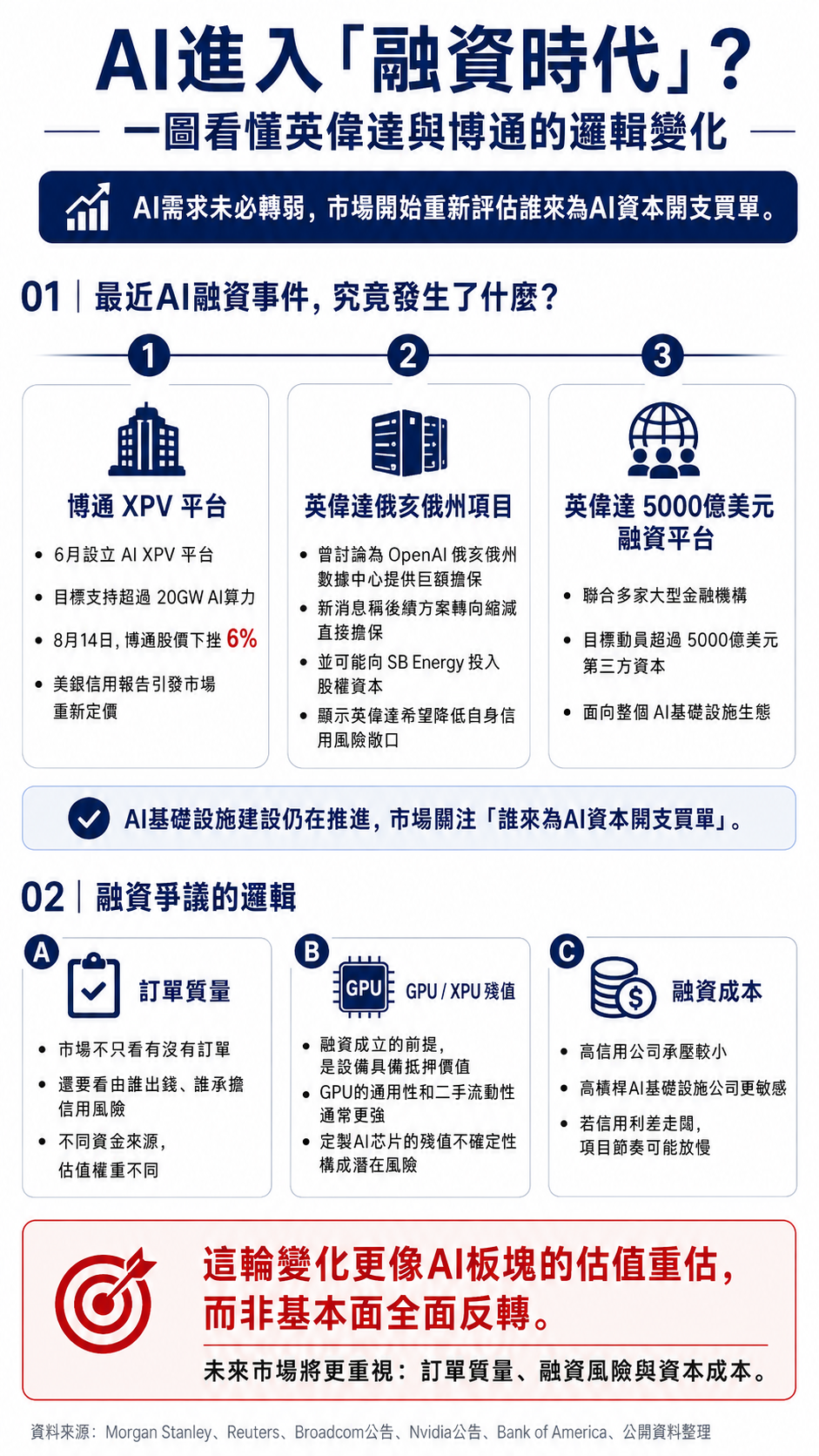
While these developments may seem fragmented, they all revolve around a single issue:AI capital expenditures are growing increasingly substantial post-2027, and tech companies' free cash flow alone will no longer suffice.
In its "Summer of AI Financing" report, Morgan Stanley noted that AI is gradually transitioning from a technology cycle to a capital cycle.It projects that capital expenditures for the four major hyperscalers—Microsoft, Alphabet, Amazon, and Meta—will increase by 57% year-over-year in 2027. Meanwhile, free cash flow will continue to be weighed down by capex in the short term, leading to a further widening of the financing gap by 2027.
At the same time, AI labs are experiencing robust revenue growth. According to Barclays' estimates, the annual recurring revenue (ARR) of AI labs is expected to exceed $200 billion by the end of 2026, roughly twice and five times the previous forecasts for OpenAI and Anthropic, respectively.The tension between surging demand for computing power and the tightening capital expenditures of cloud providers is creating conditions for the emergence of new financing structures.
2. The Logic Behind Financing Concerns: Order Quality, GPU Residual Value, and Financing Costs
(1) "Orders" no longer automatically equate to expected high-quality revenue
Morgan Stanley believes that financing costs and credit quality will increasingly impact the implementation of AI investments;In its stress tests for Broadcom XPV, BofA has directly incorporated customer default rates and chip residual values into its risk models. Therefore, for AI orders of the same scale, valuation certainty in the future must consider three factors: whether financing can be secured, whether end customers can sustain performance, and the recoverable value of GPUs/XPUs in the event of default.
In the past, investors seeing NVIDIA GPU orders, Broadcom XPU orders, or large data center contracts would typically convert them directly into future revenue expectations. Now, an additional layer of credit analysis is required behind these orders: Does the customer have sufficient cash flow? Who is providing the financing? Do chip manufacturers offer guarantees? If the end customer fails to perform, who bears the loss?
Therefore, the following scenario may emerge:Probability of Financing Closure × Customer Solvency × Chip Residual Value.
This means that for the same $10 billion AI order, the future valuation weight assigned to purchases made by Microsoft or Google using their own cash flows may not be identical to those made by a loss-making AI lab through highly leveraged SPV financing.
(2) The second risk stems from GPU and XPU residual values
There is a very important prerequisite for the entire financing system to hold:GPUs are a liquid form of collateral.
Bank of America believes that GPUs have better financing attributes compared to standard tech hardware.GPUs possess strong versatility and secondary market liquidity. Thanks to the CUDA ecosystem, GPUs can be migrated between different clients, and older models retain usage value. If an AI company defaults, its GPUs can theoretically be resold to other cloud providers or enterprises.
It also pointed out that the uncertainty surrounding the residual value of custom AI chips poses a potential risk.Unlike assets such as aircraft and servers, which have mature secondary markets, Broadcom's custom XPUs lack sufficient liquidity support. In the event of customer default, there is significant uncertainty regarding the price and speed of disposing of these chips, which would directly impact the safety cushion of SPV financing.
Trump's tech advisor, David Sacks, introduced the concept of 'Dark GPU': If future AI application monetization falls short of expectations, leading to lower compute utilization, while rapid iteration of new chips depresses the resale value of older equipment, the collateral value of SPVs will decline, worsening returns on leasing projects. Risks originally held off-balance-sheet or within financing platforms could gradually transmit to chip manufacturers providing backstops.If this chain of events occurs, financing risks would escalate from valuation issues to profitability issues.
(3) The third variable is the cost of financing.
Morgan Stanley believes $Microsoft (MSFT.US)$ 、 $Alphabet-A (GOOGL.US)$$Alphabet-C (GOOG.US)$ 、 $Amazon (AMZN.US)$ 、 $Meta Platforms (META.US)$ and $NVIDIA (NVDA.US)$ that issuers with high credit quality possess strong ROIC and balance sheets; thus, a slight increase in financing costs typically does not immediately alter capital expenditure plans;
$Oracle (ORCL.US)$ Some data center developers, AI infrastructure companies pivoted from Bitcoin mining, and certain REITs are more sensitive to financing costs.
3. Is the investment thesis beginning to diverge?
It is currently difficult to define AI financing risks as a reversal of the core investment thesis. The following conditions have not yet materialized simultaneously:Continued rise in financing costs, decline in compute utilization, significant weakening in GPU/XPU residual values, and ultimately deferred CapEx or order cancellations.However, risk-reward profiles are starting to diverge across different companies.
(1) The core investment thesis for NVIDIA remains relatively unchanged at present.
The $500 billion Compute Financing platform appears massive in scale, but the primary capital comes from third-party institutions such as Apollo, BlackRock, Blackstone, Brookfield, Goldman Sachs, and KKR. NVIDIA itself retains only limited, case-by-case support based on residual value. The potential guarantee for the Ohio project has been reduced from $250 billion to less than $120 billion in the initial phase,which also indicates that management is actively controlling tail risks on the balance sheet.
Morgan Stanley believes that third-party capital participation helps alleviate concerns about circular financing,and maintains an Overweight rating on NVIDIA with a target price of $288. Bank of America also continues to list NVIDIA as a top pick in the semiconductor sector, arguing that the high lease value, secondary market liquidity, and CUDA ecosystem of GPUs enhance their quality as financed assets.
Therefore, for NVIDIA, the key factors to watch in the next phase are GPU leasing prices, Blackwell/Rubin utilization rates, AI customer receivables, and the scale of financing support. If financing risks continue to shift toward third-party institutions while order demand remains strong, any pullback in the stock price can still be viewed as a window for phased accumulation.
(2) This alone is insufficient to shake the credit foundation; Broadcom's September performance will be critical.
The guaranteed exposure mentioned by Bank of America could reach $370 billion, which corresponds to the potential senior debt size that XPV financing vehicles might accumulate by mid-2029.This does not represent $370 billion in debt on Broadcom's own balance sheet, nor should it be directly interpreted as Broadcom having committed to $370 billion in guarantees. Broadcom's 10-Q filing clearly states that in the event of customer default, the company can take over leases or sell AI racks, thereby reducing ultimate losses.Looking solely at the $29 billion XPV backstop, it does not pose a significant risk given Broadcom's earnings and cash flow capabilities.Bank of America's own stress tests also conclude that XPV alone is insufficient to undermine Broadcom's credit foundation.
$Broadcom (AVGO.US)$ The current pressures involve two sides: on one hand, the market needs to incorporate a valuation discount for customer credit risk; on the other, Google is advancing diversification of its TPU supply chain, with MediaTek already involved in related projects, and recent market rumors suggest... $Advanced Micro Devices (AMD.US)$ ...that TPU v10 may participate in the supply chain for future TPU projects.
Although these remain unconfirmed rumors lacking official verification from Google, Broadcom, or AMD.Nevertheless, Google's multi-vendor strategy has indeed become a significant risk factor discussed on Wall Street.Morgan Stanley maintained a relatively optimistic outlook in July, arguing that concerns about MediaTek taking significant TPU business from Broadcom were overstated. The firm projected that Broadcom would likely retain approximately 80% of Google's TPU share in the long term and maintained an equivalent Buy rating with a $502 price target. Macquarie was notably more cautious, previously estimating that Broadcom's share of Google TPU-related revenue could decline from around 95% in 2026 to 80% in 2027 and 65% in 2028.
The early September earnings results are critical.If management can demonstrate that new AI revenue continues to grow at a high rate, while clearly disclosing the actual guarantee mechanisms for XPV, whether future XPV projects will still require financing support from Broadcom at similar levels, and the status of Google TPU orders, there is room for a recovery in the recent valuation discount. However, if the company continues to expand residual value guarantees while Google orders are further diverted to second sources, the certainty of its forward-looking AI revenue will need to be downgraded.
In light of Broadcom's nearly 6% single-day drop, regarding options strategies: For investors who believe the valuation discount is primarily driven by financing issues and that AVGO will not continue to fall sharply, but who are reluctant to buy the dip directly, a Bull Put Spread may be suitable. For those who already plan to hold AVGO for more than six months and are willing to accumulate shares at lower prices, a Cash-Secured Put can be used to allow the market to offer a better entry price.
 Want to pick stocks or get your portfolio diagnosed? Curious about the opportunities and risks in your holdings? Any investment-related questions,just ask Futubull AI!
Risk and Disclaimer Notice: 'Futubull' is an all-in-one financial investment trading platform. Brokerage services are provided by Futu Securities International (Hong Kong) Limited. This content does not constitute an offer, solicitation, recommendation, advice, opinion, or any guarantee regarding any securities, financial products, or instruments.
Risk Disclaimer: The above content only represents the author's view. It does not represent any position or investment advice of Futu. Futu makes no representation or warranty.Read more


Comments (2)
to post a comment
20
21